Kantāra and the Loris at war! 😊

Animals have always been used in war. Horses, elephants, dogs and pigeons come to mind readily as examples. Horses were used with chariots and cavalry, elephants were used for logistics and as weapons of war. Dogs were used for fighting, as sentries and as guides for scouts. Dogs are still used by several armed forces. They are a key component of counter insurgency operations in India to this day.

Pigeons were used as messengers. Mules were and still are used as pack animals. Camels were used as mounts for mobile light artillery in the past! They are still used as pack animals and as mounts for patrols in the desert regions of India. Raptors have also been used in war. Kites are still used in some instances to take down drones. If strange projects are to be considered, there were attempts to use dolphins as tools of the navy! And if we consider folklore, monitor lizards were also used in war, specifically as grappling hooks*!

Apart from pack animals and fighting animals, there are also animals that historically have provided chemical weaponry! Humans have used secretions from animals and plants for hunting and in warfare. Secretions from the skin of multiple species of Arrow Poison frogs have been used in South America for hunting. Snake venom has supposedly been used as poison on projectiles, though I cannot recall specific examples at this time. Venom from certain species of snails is also supposedly extremely potent and can be used as poison.

This brings me to a recent and interesting experience. I watched the movie “Kantāra: A Legend – Chapter 1” a few days ago. The rest of this article holds spoilers for the movie. So, if anyone reading has not watched the movie and plans to do so, please decide if spoilers are fine by you. The movie depicted the use of the Loris as a weapon of war! :-O 😊
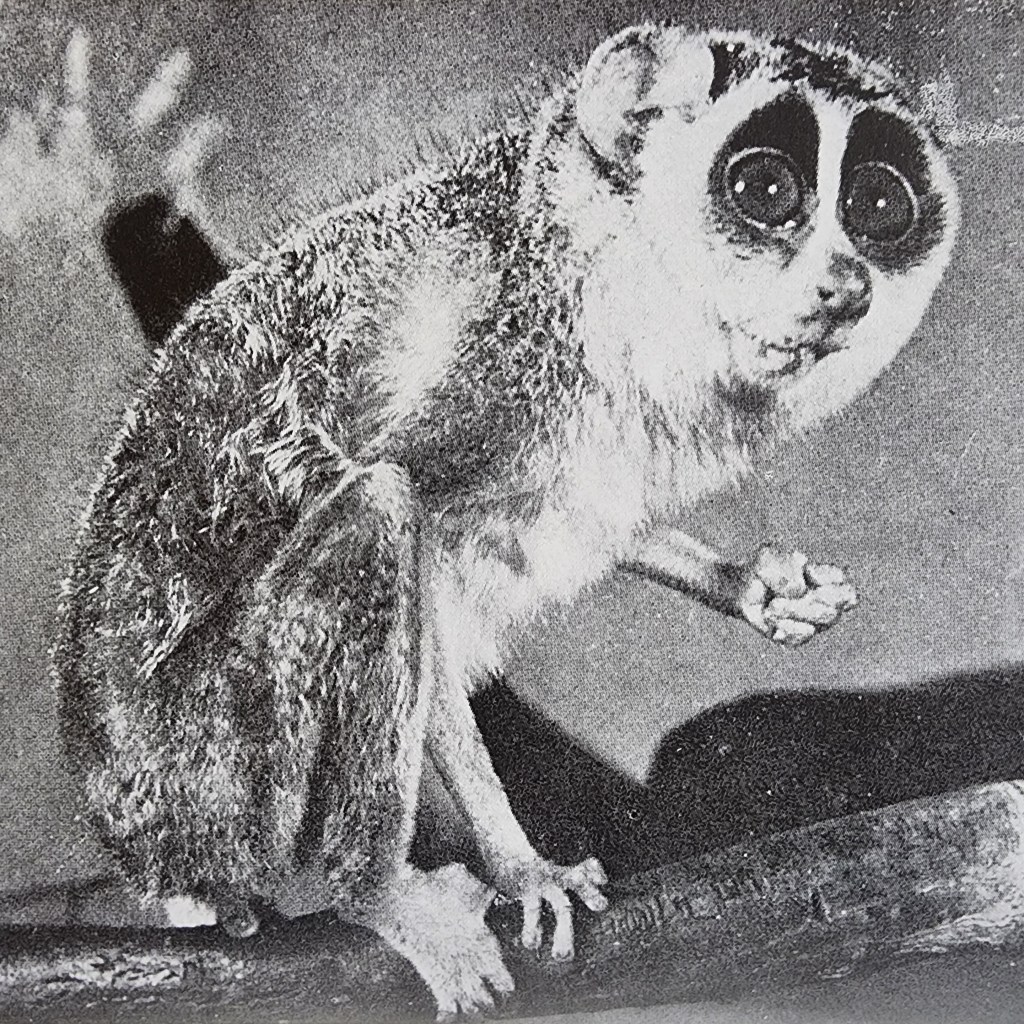
A Slender Loris. Image credit – “The Book of Indian Animals”, by S H Prater, published by Bombay Natural History Society.

There is a tribe depicted in the movie that utilizes the loris as a weapon. This tribe also uses the blood of the loris in magic rituals, which they supposedly use to render the Gods revered by other tribes, powerless. This is absolutely the very first time that I have seen the loris have a starring role in any form of media or storytelling!

Granted, the loris depicted is not as accurate as it could have been. The movie is set in Tulu Nadu, a part of the coastal region of the state of Karnataka in India. The species of loris native to this region is the Gray Slender Loris. This animal is small, nocturnal, omnivorous, has large, beautiful eyes, and is not well known. It has rarely been seen by most people, and rarely, if ever, encountered in the wild+.

The loris seen in the movie appears more like a species of Slow Loris. A species of Slow Loris, called the Bengal Slow Loris is native to the Northeastern parts of India. This animal is larger and furrier than the Slender Loris, though both are arboreal creatures. The animal depicted in the movie hisses when threatened. This is correct, as I can attest from personal experience with a Gray Slender Loris.

But the greatest drawback with the depiction of the Loris in the movie is in relation to its locomotion. The lorises on screen move very fast, and at times seems like a lemur or a meerkat. Of course, this speed can be attributed to magic in the movie, but that is not specifically explained on screen. So, I find the speed of movement of the lorises in the movie unsettling.

A Slender Loris I had the privilege of observing at close quarters. Image credit – “Menagerie Memoirs” by Dr. M K Shashidhar, published by Notion Press.

In reality, the Slender Loris has a slow, deliberate, cautious way of locomotion. This is part of why it is incredibly hard to spot in its natural habitat. This protects it from predators in the wild. The movement of the loris could remind one of the movements of the sloth, which inhabits South America. I personally feel the sloth is more deliberate and slower than the loris, based on my experience with the loris and what I have seen of the sloth in documentaries.

The Slender Loris used to be hunted in the past. This is supposed to have reduced considerably since the 1990s. From the 1980s through to the early 2000s, I have had the good fortune of observing closely a few Gray Slender Loris specimen. These were all rescued from attempted poaching/hunting activity or from the exotic pet trade.

One story I had heard back in the day was that there was a superstitious belief in relation to the eyes of the loris. It was supposedly believed (wrongly) by some that if one added the eyes of a loris to a potion and consumed it, one would be reunited with one’s lost love! I have not been able to ascertain if this tale is just hearsay or if there is any evidence to this belief in any local folklore.

But this potential (and untrue) attribution of a mystical quality to a loris is tangential parallel to the movie. In the movie, the tribe mentioned earlier, uses the blood of the loris as part of their magic ritual, almost like a magic potion, to capture and subdue the deities of other tribes. So, a mystical quality is attributed to the loris, to its blood if not to its eyes.

The loris is called the “Kaadu Paapa” in Kannada. “Kaadu” means “forest” and “Paapa” means “baby”. The loris is literally called “the baby of the forest”, a name this is apt, considering the cuteness of the animal. The name also exacerbates the tragedy of poaching the animal, for it is akin to abusing a child, which is what the loris is called in Kannada.
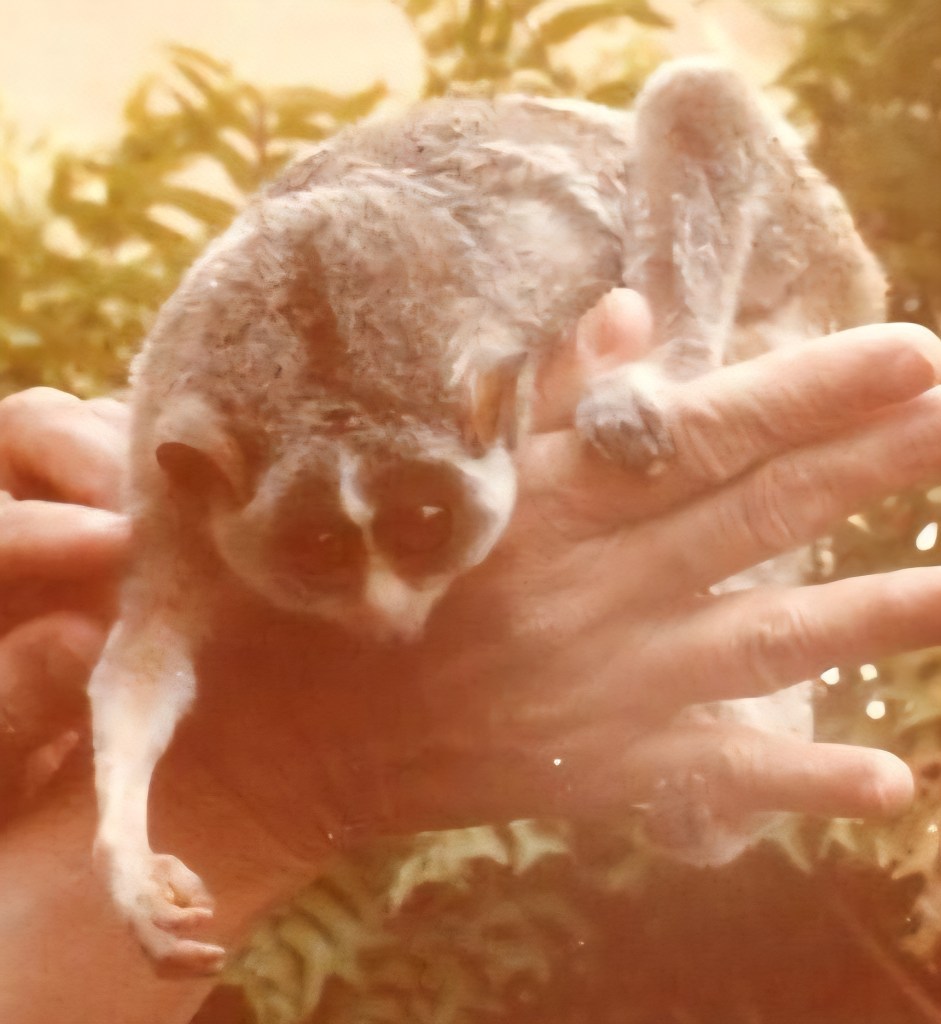
This image of a Slender Loris shows its size, in relation to a human hand. The animal is really small, much smaller than how it is depicted in the movie. Image credit – “Menagerie Memoirs” by Dr. M K Shashidhar, published by Notion Press.

The fact that the loris, a small, slow species has survived on the planet gives it a tenuous connection to the martial arts. No, there is no “Loris Style” of fighting that I am aware of. Nor is there any modern military technology that is specifically inspired by the Loris, again, as far as I know. The connection is more in the form of a bit of advice we once received.

Sometime between 2017 and 2019, a few of my Buyu (fellow practitioners of the Bujinkan system of martial arts) were attending a class by Nagato Sensei in Japan. Nagato Sensei is among the most senior teachers of the Bujinkan system and the Soke** of the Shinden Fudo Ryu. During the class, Nagato Sensei spoke of how the loris can be an inspiration during training.

Sensei was speaking of how the urge to move fast during training is not always beneficial. Speed and strength are always important in the martial arts, at least in the sport versions of martial arts, where two individuals are fighting each other. But Sensei was suggesting that one only needs to move as fast as is necessary. If one is moving to avoid an attack, moving too fast might lead to overcompensation, which can then lead to a potential opening.

Also, when training, moving slowly enables one to study one’s own movements and improve or fine tune one’s form or technique. Taking the two aspects together, he said that one must move like a loris – I think he specifically said Slow Loris – though I am not sure if he used the word “slow” to refer to the type of loris or to just drive home the point that speed is not panacea.

Sensei was referring to how a loris moves slowly and deliberately and still survives successfully. It is able to hunt and stay protected from predators. In this same manner, one needs to move just as fast as is necessary to survive, which is not slow or fast, it is just deliberate. At the same time, moving slowly, except until the last instant of the attack prevents an opponent from being defensive and overly alert. This is what I understood from what I heard of the exchange between Sensei and those who attended that class. This in a way feeds into the saying, “Slow is smooth, smooth is fast”. This then is the link between the loris and the martial arts. 😊

I will return to the reference about venom and the movie Kantāra to conclude. I recently learnt that Slow Lorises have venom glands, making them the only primates in the world to be venomous. The venom glands are on the insides of their elbows. The Lorises supposedly lick the glands to secrete the venom and mix it with their saliva. They then lick their hands and apply the now toxic saliva on their bodies. This protects them from potential predators. Also, the toxic saliva is transferred to a prey when the Loris bites it, as the saliva is transferred with the bite.

A Slow Loris. Image credit – “The Book of Indian Animals”, by S H Prater, published by Bombay Natural History Society.

Venom is a chemical weapon; there is no doubt about that. That is part of the reason why a lot of people fear snakes, and that is also why poison arrows have always existed. In the movie “Kantāra: A Legend – Chapter 1”, the lorises are controlled by the sorcerers of a tribe, and they direct the lorises to attack as a group. This more like a special forces raid than open warfare as the lorises simply do not have the strength or numbers to overwhelm large numbers of enemies.

As I mentioned earlier, the lorises depicted in the movie, due to their size, look like Slow Lorises. And if we assume that is the case, a new dimension comes into play. The sorcerers now have a number of animals that can deliver a toxic bite! They can direct the lorises to attack specific individuals to deliver a bite that will either kill or at least incapacitate high value targets, given a sufficient number of bites! This is not unlike people dying when they are subjected to a large enough number of bee stings. And this is exactly how the lorises are used in the movie!

Thus, the lorises are indeed weapons by themselves. And this is something I have never seen in any form of storytelling ever! And that made the movie experience simply fantastic. 😀

This remaining part is just an aside, not an essential part of the article. I am just sharing another observation relating to animals and warfare. We all know that horses were used in war over several centuries. In India, in the past, a yajna called the Ashwamedha Yajna used to be performed. This involved letting loose a horse which traversed many lands over the course of a year.
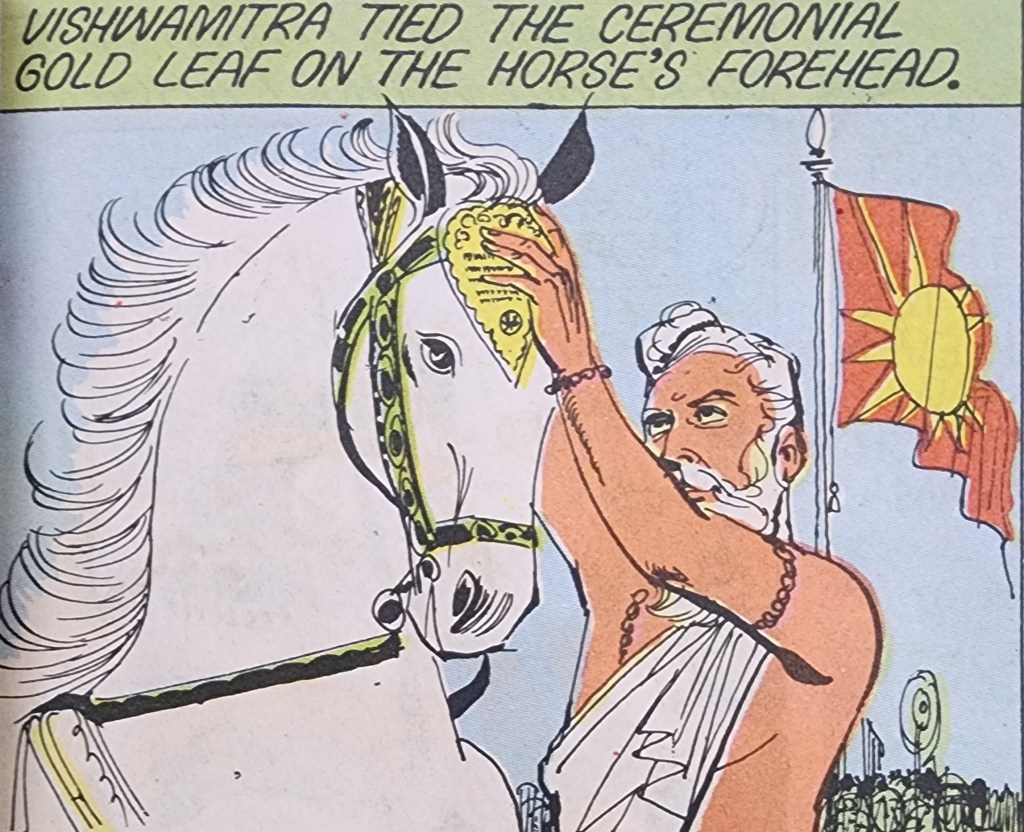
A representation of the horse from the Ashwamedha Yajna in the Ramayana. Image credit – “The Sons of Rama”, published by Amar Chitra Katha.

If the horse passed through the lands of a neighbouring kingdom, the king or leader of that kingdom could either let the horse pass or stop it from going further through his lands. If he let it pass, he would have to accept the suzerainty of the king performing the Ashwamedha Yajna, or at least accept some form of treaty, likely an unequal one.

If however, he chose to stop the horse, he would have to fight the king performing the Yajna. An army followed the horse and would fight the army of the kingdom through which the horse was passing. The war would have a natural conclusion. If the army of the king performing the yajna won, the other kingdom would be annexed. If it lost, the yajna would be over, as a failure.
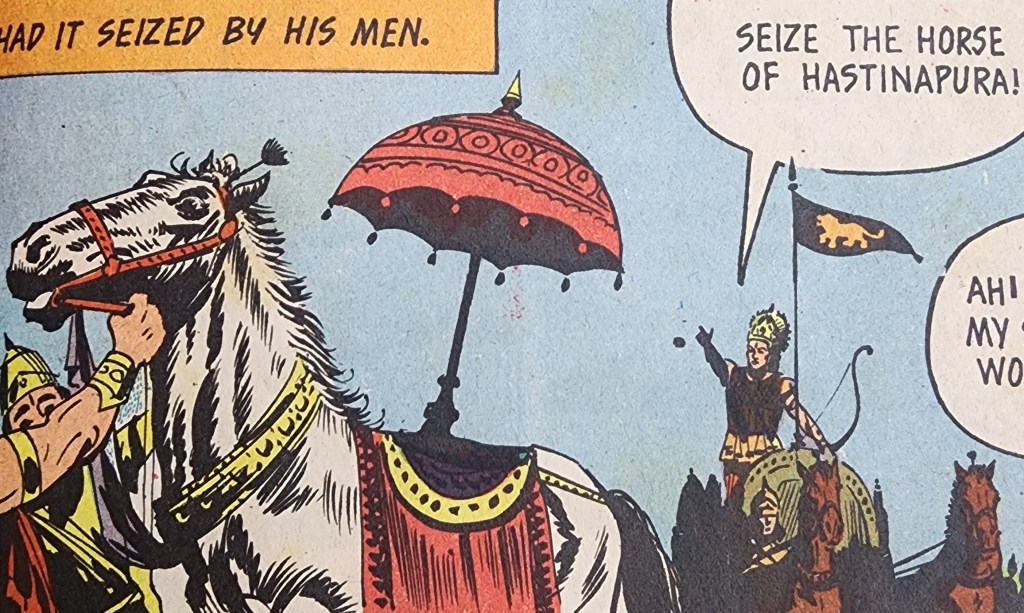
The horse from the Ashwamedha Yajna being stopped by a king whose lands it has wandered onto, triggering a war. Image credit – “Uloopi”, published by Amar Chitra Katha.

A representation of the horse from the Ashwamedha Yajna in the Ramayana. Image credit – “The Sons of Rama”, published by Amar Chitra Katha.

In popular depictions of the Ashwamedha Yajna, the horse that is let loose is always a WHITE HORSE. In the movie Kantāra – A Legend: Chapter 1, there are 2 sequences with white coloured horses. One on the port and another in the forest (the Kantāra).

On the port, a white Arab horse runs amok. This horse is subdued by the hero of the movie, a leader of the people of the forest. In this manner, the horse could be said to be his, as he is the one who restrained it. Later, the people of the forest, under the leadership of the hero capture the port. The horse is also slain by the villain of the movie. In this manner, the entire sequence is reminiscent of the Ashwamedha Yajna!

A white horse is let loose, it belongs to the leader of the people of the forest, the horse wanders to the port controlled by a different king, and the port is conquered. Add to this, the horse is killed, like in the sacrificial part of the Yajna. Thus, the Ashwamedha Yajna has been successfully completed by the hero, the leader of the people of the forest!
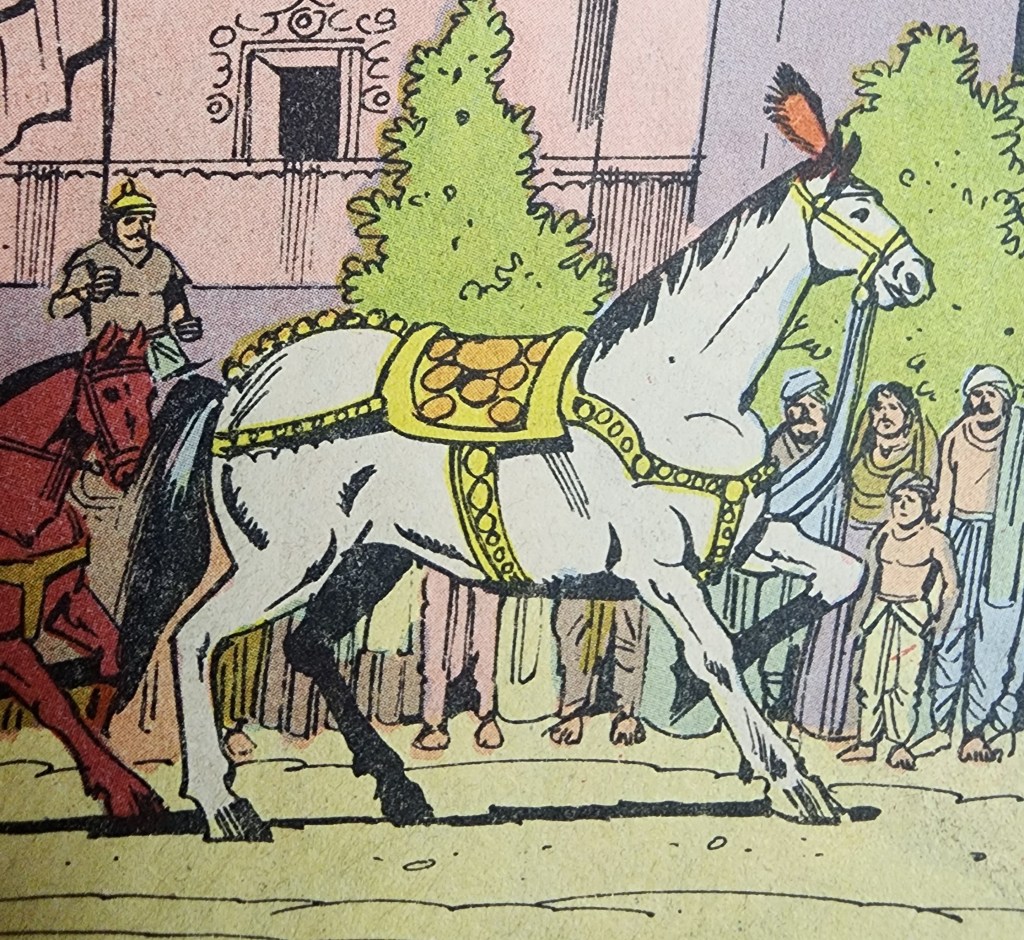
A representation of the horse from the Ashwamedha Yajna in the Mahabharata. Image credit – “The Ashwamedha Yajna – Mahabharata 41”, published by Amar Chitra Katha.

The king from whom the port was conquered, later invades the forest. He causes a lot of carnage but is eventually defeated and killed. He also rides a white horse! Of course, the horse is not let loose, but the parallel is close. In this case, the Ashwamedha Yajna fails as the king is killed, and the invasion is defeated.

The White Horse that is let loose during an Ashwamedha Yajna is an instrument of war by itself, as it can cause kings to fight and lose or accept defeat without fighting. In that way, the horse is an incredible martial tool! One that can lead armies to their death or a people to increased prosperity. Of course, this aside could be just me overthinking things. The interpretation could be completely wrong and not what the filmmakers meant at all.

Notes:

* Swaraj and the Lizard (and Ninjas?!) – Mundane Budo

+ There was a time when group walks were allowed in protected areas. This provided an opportunity to encounter and observe smaller wildlife, like gerbils, lorises and invertebrates. But as far as I know, walks are no longer allowed in forests if elephants are known to inhabit the area. So, the opportunity to spot the smaller creatures has diminished greatly.

** Soke – Grandmaster is a good understanding of this word, though it is not a literal translation

Bhrāmari Devi, Bees and Martial Arts

20th May was “World Bee Day”. In India, Bhrāmari Devi is a form of the Devi, the Female Principle or Goddess, worshipped in many forms. “Bhramara” means a bee in some Indian languages. So, Bhrāmari Devi is the Goddess of Bees or Goddess with attributes of bees. Like with all forms of Gods and Goddesses, Bhrāmari Devi is also credited with slaying an Asura who had upended the natural order and thrown the doors open to chaos. And this brings the aspects of martial arts into the story which I shall explore further in this post.

The Asura Aruna like many other Asuras gained a boon (vara) from Lord Brahma. According to the boon, he could not be defeated or killed by any creature that was a biped or a quadruped or a combination of the two. This meant that he was invulnerable to all humans, Gods, Goddesses, other humanoid entities and also the large beasts that could harm most humans as we understand them now. This boon seems to be one that compensated for the Varāha and Narasimha avatāras. Varāha was a boar and Narasimha was a combination of man and lion.

I am making one assumption about this boon. If a biped, in other words Devatas, Mānavas (humans), Vānaras, Rkshyas (Jambavan’s kind – sometimes written as Rikshyas) and the like are prevented by the boon from killing Arunāsura, that includes any weapons wielded or discharged by them. So, a human shooting an arrow at the asura would not kill Arunāsura, nor would a warrior wielding a sword. If this was a boon in modern times, a bullet or missile fired by humans would not kill Arunāsura, nor would an AI system with human programming or input.

With this boon, Arunāsura dominated the three worlds and threw natural phenomena, the guardians of which were the Devas, into chaos. This required that he be stopped, even if it meant killing him. Since no weapon or massive beast of prey would have any success, other options needed to be explored. This is where bees and Devi Bhrāmari help resolve the problem.

Bhrāmari Devi, image credit – Wikipedia

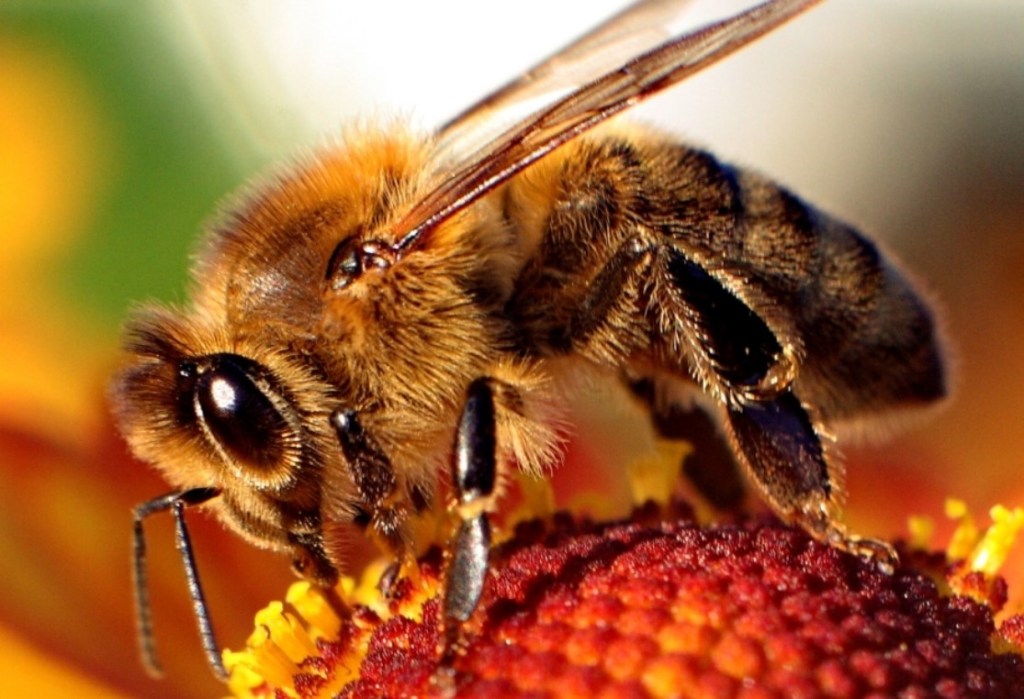
Devi Bhrāmari unleashed a swarm of bees that stung Arunāsura. The Asura’s own attacks against the Devi were successfully defended by her. Arunāsura could not fight the bees. He eventually succumbed to the venom in the bee stings. The boon held and Arunāsura was defeated and killed by Hexapeds (creatures that walk on 6 legs), not bipeds or quadrupeds! Also, the mighty Asura was laid low by insects, among the smallest of creatures!

It is possible that Arunāsura did not include insects and other hexapods in his request for the boon since he did not consider them a threat to worry about. In this sense, a lack of awareness or incomplete threat perception did him in. He “expected” insects to not be a threat! This was an assumption, and in a conflict, assumptions and expectations are dangerous things.

I have heard a joke that has been around for at least a few decades now. A few Japanese swordsmen are competing to determine who among them is the best. The contest is to cut a fly! This joke works because everyone realizes that a sword is not what one fights a fly with. It is extremely difficult to hurt a fly with a sword. This fact holds true for bees as well!

There is a proverb I have heard, “You cannot fight smoke with a sword”. This aptly explains the situation anyone faces against a swarm of bees. When one is attacked by a swarm, all creatures know that getting away is the only option, one cannot stand and fight the swarm, unless one specifically came prepared for that eventuality. The fact that Arunāsura did not include protection from insects in his boon, shows that he was not prepared for this attack at all.

From what I know, it takes a couple of thousand or more stings to kill an adult human. Of course, if one is allergic to the venom, the number required is a lot lower. Considering we are currently in the “year of the snake”, it is apt that we are discussing a story where venom is the weapon! Venom is poisonous and fatal when injected beyond certain doses. In the case of Arunāsura, thousands of bees would have injected small doses, the sum of which was sufficient to kill him. It is a case of applying a large quantity of small solutions to a very big problem (the world ending kind!). It is the natural world equivalent of the classic adage “death by a thousand cuts”.

The story of Arunāsura is one in a long line where natural phenomena and animals are used to defeat threats to the natural order/humans and the Devatas. The stories of Varāha, the boar and Narasimha, the man-lion are well known. Another story that is pretty well known is when King Pareekshith was killed by the bite of a venomous snake. A less well-known story is Indra murdering a meditating asura by the name of Karambha. Indra committed this murder in the form of a crocodile. Indra paid for this subterfuge and assault on an innocent victim (Indra was worried that the meditation would lead to a boon which could make Karambha a threat to him in the future – a “Minority Report” kind of “pre-crime” situation).

A more interesting story of using a natural phenomenon as a weapon is that of Namuci and Indra. Namuci was an Asura of great renown and an enemy of Indra, the king of the Devas. Indra had promised Namuci that he would not attempt to kill him with anything that was either wet or dry. This seemed like a fair promise. But Indra smothered Namuci with foam on a seashore. Foam, supposedly being neither wet nor dry, allowed him to kill Namuci without breaking his promise. Indra had to face the consequences of his treachery of course.

In Hindu tradition, we celebrate a festival called “Āyudha Pooja”. This festival is celebrated on the ninth day of the 10-day long Dasara (Dussehra) festival. On this day, various tools of various trades are cleaned and receive gratitude from their users, for aiding them in living a good life. The tools that are worthy of respect in this festival include agricultural implements, weapons of war, machines in industries and even the laptops we use in the service sector.

The term “āyudha” means weapon. But it also means “tool”. Any tool that aids in life is an “āyudha”. Weapons are just tools that are used in war or any physical fight/conflict. And of course, in many cultures around the world, agricultural tools have doubled up as weapons on several occasions in history. A great example of this in Hindu culture is Balarama, the elder brother of Lord Krishna. The weapon associated with Balarama is the plough, which is most definitely an agricultural implement.

Animals have been used as tools and also as weapons of war for ages. Elephants, horses, pigeons and dogs are well known to have been used in war. If conspiracy theories are considered, even dolphins and chimps have been used as potential weapons in the 20th century, during the cold war and the 2nd world war before that. The story of Bhrāmari Devi is just an extension of this well-known teaming of humans and animals during times of conflict.

Honey Bee, image credit – Wikipedia

One instance of an animal being a tool to end a war while NOT being a weapon is the story of how Lord Muruga/Skanda/Karthikeya came to have the peacock as his vāhana. Vāhana can be translated as “vehicle” or “mount”. Most Gods we Hindus revere have animal companions, most of whom are vāhanas. The vāhana of Lord Muruga is the peacock.

Lord Muruga defeated and killed the Asura Tāraka. He also defeated another asura named Surapadman. I have heard in some stories that Surapadman is the younger brother of Tārakāsura. Surapadman eventually surrendered to Muruga. He asked for forgiveness and wanted to make amends for the harm he had caused. In return for his surrender, Lord Muruga spared his life. Surapadman then became a peacock and would serve Muruga as his vāhana. The peacock in this case is more like a peace treaty which led to the end of a war. Here, the peacock is not a weapon, but a tool, which led to peace.

This same aspect is true for bees in reality as well. That bees can kill is well known. I remember reading an article in the Reader’s Digest in the early 90s, which featured an attack by a swarm of bees. It was part of the magazine’s “Drama in real life” segment. That was the first time I read of a situation where an individual’s life was at risk due to an attack by bees. Even though we knew that bees and wasps are potentially dangerous, this article brought home to me the threat to life that they can pose. A similar article was also available in the same magazine, more recently, in 2021. I am sharing the link to that article in the notes below*.

Despite the threat bees pose, they are widely respected in the modern world. They are well known for the vital role they play in the ecosystems they inhabit and also for the wealth they can generate. The pollination services bees provide make them a keystone species in the ecosystems they have evolved to inhabit. Similarly, honey and beeswax are both sources of income for people around the world. Beeswax is used in cosmetics and honey as most would know has some medicinal properties.

Bees deploy chemical weaponry, in the form of the venom from their stings. The same biochemical abilities of the bees, results in the beeswax for the hives they build and for the honey, that is created from the nectar of flowers they visit.

I must mention a few pop culture references that come to mind due to this article. The point about bees being extremely useful and vital to the environment while being capable of threatening life has a hilarious parallel in the movie “Ninja” (2009). The movie stars Scott Adkins who is a great martial artist. The move itself is a fun watch. In the movie, the hero’s girlfriend is poisoned. The hero has inherited a katana from his teacher. The hilt of the katana has a secret chamber which has the antidote to the poison killing his girlfriend! He uses it to save her, and the antidote in the vial is the exact quantity needed to save her life! 😊

The hero does not know that there is a vial of antidote hidden in the structure of the sword until his girlfriend is poisoned. One of the teachings he has received from his teacher is that the katana of the ninja can take a life and also save a life. The hero recalls this teaching at the end and realizes that the teaching was literal! He then deduces that the antidote must be hidden in the sword! 😀 The whole scenario reeks of plot armour for the girlfriend!

The other reference has wasps** as the stars and not bees. But I am including it here since wasps are close relatives of bees and the scenario is far too amazing to ignore. There is a novel called “The Impossible Virgin” be Peter O’Donnel. It is one of the novels by the author in a series that stars the character “Modesty Blaise”. Modesty Blaise appears in 11 novels, 2 short story collections and 96 stories that appeared as newspaper comic strips.

Modesty Blaise and her friend Willie Garvin are extremely competent individuals. And they are both extraordinary martial artists with skills in unarmed combat and proficiency in many weapons, both historical and modern. In the novel “The Impossible Virgin”, they face off against a large number of gangsters while being outnumbered. This fight happens in a valley called “The Impossible Virgin” as people avoid entering it. Yes, the name is corny by modern standards, but the novel was published in 1971.

The Modesty Blaise novel, “The Impossible Virgin”, authored by Peter O”Donnel, published in 1971

Modesty and Willie are stuck without firearms against opponents who are carrying guns. But their opponents cannot use guns due to the valley. The valley is home to hundreds of active wasp nests. The sound of any gunshot will echo across the valley and trigger the wasps to attack. So, the fight is now against the machetes carried by the gangsters. Modesty and Willie use quarterstaffs to fight and defeat the gang. Fighting with a quarterstaff is basically bojutsu as we practice it in the Bujinkan system of martial arts. The sequence of bojutsu in the book is wonderful. And the reason for fighting with a staff is the presence of the wasps! The insects here are a shield without intending to be so! 😊

I included this sequence here since the wasps are responsible for some wonderful bojutsu action. But the sequence reminds us of another martial aspect of bees. Bees are quite militaristic! They have various roles and specialize in their tasks, just as modern militaries with high technology have specialists for different roles. And in conclusion I must add, a swarm of bees sounds a lot like a modern-day drone, at least the ones used by photographers at weddings and other ceremonies. So, perhaps quadcopters and similar military drones also sound like a swarm of bees on the attack! 😛

Notes:

* https://www.readersdigest.in/true-stories/story-a-thousand-stings-127356

** “World Wasp Day” is on 24th September

A Plesiosaur in Kerala :-)

A pesiosaurid. Image credit – “The Animal World – from the Knowledge Quest series by Reader’s Digest”

I visited Lake Vembanad in Kerala some time ago. It is one of the largest lakes in India. It is extremely beautiful and allows for some great cruises. The lake is host to several species of birds which make great subjects for photographs. Considering we have great cameras on mobile phones these days, one can take a lot of snaps, which will not be of professional quality, but make for great memories. Combine this with the image search feature on Google, one can also identify the species of bird or animal photographed, which adds to the entire experience. But the identification is not perfect, and depends on the photograph. Sometimes we would expect that photo is clear enough for an identification, but Google seems to disagree, and the search result is surprising. One such surprising result is what drives this article.

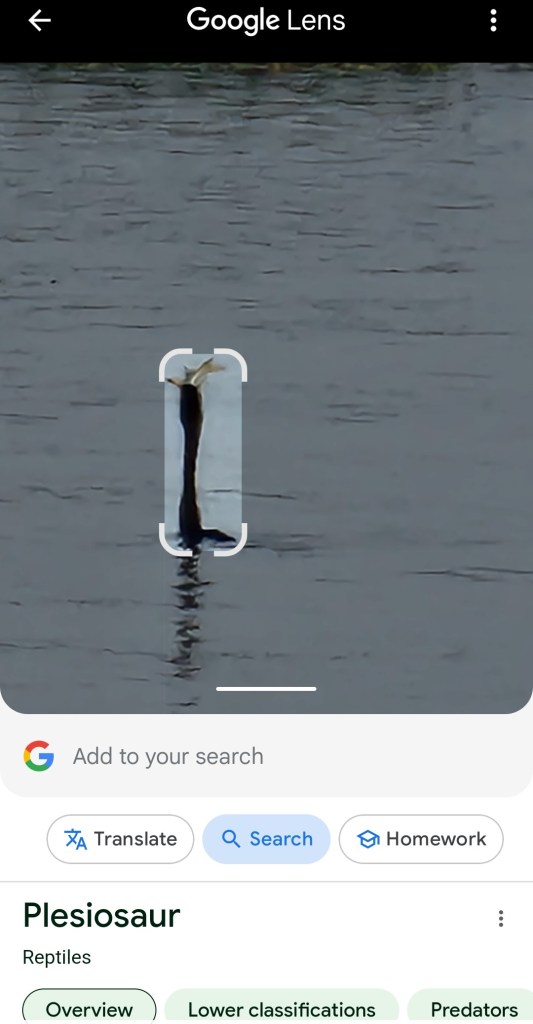
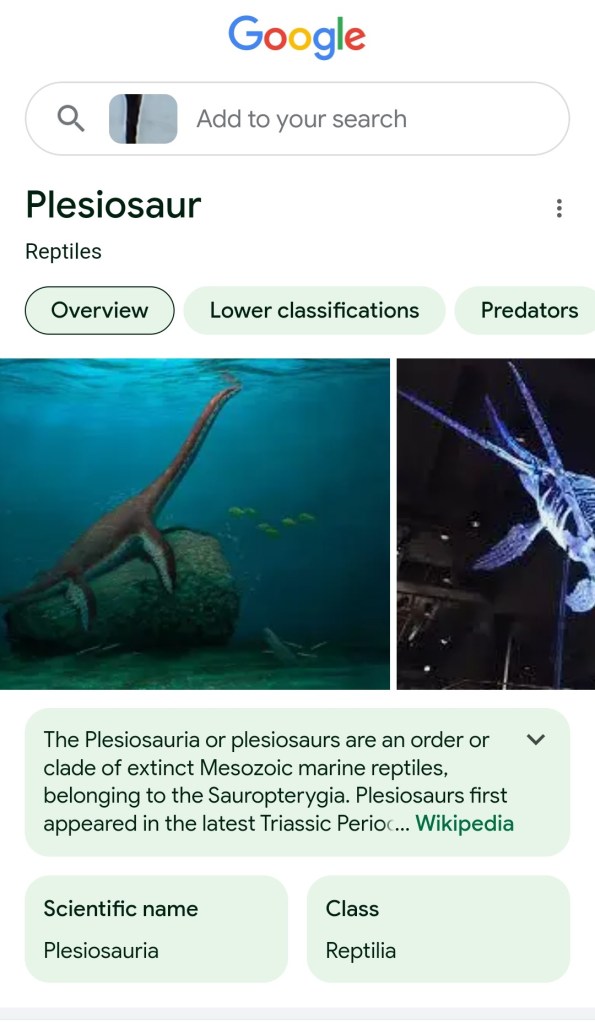
While out the lake, I took a short video of a bird swallowing a fish. I also captured an image. I thought it was a purple heron or a darter (snake bird), but was not certain. To confirm, I used the image search on Google. Aaaaaannddd, Google suggested that the creature in the image was…….wait for it……drumrolls…..

A PLESIOSAUR!!!! 😀 😀 😀

It was like I had discovered the local Loch Ness Monster (Nessie)! The image I used to search and result from Google are seen in the images seen below.

The image on the left was what was used for the search. The search result is seen on the right.

Now look at another image I took of the same bird. It definitely bears a passing resemblance to the famous, and very FAKE, Surgeon’s photograph of Nessie*.

The image on the left is the one used for the search. The image on the right is another image of the same bird. The image is the centre is the famous “Surgeon’s photograph” of Nessie. Image credit for the image in the centre – “Myths, Legends and Folktales – from the Knowledge Quest series by Reader’s Digest”.

Here is a video of the bird, just to confirm that it is not a dinosaur.

This incident goes to show how, even in current times, when we have a surfeit of information and access to the knowledge of the Internet, we are saddled with information that is wrong, glaringly and obviously so. And this with absolutely no intent on anyone’s part of deceit, malice or even mischief. And if this can happen, how often can it be that the information and we have is wrong and we are oblivious to the fact? Now, if there is a deliberate intent to pass misinformation or deceive, how incredibly difficult is it to overcome the wrong knowledge emanating in such a situation? Expand this further and if the knowledge is wrong due to a case of delusion, is there any way to escape at all?

Consider the use of deception and misinformation in the world with the few examples seen below.

  • The most expansive example is perhaps Operation Fortitude, the large scale endeavour carried out during World War 2, before the Normandy invasion (Operation Overlord) to hide the actual location of the landing.
  • The Indian army used the fear in Pakistani soldiers of being burnt to death in tanks to get them to abandon their armoured vehicles on the western front in the war of 1971.
  • Sounds of weapons were used as psychological warfare during the first Gulf War (Kuwait liberation war) to induce Iraqi soldiers to surrender.
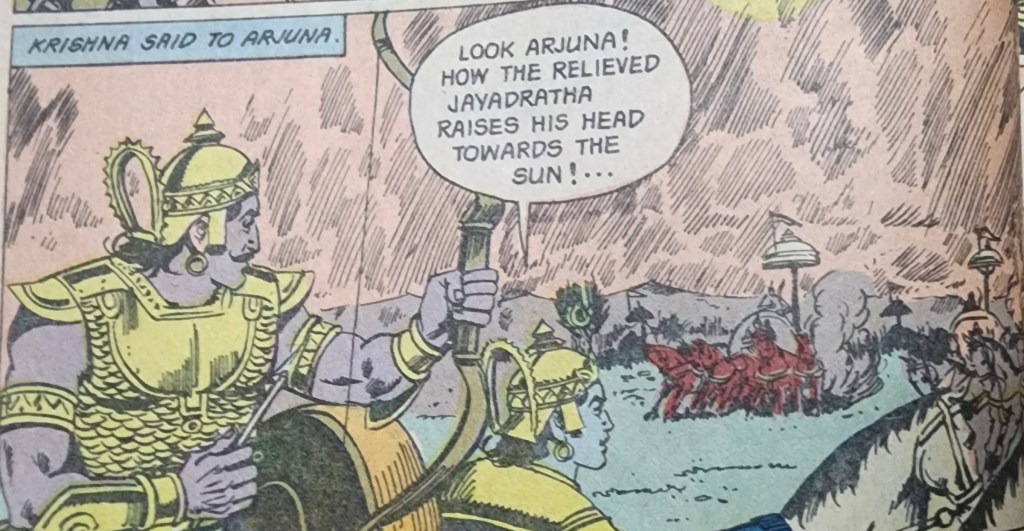
  • This last example is not historical, but is aitihāsic. In the Mahabharata, Krishna uses a solar eclipse (or magic) to get Jayadratha to reveal himself and be slain by Arjuna.

Credit for the 2 images above – “Arjuna fulfills his vow – Mahabharata 35”, published by Amar Chitra Katha

The last example above just goes to show how misinformation has always been used by humans. Could this be an evolution of ambush hunting of animals adapted to attack humans?

Now consider how we look at the use of technology in modern day democracies.

  • In India, specifically during the elections, we discuss how there is a “tool kit”, which is a euphemism to suggest that specific organizations (mostly foreign with Indian allies) and foreign deep states are indulging in narrative warfare to affect the development of India and to control its regime.
  • In the USA and now in Canada, there is talk of election interference and manipulation by foreign powers.
  • National governments are increasingly identifying mechanisms to regulate and control digital and social media as these are the front lines in information manipulation and narrative control, 5th generation warfare, as it is called.

So, there has always been an attempt to achieve superiority through either a denial of information or through the use of misinformation. The counter to this would be to identify misinformation and the acquisition or gathering of authentic information, which might translate to knowledge. Both of these are continuous and incremental processes, not unlike the gradual application of misinformation.

This is perhaps why we have so many festivals in Hindu culture that are attributed to the celebration of knowledge. Consider the previous and coming month. There is a surfeit of opportunities to realize “knowledge is everything”.

  • 22nd August, 2024 was World Folklore Day. Folklore, in many cultures, was a means of passing on knowledge, especially with oral traditions.
  • 24th August, 2024 was Hayagreeva Jayanthi. Lord Hayagreeva is the incarnation of Lord Vishnu where he is depicted with the head of a horse. Lord Hayagreeva is considered the God of knowledge.
  • 26th or 27th August, 2024, was Krishna Janmashtami. Lord Krishna imparted knowledge on several aspects, including through the Bhagavad Gita.
  • 5th September is always Teacher’s Day in contemporary India. It is the birthday of former President Dr. S Radhakirhsnan. It is a day to celebrate teachers who impart knowledge.
  • 7th September, 2024 was Ganesha Chaturthi. One of the epithets for Lord Ganesha is Vidya Ganapati. Vidya is knowledge.
  • 10th October, 2024 will be Sapthami, the 7th day of Dasara. On this day, some communities celebrate Saraswati Pooja. Devi Saraswati is the Goddess of learning.
  • 12th October, 2024 will be Navami, the 9th day of Dasara. On this day, apart from Āyudha Pooja, some communities perform pooja of Lord Hayagreeva as well. As mentioned earlier, Lord Hayagreeva is the God of knowledge.

So, knowledge is a key theme in several festivals of Hindu culture. Another aspect of knowledge that is celebrated in Hindu culture is the time and effort that goes into acquiring knowledge. This includes the development of expertise as well.

The time and effort in developing knowledge or expertise goes into training (including studying, practicing, interacting, experiencing etc.). In the Bujinkan system of martial arts, two Japanese terms are used in relation to training. One is Genjitsu and the other is Genjutsu. Genjitsu refers to reality or the actual truth. Genjutsu refers to using illusions or misinformation, mostly to weaken or negatively affect opponents.

Genjutsu however, could be turned inward; it then becomes a delusion. This is a result of training going bad or being in a silo for too long, when one does not realize that the training one is going through is either not of any benefit or actively detrimental to oneself or others. A mentor of mine, Arnaud Cousergue, has written about this in an article which I am linking below+. He refers to some practitioners choosing to only practice what is termed “cosmic stuff” without a firm grounding in hard training and technical aspects.

I had earlier mentioned how folklore is a means of transmitting knowledge in oral traditions. I personally feel urban legends are modern day folklore, but are not designed to transmit any knowledge. Consider the following two examples to illustrate the same.

Around the year 1990, there was a story doing the rounds in Bangalore of “Nāle Bā”. “Nāle” is “tomorrow” and “bā” is “come” in Kannada. The story was that a supernatural entity was going around parts of the city and causing harm to the residents. The entity’s means of gaining entry to a residence was to knock on the door and speak in the voice of a resident. The easiest way to deter this entity was to ask it to “come tomorrow” or “nāle bā”. This could even be achieved by putting up a board at the gate or write on the main door or the compound the same words (in Kannada). There were several homes which had done this.

In 2001, there was the menace of the “Monkey Man” in Delhi. A creature(s) or an individual(s) in the garb of a monkey/ape was attacking people on the streets of Delhi at night. In this case, there were some people who suffered injuries. These varied from serious to minor ones. There were even a few deaths reported due to the “Monkey Man”. But it was never clear if the cause of death was the attack or an accident caused out of fear and panic. There were also suggestions that some of the incidents were misreported. In the case of “Nāle Bā”, I am not aware of any case of real threat or harm of a grievous kind to anyone.

Both of these are urban legends, but did not serve to transmit any knowledge. It was just a story that gripped a city for a short duration. This is analogous to a delusion in training. One reacts to a situation that is not real or believes that the training one is indulging in is very useful, while it really is not.

So, in the world we live in, with deep fakes, fake news and “narrative setting/engineering”, it is extremely difficult to acquire or develop knowledge with real and accurate information. It is a continuous process to develop one’s ability to sense if a piece of information could be fake or partially false. It is exactly like continuous training with an awareness of whether or not it is relevant. It is the development of the ability to spot the Genjitsu and not be overcome by Genjutsu, whether it is delusions or external illusions.

Sensei Masaaki Hatsumi, the soke (inheritor) of the Bujinkan system of martial used to have themes to focus on for every year of training. This was a tradition that lasted from the 90s to the beginning of the pandemic. The theme for the year 2008 was “Menkyo Kaiden”. This phrase from Japanese can be used to illustrate how changes in the way a word is spoken and the spelling is changed can result is vastly different meanings.

Most of the times, “Menkyo Kaiden”, as far as I know, means that a person has received or learned everything a teacher has to offer, and is ready to add to that body of knowledge. One “receives a menkyo kaiden” after she or he has learnt everything a teacher has to transmit and has imbibed the same to the satisfaction of the teacher.

But when theme was mentioned as Menkyo Kaiden in 2008, Hatsumi Sensei, as far I know, wrote the theme in such a way that, while the pronunciation would remain the same, meant “transmitting falsehoods to the mind”. In practice, it meant, “confuse the opponent” or “mess with the opponent by confusing her or him”. This was all about feints and movements that caused the opponent to react in a manner that put her or him at a disadvantage.

This is literally the opposite of the original meaning! In the first case it was about giving all the knowledge possible. In the second, it is all about confusing a person with information and intentions that could be false or true, the truth of which that person is not supposed to be able to discern!

This is similar to another concept called “Kyojitsu tenkan ho”. This means that truth and falsehood are like a revolving door. It could be faking an attack or the intention to attack or the nature of the attack. The attack might be real, or a feint, which could be an opening to something else. This is something that all martial arts and martial sports teach. So, it is commonplace to want the opponent to be unsettled at all times so one can achieve an objective, which could be detrimental to the opponent.

This in itself would be a wonderful elucidation of how one needs to develop an instinct to determine if information received and knowledge gained are correct, relevant and beneficial. This aspect is also taught in the martial arts. Practitioners of the martial arts are expected to, apart from the physical techniques and abilities, also develop their intuition, awareness of situations and mindfulness of the opponent and factors like the surroundings and the atmosphere/environment of a place.

All of these are intangibles that are related to the instinct that is needed to survive a fight, or a conflict in general (like in the office where there is no physical threat). In the Bujinkan, this is taught as “Sakkijutsu” and is very important to develop over years of practice. This roughly leads to a practitioner having “a feel” of the situation, which includes the opponent, the place, the situation and most importantly, the potential for danger. This hopefully leads to either minimal conflict or hopefully the nullification of one, but in either case, the key is to escape/avoid any harm to the self.

This concept is not specific to the Japanese language either. In many Indian vernacular languages, the term for “experience” and “feeling” is the same. The word “anubhava” in Kannada and “anubhav” in Hindi are used to express this. “Anubhava” could mean quantum of experience, or what one is feeling. In the first case, the sentence in Kannada would be, “ninage yeshtu anubhava ide?” which translates to “how much experience do you have?” In the second it would be, “neenu yenu anubahisuttiddiya?” which would translate as “what are you feeling/experiencing?”

The word for expertise is “parinati”. In other words, while expertise is something that is recognized as a consequence of effort over time, the words for experience and feeling are the same, which could mean that an experience is the feeling that one can receive or gather. And when one is able to “get a feel” for anything, easily or nonchalantly, that is a sign of long experience, which is the root of expertise.

In conclusion, in contemporary times, when information is in surplus and easily accessible, knowledge, which is processed information, is not easy to come by, for the veracity of the information is hard to ascertain. With experience, one can perhaps get a feel for the correctness of information, and this skill could be knowledge unto itself.

I recently saw a video on Instagram where Eminem was discussing chemistry like a pro! It was an AI generated video**. If the maker of the video had not mentioned this, one would be left wondering if Eminem is a chemist by profession! But the video certainly “feels” off and anyone who knows of Eminem will check if this video is fake or not.

We recently had a training session with Daishihan Alex Esteve of the Bujinkan. During the class, Alex mentioned that the knowledge of biomechanics is accessible for anyone who needs it these days. But about 200 years ago, the knowledge of the use of biomechanics in martial arts would be a closely guarded secret, for the knowledge of the same was an advantage to the ones who possessed it, and this knowledge was not available to most of the populace. Go back further, by about a thousand years and the knowledge of biomechanics would have seemed mystical knowledge, for the number of people possessing the same would be a handful in any society and the effect of its use on any individual would perhaps be seen as magical.

In the case of the Eminem video I mentioned, the ability or skills to identify the video as AI generated is not commonplace, not all of us can do it. So, it does seem mystical, if someone can nonchalantly identify it, especially if that person does not know who Eminem is. But the regulation of the use of AI is beginning and an option is now provided on platforms to mark something as AI. This is likely to be the beginning of more people developing the skill to identify AI handiwork. So, as more methods to identify AI are developed, those are likely to be kept secret simply for IP reasons. Now this skill or ability is not mystical, but carefully guarded. And perhaps the ability to identify the involvement of AI without being told so will become second nature in the future. Until then, it is good to have a “feel” for something that doesn’t seem quite right, or all real.

As a last word, I will share a link to a video by Praveen Swamy, on the YouTube channel of the media organization, The Print. In the video he discusses how the conflict between cryptographers and cryptanalysts has been going on since millennia. The context in the video is about hiding information, but it is not that different from misinformation and the hiding of authentic information. This conflict between real knowledge and its duplicitous variants is eternal, all one can do is flow through this battle safely.

Notes:

* https://en.wikipedia.org/wiki/Loch_Ness_Monster – Look at the segment on the “Surgeon’s photograph”

+ https://kumablog.org/2014/07/ – The cosmic stuff that is referred to in the article is the belief that training only soft movements against slow attacks has prepared one for a real fight without having undergone rigorous training in the basics and hard training.

** The video was on the Instagram account of “yourchemistrypal.sg”, who had made the video using Parrot AI.

Swaraj and the Lizard (and Ninjas?!)

Today is “World Lizard Day” (August 14th). Tomorrow is the Independence Day in India (August 15th). So, the two were connected (in my head) with a nice little legend from Indian history and I felt like sharing the same. This is unlike my usual posts where I explore the intersections between Hindu/Indian culture and the martial arts (mainly the Bujinkan system of martial arts). I had no idea that there was a day to celebrate lizards! I was told that today was Word Lizard Day by Windows and this new learning triggered this article. There is no specific link between this article and the Bujinkan or any other martial art. But I will definitely make a stretch and try to connect this legend with the martial arts. 😛

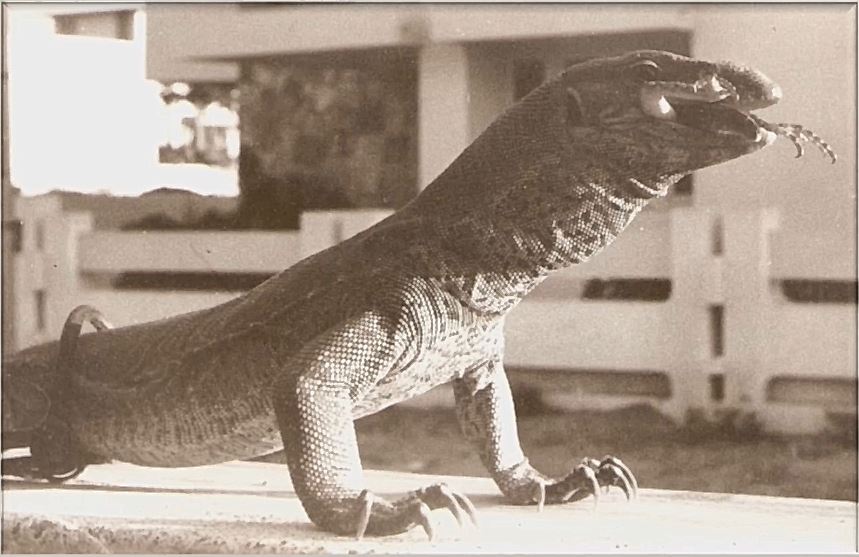
In India we share space with a species of monitor lizard called the “Common Indian Monitor”, also called the “Bengal Monitor” (Varanus Bengalensis). It is seen in almost all parts of the country. Along the east coast of India there is another larger species called the Asian Water Monitor (Varanus Salvator). The Common Monitor lizard grows to be between 5 and 7 kg and grows to a length of around 4 feet or a little more. The Water Monitor is almost one and a half times larger in size.

Image credit – someone from my family

The Common Monitor eats small birds, mammals, reptiles, amphibians and eggs of all of these. It is in turn eaten by many species including humans, especially when it is young or in its juvenile years. Young monitors have spots while adults are more a uniform grey. It is not a threat to humans. The largest extant monitor lizard is the Komodo Dragon that inhabits a few islands of Indonesia. The largest ever monitor to have existed, as known today is the Megalania, which once inhabited Australia, but is long extinct (early humans who entered Australia are likely to have encountered this monster).

The Indian Independence Day is celebrated to mark the occasion when the British left our country after nearly two centuries. But the notion of Independence is older as I have learnt it, as India has been invaded by outsiders several times over the last 2,500 years. Most of the invaders assimilated into the existing society and culture after capturing parts of the geography. But some over the last thousand years did not and tried to impose external culture, ideas and ways of life on the existing society. And there has always been an attempt to restore self-rule or uproot the invading powers.

During the time when the Maratha empire was being established, as modern history and popular consciousness teaches us, there was a notion of Swaraj or Swarajya, (I have heard it sometimes referred to as Hindavi Swarajya) which means self-rule or more appropriately as I understand it, “our own rule or our own kingdom”. This notion was to ensure that the lands where the Maratha lived were free from the rule of the Mughal empire and some of the Deccan sultanates. Both the Mughals (Turco-Mongol Timurids) and the Deccan sultanates were of foreign origin and Islamic in nature. The Deccan sultanates were far less foreign, but were defeated and supplanted by the Mughals and the Nizam of Hyderabad (a vassal of the Mughals, who later became independent).

The Marathas fought all these powers over several decades and emerged victorious, supplanting or at least subduing all of them. They were the pre-eminent power in India when the British East India Company started having ambitions of power and grandeur. The idea of Swaraj that the Marathas aspired to is the one I am referring to in the title of this article.

One of the great generals of the Marathas was Tanhaji Malusare, about whom a popular and successful Hindi movie was produced in 2020. He, along with his troops captured the fortress of Kondhana, but Tanhaji lost his life in this battle. The fortress is called Sinhagad today in honour of Tanhaji (he was a lion, which is a Sinh and hence Sinhgad, fortress of the lion). This battle was very hard and the Marathas scaled the sheer walls at night, an act of great daring, before defeating the garrison to take fortress.

There is a legend that Tanhaji and his troops used a monitor lizard to scale fortress walls. I am not sure if this legend is specific to the battle of Sinhgad or if they are supposed to have done so in general, in other campaigns. A monitor lizard has very powerful claws and are good climbers. This is a known fact. So, the Marathas are supposed to have tied a rope to a pet monitor (monitors are kept as pets even to this day in many parts of the world), which then scaled the fortress wall and with its strong claws held on as some soldiers scaled the walls and then helped the rest of the troops do the same. The monitor was, in essence, used as a living, trained grappling hook.

Of course, this is a legend and not real history. I have even seen a name that the pet monitor is supposed to have had! A monitor lizard is called a “Ghorpad” in Marathi. Ghorpade is also a last name used in Maharashtra to this day, and obviously it is used in other parts of India as well with migration over the last few centuries. So, from what I have learnt, it is likely that there was a group of people from the Ghorpade community, who were expert rock climbers/boulderers. This team of climbers scaled the fortress first and led the rest up. The climbers were so good that either they were compared to a monitor, or vice versa. This is an explanation for the legend. Considering that the Marathas were successful in achieving Swaraj, the legend of the monitor lizard is inextricably linked to the creation of the same 🙂 . This is the connection between “Swaraj and the lizard”.

The martial arts of the Bujinkan system are sometimes referred to as “Ninjutsu”. “Nin” refers to “perseverance”. So Ninjutsu is “the art of perseverance (or persevering)”. The Marathas, all through their existence as a power centre in India, from being a small one in the mid-17th century all the way till their fall in the early 19th century, fought in different terrain and against all odds. They mastered guerrilla warfare apart from fighting pitched battles and fighting in the forests and mountains. They also developed a very effective navy.

During the time when Mughal emperor Aurangzeb fought them for twenty six years, most of which he spent in the south, the Marathas fought a running war. Many of their commanders were examples of “living in the saddle”. To fight a numerically superior force, they were extremely mobile and fought as light cavalry, leaving behind their artillery. The Marathas eventually wore down and defeated the Mughal invasion.

There is a wonderful book called “Battles of the Maratha Empire” by Aneesh Gokhale*. In the appendix of this book, Mr. Gokhale lists the battles fought against Aurangzeb. The battles fought were from central India all the way to Tamil Nadu. The Maratha troops literally rode across peninsular India to fight battles. They did this week after week, all their lives, for multiple generations. This is the very DEFINITION of perseverance. Add to this their ability to fight in different terrain and different foes, from the Deccan sultans to the British, each in a different manner, and across two centuries, they are the very picture of the “art of persevering”. So, purely as the definition goes, they were true practitioners of Ninjutsu. Of course, this is only with the benefit of hindsight, but the concept holds as far I am concerned.

Now, I have one last point, on a lighter note. The popular image of the Ninja is that of a black clad warrior who is doing secretive activities like a spy or Special Forces operatives. The ninja is seen in a solitary manner or in small groups. One tool that is fairly often associated with the ninja is the “kagi nawa”. The kagi nawa is a rope with a hook, a grappling hook, used to scale castle walls in Japan (or elsewhere in modern movies). This tool also doubles up as a weapon if the situation demands.

Considering that this article is about a grappling hook (!) albeit a legendary live one in the form of a lizard and an oft represented ninja tool/weapon is the grappling hook (kagi nawa) as well, just revisiting a legend of how a lizard aided in the formation of Swaraj, turns the Marathas into Ninjas! 🙂 Of course, as already stated, this last bit is in a lighter vein and should only be considered inasmuch that it brings one to smile.

I usually post on alternate Thursdays. But considering the Independence Day tomorrow, I am making an exception and posting on a Tuesday, two days before schedule. I will revert to the usual Thursday posts from 31st August.

Notes:

*Link to the book mentioned above is seen below.https://www.amazon.in/Battles-Maratha-Empire-Aneesh-Gokhale/dp/8194509920/ref=sr_1_3?keywords=battles+of+the+maratha+empire&qid=1692008465&sprefix=battles+of+the+%2Caps%2C515&sr=8-3

Some absurdity – If I had to stretch the connections above further, I would link the monitor lizards to martial arts as well. Monitor lizards are found in most of Africa, West Asia, the Indian Subcontinent, South East Asia, East Asia and in Australia as well. Many Monitor species, when they need to establish a pecking order or fight over mating rights, wrestle each other. They grapple while standing on their hind legs with support from their tails. Across almost all the territories they inhabit, humans also have strong traditions of the martial arts, if not specifically unarmed wrestling itself! So, the lizards are as martial as the humans. 😀