Indian Independence & the Revolutionary Movement – The Gift of Ukemi
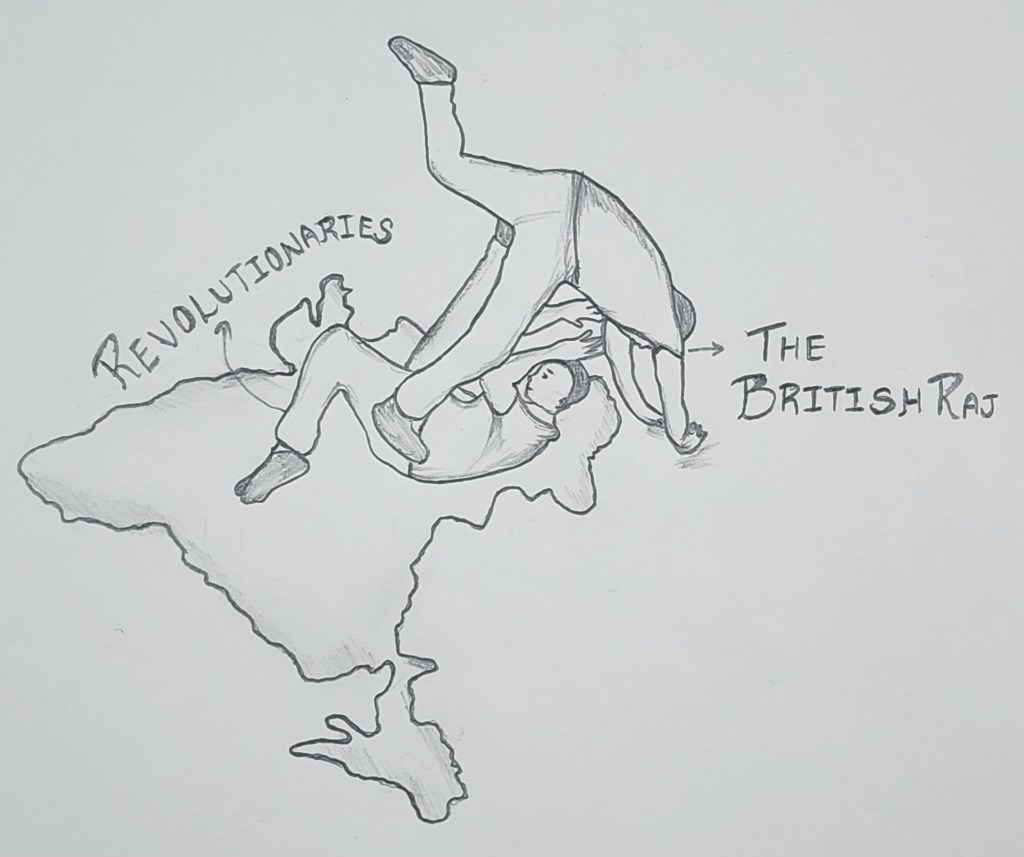
Artwork by Shushma N
In the previous two write-ups in this series I have opined that Ahimsa is about not letting the opponent realize that he/she/they are being countered and making them retreat or just give up the fight/aggression that was initiated by the opponents’ side. I also opined that this concept can be applied not only to a one on one fight, but also to a large scale conflict spread across a vast geography (the example used was the Indian Freedom Struggle).
In this part of this series, the last one for now, I shall express a few of the remaining thoughts I have had over time with regard to Ahimsa in the martial arts and how the same is also evident ( at least to me) in the struggle for Indian independence from the British Raj. Of course, I need to reiterate here, the application of martial arts concepts is from my own perspective and with the benefit of hindsight.
When we train in the Bujinkan, after a considerable amount of training, we begin to realize that a lot of the times we support the opponent. This is very true in the Nage Waza or “throwing” related movements. “Support the opponent” here means that the opponent is not only being held up by the tensions in one’s (defender’s) own body, but also by being able to sense where the threat to him or herself is likely to come from based on the same. Here, “tensions in one’s own body” refers to the strength all of us use in defending against or resisting the attack of an opponent. Specifically, with relation to the Nage Waza and related concepts (maybe movements), when an opponent is being thrown, he or she can stop him or herself from falling by sensing (feeling) the resistance from the person executing the throw and latching onto the person based on that feedback. This is why we are taught that in the Nage Waza, we need to learn to “let the opponent fall” and how that should be enabled by gravity, not individual strength.
Once we understand (or at least say/accept) that a lot of throwing of opponents happens by letting the opponent fall, we need to learn what position and space we need to occupy in relation to a specific attack from an opponent. A specific set of movements might be needed to occupy the space and posture in relation to an attacker to take his or her balance and make them fall. This is the whole purpose of Nage Waza training.
Now, when seen from the perspective of an attacker, when he or she is falling, he or she will fall in a manner that will be least painful and causes least bodily harm due to the same. This is what we call Ukemi or “receiving the ground”. In common parlance, an attacker executes a break-fall or a roll while falling to come out of the fall unhurt or at least with minimal injury.
Consider a situation where an attacker either cannot perform a good ukemi or has only the option of an ukemi that will result in significant physical injury (or worse). This situation delays the attacker (Uke) from performing an ukemi to retreat from the attack he or she initiated. Often enough, in the absence of a good fall-back option like a break-fall or roll, the attacker will fight harder and try to force a tension in the defender’s body to latch on to, thus mitigating or nullifying the need for an ukemi. Therefore, the defender (Tori), by disallowing an ukemi for the attacker, might extend the fight by not allowing the Uke to retreat with an ukemi.
An aside – It can also be argued that the Tori becomes Uke in such a situation (denial of ukemi), especially if the Tori has to resort to use of physical strength that reverses the gained advantage with the earlier movement. Of course, very skilled practitioners can deny an ukemi and also prevent a fightback from the uke (this is a deserving discussion for different time). Here, at least in a practice scenario, the tori physically stops uke from falling, thus gaining the gratitude of the uke for the life-saving move. This “saving the uke” is an act of benevolence and also results in the ending of the current attack.
With this introduction in the background, I would like to recall a sentence I had read in a newspaper op-ed back when Operation Parakram was going on. This was the massive military build-up that India had used to retaliate against the attack on the Indian parliament back in December 2001. I do not recall the newspaper name, but I think it was The Hindu. The sentence said that one of the things that the Indian Government and the Military leadership was cognizant of was that they did not want to push the then Pakistani Dictatorship to think they did not have any wriggle room in the discussions with India. This feeling along with a belief that a massive invasion was imminent would push them to the wall. And the knowledge that Pakistan would not be able to win a conventional war against India along with no faith in negotiations would drive them towards the nuclear option in the war. This was something that India did not want, for it would adversely affect India and also not result in the scaling down of terrorism which was the objective of the military mobilization in the first place. In hindsight, India succeeded, to a limited extent, in getting Pakistan to act on terrorism emanating from its soil and there was no war. Op Parakram was called “gun-boat diplomacy” as well by some, for this reason.
But the key here is that the option of negotiation was the ukemi that the attacker could use to disengage and end the fight. The lack of this option would have resulted in a military conflict with unforeseeable consequences which need not have been favourable to either the attacker or defender.
I have used the above example because it perfectly encapsulates the use of diplomacy with military capabilities to achieve a strategic or geopolitical objective, with minimal or no use of the kinetic military option. And all this in a short time frame of less than a year.
If we can look back towards the Indian Freedom Struggle with the above example and the use of ukemi in mind, some wonderful revelations are likely. This is especially true if we consider the work of a lot of new historians who are beginning to opine that Indian Independence from the British Raj was not just due to the Ahimsa (supposedly “non-violent”) and movement of the Indian National Congress (INC), but also due to the work of the armed Revolutionary Movement, the pinnacle of which was the Indian National Army (INA) under Netaji Subhash Chandra Bose.
It is well documented, and these days, pretty widely mentioned, that Clement Atlee, the PM of Britain when India won independence, stated that Gandhiji and the movement led by him (I suppose we could say the movement spearheaded by the INC?) was of very little relevance in the final British decision to leave India and acquiesce to Indian Independence. This statement is supposed to have been made when he was on a visit to India in 1956, when he was staying at the residence of the then Chief Justice of Bengal. Further, Clement Atlee is supposed to have credited the British decision to leave India to the spark lit by Netaji and the rebellion in the then Royal Indian Armed Forces (the greatest of which was the rebellion by the Royal Indian Navy in 1946).
So, Indian Independence was a consequence of the well-known Freedom Struggle and also loss of control of the armed forces in India. The rebellion in the armed forces after the end of the Second World War itself was triggered by the trials in the Red Fort of the prisoners of the INA. The INA being a product of the armed revolutionary movement, it is clear that the objective of this movement was always to turn the British Indian Army against the British. With the Army being staffed mostly by Indians with British leadership, the loss of control of the army was always going to be the end of the British Raj.
This idea of throwing the British out by subversion of the British Indian Army had been the same since the First War of Independence in 1857, which also occurred due to troops of the then East India Company (EIC) rebelling against the Company. After the failure in 1857, the idea was revived in the early 20th century with many events working towards the same goal, during the First World War which were not successful. Eventually, the same idea came to fruition after the Second World War. In the interim when the idea of subverting the army was on the back burner post the failed Mutiny of 1857, the INC was born in 1885 and initiated the parallel struggle for freedom through a political process, which is the better known “non-violent” movement.
For greater details about the revolutionary movement, I strongly suggest looking for and watching the talks given by Mr. Sanjeev Sanyal*. There are several of those on YouTube, all very interesting. This is one of my own main sources of knowledge about these aspects. There are others out there as well sharing the happenings of these times in differing ways**.
So, the armed revolutionary movement was instrumental in taking away the Indian Armed forces from the British, while Gandhiji and the INC were responsible for breaking the British moral high ground and belief in their own responsibility to civilize India after a Western model.
I have mentioned my thoughts on the use of the Ahimsa movement in using British moral superiority against themselves in a previous article***. In that article I have also mentioned that the Ahimsa movement provided a safety valve and a face saving exit out of India, for the British. This is exactly like keeping negotiations on during Op Parakram. In other words, the Ahimsa movement was the Ukemi allowance to the Nage Waza of the armed revolutionary movement.
The British were financially weak after the Second World War and the training and knowledge of weaponry they had imparted to Indian troops during the same had mitigated their technological superiority. And thus, with the loss of the Indian Armed Forces, their last tool to hold the country they had occupied over the last two centuries was taken away from them. This was them being subjected to an absolute bad-ass Nage Waza, a literal being “thrown out”!
This left them with taking the Ukemi option provided by the INC, for a face saving retreat, thus ending the struggle India had not asked for. The British were forced to negotiate earnestly with the INC about complete Independence and not just spare concessions like they had in the earlier decades. This allowed them to survive the “fall” due to the “Nage” of the revolutionary movement. They could hold on to the face saving belief in being civilized by acquiescing to the call for Indian Independence and over time sweep from the mind the fact of being “thrown” out.
So, the twin use of the revolutionary movement and the political movement of the INC were the Nage Waza and “allowed” Ukemi that showed the British the path of retreat, and nullified the aggression that led to the Freedom Struggle in India****.
Notes:
*Mr. Sanyal is the Principal Economic Advisor to the Govt. of India and a member of the PM’s Economic Advisory Council. He is also a wonderful historian who has written multiple books.
**One very recent book called “True to Their Salt” by Ravindra Rathee comes to mind. I have not read this book, only watched an interview with the author, about the book.
***Ahimsa and the Martial Arts – Part 2
****Does this have a parallel in the IRA / Sinn Fein tandem movement? Perhaps this is something to look at, for if true, would be a second use of the same Nage – Ukemi combination against the same colonizer.


[…] ** https://mundanebudo.com/2022/11/10/ahimsa-and-the-martial-arts-part-3/ […]
LikeLike