In the Bujinkan, we learn of the Gojo. Gojo, as I understand it, means “five treasures”. Here the word “treasure” could mean what we call, “pearls of wisdom”. So, the Gojo are five precepts of wisdom. In other words, they could be guiding principles of life. The five Gojo, in the order I have learnt them are as mentioned below. I am documenting how I understand these, with examples and analogies from Hindu culture and the history of life on Earth.
- Fumetsu no fusei
- Mamichi no jikai
- Shizen no niniku
- Shizen no choetsu
- Komyo no satori
Fumetsu no fusei
Fumetsu no fusei is translated as “Give and give” or as “endless giving”. This generally means one needs to remember to always be ready to give away things and not hold on to them. It does not, however, relate to generosity. The giving is not exactly related to or proportionate to the need of another, though it could be, but that is neither a necessary nor a sufficient condition.
To elucidate this further, remember the story of Karna. He was tricked into giving away his divine armour, which likely would have resulted in the outcome of the Kurukshetra war being that the Kauravas won. He was made aware that he was going to be tricked and yet, chose to give away the armour, because he had made a vow to always give whatever was requested after morning oblations, and when the same was asked for, despite being aware of the motivations and the possible result, he still gave away the armour.
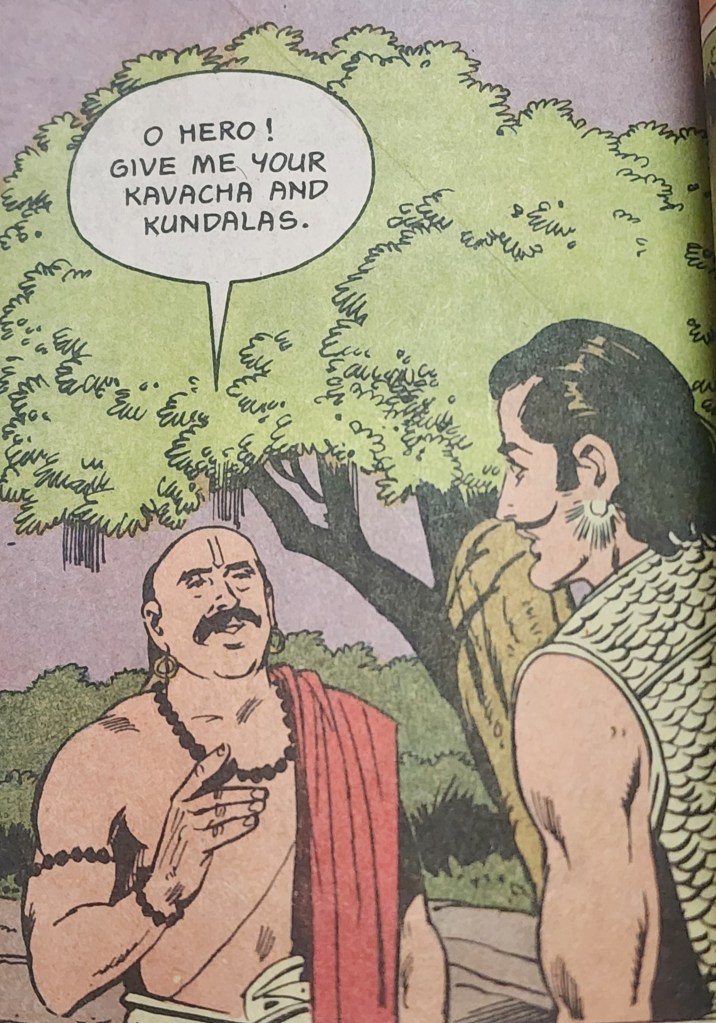
Indra in disguise asks for Karna’s divine armour. Image credit – “Mahabharta 32 – The Fall of Bheeshma”, published by Amar Chitra Katha
There is also the situation with Bheeshma, who had two opportunities to break his vow of celibacy. One during the episode with Amba and more importantly when his stepmother Satyavati herself asked Bheeshma to relinquish the vow. This was a case where the cause of the vow was asking the vow to be broken for the purposes of the greater good. If perhaps Bheeshma has broken his vow, the miseries of the Mahabharata might have been mitigated.
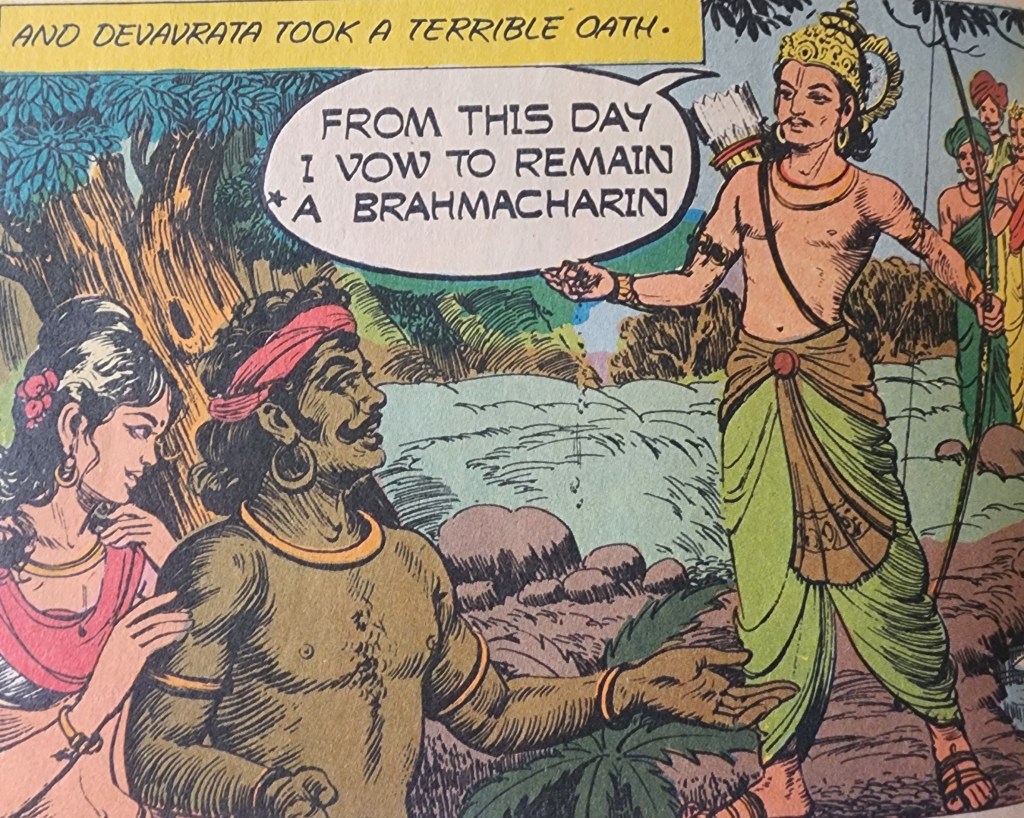
Devavrata becomes Bheeshma, Image credit – “Nahusha” published by Amar Chitra Katha
So, with these two episodes in mind, what does Fumetsu no fusei mean, or teach? This could be two-fold, one in a more generic way and one perhaps specific to the martial arts.
The first generic one is where “give” could be “give-up”, more like, “let go” or “don’t be afraid to give up”. This give up could be applied to anything. In both the episodes mentioned above, Karna and Bheeshma could have chosen to give up the vow, not the armour or the need for celibacy. They could have let go of the need to be seen to be beholden to a promise or be honourable. This of course could have been possible if they saw the need to break the vow as the best option for a suitable course of action. Did they instead choose the path of honour as that fed the ego? Does this mean endless giving is referring to always being aware of things that feed the ego and letting them go, because that could lead to a better path in life, or in a given situation?
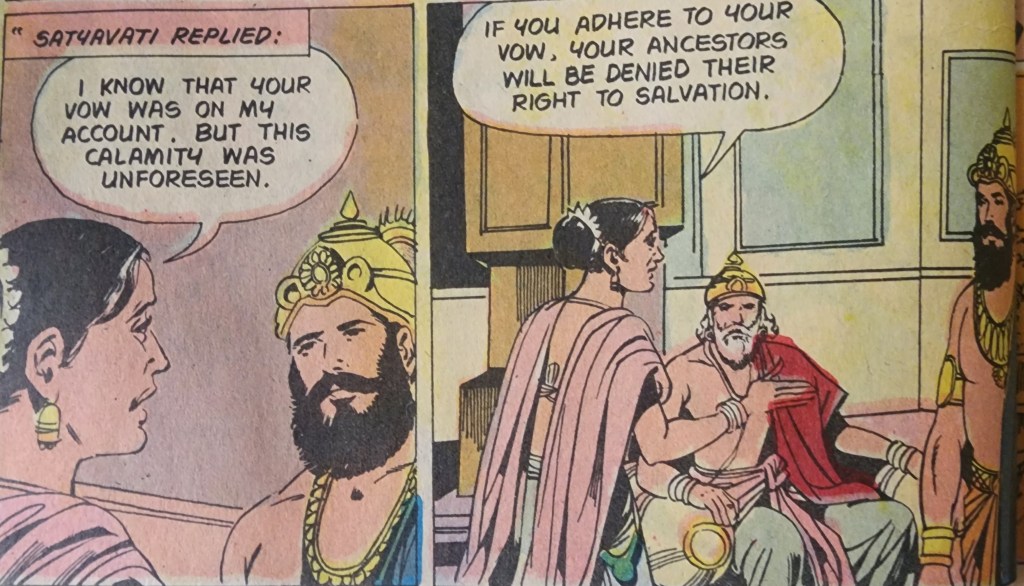
Image credit – “Mahabharata 2 – Bheeshma’s Vow” published by Amar Chitra Katha
The second meaning a little more specific to the martial arts is where one is told to not actively resist the opponent or more expansively to “not trouble” the opponent. Here, allowing the opponent to carry through with an attack while realigning oneself to safe position or place, is giving the opponent the opportunity to do what he or set out to in the first place, which is the attack. This realignment (kamae?) gives one an opportunity to use the opponent’s movement against him or herself or at least get to a safe position which might make the opponent less sure of or less willing to commit to the next attack. So, one gives up the need to fight the strength of the opponent while giving the opponent the opportunity to go through with the attack, while still not incurring any harm to oneself, this is endless giving. And since happens perpetually in an attack and hence is analogous to all conflict in life, this is “give and give’. Of course, all of this sounds wonderful, but is unimaginably difficult to implement in a real fight, let alone life.
Mamichi no jikai
Mamichi no jikai translates to “following the right path” or “being on the right path”. I have also sometimes heard it called the “righteous path” instead of the “right path”. This second gojo seems like a reminder of the first one and a pointer to the third one, kind of like “remember the first rule, and don’t forget to read the third rule”. I say this as, perhaps the right path is to follow the principle of endless giving all through one’s life. But as already noted, practicing endless giving is so hard that it is better not attempted. Thus, maybe it is more “enduring” the first principle than “following” it. And this points to the third gojo.
Shizen no niniku
Shizen no Niniku translates to “the perseverance of nature” or “make perseverance like that of nature your armour”. To endure anything, one needs perseverance. That said, how can one perceive the perseverance of nature? Perhaps nature is the entire ecosystem of the earth or maybe the universe. If we just consider the Earth and evolution of life here, that might be an instance of perseverance, extraordinary perseverance. Consider just two of the great extinctions of life in the past. The extinction at the end of the Cretaceous era resulted in the extinction of over 70% of all lifeforms on land. The dinosaurs, pterosaurs and saurians of the seas went extinct. But a remnant of them endured and became the birds of today. Tiny mammals of that age exploded onto all environments and created the richness of life of today.
The extinction at the end of the Permian era saw the extinction of over 90% of the lifeforms on earth. Mammal like reptiles that ruled all environments during that age were replaced by the dinosaurs, until the mammals came back millions of years later. Reptiles like crocodiles have been around in all of these ages, changing their sizes and shapes to suit the environment, and eating everything from other mammal like reptile to the mammals of today!
So, life endured, never went extinct, though forms of life did. This is like letting go or giving up that which needs to be let go of, given the circumstances. The perseverance here is to do what needs to be done, survive however possible, do what can be done, and change (evolve) endlessly. So, as the second gojo points out, this relentless enduring and evolving to survive through perseverance is perhaps the right path (or is this the meaning of righteous?!).
If the perseverance is not obvious, just consider the time scales, the Permian and Cretaceous are not even encompassing of the origin of life. That is well over 2 BILLION years ago. The Permian was between 250 and 300 million years ago, and the Cretaceous was roughly between 150 to 65 million years ago! Crocodile like reptilians have thus endured for 300 MILLION years! Mammals came back after 200 MILLION years to reclaim all environments while being in the shadow of the dinosaurs for all that LONG time! Now that is what embodies perseverance and endurance!

Above – Mugger or Marsh Crocodile
Shizen no choetsu
Shizen no choetsu is translated as “transcendence of nature”. This is like a reminder to not miss out on the nuance of the third gojo. While it is easy to be impressed with the vastness of time and the awesomeness of the endurance observed in the third gojo, consider what it took to actually endure during all that time! And that is “transcendence”.
Crocodile like reptiles, or crocodilians endured for 300 million years, but not specific crocodile species (or alligator or gharial or caiman species). Some species survived, but not as the same, they evolved and changed and became new species.
Dinosaurs are gone, but birds thrive today, and they are modern dinosaurs. But they are not dinosaurs, they are descendants of descendants. They evolved through many stages into the existing forms. This is an even greater change than the crocodilians. The crocodilians of today bear a resemblance to the crocodilians of old, but the birds bear no resemblance to dinosaurs, barring a few with a handful of species of the past. But in both cases the scale (size not the scales of the skin) of the creatures has changed in ways that are hard to conceive!
Now consider the mammals. Do any of the mammals of today bring to mind the sail backed Dimetrodon, which was a mammal like reptile (synapsid) of the early Permian. Absolutely none. Considering even a smaller time scale, the ancestors of whales were amphibious, large otter sized creatures, and lived supposedly lived at the edges of swamps. They were mammals for sure and lived after the end of the Cretaceous. But between then and now, some of them became the Blue Whale. From the size of a large otter to the size of a Boeing 747. Imagine that!
Now all of this is gradual evolution over time, doing what needs to be done; eat, reproduce, hide, hunt, survive. But over time, advantages are found, niches explored and exploited, and over millions of years, the original creature has morphed into something that would never recognize its ancestor and vice versa. This evolution, where the past or original specimens are unrecognizable as being related, is transcendence. Transcendence as result of relentless endurance through perseverance to survive, all the while doing just what needs to be done.
Thus, transcending is evolving to perhaps not being able to recognize the old self, or even remembering the old one. There is no sense of achievement at having evolved, it is just a new self, suited to survive in a new ecosystem. The new form cannot remember the old one to have pride or even learn from the transcendence, for the next evolution (read transcendence) likely will have no learning or similarity to the previous iteration. So, just follow the path you see 😊 and the learning will come. The path is to just do what needs to be done and letting go of that which needs letting go of. Maybe then, is not knowing transcendence and not having the need to know fumetsu no fusei? And only this leads to the right path? For even having a need to hold on to learning, is not being able to let go. We might have to accept that it is necessary to let go of the need to remember our learning or even think learning is important! Or does just staying the path of perseverance while letting go of that which needs to be let go, lead to learning without trying and is that a transcendence by itself?

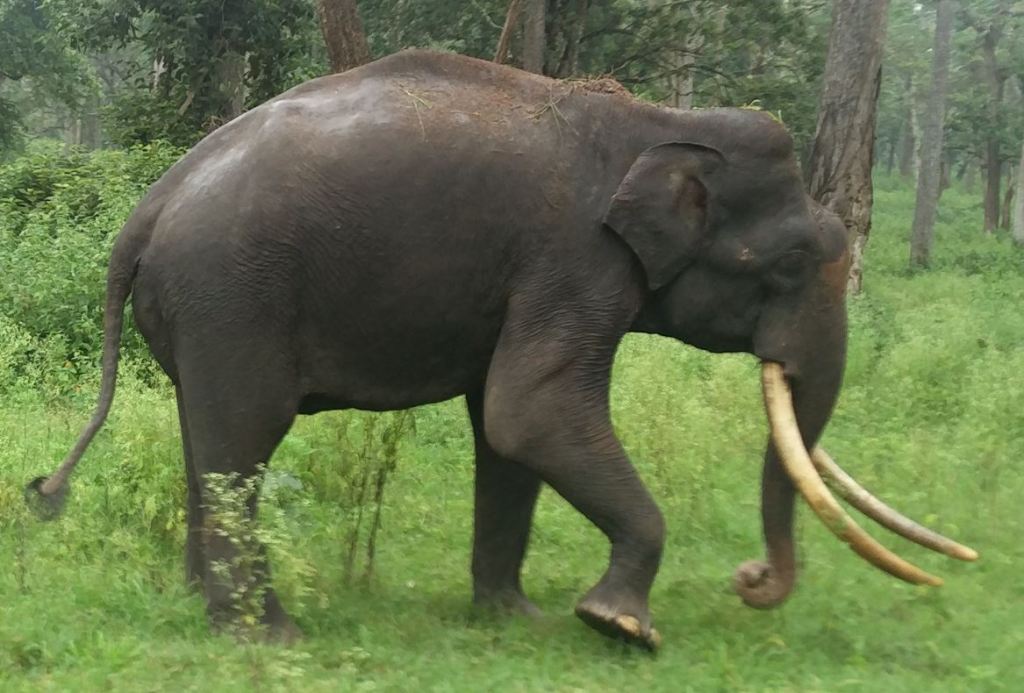
Dimetrodon, mammal-like synapsid to Elephant, modern mammal
Komyo no satori
The last gojo is “Komyo no satori”. This translates to “the light of wisdom”. This seems to be a wink to make you realize that the end is not really the end. If the path lasts all life long and at its end there is no need for wisdom, what is the purpose of wisdom, let alone a light that perhaps signifies the gaining of it (like the light bulb in comic books 😊). Perhaps this just means one realizes that there is no end, and one has to follow the other concepts that have already been realized and that realization is wisdom in itself. Maybe it just means you smile and realize that the journey was the light and wisdom is the continuation of it without any grouse at having to endure further.
The wisdom was always in one, if one had to endure and if transcendence results in the loss of that wisdom, then that is something to give away as well, and then go again. 😊
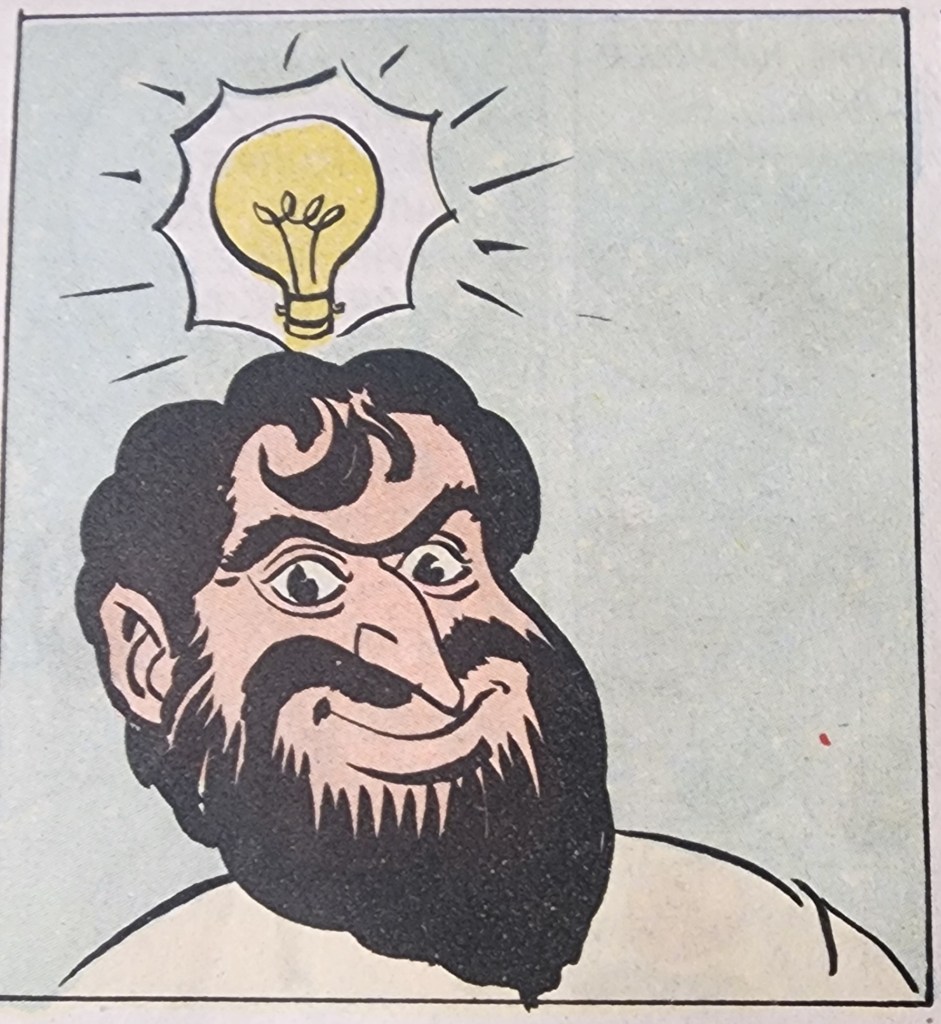
Image credit – “Tales of Humour 3”, published by Amar Chitra Katha
 Mundane Budo
Highly philosophical. But narrative is interesting. Thanks for a thought provoking article
LikeLike
[…] The Gojo – A personal understanding […]
LikeLike
[…] 1https://mundanebudo.com/2023/03/16/the-gojo-a-personal-understanding/ […]
LikeLike
[…] that is oft quoted in Bujinkan dojos. I had written an article some time ago where I have discussed my understanding of the five Gojo. The same is linked […]
LikeLike
[…] * The Gojo – A personal understanding – https://mundanebudo.com/2023/03/16/the-gojo-a-personal-understanding/ […]
LikeLike