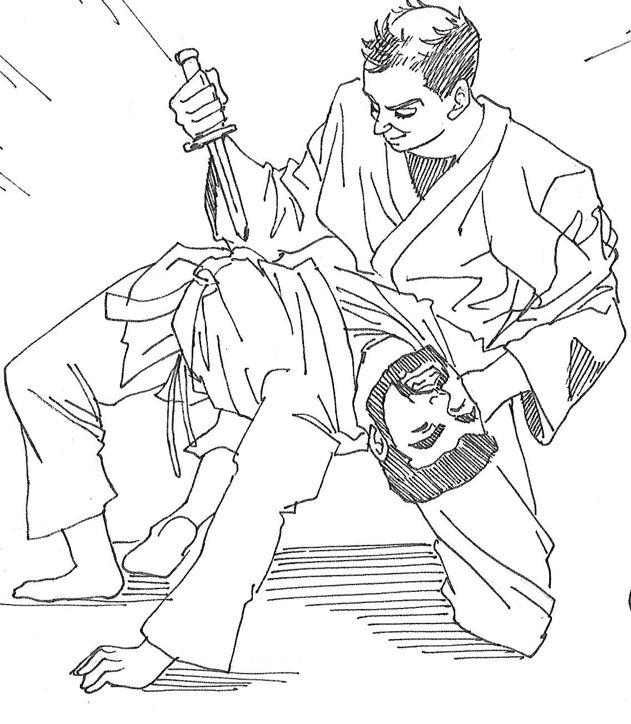
One thing that all martial artists would have experienced in their training lives is having people ask them to show “something” of what they train or have learnt. This, if I am not wrong, is more often in the early part of one’s training life when you are an oddball, for being a part of something that is not common, in one’s family or social groups. When people start associating you with martial arts over the years, this reduces, with older social groups and also with older people. But one still does get asked for a demonstration, by younger people one interacts with and newer members of one’s social and familial circles. This request is also more likely with younger folk who are possibly familiar with the more popular martial arts forms like MMA or what they have seen in movies, on OTT or in video games. It is also likely that this is a situation that comes up with folks who frequent the gym regularly; of course, the older folk at the gym might again not be the ones who make this request.
The interesting part is what a practitioner of the Bujinkan should demonstrate when asked to show “something” of what he or she knows or has learnt. I am speaking here predominantly from an Indian perspective. The answer to this can be split into two parts with two segments within each. These are as seen below.
- Beginner is demonstrating to
- People with no experience in the martial arts or any other physical activity (like working out at a gym, regular sports, running, dance, yoga* etc.)
- People with experience in either martial arts (any art form) or any other physical activity
- An experienced Budoka is demonstrating to
- People with no experience in the martial arts or any other physical activity
- People with experience in either martial arts (any art form) or any other physical activity
The table below shows the same a bit better.
| Demonstrator | Audience | Audience |
| Beginner | No experience in martial arts or physical activity | Experienced in martial arts or physical activity |
| Experienced Budoka | No experience in martial arts or physical activity | Experienced in martial arts or physical activity |
Before looking at the answer for any of the above four subsets, let me lay some groundwork for how I might arrive at the answer.
In the Bujinkan, we study the Ten Chi Jin to learn all the fundamentals. We next study the 6 styles of fighting through the study of 6 different schools respectively. The Ten Chi Jin has concepts, kata and waza originating from the schools put together to allow practitioners to learn and familiarize themselves with various important concepts and movement requirements. Also, we study the weapons in the Buki Waza part of the Ten Chi Jin. We also study weapons from mainly the Kukishinden Ryu and some other schools.
In all this training, there is one common thread. In all the forms we study, there is a defined attack. Later, when we have many years of experience, we move to studying concepts and unlearn the set forms to be able to survive with attack, which need not be defined or expected. But for the initial years, for safety and to understand the martial art and our own movement, there are set forms and these set forms have defined attacks. The attacks are taught as part of the training. Even the techniques as written, from the schools have as their first line, a statement of how Uke attacks the Tori. So, first there is an Uke (attacker, for simplicity) and then there a Tori (defender, for simplicity). If there is no Uke in these forms, there is no need for a Tori (of course, there are exceptions which will referred to later).
Perhaps because we are graded as Tori and not as Uke, we think what we have learnt is the response or reaction to an attack; after all, that is what the names and forms refer to. And hence, when asked to show something or demonstrate what we know, we default to being a Tori and here begins the problem. With this background, we can get back to the four subsets defined earlier.
Let us start with a beginner demonstrating what they know. As a beginner, one might not be very comfortable with the waza or kata. This problem might be exacerbated with attacks that one is not yet familiar with. So, if the demonstration is for or on someone who is not familiar with the attacks that have been used to train the basics, one might have to end up showing someone from outside the Bujinkan, how to attack. This leads down the rabbit hole of endless “what happens if” questions regarding attacks that are not being demonstrated. And this might lead to a situation one is not sure of being able to handle.
One solution to his situation is to stop being the Tori in the demonstration and start being the Uke. We learn a plethora of attacks, ranging from punches to kicks to throws to chokes (there is a cornucopia called the Hi Ken Juroppo). Attack them and show them that this is how you can attack effectively. One does not have to be violent with the attack, it just needs to be shown that a threatening situation can be created. Also remember, the attack need not be from the front, a choke from behind or a side kick are completely legitimate, as are the kyusho points including stomping of toes and attacks to fingertips. This is a demonstration all by itself!
If this can be done, the demonstration can be switched around. You can tell the other person to respond to your attack and you can offer to attack at low speeds. Of course, make sure that there is no malice in the attack. Now, we can differentiate between the two types of audiences we considered earlier, for the demonstration of what has been learnt.
If the person you are demonstrating to or on, has no background in the martial arts or in any other physical activity, you can show them how the attack can be received and go on to show one of the simple basic waza. This is experiential demonstration. And since they cannot generally get it, you can then ask them to attack as you did and show how the waza works. You have now overcome the issue of unexpected attacks and also set the context for a waza in the demonstration by starting with and controlling the attack.
If the person you are demonstrating to has experience in a different martial art the onus is now on that person who asked for a demonstration to defend effectively against your attack. This attack will be the unexpected attack for that person and the opportunity to go with multiple attacks is open for you. You can go with the “what happens if the attack changes” conversation with that person and shift the onus for a successful demonstration onto that person. If that martial artist has specific rules about how not to attack, then the conversation moves onto the context of the attack and you can go with explaining how the Bujinkan is a battlefield martial art and has no rules. This then, can allow you to repeat what you did with the person with no martial arts background. Show the other person how to defend and demonstrate the waza in that way. All of this also can lead to a good conversation about the heritage (history, geography, technology) of different martial arts and better understanding in that way of the Bujinkan, maybe more than the waza demonstration itself.
If the other person is not a martial artist but has experience in some other form of physical activity, the way to demonstrate the waza by starting with attacking that person will fall somewhere between the method used for a fellow martial artist and someone who is not into physical activities.
If as a beginner, one has learnt the use of weapons, specifically the smaller weapons like the knife or jutte or kunai, movements with those weapons can also be considered as a valid attack to demonstrate as well. We also have the concept of kakushi buki (hidden weapons) that can be used for setting a context here. Keys and key chains are good magnification devices for boshi ken (thumb knuckle strike) and a lot of house hold devices like pens and spoons act as yawara sticks or tanbo to magnify basic shutos. And kunai movements can be wonderfully replicated with kitchen implements like rolling pins, pans, skillets and the like. On the defensive side, a bag, a helmet or a biking jacket helps reduce the effectiveness of attack, akin to armour studied in the Bujinkan. This is also a good aspect to use in an attack, by either changing the direction of attack to account for the presence of one or using these objects as additional hand holds for a choke or grabbing attack.
While being the Uke and using an attack as the initiation of a demonstration, one needs to identify and keep in mind the attitude of the person who wants the demonstration. This is apart from the martial arts background of the people who might be asking for a demonstration. The different types of people who might ask for a demonstration, based on attitude, that come to mind, are seen below.
- It could be someone who carries fear due to some unfortunate experience, who wants to know how to defend herself or himself (telling them that self-protection is more important would be preferable to any demonstration).
- It could be people who want to check you out, maybe people who are larger than you or just people with big egos, might be looking at the demonstration as an interview or an interrogation.
- It could be people who like the theory and concepts from the martial arts.
- It could be people with no ego issues and have no intention of training, but are genuinely interested in something they have no idea about; these people are glad to have someone who might be able to satisfy their curiosity.
In all of these cases except the second one above, the attack needs to be actively non-threatening and without any malice. The person consuming the demonstration should be absolutely sure that there is no risk of any injury. In the second case, the one demonstrating should be aware of protecting herself or himself.
Apart from the above, one also needs to consider the gender, size and age of the person who wants to see a demonstration. The attack, and specifically its speed, needs to be tailored based on whether the person interested is a woman, a kid, an older person, a person who is differently abled or a person physically smaller than the demonstrator.
There is one other advantage of choosing to begin a demonstration by being the Uke. There is a prevalent notion among quite a few that martial arts are all about defence. There is also a notion that martial arts are about honour. By choosing to attack first and maybe from an unexpected angle and using deception while doing the same dispels both these notions. This is a great opening to start a conversation about how the Bujinkan is a battlefield (“battlefield” can be defined in many ways) martial art and has no explicit rules, except ones based on common sense for protection in the dojo. This also helps elucidate why sport martial arts have strong rules for protection of the participating martial artists.
This in turn helps explain why self-protection is a good concept to adopt over self-defence, since the former is self-centred and perpetual while the latter tends to be more reactive and situational. It also helps explain how it is reflective of real life, where there are no rules either. Any deception you might demonstrate in an attack is how real fights and wars happen. One only needs to search about 4th generation warfare, stand-off weapons and such to see the similarities between modern warfare and deception. Deception is a concept we train called Kyojitsu. This concept brings us to the situation where an experienced Budoka demonstrates the Bujinkan to either of the two audiences defined earlier.
When an experienced Budoka is requested to demonstrate knowledge from the Bujinkan, she or he can choose to be Uke or Tori. The experience will likely guide this decision. All the above points are still valid, but the added experience gives a lot of leeway in doing something different. If one chooses to be the Tori and there is an unexpected attack/situation the same will have to be dealt with however possible. In case the Budoka faces injury, she or he can only blame herself or himself. The reason for this and the solution are the same, Sakkijutsu.
Sakkijutsu refers to intuitive abilities. This is perhaps the most important concept to study, train, learn and experience in the Bujinkan, after years of basic training. So, if a Budoka is able to access and apply Sakkijutsu, the risk of injury due to unexpected situations while being a Tori is supposed to be mitigated. This is because using Sakkijutsu is all about being able to move to achieve safety due to an intuitive understanding of the situation. Experience also allows a demonstration to happen without a defined waza or kata. Any movement can be used to explain aspects of the Bujinkan.
Another reason an experienced Budoka can start as Tori is because he or she is expected to also be able to use Kyojitsu to achieve a favourable outcome in a demonstration. Kyojitsu is about being able to use deception in movements and intents. This also allows switching between Uke and Tori as they are not roles set in stone. Thus, Kyojitsu with Sakkijutsu is a potent mix when applied by an experienced Budoka that allows her or him to demonstrate effectively with safety to the one demonstrating and the one being demonstrated on, or to.
There are techniques in some of the schools we study, like the Takagi Yoshin Ryu and Koto Ryu, where the attacker is just walking past or just coming towards you. There is no explicit attack. You still take them down. These are techniques used when one is supposed to know that the person is the enemy or Sakkijutsu suggests there is a threat from that person. Here, the Tori is Uke because he or she initiates the movement set, and Uke is Uke just by existing! In these cases, Kyojitsu can also be applied to confuse the person being taken down to create an opening that can be exploited. Also, these are cases where the attack is the kata and there is no need for an Uke doing an expected attack for a demonstration. So, this is an option even beginners can use if they know the kata.
One final point about Kyojitsu. The very fact that even a beginner can choose to be Uke to become Tori is already an application of Kyojitsu, for by switching the onus of defence onto the person requesting the demonstration, you have already created confusion in the person, who might have expected to see you perform the same. So, becoming the Uke in the situation itself is an act of deception, which leads to great conversations as we already looked at earlier.
This is all I have on this topic at the moment. Hope I have conveyed why being an Uke, when someone asks you to “show something you have learnt in the Bujinkan”, is a good start, especially if you are not experienced and unsure of how to go about the same.
Notes:
*Here I am referring to Yoga mainly as the physical activity and not all the other aspects that are a part of it.
 Mundane Budo
I was able to understand some aspects of Bujinkan better. Thanks .
LikeLike
That’s a really good perspective on how to demonstrate when someone asks for one. Not very often thought about, this will certainly change the awkwardness dynamics of a demonstration, and help the person who’s curious to understand Bujinkan understand it, and martial arts in general, better.
LikeLiked by 1 person