Today is “World Lizard Day” (August 14th). Tomorrow is the Independence Day in India (August 15th). So, the two were connected (in my head) with a nice little legend from Indian history and I felt like sharing the same. This is unlike my usual posts where I explore the intersections between Hindu/Indian culture and the martial arts (mainly the Bujinkan system of martial arts). I had no idea that there was a day to celebrate lizards! I was told that today was Word Lizard Day by Windows and this new learning triggered this article. There is no specific link between this article and the Bujinkan or any other martial art. But I will definitely make a stretch and try to connect this legend with the martial arts. 😛
In India we share space with a species of monitor lizard called the “Common Indian Monitor”, also called the “Bengal Monitor” (Varanus Bengalensis). It is seen in almost all parts of the country. Along the east coast of India there is another larger species called the Asian Water Monitor (Varanus Salvator). The Common Monitor lizard grows to be between 5 and 7 kg and grows to a length of around 4 feet or a little more. The Water Monitor is almost one and a half times larger in size.
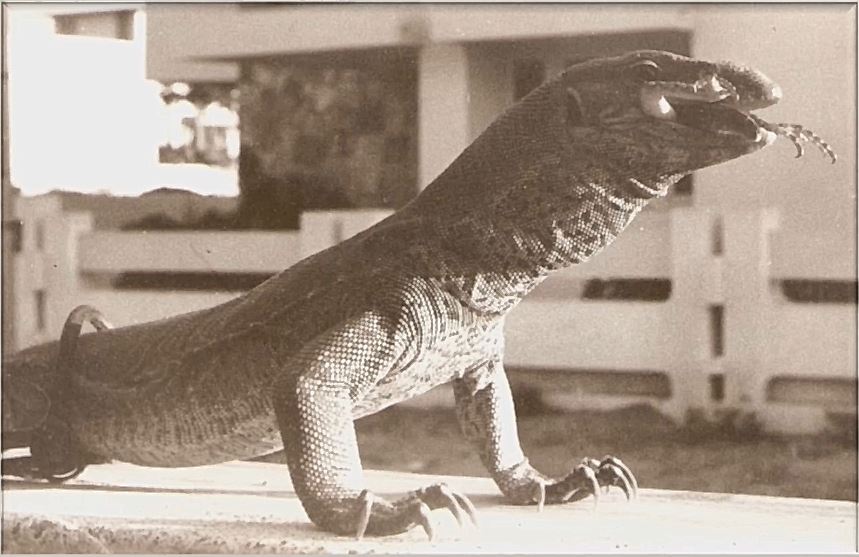
Image credit – someone from my family
The Common Monitor eats small birds, mammals, reptiles, amphibians and eggs of all of these. It is in turn eaten by many species including humans, especially when it is young or in its juvenile years. Young monitors have spots while adults are more a uniform grey. It is not a threat to humans. The largest extant monitor lizard is the Komodo Dragon that inhabits a few islands of Indonesia. The largest ever monitor to have existed, as known today is the Megalania, which once inhabited Australia, but is long extinct (early humans who entered Australia are likely to have encountered this monster).
The Indian Independence Day is celebrated to mark the occasion when the British left our country after nearly two centuries. But the notion of Independence is older as I have learnt it, as India has been invaded by outsiders several times over the last 2,500 years. Most of the invaders assimilated into the existing society and culture after capturing parts of the geography. But some over the last thousand years did not and tried to impose external culture, ideas and ways of life on the existing society. And there has always been an attempt to restore self-rule or uproot the invading powers.
During the time when the Maratha empire was being established, as modern history and popular consciousness teaches us, there was a notion of Swaraj or Swarajya, (I have heard it sometimes referred to as Hindavi Swarajya) which means self-rule or more appropriately as I understand it, “our own rule or our own kingdom”. This notion was to ensure that the lands where the Maratha lived were free from the rule of the Mughal empire and some of the Deccan sultanates. Both the Mughals (Turco-Mongol Timurids) and the Deccan sultanates were of foreign origin and Islamic in nature. The Deccan sultanates were far less foreign, but were defeated and supplanted by the Mughals and the Nizam of Hyderabad (a vassal of the Mughals, who later became independent).
The Marathas fought all these powers over several decades and emerged victorious, supplanting or at least subduing all of them. They were the pre-eminent power in India when the British East India Company started having ambitions of power and grandeur. The idea of Swaraj that the Marathas aspired to is the one I am referring to in the title of this article.
One of the great generals of the Marathas was Tanhaji Malusare, about whom a popular and successful Hindi movie was produced in 2020. He, along with his troops captured the fortress of Kondhana, but Tanhaji lost his life in this battle. The fortress is called Sinhagad today in honour of Tanhaji (he was a lion, which is a Sinh and hence Sinhgad, fortress of the lion). This battle was very hard and the Marathas scaled the sheer walls at night, an act of great daring, before defeating the garrison to take fortress.
There is a legend that Tanhaji and his troops used a monitor lizard to scale fortress walls. I am not sure if this legend is specific to the battle of Sinhgad or if they are supposed to have done so in general, in other campaigns. A monitor lizard has very powerful claws and are good climbers. This is a known fact. So, the Marathas are supposed to have tied a rope to a pet monitor (monitors are kept as pets even to this day in many parts of the world), which then scaled the fortress wall and with its strong claws held on as some soldiers scaled the walls and then helped the rest of the troops do the same. The monitor was, in essence, used as a living, trained grappling hook.
Of course, this is a legend and not real history. I have even seen a name that the pet monitor is supposed to have had! A monitor lizard is called a “Ghorpad” in Marathi. Ghorpade is also a last name used in Maharashtra to this day, and obviously it is used in other parts of India as well with migration over the last few centuries. So, from what I have learnt, it is likely that there was a group of people from the Ghorpade community, who were expert rock climbers/boulderers. This team of climbers scaled the fortress first and led the rest up. The climbers were so good that either they were compared to a monitor, or vice versa. This is an explanation for the legend. Considering that the Marathas were successful in achieving Swaraj, the legend of the monitor lizard is inextricably linked to the creation of the same 🙂 . This is the connection between “Swaraj and the lizard”.
The martial arts of the Bujinkan system are sometimes referred to as “Ninjutsu”. “Nin” refers to “perseverance”. So Ninjutsu is “the art of perseverance (or persevering)”. The Marathas, all through their existence as a power centre in India, from being a small one in the mid-17th century all the way till their fall in the early 19th century, fought in different terrain and against all odds. They mastered guerrilla warfare apart from fighting pitched battles and fighting in the forests and mountains. They also developed a very effective navy.
During the time when Mughal emperor Aurangzeb fought them for twenty six years, most of which he spent in the south, the Marathas fought a running war. Many of their commanders were examples of “living in the saddle”. To fight a numerically superior force, they were extremely mobile and fought as light cavalry, leaving behind their artillery. The Marathas eventually wore down and defeated the Mughal invasion.
There is a wonderful book called “Battles of the Maratha Empire” by Aneesh Gokhale*. In the appendix of this book, Mr. Gokhale lists the battles fought against Aurangzeb. The battles fought were from central India all the way to Tamil Nadu. The Maratha troops literally rode across peninsular India to fight battles. They did this week after week, all their lives, for multiple generations. This is the very DEFINITION of perseverance. Add to this their ability to fight in different terrain and different foes, from the Deccan sultans to the British, each in a different manner, and across two centuries, they are the very picture of the “art of persevering”. So, purely as the definition goes, they were true practitioners of Ninjutsu. Of course, this is only with the benefit of hindsight, but the concept holds as far I am concerned.
Now, I have one last point, on a lighter note. The popular image of the Ninja is that of a black clad warrior who is doing secretive activities like a spy or Special Forces operatives. The ninja is seen in a solitary manner or in small groups. One tool that is fairly often associated with the ninja is the “kagi nawa”. The kagi nawa is a rope with a hook, a grappling hook, used to scale castle walls in Japan (or elsewhere in modern movies). This tool also doubles up as a weapon if the situation demands.
Considering that this article is about a grappling hook (!) albeit a legendary live one in the form of a lizard and an oft represented ninja tool/weapon is the grappling hook (kagi nawa) as well, just revisiting a legend of how a lizard aided in the formation of Swaraj, turns the Marathas into Ninjas! 🙂 Of course, as already stated, this last bit is in a lighter vein and should only be considered inasmuch that it brings one to smile.
I usually post on alternate Thursdays. But considering the Independence Day tomorrow, I am making an exception and posting on a Tuesday, two days before schedule. I will revert to the usual Thursday posts from 31st August.
Notes:
*Link to the book mentioned above is seen below.https://www.amazon.in/Battles-Maratha-Empire-Aneesh-Gokhale/dp/8194509920/ref=sr_1_3?keywords=battles+of+the+maratha+empire&qid=1692008465&sprefix=battles+of+the+%2Caps%2C515&sr=8-3
Some absurdity – If I had to stretch the connections above further, I would link the monitor lizards to martial arts as well. Monitor lizards are found in most of Africa, West Asia, the Indian Subcontinent, South East Asia, East Asia and in Australia as well. Many Monitor species, when they need to establish a pecking order or fight over mating rights, wrestle each other. They grapple while standing on their hind legs with support from their tails. Across almost all the territories they inhabit, humans also have strong traditions of the martial arts, if not specifically unarmed wrestling itself! So, the lizards are as martial as the humans. 😀
 Mundane Budo
Nice imaginative article with quite a few anecdotes and facts. Thanks for the piece
LikeLike
Nice & interesting article. This lizard, hope it is called as Udumbu in Tamil. This has been shown in very old movies as well as if the hero trying to escape a tallest building without any handhold, with the help of this lizard.
LikeLike
The monitor lizard is called “Uda” in Kannada. And, the idea holds great appeal.
LikeLike
[…] https://mundanebudo.com/2023/08/15/swaraj-and-the-lizard-and-ninjas/ […]
LikeLike
[…] considered, there were attempts to use dolphins as tools of the navy! And if we consider folklore, monitor lizards were also used in war, specifically as grappling […]
LikeLike