Anyone who has read stories from Hindu culture or watched TV series based on the same, would have heard of the ability called “Shabdavedi”. This is the ability of an archer (either a hunter or a warrior) to accurately strike a target purely based on the sound it makes, with no visual input at all. It is a highly revered skill and individuals who could accomplish this were considered great archers. I am not aware of how rare this skill was. It essentially means that an archer, even when blindfolded, hears a sound made by a target and shoots an arrow, which unfailingly strikes the target. This is something archers with this ability can always do, and it is not a fluke or a one off.
I am aware of three examples from stories which demonstrate this ability. Two of them are from the Epic Itihasa poems of India, one each from the Ramayana and the Mahabharata. The third is from the historical Epic poem, “Prithviraj Raso”. Interestingly, the use of Shabdavedi in all three examples is related to tragedy; in two of the examples, success with Shabdavedi leads to great tragedy in the future and in the third, it is used in an extremely tragic situation.
In the Ramayana, King Dasharatha (father of Lord Rama) is out hunting at night. He hears a sound that seems like an animal is drinking at a waterhole. As it is dark, he cannot see the animal. So, he shoots an arrow at the animal using his Shabdavedi ability. He successfully strikes the target, but then, tragedy strikes. The target he has hit is a boy named Shravana Kumara. Both of his parents are blind, and in their old age cannot move about on their own. So, being a dutiful son, he carries his parents from one place to another, like a water-carrier, where his parents are seated in two baskets tied to the ends of a pole, which Shravana Kumara carries on his shoulders.
On that day, the parents are thirsty, and the son is filling a vessel at the waterhole to quench the same. Dasharatha’s arrow kills the boy. He begs the distraught parents for forgiveness. But they curse him, stating that just as they would die pining for their son, so would Dasharatha; he would die wishing his son was with him. This curse sets up the events of the Ramayana, where Rama is exiled to the forest and Dasharataha dies unable to bear the separation and his role in all the hardships his two sons and daughter-in-law have to endure for years in the forest. The exile in the forest also leads to the several tragedies that occur in the Ramayana.
In the Mahabharatha, King Pandu is out hunting. He hears what sounds like a deer. He cannot see the animal though. But he uses his Shabdavedi skill and shoots an arrow at his target. The arrow strikes its mark, but then, so does tragedy. Pandu realizes that he has struck not one, but two deer which were in the act of mating. But it turns out that it was a sage and his wife who were being physically intimate in the form of deer. So, Pandu has mortally wounded the sage and his wife. Pandu begs for forgiveness, but the sage curses him. The curse is that if Pandu ever tries to be physically intimate with either of his wives or if he even has thoughts of the same, he will immediately lose his life.
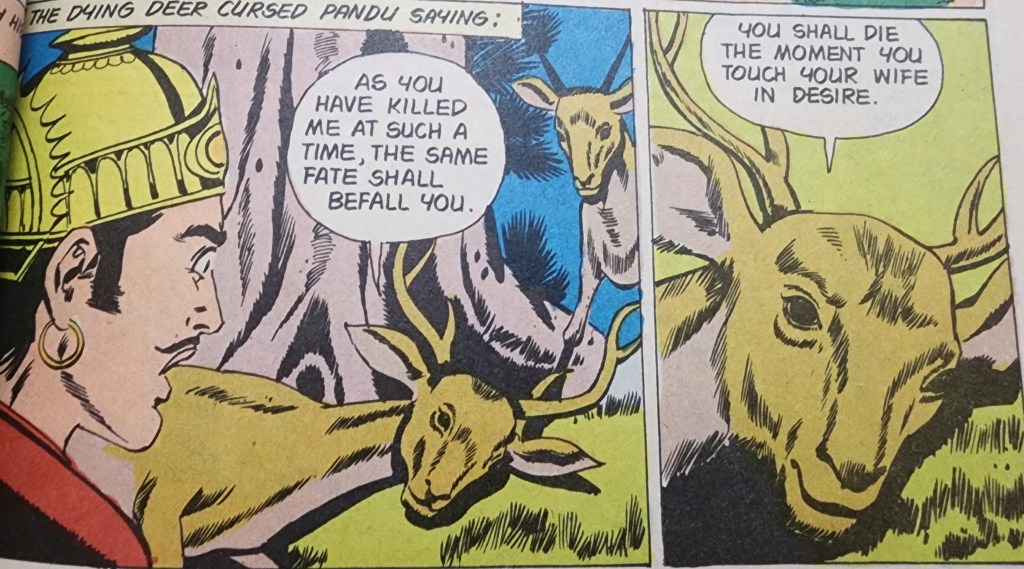
Image credit – “Mahabharata 3 – Advent of the Kuru Princes”, published by Amar Chitra Katha
In repentance of his act, Pandu relinquishes his throne in favour of his blind older brother Dritharashtra and retires to the forest with his wives. Later, he succumbs to the curse in a moment of weakness. This act of Pandu’s sets in motion a whole chain of events, which along with the actions of his grandfather Shantanu lead to the great war of Kurukshetra which resulted in the loss of life and suffering on an unimaginable scale.
In the Prithviraj Raso, after Prithviraj has been defeated at the battle of Tarain, he is imprisoned, blinded, and taken as a prisoner to Ghazni, by Mohammad of Ghor. Prithviraj is humiliated, his armies destroyed and his kingdom is reduced to being a vassal state and has suffered great losses. While in prison in Ghazni, Prithviraj’s close friend, court poet and minister, Chand Baradai, finds him and they hatch a plot to avenge their defeat by killing Mohammad Ghori. Chand Bardai extolls Prithviraj’s ability with Shabdavedi. So, Ghori wants to see a demonstration of the same. An arena is set up and a goat is let into the arena. Prithviraj is also brought in and handed a bow and arrow. The goat is made to bleat, thus providing a target for the arrow. Prithviraj says he will only shoot the arrow on a command from Ghori. Ghori does so and this allows Prithviraj to shoot Ghori instead of the goat as his location is now revealed. Then Chand Bardai and Prithivraj both commit suicide. Thus, they have avenged their defeat despite being severely weakened by circumstances. Of course, this story is not actual history, but epic poetry.
The circumstances of all three examples above might be tragic, but the ability of Shabdavedi was coveted and deeply respected. This is obvious, because any ability to shoot targets without the use of sight is indeed extraordinary and takes a lot of practice to achieve. It is mastery despite the absence of the most vital of human senses, sight, required for archery.
In the Bujinkan system of martial arts, there is a concept called “Sakkijutsu”. This refers to “intuitive ability”. This is among the most important precepts of the Bujinkan. It is referred to most often when practitioners of the art with a lot of experience practice or teach. Sakkijutsu relates to responding to the intention of the opponent(s) and not the action of the opponent(s). Intention occurs before action and hence, responding to the intention gives an extra fraction of time to the defender, which might be vital in saving oneself (or anyone else).
There is no scientific measure that I am aware of to measure the “Sakki” or intuition. The use of intuition is also not something that is taught. It is described and demonstrated, and this allows the ability to be learnt. The ability is learnt and refined over years of training. It is purely experiential learning and requires training physically with fellow practitioners, mentors, teachers and students. But the centrality of this concept in the Bujinkan never changes, even when one is not yet able to express Sakkijutsu.
Since Sakkijutsu relates to intuition, the experience of getting a feel of the situation where the conflict (physical or otherwise) is occurring in, is very important. This includes, the context, individuals, groups of individuals and the overall atmosphere of the place (time & space). All of this adds to the abilities, past experiences, life experiences beyond the martial arts and general wisdom of the individual. These aspects inform one’s intuition, which could also be referred to as “gut feel”. This is very important as one should also realize what cannot be done in managing a conflict and should avoid acts that lead to injury (including psychological, emotional and spiritual ones) and death.
I have referred to intuitive ability and Sakkijutsu in multiple other articles as well. The test to achieve the 5th Dan in the Bujinkan is called the “Sakki test”. It involves one demonstrating intuitive ability and at the same time realizing for oneself that he or she has the ability, and it should be applied in all situations in life. I have described this test in the article related to “Boons, Blessings and Curses” *. The link to this article is seen in the notes below.
The concept of Shabdavedi is offensive in nature, as it is used by the attacker to target a hidden opponent (or quarry). I suggest that the counter to this ability is Sakkijutsu. Sakkijutsu is protective in nature, as it allows the target of the person using Shabdavedi to survive the attack, irrespective of whether it is a human or an animal. If the target can sense the malicious intent of the person shooting the arrow, at the moment when the person decides to shoot as he or she has got a target lock due to Shabdavedi, the target can move in that small instant of time. As the time between the decision to shoot and the release of the arrow is small, if the target is no longer in the same space which is targeted, it is almost impossible for the archer to track and change the targeted space, thus allowing the quarry to survive. Of course, for this to work, the target should also move only when the decision to shoot is made. If it is too early, the archer can sense the movement through Shabdavedi and change his or her target. If the movement is late, well, it doesn’t matter anymore. So, Sakkijutsu is no magic survival card. It is just one extra opportunity to survive, which can hopefully be exploited successfully.
I am not aware of the right word to use in either Sanskrit or other Indian vernacular languages (mainly Kannada in my case) for Sakkijutsu. Antahprajne, Saakshaatkaara (could also mean epiphany), Aparokshajnana, Asaamanya Prajne, Ola Arivu and one I like best, Antarbhoda are the words I found online as a translation for “intuition” in Kannada. The word I found online most often, from Sanskrit, as a translation for intuition, is “Pratibha” (apparently according to the 5th century Sanskrit scholar Bhartrihari). But this also means ability or skill in some cases. So, I will say “Antarbodha” is a counter for “Shabdavedi”, just to square off words from the same language. 😛 But I will use the word Sakkijutsu itself in the rest of the article simple because I am neither satisfied nor convinced with the other words I have found.
A couple of additional points about Sakkijutsu here. Firstly, Sakkijutsu is NOT magic. It is a natural ability which we all possess. The key in its practice is to build trust in one’s own intuition and not second guess its drive. Imagine walking alone in a dark place with no people around. We feel our senses are heightened and are very aware of our surroundings, as threat perception is high and we are in self-protection mode. Similarly, when we are driving through heavy traffic, we get the feel that we need to change speed, change gears, or avoid moving into an empty space on the road. We involuntarily slow down more at some blind turns than at others. Similarly, if there are two roads that can be taken to the same destination, we take one without analysis based on the “gut feel” in that moment. All of these are examples of us using our Sakkijutsu, even if our life is not on the line in many of these cases. There are also cases when we know of a call coming through just before the phone rings. This also happens at work when we realize that someone is looking for us or looking at us just before the person arrives. It is this ability that we apply, train, and refine. I have described this in slightly greater detail in a previous article of mine**, the link to which is seen in the notes below.
The examples of Shabdavedi with which I am juxtaposing Sakkijutsu are from the past. But the practice of Sakkijutsu and instances to elucidate the same I am using are from the present. The second point is relating to this discrepancy. In current times, while Shabdavedi still exists, the levels of technology and the availability of the same make the need for the Shabdavedi fairly unnecessary. So, if we consider an exact situation from the modern day, snipers and their modern rifles can target individuals at ranges greater than ever before. Add to this the use of drones and this range increases even further+. The drone operators need not even be on the same continent. Does Sakkijutsu work in such cases? I do not know. I have heard it said by some practitioners of the Bujinkan who are also veterans of the armed forces that in the case involving snipers, it might. This is because the weapon and its human operator are just like an archer. But I cannot vouch for this information as I have no experience regarding this.
When it comes to drones, the person with the intent to kill is nowhere near the drone. So, is there an opportunity for the quarry to sense the intention of the attacker/hunter? Again, I have no idea. Since there are so many layers of technology, is it the drone or any other form of technology doing the targeting? If yes, as it is not sentient in the same way as a human or any other animal, can it have the same intention? If not, how can Sakkijutsu work, as there is no malicious intent to sense? After all, Sakkijutsu is our ability from when we were prey animals and it is just like a herbivore at a watering hole which is skittish and ready to bolt based on Sakkijutsu, when it gets a sense of danger based on the intentions it feels, and not just based on any of the other senses. If Sakkijutsu is not of much use against drones, is the next step to train and heighten the five conventional senses? Or just start applying other principles of the Bujinkan and other martial arts with drones as the weapons (drones vs drones with martial concepts as the differentiator)? I do not have answers to these questions and would be grateful for any light thrown on the same.
But then, there are a couple of examples that come to mind from ancient times, of Sakkijutsu being applied. These again are from the Mahabharata, and both involve Krishna when he was the charioteer for Arjuna during the Kurukshetra war. Krishna had agreed to be Arjuna’s charioteer and a guide to the Pandava side. But he had sworn that he would not raise any weapon or get involved in the fighting himself.
On the 12th day of the war, the king Bhagadatta, mounted on his elephant (the most fearsome beast in the war) fought Arjuna, who was on his chariot, with Lord Krishna as his charioteer. During the fight, Bhagadatta invoked the Vaishnavaastra. This was a celestial weapon originating from Lord Vishnu. There was no way Arjuna, despite all his abilities and the assortment of astras at his disposal, could counter this weapon, let alone survive its onslaught. But Krishna realized this when the astra was released by Bhagadatta and instinctively stood up in the chariot, letting the astra strike him, thus protecting Arjuna. Of course, Krishna, being an incarnation (avatar/avataara) of Vishnu, could bear the attack of the Vaishnavaastra unlike other mortals. Thus, Krishna, while not breaking his vow of not being involved in the fighting, still saved Arjuna while not raising a weapon. He did this by putting himself in harm’s way.
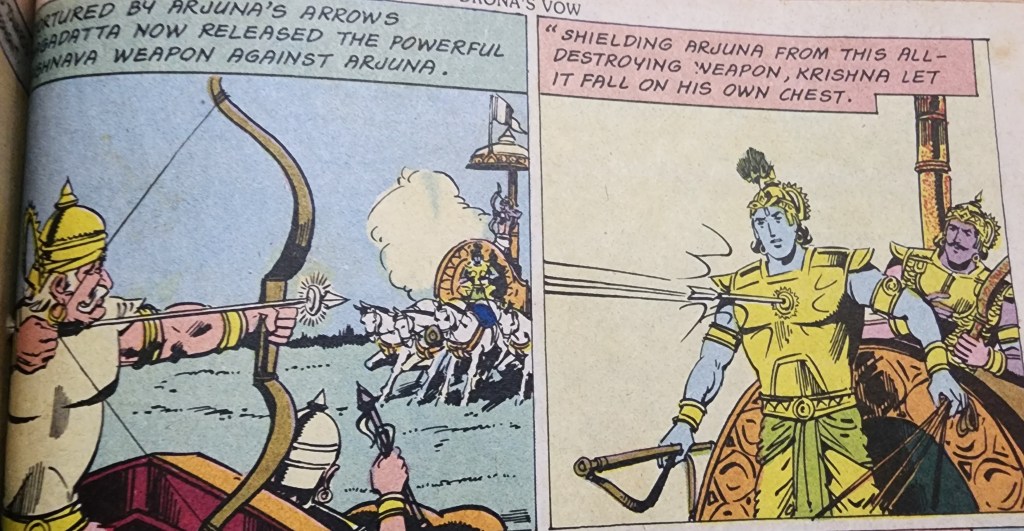
Image credit – “Mahabharata 33 – Dorna’s Vow”, published by Amar Chitra Katha
I opine that this is an example of applying Sakkijutsu. Sakkijutsu is intuitively doing what needs to be done in a given situation to prevent injury or harm to oneself or anyone else. In this example, in the very short time between the astra being discharged and it striking Arjuna, Krishna intuitively realized a lot of this and acted on the same. He realized that it was the Vaishnavaastra that was invoked, and that Arjuna was helpless against the same. He also instinctively knew what he needed to do as a charioteer, to protect his warrior. He stood up and put himself in harm’s way. It would all have happened in the blink of an eye, and so, it is an instance of Sakkijutsu.
On the 17th day of the war, Karna used the Nagaastra against Arjuna. This astra was infallible and would always strike its intended target, no matter how it was countered. So, Arjuna was in great danger. In this instance, Krishna maneuvered the chariot such that the horses buckled, and the chariot was pushed down by a few finger-widths/inches. This was done at the very last instant. The astra was discharged with Arjuna’s neck as the target. When the chariot was lowered, the astra struck the base of Arjuna’s crown/helmet and knocked it off. The astra did not miss, it struck the space where it was supposed to, only that the space which was occupied by Arjuna’s neck was now replaced by his crown. Thanks to Krishna’s action, Arjuna was saved again.

Image credit – “Mahabharata 37 – Karna in Command”, published by Amar Chitra Katha
Here also, Krishna knew intuitively that he needed to intervene to save Arjuna, and the action that needed to be taken, in a an extremely small duration of time, thus making it a demonstration of Sakkijutsu. Of course, it can be said that Krishna is a God and hence his divine abilities allowed him to do what he did. Add to this, the magical aspects of the weapons involved, and the examples can be considered fantasy. But then, the nature of the actions taken by Krishna in the spur of the moment was instinctive. Plus, the same could be done with none of the magical aspects of the astra by any charioteer to protect the warrior for any number of reasons, thus making them intuitive and not divine intervention. The explanation for the actions were also given after the act, and it was not planned. These aspects make the actions of Krishna in both cases, examples of Sakkijutsu.
Speaking of Lord Krishna as a charioteer and his actions while being one, is a good segue to have a look at charioteers and their abilities during the days of the Mahabharata and maybe in general in India during ancient times. We know the names of famous charioteers and some famous individuals who excelled at charioteering, other than Krishna himself. Some famous charioteers we know of are, Sanjaya, charioteer of Dritarashtra, Daruka, charioteer of Krishna and Maatali, Indra’s charioteer. Other than Krishna, Yudishtira was a great charioteer and so was King Shalya. Shalya was the king of Madra and an uncle of the Pandavas (specifically only Nakula and Sahadeva) as he was the brother of Maadri, wife of Pandu. He was one of the greatest mace fighters of his time, on par with Bhima, Duryodhana, Jarasandha and Keechaka. His excellence as a charioteer is attested by the fact that he was requested to be Karna’s charioteer on the 17th day of the Kurukshetra war. This was when Karna was commander-in-chief of the Kaurava armies and needed a charioteer who could match the abilities of Krishna when Arjuna and Karna faced off. This shows how incredibly important charioteers were and the great regard in which they were held.
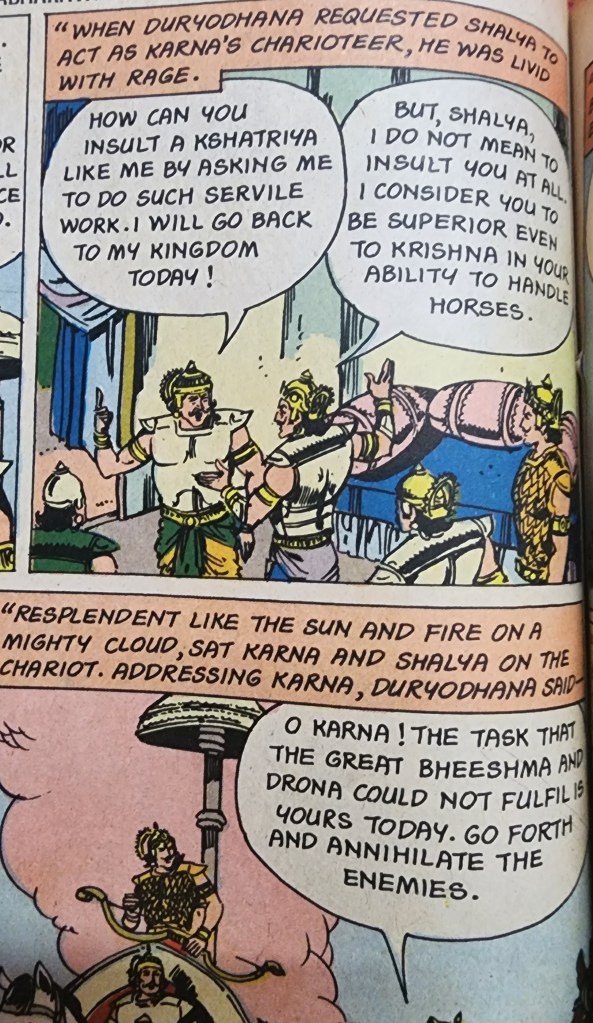

Image credit (L) – “Mahabharata 37 – Karna in Command”, published by Amar Chitra Katha
Image credit (R)- “Mahabharata 35 – Arjuna fulfils his Vow”, published by Amar Chitra Katha
When Arjuna fought against the Nivaatakavachas and Kaalakeyas, as repayment for receiving celestial weaponry (and the knowledge for their use) from the Devas, much before the Kurukshetra war, he was granted use of Indra’s chariot, with Maatali as the charioteer. Maatali served as both guide and friend to Arjuna during this time. Daruka, Krishna’s charioteer was tasked with keeping his chariot ready for war in case Arjuna failed to fulfil his vow on the 15th day of the war. And lastly, Sanjaya, apart from being Dritarashtra’s charioteer, was a trusted confidante and advisor to the king. This is why he, of all people, was granted divine vision by Maharishi Veda Vyasa, so that Sanjaya could narrate the events of the war to the blind Dritharashtra. All of these extend the idea that charioteers were respected individuals and important members of the social circles of famous individuals.

Image credit – “Mahabharata 22 – The Reunion”, published by Amar Chitra Katha
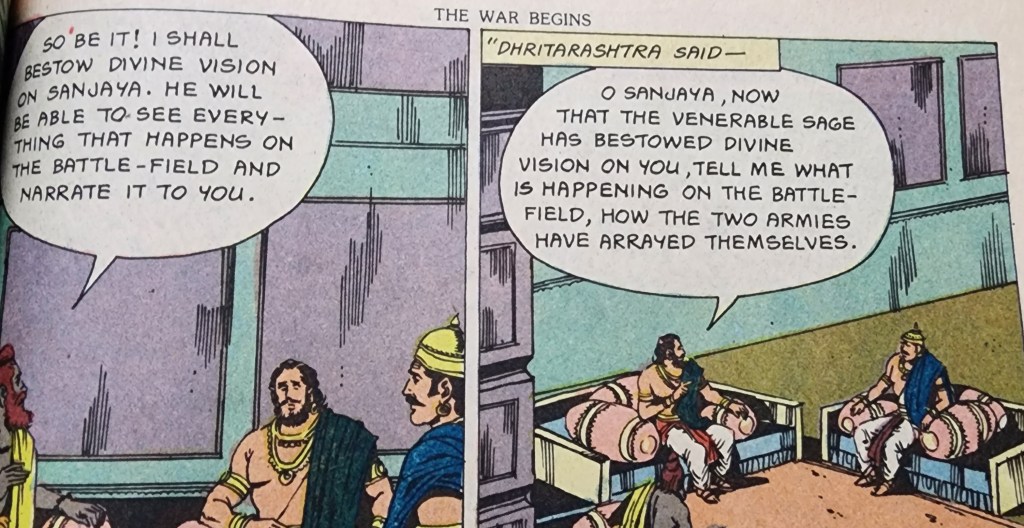
Image credit – “Mahabharata 30 – The War Begins”, published by Amar Chitra Katha
I suggest that the reason for this deep respect that charioteers commanded in the society of the Mahabharata was their importance in warfare. I also opine that Sakkijutsu was vitally important for charioteers, or as they are called in the vernacular, Sarathis (Sarathi for singular)++.
A Charioteer and the warrior in the chariot would have been a team, not unlike a doubles team in badminton, tennis, table tennis or any other similar sport. They would need to understand each other and act in tandem, backing each other in case of a mistake by the other and allowing the other to express what he or she is best at. In a war, one of the chariot’s important advantages is its mobility. And when a chariot faces other chariots or cavalry (either horses or elephants) it faces off against other mobile enemies. Therefore, the warrior in the chariot has to strike opponents that are mobile and continuously moving. This is why the wheels of chariots, the horses and indeed the charioteers themselves were always valid targets.
While the warrior focuses on finding, tracking and attacking enemies with arrows, javelins or spears, it would fall to the charioteer to do everything else. In this sense, the warrior is like the weapons officer in a two-seater fighter aircraft. But the charioteer is more than a passive pilot or worse, a driver. He or she (Kaikeyi, Lord Rama’s step-mother, was a famous Sarathi and played the role when Dasharatha fought in battles) did not just take a chariot to a given place as commanded and park the vehicle while the warriors engaged in fighting.
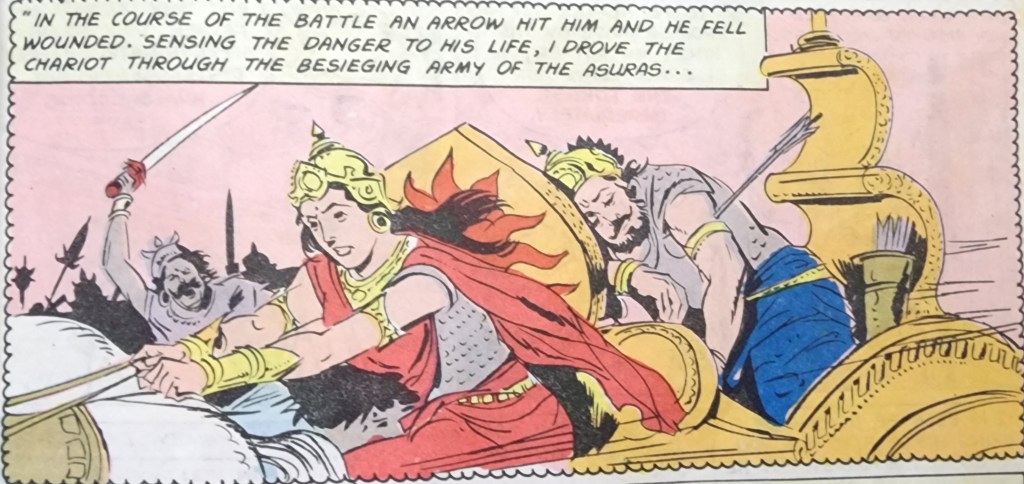
Image credit – “Ramayana”, published by Amar Chitra Katha
Charioteers would need to have a sense of all the following.
- the surroundings on the battlefield
- the enemies targeting the chariot or the warrior in it or both
- the condition of the structure of the chariot
- the condition of the horses drawing the chariot
- the targets that are feasible and the total set of available targets (like a radar on a fighter aircraft)
- the targets the warrior is focusing on and the weapons he is using to carry out the attack
With all the above in mind, he or she has to pilot the chariot in a way that allows the most efficient attack against a specific opponent, while the risk to the warrior and the chariot itself is minimised. It is an act of continuous and dynamic optimization, while one’s own life is on the line. The charioteer needs to move the chariot to avoid an arrow or javelin from striking the warrior if he or she is targeted while the same individual is busy attacking another target on an ever-changing battlefield.
The charioteer also needs to put the chariot in the best place possible, from where a specific opponent can be targeted and attacked. This has to happen while being aware of the ground and if it is conducive to take the weight of the chariot and horses, for they should not get stuck or mired in the mud. The charioteer must also be aware of possible paths to take to either advance or retreat on the battlefield. He or she must also communicate effectively to the warrior all necessary information so he or she can do the job as effectively as possible. The charioteer must also know which targets the warrior can take out while the chariot is moving and when the chariot needs to be stopped to allow for the same. And then there will be idiosyncrasies and pride of the warrior to take into account, the communication of which cannot be allowed to impact their working together in the best possible way.
So, in a way, a charioteer of old is not unlike the smart mission system and electronics of modern-day weapon system (of course, it is OBVIOUSLY NOT an exact comparison). They have great battlefield awareness, inform about radar locks, approach of missiles and dispense flares or chaff or other defensive weapons. They allow electronic counter measures, electronic counter-counter measures and communicate when the firing solution is ready so that the weapons officer can choose to discharge the same. No wonder, a charioteer was revered in the ancient world, they were as important as, if not more important than, the warriors themselves. Imagine an adrenaline pumping chase and fight sequence in a Mission Impossible movie action sequence in the ancient world with chariots facing off to get a sense of the awe the situation can inspire.
In ancient India, there was a community called “Suta”. These days it might be considered an occupation-based caste. Sutas are born of Brahmin mothers and Kshatriya fathers. Several individuals of the Suta community excelled as charioteers. So much so that sometimes it is said that a Suta is a charioteer, even though that is not correct. Some famous Sutas include Keechaka, the great commander of the armies of King Virata of the Matsya kingdom, where the Pandavas hid during their 13th year in exile. He was a warrior on par with Bhima and others as already mentioned. His sister Sudeshna was the queen. This makes her the maternal grandmother of the future king of Hastinapura, Pareekshit, who is also a grandson of Arjuna on the paternal side.
Another revered Suta is Ugrashrava Lomarshana Sauti. He is a deeply respected bard/storyteller. His recitation of the story of Pandavas and Kauravas to Rishi Shaunaka and his students in the Naimishaaranya forest is what is today considered the Mahabharata00. Sutas also excelled as story tellers/bards and warriors as seen from the above examples.
Thus, a Suta (which can also be written Soota to be closer to the vernacular pronunciation) was a very respected and multi-skilled community of the past. But most of us associate the word with the word Sutaputra used in the televised versions of the Mahabharata. Karna, is adopted by the charioteer named Adiratha, who is a Suta. So, Karna is called a Sutaputra as he is the son of a Suta. This term is used by the Pandavas in a derogatory manner towards Karna a lot of the time in the Mahabharata TV series. I am not sure if this is a correct reflection of the original written by Veda Vyasa, in the number of times this term is used in a derogatory manner towards Karna. Considering that Karna is also made a more sympathetic character on TV than he was in the original epic, it is a possibility. This in turn makes one wonder if the Sutas not being as respected on the TV series as they were in the past, is more a result of virtue signalling in the modern-day.
It is indeed a joy to be able to move from Shabdavedi to Sakkijutsu to realizing how important this skill might have been to charioteers and to realize how virtue signalling might keep us from discovering the same.
Notes:
* https://mundanebudo.com/2023/07/20/connect-control-part-2-boons-blessings-curses-the-sakki-test/
** https://mundanebudo.com/2023/06/22/when-there-are-no-solutions/
+There are missiles today that have no explosive warheads, but blades that open out, making mincemeat of the target. This is essentially a very high-tech arrow!
++One of the many names of Lord Krishna is “Parthasarathi”. Here “Partha” is Arjuna as he is the son of Kunti, whose birth name was Pritha (son of Pritha is Partha – pronounced Paartha). “Sarathi” means charioteer. So, as Krishna is a charioteer of Arjuna’s, he is “Parthasarathi”. Also, Sarathi is pronounced “Saarathi”.
00The Mahabharata is three narrations nested one inside the other. The “Jaya” was composed by Maharishi Veda Vyasa and this contained a conversation between Dritharashtra and Sanjaya about all the events that led upto the war, while the latter is narrating the happenings on the field of battle, thanks to his divine vision, which was also granted by Veda Vyasa. The “Jaya” was narrated in a conversation, by Vaishampayana, a disciple of Vyasa’s to King Janamejaya, during the Sarpa Satra conducted by the latter. Janamejaya is the grandson of Abhimanyu, son of Arjuna. Ugrashrava Lomarshana Sauti was present at the Sarpa Satra and witness to this narration. He in turn narrated the narration that he had heard, to Rishi Shaunaka and his pupils at their ashrama in the forest, Naimishaaranya. This is what has come down to us as the Mahabharata.
 Mundane Budo
[…] +https://mundanebudo.com/2023/08/31/shabdavedi-sakkijutsu-and-why-charioteers-are-awesome/ […]
LikeLike
[…] 2 https://mundanebudo.com/2023/08/31/shabdavedi-sakkijutsu-and-why-charioteers-are-awesome/ […]
LikeLike
[…] https://mundanebudo.com/2023/08/31/shabdavedi-sakkijutsu-and-why-charioteers-are-awesome/ […]
LikeLike
[…] was a core requirement to be considered a great warrior! Charioteers were called “Sārathi”. Charioteers were held in high regard and some ended up being close confidants and advisors of the kings and nobles they […]
LikeLike