Credits for the images – (L) “Dashavatar” published by Amar Chitra Katha (Kindle edition), (R) “Krishna and Narakasura” published by Amar Chitra Katha
Deepavali or Diwali as it is mostly called, is light personified. It is a five or three or one day festival, depending on one’s culture, traditions, community, geography and upbringing, or any combination of the above. One of these days, is celebrated as “Naraka Chaturdashi” (usually the first for my community) and another is celebrated as “Bali Padyami” (the third day for my community). The festival “Bali Pādyami” is celebrated for the same reason that Onam is celebrated in the state of Kerala.
“Naraka Chaturdashi” is observed to celebrate the victory of Lord Krishna over the Asura Naraka (hence Narakāsura). Bali Padyami is observed to celebrate the yearly visit of the Asura King Bali (sometimes referred to as Mahabali) to the land of the mortals. King Bali is otherwise the ruler of one of the seven nether worlds. Narakaasura was defeated by the eighth avatar of Lord Vishnu, namely Lord Krishna. Narakaasura was killed when he was defeated. Bali was defeated the fifth avatar of Lord Vishnu, namely Lord Vaamana. But when Bali was defeated, he was not killed, or even physically injured. The defeat of Bali, in my opinion, was more like a negotiated settlement, with both the Devas and the Asuras gaining greatly. The contrasting means of these two conflicts, with Naraka and Bali, and the outcomes of the two, which lead to the two festivals mentioned earlier, is the focus of this article.
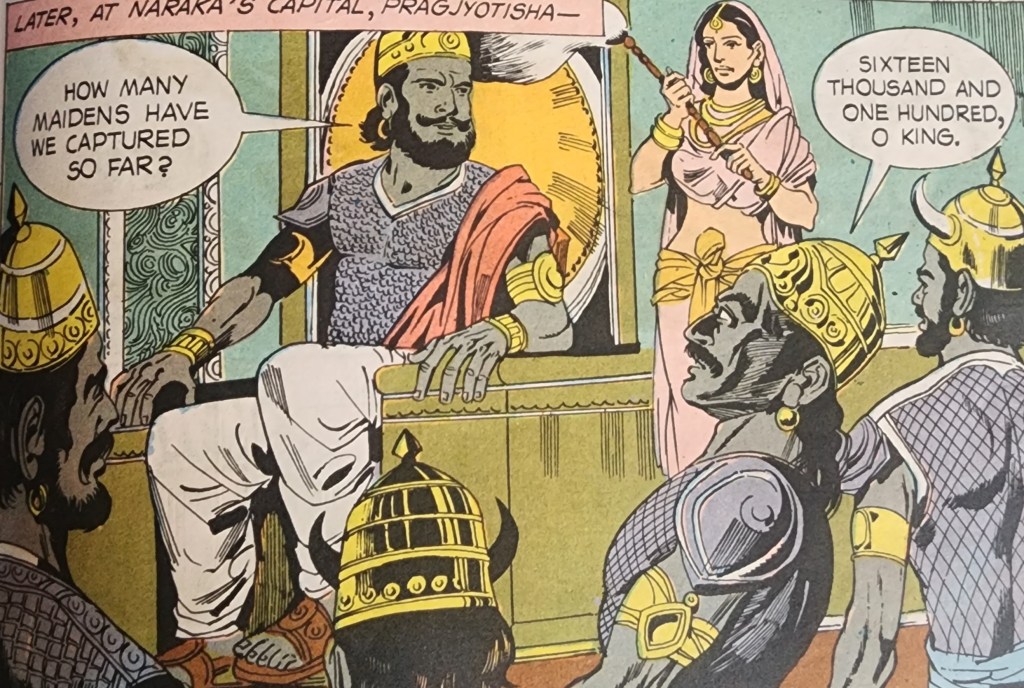
Narakāsura was the ruler of a kingdom the capital of which was Pragjyotisha. In current times, Pragjyotishpura is in Guwahati, in the state of Assam. Pragjyotishpura was the capital of the ancient kingdom of Kāmarupa. Based on my knowledge, Kāmarupa was the ancient name of roughly the region that is the modern-day state of Assam. But I have seen it mentioned that ancient Pragjyotisha was in modern day Uttarakhand or Himachal Pradesh1. This is where the great warrior king Bhagadatta came from with his armies to fight on the side of the Kauravas in the great war of Kurukshetra. Bhagadatta was the son of Naraka. The ancient Varman dynasty, which was a contemporary of the imperial Guptas, ruled the region of Kāmarupa and claimed descent from Narakāsura. Apparently, this is how Prahjyotishpura moved to the east from the north. This little detail is not relevant to this article, but an interesting one nevertheless.
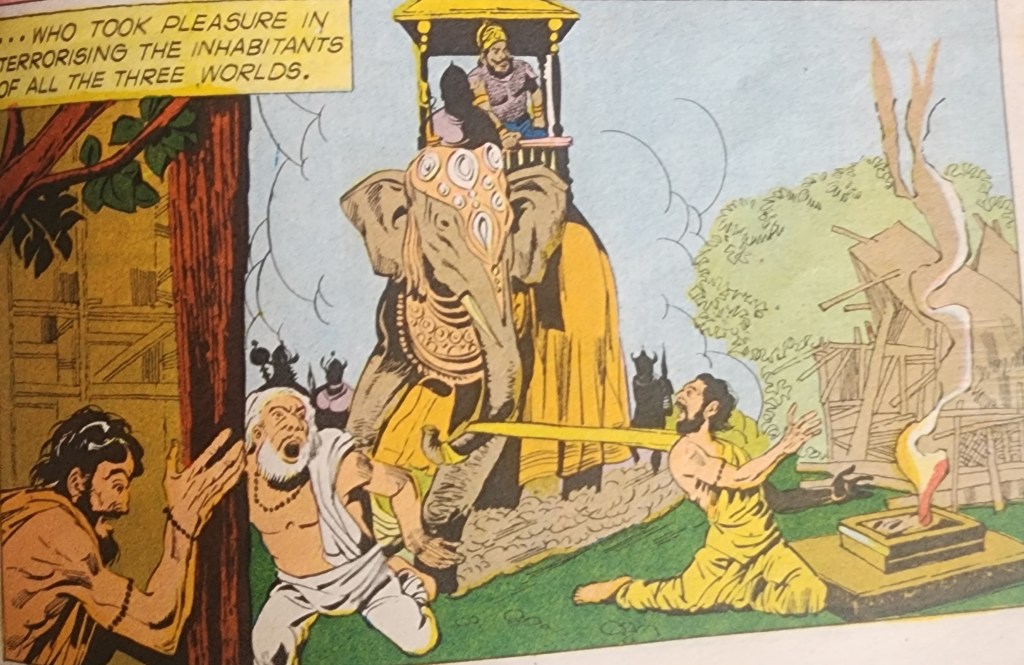
From the stories that I have heard, Narakāsura was the son of Bhoomi Devi and Lord Varāha (the boar incarnation of Lord Vishnu). Due to his parentage, he was a formidable warrior and a great ruler. But arrogance got the better of him and he became a terror not just to the Devas but also to other denizens of the lands he controlled, conquered, or raided.
Narakāsura was far too powerful to be defeated by any of his contemporaries, be they kings or warriors. He was a contemporary of the people and events of the Mahabharata. It might just be that the geopolitics of the time simply did not allow anyone the leeway to focus on the threat that he posed. Hence, it fell to Lord Krishna to nullify the havoc he was causing. Naraka had imprisoned sixteen thousand one hundred women++, as war booty from his raids and conquests. This atrocity alone required that he be eliminated.
Credits for the images – “Krishna and Narakasura” published by Amar Chitra Katha
Krishna, along with the Yādavas was living in Dwaraka at this time. This means that the kingdoms of Krishna and Naraka were on extreme sides of the subcontinent. Perhaps this meant that an attack on Naraka’s kingdom was difficult logistically, considering the other mighty kingdoms that lay between them, some of which were not friendly with Dwaraka. If Naraka’s kingdom is considered to be in the east, Magadha, ruled by Jarasandha lay in the way; and Jarasandha was no friend to either Krishna or the Yādavas. If Pragjyotisha is considered to be in the far north, the kingdom of Sālva lay in the way, and he was an enemy of Dwaraka as well.
So, Krishna carried out an aerial attack on Narakāsura, with the objective of not defeating the military of Pragjyotisha, but of only killing Naraka. Narakāsura was the problem, not his kingdom. Krishna flew to Pragjyotisha on Garuda, the mount of Lord Vishnu and killed Narakāsura. The presence of Garuda, one of the mightiest beings in Hindu culture, not only allowed Krishna to go over the walls of the city and palace of Naraka, but also gave him the advantage of height, not to mention the skills, abilities and sheer power of Garuda in protecting him.
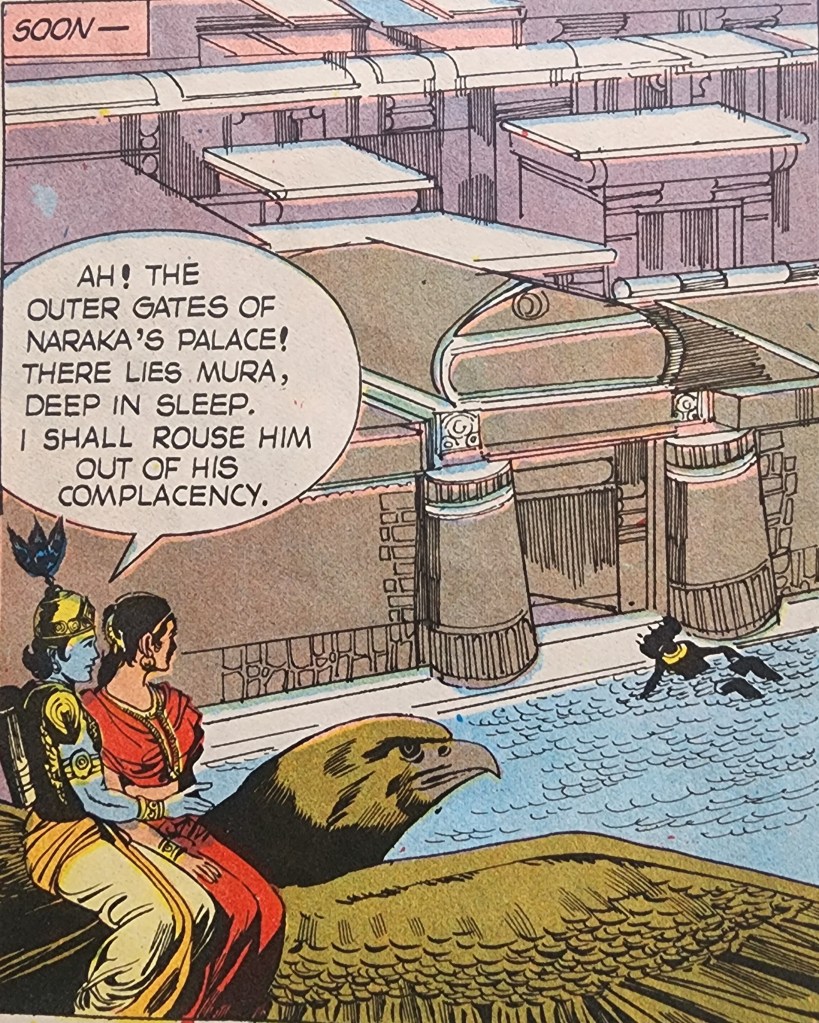
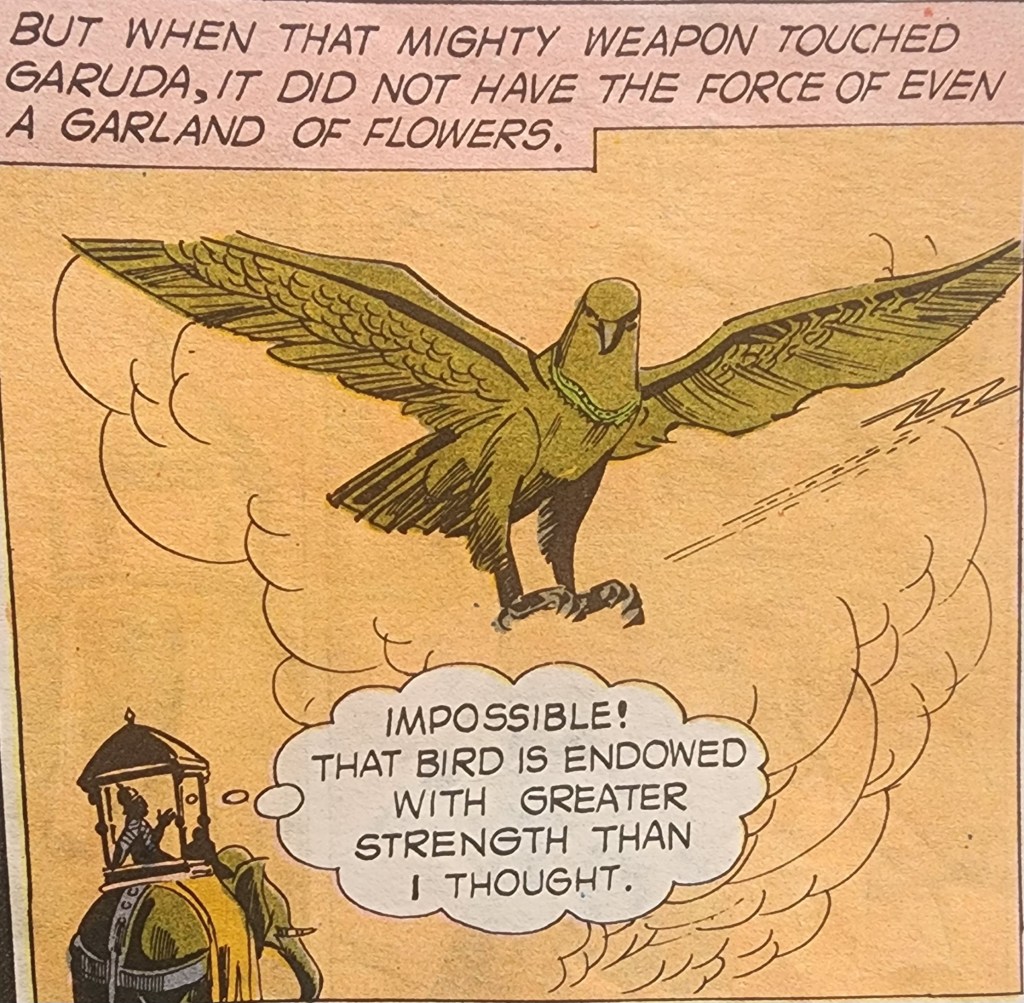
Credits for the images – “Krishna and Narakasura” published by Amar Chitra Katha
The story I have read also mentions that Krishna took his wife Satyabhama along with him during this assault. I am not aware of the exact role that she played during this episode, based on my limited reading. Her role varies from actively fighting alongside Krishna to being a passenger during the attack, who was taken along as she was not happy that Krishna could not spend time with her. The latter essentially glorifies Krishna by showing him to be multitasking, spending quality time with his wife while taking on several dangerous foes! Yes, this rendition does not make everyone happy, with our modern-day value systems. But this aspect is not relevant to this article.
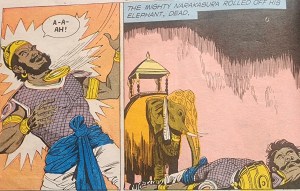
Krishna, in what is essentially a special forces raid on the palace of Narakāsura, killed the man responsible for several crimes. The day on which Krishna defeated Narakāsura is celebrated as the festival of “Naraka Chaturdashi”, which falls on one of the days of Deepavali. Krishna later handed over the reins of the kingdom to Naraka’s son Bhagadatta, who, along with his grandmother Bhoomi Devi, ruled the kingdom well. This is the same Bhagadatta who fought in the Kurukshetra war on the side of the Kauravas.
Bhagadatta commanded the greatest elephant army at that time and his personal war elephant, Supratika, was supposed to be a very large animal and extremely effective in battle. He was also a devout bhakta (ardent/devotee) of Lord Vishnu, due to which he possessed the Vaishnavāstra. This was a weapon he used against Arjuna during their fight. Krishna had to intervene to save Arjuna, by letting the missile strike him instead of the intended target. This is an incident I have described in my previous article discussing Sakkijutsu and Charioteers2. In the end, Bhagadatta, like almost all the warriors who fought at Kurukshetra, died during the war.
King Bali, or Mahabali as he is sometimes referred to, was the grandson of Parhlad, who was the son of Hiranyakashipu. Hiranyakashipu was the Asura king who was slain by Lord Narasimha (the fourth incarnation or avatar of Lord Vishnu, according to the Dashāvatara (10 avataras)). Bali, like his grandfather was also a wise, righteous, and great ruler. He was also great bhakta of Lord Vishnu, like his grandfather. His father Virochana was originally a friend of Indra’s (Indra, the king of the Devas). But Virochana was eventually killed by Indra through deceit. There are multiple variations regarding the death of Virochana and the role played by Indra in the same. I am not going into the details of these. But the fact that Indra had a part to play in the death of Bali’s father is relevant, as it gives Bali a motive to work against Indra.
Bali went on to perform several Yajnas. He performed the Vishwajit Yajna, which gave him armour and equipment which was impossible to overcome. With this protection, Bali defeated the Devas and conquered Amarāvati, Indra’s capital. Later, he was on the verge of performing his 100th Ashwamedha Yajna. The successful completion of this Yajna would consecrate him as the new Indra and he could unseat the current holder of the title (son of Aditi, Indra, after whom the title itself is named). By achieving this Bali would have overthrown his father’s killer, but without having to resort to any further violence against the Devas. Bali was a rarity in this aspect; many of his kin had used the varas (boons) they had received from Lord Brahma as an advantage to then use violence against the Devas to unseat them. In Bali’s case, when he had taken over Amarāvati, the Devas ran away, leaving him the city and there was hardly any fighting.

Credits for the image – “Dashavatar” published by Amar Chitra Katha (Kindle edition)
Though Bali would have defeated Indra without violence and Indra was deserving of punishment, this act would mess with the natural order of things, as Indra and the other Devas were also Lokapālas, the guardians of the directions. Their overthrow would mean messing with natural phenomena and lead to a collapse of the ecosystem. Hence, Bali had to be stopped. Moreover, Indra had been punished for his transgressions and been severely weakened as an individual, and had lost the respect he had commanded as the king of the Devas.
In order to stop Bali from completing the Yajna, Lord Vishnu visited the Yajna in his avatar as Vāmana, the short statured Brahmana. He used his knowledge of Bali to get him to stop the yajna. He also did not use any violence against either Bali or any of his fellow Asuras. Vāmana got Bali to promise him land equivalent to three paces of his. Bali readily agreed, despite the warning of his Guru Shukracharya against this. Shukracharya had supposedly identified Vāmana as being more than he small Brahmana, perhaps Lord Vishnu himself. But Bali supposedly was overconfident and did not expect any threat or danger to the yajna.
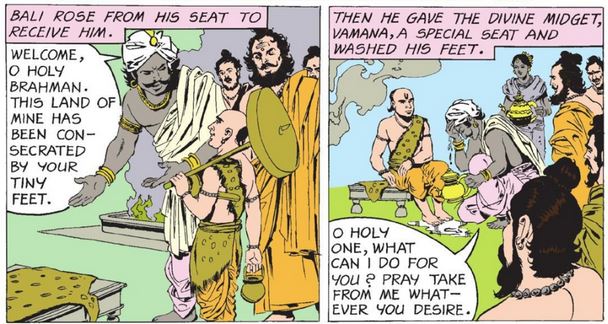
Credits for the image – “Dashavatar” published by Amar Chitra Katha (Kindle edition)
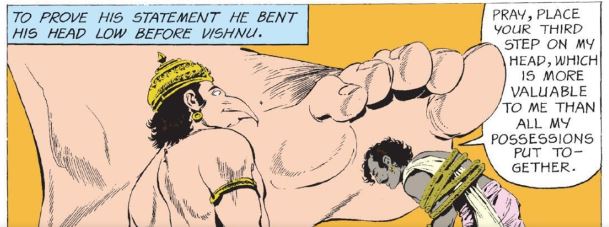
Once Bali agreed to the request, Vāmana grew in size and two steps of his could occupy all of the heavens and the entire Earth. So, there was no space left to take the third step. So, Bali requested Vāmana to place his foot on his own head, as a promise given by a good king should not be broken. This meant that Bali was defeated by Vāmana and could no longer complete the yajna. In this way, Indra’s position was saved. But Bali had done no wrong and was loved by his own people. So, Vāmana blessed Bali with being the one to hold the position of Indra in the next Yuga cycle, after the term of the current Indra was complete. Until then, he would live and rule over the nether world of Pātāla^.
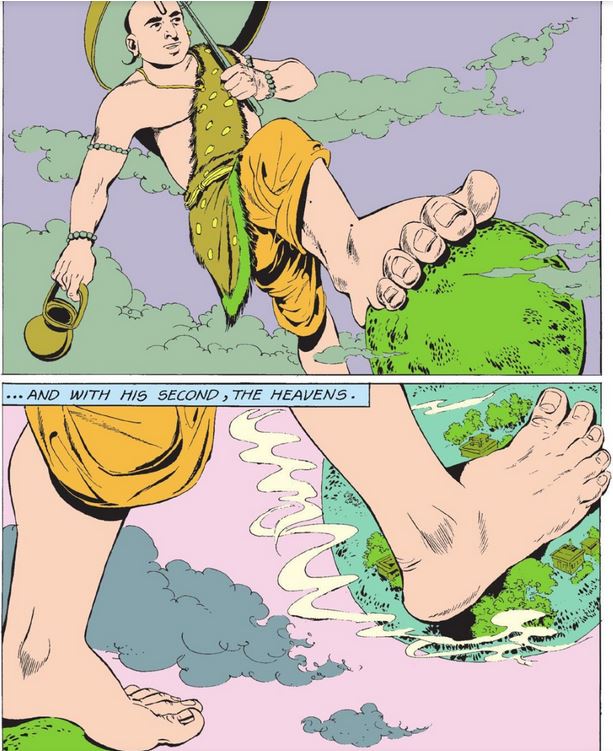
Credits for the image – “Dashavatar” published by Amar Chitra Katha (Kindle edition)
So, while Bali was thwarted in his goal, he was not harmed in any way. His goal would also be met, despite it being deferred to the future. Indra, was punished after a fashion as mentioned earlier. Also, Indra diminished in importance after this episode, adding to the retribution for his misdeeds. The cosmic order was also preserved. In addition to all this, Bali would be visiting his citizens on Earth once every year, as his citizens would miss him greatly. The occasion on which Bali visits his citizens above ground is celebrated as “Bali Padyami”&, on one of the days of Deepavali. The same festival is celebrated approximately a month before Deepavali as the festival “Onam” in Kerala.
If we use modern terminology here, a treaty was signed between Bali and Vāmana, which stated the points mentioned above. Vāmana used deceit to get Bali to negotiate, but that was the only option available, as Bali was too powerful and held all the cards, to need to consider a negotiation. Yes, an avatar of Vishnu could have just killed Bali, like had happened with Hiranyakashipu and his brother Hiranyaksha, and much later with Naraka. But violence against a wronged man (murdered father) who has done nothing wrong (punished the murderer and abstained from violence) is not acceptable. Hence, violence was never an option here. The only way was a means to begin a negotiation.
The manner in which Naraka and Bali before him were defeated, or at least had their objectives thwarted, are completely in contrast to each other. It was a violent conflict in the case of Naraka, while it was a conversation with a mechanism to resolve all issues in the case of Bali. It was literally a case of the sword against Naraka and the pen against Bali. This difference in the manner of approaching the conflict in the two cases, in my opinion, is a reflection of the concept of “Kannin dokuson”.
I have mentioned in earlier articles that in the Bujinkan system of martial arts, Soke Hatsumi Masaaki used to introduce a “theme of the year”. This concept was something that would be integrated into the training during that year, so as to enhance the learning and experience of practitioners. The theme for the year 2017 was “Kannin Dokuson”. This phrase, in Japanese, refers to “mutual respect” or to “always develop respect towards everything”. My teacher, Daishihan Shiva Subramanian, put it thus in one of our classes, “respect for yourself, respect for the opponent, respect for the space in-between”. In my opinion, it means that one should always show respect to everything in one’s surrounding, including opponent(s) and also to oneself. Of course, this conversation is more important in the context of a conflict, even if it is not physical. Chances of kannin dokuson needing a reinforcement in a non-conflict scenario is definitely lower.
The concept sounds prosaic, but really is very simple and is practiced by most of us in our daily lives, even in conflict situations. The idea when introduced with a name from a language that is foreign to most of us, just ensures that we appreciate it better and reduces the chances that we might, in rare instances, forget the same. Consider a situation where one has a disagreement with a client, or a colleague or a close relative. Consider further that the same disagreement is present with two different people. The manner in which one will handle this conflict with the two people need not be the same. In fact, we will definitely change the way we handle the two situations.
Depending on the other person, her or his age, gender, attitude, body language, tone of voice, life experience, access to money and other resources, family background, societal and professional networks, past experience with that person, and maybe many other factors affect the manner in which we handle the disagreement with that person. Of course, one’s own life and experiences, including the parameters mentioned above will also have a bearing on the management of the conflict. The tone of voice, the subtle signs of aggression, body language, choice of words – these and much more will vary across different people, even if the disagreement/conflict is the same.
To expound on this further, imagine a parent has to express displeasure with a child and with a sibling of similar age. If the child is young, the parent can choose to be strongly assertive with the child (assuming it is not a teenager who will be angered). This is because the child is dependent on the parent completely and cannot do anything to retaliate. This is commonly termed as “taking someone for granted”, the child in this case. However, the same level of assertiveness cannot be used with the sibling, who is an adult, as the potential for negative consequences are much larger due to the sibling’s abilities. Assertiveness might not be possible at all, irrespective of how one feels about the situation. The negative consequences here range from a disruption of the existing relationship, emotional pain and in the rare and unfortunate case, physical violence.
Based on the above observations, one needs to know the context of the conflict being managed. To know the context, one needs to be aware of a lot of things, from the individuals involved and their stakes, details about the individuals like were mentioned above, the antecedents of the issue at hand and the stakes for all those involved. All of this can also be paraphrased as “mindfulness” as well, instead of the simpler term “awareness”. This again is not rocket-science. All if us do this to varying extents in daily life with various people.
Being aware or mindful of the context of a conflict leads us to be respectful of the situation as a whole. This includes respect for the opponent(s), the self and for the surroundings (space included). “Respect” here does not mean placing the situation or the other person on a pedestal; it does not even mean that the other person(s) should be treated as betters or even equals. It just means that our awareness/mindfulness informs us of the best course of action to take, or at least to consider, in a given situation. The best course of action could be, being nice in the negotiation, running away or delaying the handling of the situation or putting off the negotiation with any reasons possible. It could even mean being ready for and doing violence as required. One doles out the “respect” that is deserved, as the situation requires.$
Once we accept that the same situation in two different contexts call for different approaches to the solution, even if the end result expected is the same, the stories become clearer. Consider the cases with Bali and Narakāsura we looked at above. In both cases, Indra had been driven out of Amaravati (Indra’s capital). In both cases, the aggressor were Asuras. In both cases, the desired result is to get the Asuras to vacate Amaravati and reinstall Indra there, so that the ecosystem is not affected. So, the problem and the required outcome are the same in both cases.
The nuances, or the “context” in both cases is vastly different. Bali is a wise and righteous ruler. Perhaps he is also justified in his need to punish Indra, who was responsible for the death of his father. Bali was loved by his citizens and was not prone to violence against anyone unless necessary. He was not a tyrant and a bhakta of Lord Vishnu.
Narakāsura on the other hand, was an absolute tyrant. He reveled in violence, and everyone lived in dread of his raids. He had captured women as war booty. He stole the resources of others and had no inclination to stop his disruptive ways. He was not righteous despite his parentage, and affected the livelihoods of everyone.
Considering the difference as seen above, Bali, owing to his character and likely motivations, deserves respect in the conventional manner we understand today. Negotiation deserves a chance in the resolution of the conflict with him, for he is a reasonable man. However, Naraka deserves the respect of being treated as a warrior who should be responded to with violence. Thus, in both cases, the Asura leaders are treated with respect, it is just that the respect they deserve is different.
There is one other obvious similarity between the defeat of both Bali and Narakāsura, apart from showing them both the respect they deserve. This is the use of “deception” against the two Asurās. With Bali, deception was used to get the opportunity to initiate a negotiation. With Naraka deception was used to enable an attack against his palace without the need of an army.
Bali was too powerful and had no need to discuss anything with Vāmana. Bali was a monarch bound by rules of conduct towards Brahmanas. Hence, when one came with a request during the performance of a yajna, he could not deny him an audience. Also, Bali was too proud and righteous to go back on his word once it was given, irrespective of the outcome. The deception used here was the true scale and abilities of Vāmana. The small built Brahmana took advantage of his small stature to make Bali think that his request of land was a small one. When he changed his stature to that of a vast being, Bali had no choice but to capitulate. The deception was the invisibility of the true scale of Vāmana.
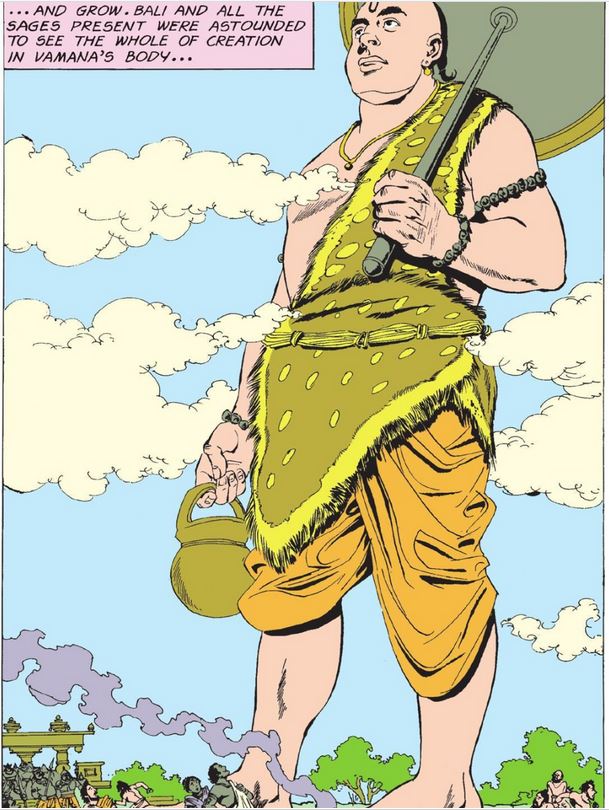
Credits for the image – “Dashavatar” published by Amar Chitra Katha (Kindle edition)
If Lord Vishnu had not been in the guise of a Brahmana, he would not have been granted an audience with Bali in the first place. And if the promise by Bali had not been elicited before the true scale of Vāmana was revealed, the likelihood of violence to achieve the final outcome was very high. Bali’s warriors wanted to attack Vāmana, but Bali held them back, as he was beholden to his promise. So, Indra was restored to his position without any violence. And Bali, for this impeccable conduct was rewarded as well. This whole episode is perhaps the perfect outcome of the use of deception, which is, many a time, to limit damage.
Narakāsura was incredibly powerful, and his army was feared as they had caused havoc against several opponents. So, getting past his army was a challenge and would take time, effort and resources. It would also definitely result in considerable loss of life and resources. To eliminate all of these, Krishna would attack Naraka by himself. He would also bypass the army and target Naraka directly. Of course, Krishna would have to go past Narakāsura’s personal guards and household troops when his palace was attacked, and this is what happened. In order to bypass the army and minimize the forces Krishna would have to get past to kill Naraka, he chose to take the aerial route3. He attacked with Garuda. This was the deception used. Krishna took a fast aerial route, surprised Naraka and defeated the enemy at night. This is perhaps a special forces operation by modern day standards.
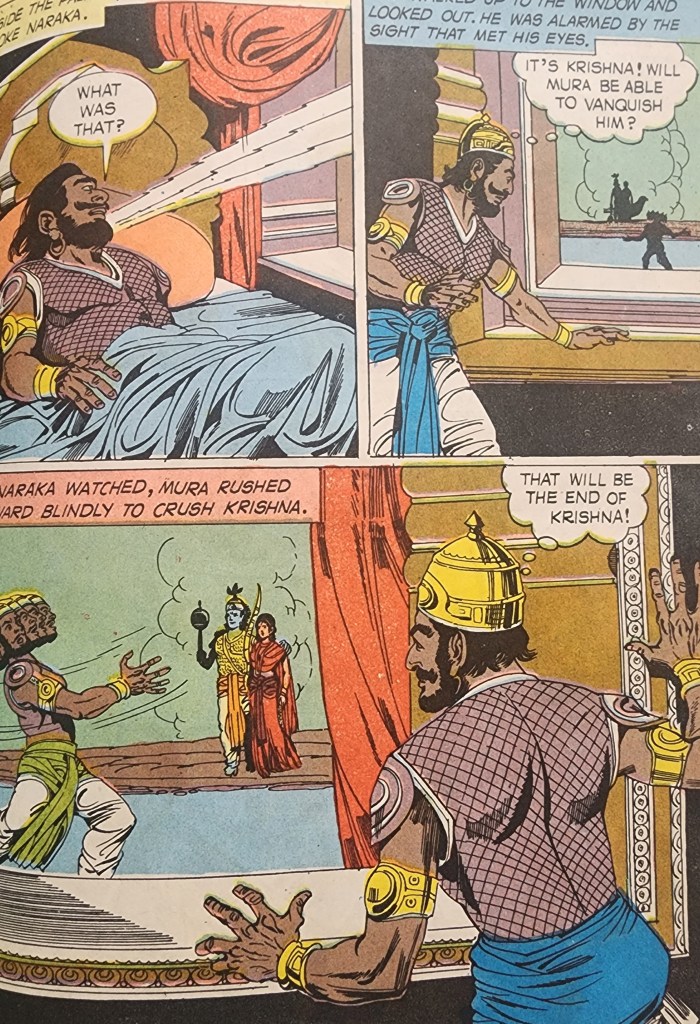
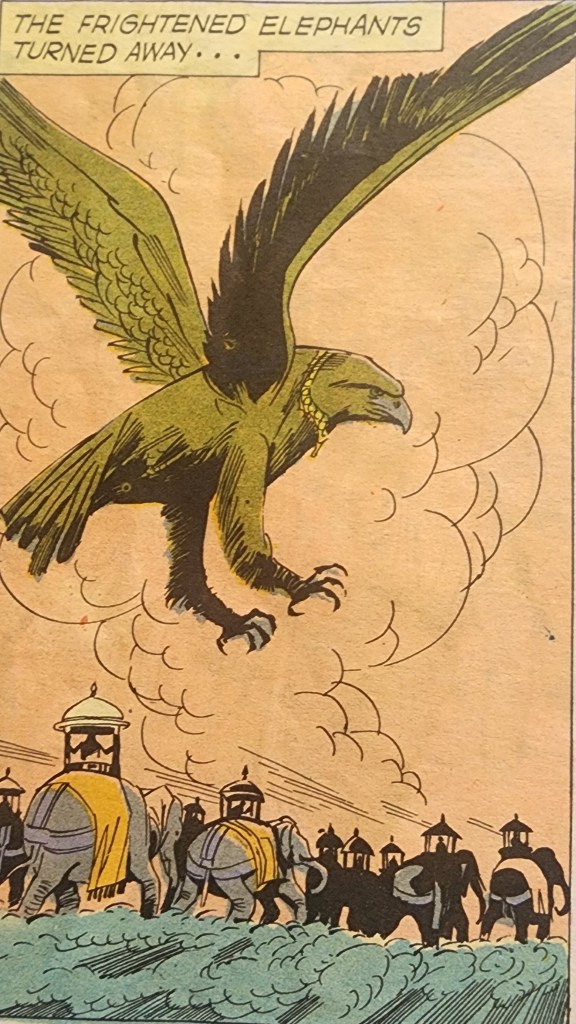
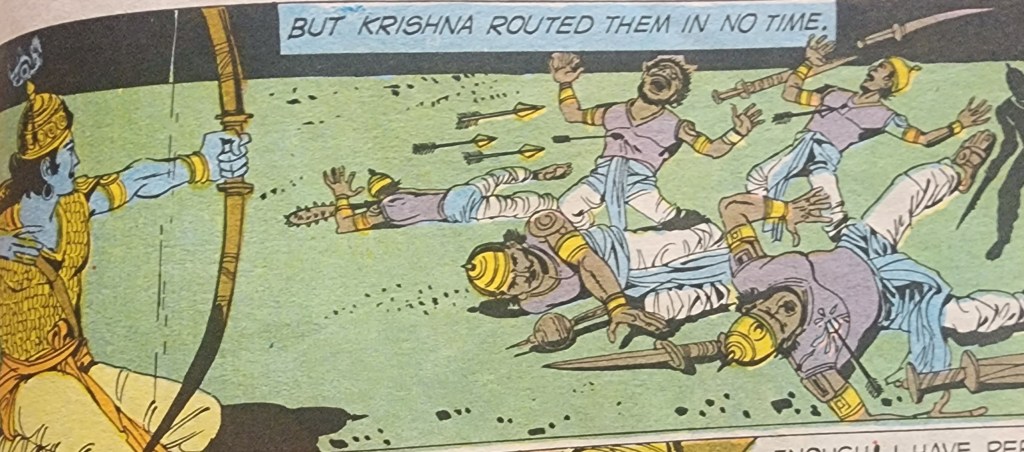
Credits for the images – “Krishna and Narakasura” published by Amar Chitra Katha
This notion is using deception in a conflict is very important in the Bujinkan system as well. The theme of the year, for the year 2006 was “Menkyo Kaiden”. The term Menkyo Kaiden is commonly used to denote “a license to further develop or teach” a specific art form or system. This could specifically refer to a license to, “using the concepts of martial arts for healing”, “the ways of the tachi” and many others. This license is in addition to the usual dan ranks and title in the Bujinkan. It is given out to individuals who have achieved a lot of learning and gained experience in a specific aspect of the martial art form.
But the term “Menkyo Kaiden” when it was used as the theme of the year, as far as I have understood, does not refer to this commonly used connotation. It is closer in usage to the phrase, “Kyokitsu Tenkan Ho”. Both of these refer to the use of deception. Both of these of course, are phrases from Japanese. Based on my discussion with my teacher and buyu, these phrases mean the following.
“Menkyo Kaiden” refers to “transmission of information to cause the mind to perceive falsehoods”. This means that we use martial ability and movement to make the opponent(s) not perceive the real intent of the movement, but to be confused into thinking something else might be done. This mistake of perception will hopefully lead to an opening or lapse on the part of the opponent that can be exploited. The initial movement is the transmission of information in this case. It is not unlike a punch which is a feint, but leads to a kick or any other attack. It can also be a cut with a sword that is short of the target and leads to a thrust, while the opponent was busy blocking the cut that was never there.
“Kyojitsu tankan ho” refers to “the way of alternating between truth and falsehoods like the swiveling of a door”. This is about combining feints and attacks in a way that leaves the opponent(s) bewildered, because they are never sure if an attack is real or not and if they should defend against it or not. This confusion is hopefully exploited to their detriment. Maybe this concept is something that extends to fake armies (like the Third Army in WW2) or a feigned retreat in the warfare of the past (used a lot by the cavalries of the Turkic peoples).
Based on the above two paragraphs, the two phrases mean roughly the same thing. They both emphasize the importance of deception. And this is the concept highlighted by two of the festivals during Deepavali as well!
Deception is venerated to a point that a mentor of mine in the Bujinkan says this. One needs to move in a manner where he or she is not sure of what will be done next. In a situation where the opponent is also experienced and can get a sense of what one is going to do next, he or she can move or change accordingly. However, if one is unsure of what to do, how can an opponent predict the same? And if the opponent senses the lack of decision, will that awareness lead to confusion by itself? This situation is perhaps the epitome of deception, but very hard to pull off, especially as a team.
The outcome of deception in the two cases we are considering are vastly different. In one case, lives were taken and in the other, lives were saved. So, deception is as much a weapon as any other. In the Bujinkan system, this is a practiced as the “Katsujiken” (life taking sword) and “Satsujiken” (life giving sword). Here we can consider any weapon instead of a sword. In this case, “deception” fills that role. When we consider the use of weapons, we can consider weapons as tools applied as a means to an end. The tool and how to use the same leads to other interesting concepts, one of which in my opinion relates to how the sword-master Yamaoka Tesshu from the late 19th century devised his school. Yamaoka Tesshu was a teacher and advisor to the then Emperor of Japan. The school he created and developed is called “The way of no sword”. I will delve into these concepts in a future article, which in my opinion relate very strongly with the Dashāvatāra.
Considering that we are discussing Indian and Japanese concepts and that I have shared stories from Hindu culture that have many layers of knowledge and meaning, I will share a couple of apocryphal stories from Japanese history. This is related to the two great Daimyo (Lord) from the Sengoku Jidai (warring states period). These stories are from the middle of the 16th century, roughly between 1525 and 1575.
Takeda Shingen and Uesugi Kenshin were two great Daimyo of this era. They were both great warriors and great strategists. They were both masters of warfare and very difficult to defeat. They fought against each other and there was no conclusive victor. Their tactics are the stuff of legend. The conflict between the two is shown in the movie Japanese movie “Ten Chi” (Heaven and Earth). They both also fought other Daimyo, considering that a lot of battles were being fought during this era, when a unification of Japan was being attempted.
The death of both these Daimyo is also the stuff of legend and these are the stories I am referring to. Takeda Shingen, along with his forces had besieged the castle of a rival. During the nights of the siege someone in the castle played a flute melodiously. Shingen liked music and came forward to listen and see if the person playing could be identified. When he came forward, a shot rang out and a musket ball killed Shingen. This shot was supposedly fired by a random cook who was serving food to the defenders on the castle ramparts. While a soldier was eating, the cook picked up his gun and randomly fired in the direction of the enemy and got lucky by hitting the Daimyo on the other side!
The story goes that Takeda Shingen had created body doubles to counter assassins. These doubles were “Kage Musha” or shadow warriors. One of these doubles took the place of Shingen after he was killed and continued the war, but he was not as effective, and the Takeda clan eventually lost. This is the story of the Japanese movie of the same name, “Kage Musha”.
Another story suggests that the music was deliberately played, knowing that Shingen liked music and would come forward in the dark. It goes on that the cook who took the shot was a trained ninja who was masquerading as a cook, looking for an opportunity to kill Shingen. And we are back to the concepts of respect and deception in this story. Shingen could not be defeated and the fact that deception was used is the respect he is being shown as a master strategist. He had to be tricked into exposing himself and he was killed from a distance by a sniper, one who was not even supposedly a soldier!
Uesugi Kenshin is accepted to have died of illness. But the story goes that an assassin was hiding in the pit under the toilet and killed Kenshin when he went to use the same. The weapon used is supposed to be a short sword or a short spear. This assassin is also supposed to have been a ninja. Additionally, the assassin is supposed to have been a dwarf or just a very short individual who could hide in the cesspit under the toilet and wait for the victim to arrive.
Here again, we see the concepts of respect and deception in the story. Kenshin was a master at warfare and was forming an alliance against Oda Nobunaga (the first of the 3 unifiers of Japan). He would be very had to beat on the field and hence deception was used. This is him being shown respect as someone who is almost unbeatable. The deception of course is to use a small individual who would kill from hiding.
This last point is perhaps just me reading too much into stories. But I see a parallel in the stories. A small individual killed Uesugi Kenshin in the legend, while Vāmana who defeated Bali was also a person of a short or small stature. Narakāsura was killed by an attack from a height (an aerial attack) and so was Shingen Takeda, who was shot from a height (a castle wall).
With those tales and similarities, I will conclude my observations relating to Deepavali and the martial arts. It is indeed a joy to have the light of the festival illumine the concepts of the martial arts. The tales that we heard and loved as kids continue to hold new learning as adults. :-D
Wish you all a joyous Deepavali! Let there be light..and sound and sparkles and food and celebration.
Notes:
1From the book “Mahabharata Unravelled” by Ami Ganatra. Pragjyotisha is see shown on a contemporary map of India in page 54 of the Kindle edition of the book. The location is based on the description of the geography of Bhārata in the Mahabharata, which occurs as a part of the description of Yudishtira’s Rājasooya Yajna. A link to the book is seen below.
++These sixteen thousand one hundred women after they were rescued were considered the wives of Lord Krishna. Due to their imprisonment, they saw a bleak future even after their rescue. Hence, to ensure that all of them had a good status in society, which is perhaps a good starting point to start a new life, Krishna mentioned that they are to be considered his wives and be shown the same respect. This is how Kirshna came to have 16,108 wives. He had 8 wives he had married. The other 16,100 were the women he rescued from Narakāsura and not women he actually married.
2 https://mundanebudo.com/2023/08/31/shabdavedi-sakkijutsu-and-why-charioteers-are-awesome/
^Different stories have Bali ruling over a different netherworld. There are 7 nether worlds, according to Hindu tradition. These are, from top to bottom, Atala, Vitala, Sutala, Talātala, Mahātala, Rasātala and Pātāla.
&Naraka Chaturdashi – Chaturdashi means fourteen (chatur – 4, dashi – 10, four and ten). It is the 14th day of one of the two fortnights of a lunar month.
&Bali Padyami – Padyami can also be called Prathamā, or “the first”. It is the first day of one of the two fortnights of a lunar month.
&The dates for both these festivals and Deepavali itself is determined based on the Lunar calendar.
$There is a story in the Mahabharata where a wise man named Kanika explains this concept to Dritharashtra through a story. I will explore this in more detail in a future article.
3Narakāsura had captured several of Indra’s elephants when he had sacked Amarāvati, Indra’s capital. These elephants were the descendants of Airavata, Indra’s elephant. Airavata was a magical being; a white elephant with 4 tusks, larger and more powerful than ordinary elephants. Airavata was also supposedly capable of flight. Yes, this is fantasy 😊. But the story of Krishna using Garuda to attack Naraka makes even more sense with this little detail. If any of Airavata’s elephant descendants were also capable of flight, the only way to counter this advantage of Naraka’s was to use Garuda, who was the master of all things flight/aerial.


Very nice analysis .The Japanese analogy show the commonality of culture and thinking
LikeLike
[…] Deepavali – Light on the Martial Arts […]
LikeLike
[…] Deepavali – Light on the Martial Arts […]
LikeLike
[…] Deepavali – Light on the Martial Arts […]
LikeLike