Exactly a month ago, we celebrated the festival of Makara Sankranti. This is when the Sun transits into Capricorn. This is celebrated every year in January and doubles up as a harvest festival in India. This festival is known by different names in different parts of the country, Pongal, Magh Bihu, Lohri and Sankranti being a few. One important aspect of Sankranti is the use of sesame seeds. Sesame seeds along with jaggery, dry coconut (kobri), groundnut (peanut) and few other optional ingredients are shared as a mixture. This is a mixture specific to this festival alone. The mixture, in Kannada, is called “Yellu Bella”, sometimes spelled “Ellu Bella”. “Ellu” or “Yellu” is the sesame seeds and the “Bella” is the jaggery. Sesame in Hindi is called “Til”. The word “Til” is used in a famous story relating to Tenali Rama and that is the inspiration for this article. The inauguration of the Ram Mandir in Ayodhya took up the spot I was supposed to post this article on and hence this comes a month later. 🙂
Anyone who practices any martial art in modern times would have used various social media platforms to watch practitioners of either the same or other martial art styles express their version/vision of the same. This leads to learning and the formation of opinions regarding the practitioners or the martial art style being demonstrated, irrespective of whether it is solo practice/performance or a sparring/training session or a competition.
The formation of opinions obviously leads to discussions and debates about the strengths/advantages and weaknesses/disadvantages of the different various systems of martial arts or aspects of the same. This inevitably leads to discussing the history, traditions and development of individual fighting arts. This is a stepping stone to talking about modern interpretations of the martial arts and the requirements there in. This means that practitioners discuss what martial arts offer in modern day living – “self-defence”, fitness, sports, spiritual development, personal growth etc.
All of this leads to opinions on “what works” and that means identifying specific situations and modern cultural contexts in which they are relevant. This entire process quite a few times leads to, “Which is the best martial art?”, “Which is the best martial art for me?” and of course, “Why this is not good enough or why this no longer works”. The focus on the first of these questions seems to be diminishing of late, and thankfully so.
One can call the discussions and debates about the various martial arts arguments, for they could become acrimonious at times. This aspect extends to both armed and unarmed (and armoured and unarmoured) martial arts. The great advantage of these discussions is that the martial arts are becoming more popular. Finer aspects of several of these art forms are brought to the fore in the discussions and the audience for these is made aware of the same. So, hopefully, more art forms and traditions will flourish thanks to the debates.
With the phenomenon that Mixed Martial Arts (MMA) has become, thanks to the various franchises like UFC, ONE, Cage Fighter, Bellator and the rest, the debate over “best martial art” and “what really works” is common place on social media platforms. This discussion extends, specifically while discussing historical/traditional martial arts, to which sword type or any other weapon is better in a given time frame and situation. Discussions also extend to armour, but to a lesser extent. The most common talking point is with respect to the use of any martial art in self-defence.
Videos are the medium best suited to demonstrating and discussing martial arts and hence they are most prevalent on YouTube. Instagram, as I see it, is more suited for demonstrations. Some YouTube channels that I know of, that not only share martial art related information but also discuss martial art effectiveness (the questions mentioned above) are Martial Arts Journey with Rokas, Hard2Hurt, English Martial Arts, Karate TV, Inside Fighting, Jesse Enkamp and of course, the podcast (and its snippets) by Joe Rogan, to mention just a few.
Some channels that focus on armed martial arts are Scholagaldiatoria, Shadiversity, Skallagrim, Sanatan Shastra Vidya, Musha Shugyo, Weaponism and Let’s Ask Shogo/Seki Sensei. There are several others that I have watched from time to time and are very good as well. There are channels that focus on historical Japanese, Filipino, Indian, Chinese, Korean, Iranian (HIMA), African (HAMA) and European (HEMA) martial arts. There are also several channels that focus on modern day practices that include or focus exclusively on firearms. Discussions here include the effectiveness, modern day practicality and various other aspects. Consequently disagreements abound on quite a few of these channels.
I do not use the word “disagreements” in a negative sense here. Whether or not one agrees with the opinions and knowledge shared on these channels, they definitely further awareness about and interest regarding the martial arts and this is a great thing. But of course, disagreements lead to debate and discussions. This is the point of focus of this article.
Debates over the martial arts are nothing new. At least the need to identify if the style one practices is effective or if one is a good martial artist is not new. It has always existed. This is where the “Dojo Challenge” comes from. This is where the duels of Miyamoto Musashi come from. It is also, in the Indian context where the concept of a “court wrestler”* comes from. These “court wrestlers” were responsible for taking on challenges by wrestlers or fighters from within and without the country, in the latter case to protect the king or kingdom’s honour and show that the society in question can produce great fighters.
The concept of debates in India extends beyond the martial arts to settling differences related to philosophy, religion and perhaps many other aspects as well. From here on I will swivel between martial arts and other aspects while discussing the use of debates and discussion in the Indian context.
India over the millennia has a hoary tradition of having debates over various aspects of life. These are heard to this day as stories and many of them are well and truly historical, even if the finer points might not be totally accurate. These debates have, on occasion, led to massive socio-cultural and political changes in the landscape of Indian history. This love for debate, discussion and argument persists to this day in the modern Indian republic. Just have a look at the various forms to media to get an inkling of this&.
Seen below are some examples of some of these well-known debates/discussions from Indian history that I am aware of.
- The Rishika Gārgi is supposed to have been instrumental in determining that the Rishi Yajnyavalkya was a great intellectual who could not be defeated in a debate based on her questioning of the latter, in the court of Janaka in Mithila. A link to the video describing the same is seen below. Watch between the 2 and 4 minute mark.
- The discussion between the Indo-Greek king Menander I (Milinda) and the Buddhist monk Nāgasena is recorded in the ancient book “Milindapanha”. The king is supposed to have become a patron of Buddhism post this discussion.
- The individual Ugra Tāpas lost a debate with a Buddhist Bhikshu and became a Bhikshu himself, with the name “Nava Bhikshu”. This person, is supposed to have later impressed the emperor Kanishka to become an ardent supporter of Buddhism with his expositions on the same. He earned the name Ashva Ghosha after this as his way with words was supposed to be able to mesmerize even horses. Seen below is a link to a video about governance during the Kushan era. Parts of this episode deal with the story of Ashva Ghosha.
- Shankarācharya’s debate with Mandana Mishra where the latter’s wife was the judge is very well known. The debate as I recall was about the merits of the Karma mārga and the Jnana mārga. Shankarāchārya won the debate and Mandana Mishra became the disciple of the former. He even became his successor with the name Sureshwarāchārya at the Sringeri Mattha.
- The debates of Rāmānujāchārya at the court of King Vishnuvardhana of the Hoysala dynasty is supposed to have convinced the king himself and several of the citizenry to convert from the practice of Jainism to that of Vaishnavism.
This practice of debates continued over the centuries. This is seen from the stories we hear as kids, specifically those of Tenāli Ramakrishna, Birbal and Gopal Bhand (of Krishna Nagar). One such story which I describe briefly is the inspiration behind this article. It appears that the courts of kingdoms had scholars, wrestlers, artists and other luminaries who added to the prestige of the court, king and kingdom. Scholars, wrestlers and artists apparently travelled around various courts to display their abilities, maybe challenge “court specialists” in their respective areas and earn awards or commissions for their achievements. Perhaps this was a way of living for at least a few.
The story goes that a scholar once came to the court of the king Krishnadevarāya of the Vijayanagara kingdom in the early 16th century. He set out a challenge for the scholars at court to debate with him over any scripture and win. He was extremely capable and everyone at court was sure they could not get the better of this individual. At this juncture, the Pandit Ramakrishna from Tenāli (in modern day Andhra Pradesh) took up the challenge and succeeded in defeating the traveling scholar. Tenāli Rama or Raman of Tenāli, as he is also called quite often is sometimes referred to as the “jester” of the court, but this seems a wrong description. From the little that I know, “Vidushaka” seems the right word.
Ramakrishna came to court on the day of the debate with a large bundle of manuscripts and told the challenger that he would like to begin with a discussion of the scripture called “Tilakāshta Mahisha Bandhana”. He added that this was scripture was a simple one and known to even the cowherds of Vijayanagara. There was in reality no such scripture and this was a ruse to trick the scholar from abroad. It worked and the scholar, having not heard of the scripture, thought he was outmatched, accepted defeat and left.
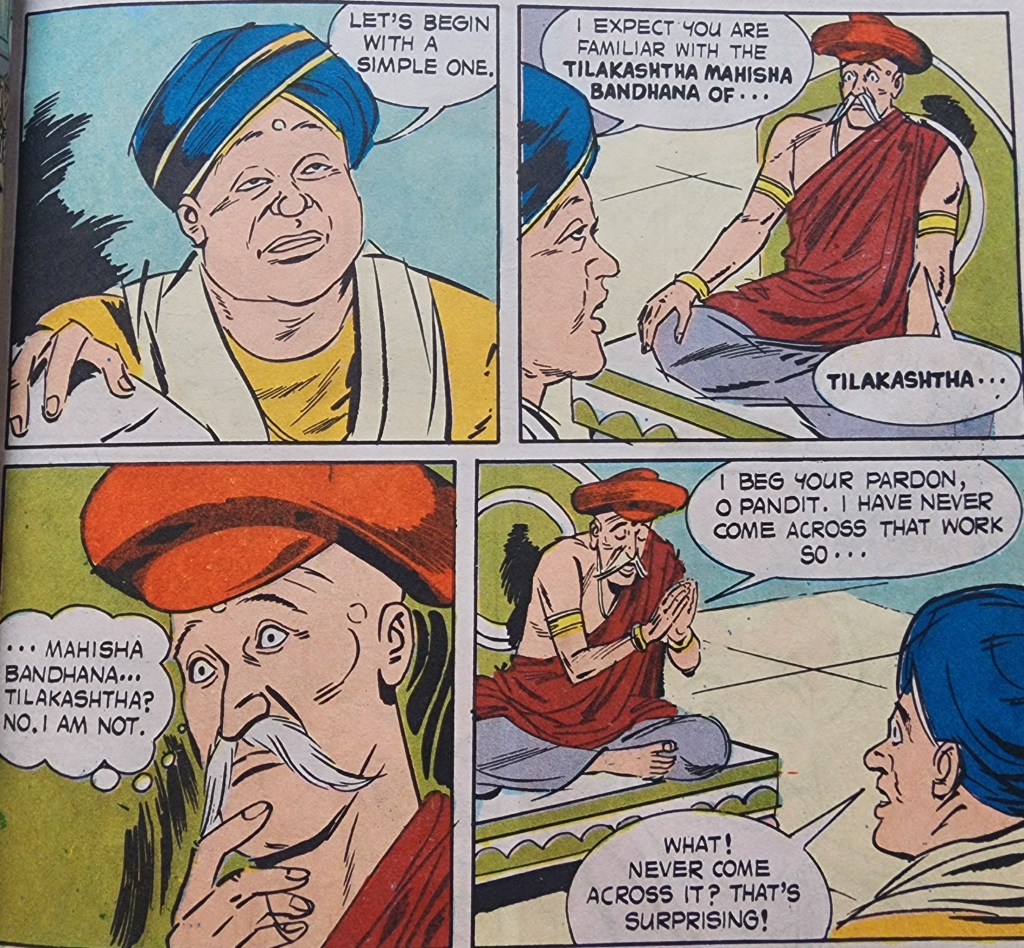
Image credit – “Raman, The Matchless Wit” published by Amar Chitra Katha in “Tales of Humour”
Thus, the “prestige” of the court was saved and Ramakrishna rewarded, following which the reality of “Tilakāshta Mahisha Bandhana” was revealed. Til is the word used to refer to sesame seeds. Tilakāshta refers to the stalk of the sesame plant. Mahisha means buffalo. Bandhana is a rope or “to tie”. Ramakrishna had tied together stalks of the sesame plant with rope used to tie buffaloes in place. Multiple such bundles were placed in a bag and the scholar mistook these to be manuscripts of scriptures. So, “Tilakāshta Mahisha Bandhana” was nothing but stalks of the sesame plant tied into bundles using rope used to secure buffaloes! TENALI RAMAKRISHNA USED DECEPTION TO WIN A DEBATE!
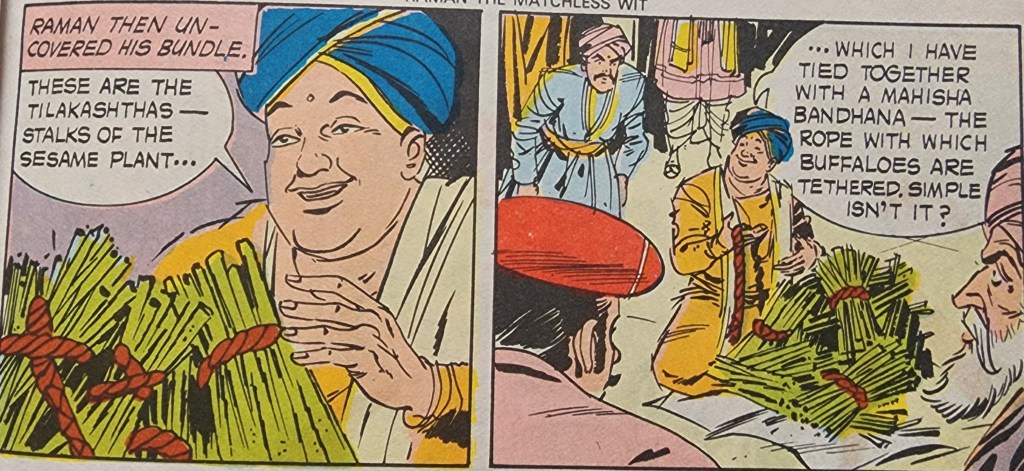
Image credit – “Raman, The Matchless Wit” published by Amar Chitra Katha in “Tales of Humour”
Debates are not restricted to areas where ideas are shared with words, in either the spoken or written format (debates can occur through articles and op-eds). They can occur in spheres where ideas are shared with physical actions. This includes debates over music, dance or of course, the martial arts. A debate about any of these would include both conversations and actual demonstrations of music or dance or the fighting arts.
In the case of the martial arts, demonstrations can transition into an actual duel or confrontation to drive home a point. This aspect of the martial arts lends itself into the tradition of the dojo challenge** or musha shugyo*** (only a part of it). These are situations where a practitioner of a specific martial art form challenges practitioners of the same style or a different one to identify who is a superior martial artist or which is a better art form. This is exactly like a debate where one side of a notion tries to prove its validity over the other.
I will share a few examples about debates in music or dance with examples from pop culture. These situations were written into fiction only because they are well known aspects of Indian culture and hence serve sufficiently as examples to illustrate the debate.
There is sequence in the old Hindi movie “Āmrapāli” (1966) where one dancer has to prove that the performance of another is flawed. She has to do this by performing the correction version. This is a case of a debate over which is the correct dance form. A link to this sequence from the movie is seen below.
There is a Tamil movie “Vanjikottai Vāliban” (1958), which is supposedly based on “The Count of Monte Cristo”. Here two dancers are in contest to determine who is superior. Again, this is nothing other than a duel. The link to this sequence from the movie is seen below. This movie was remade in Hindi and called “Raj Tilak”.
There is another Tamil movie called “Tillana Mohanambal” (1968) where there is a sequence related to a debate/challenge around music. Here, an expert with the Nādaswaram has to demonstrate his ability to perform Western music with an Indian instrument, to establish that his art form is not limited in any way. A link to this sequence is from the movie is seen below (watch specifically beyond the 2:30 mark).
The above three cases are not different from the duels of Miyamoto Musashi. Musashi fought 61 duels and survived (won) all of them. The duels were against martial artists who practiced weapons and styles other than his own. His own style with two swords developed from these experiences. Considering that the life of Musashi and that of his opponent(s) was at stake in quite a few of these duels, he definitely employed aspects other that just physical martial skill in these. This is no different from Tenāli Rama using deception in his debate with “Tilakāshta Mahisha Bandhana”.
Consider Musashi’s most famous duel against Sasaki Kojiro. Kojiro was famed for his use of a very long blade (perhaps a nodachi or odachi?). To counter the reach of his opponent’s weapon Musashi is said to have used a very long bokken (a sword made of wood). He apparently carved this bokken out of a boat oar. He is also supposed to have come very late to the duel, long after the agreed time. This is supposed to have made Kojiro tired and irritated, and perhaps prone to errors due to the same. So, Musashi got the better of his opponent by changing the weapon he used and the timing of the duel to gain an advantage. This is akin to Tenāli Rama bringing a bag full of fake manuscripts.

A statue depicting the duel between Miyamoto Musashi and Sasaki Kojiro in Japan. Image credit – Wikpedia
In another earlier instance Musashi is supposed to have taken on several practitioners of the Yoshioka school of sword fighting. I am not sure if the following tale is historical, but is surely made popular by the Manga based on Musashi’s life. The Yoshioka came in large numbers to kill Musashi in a situation where the fight was supposed to be a duel. So, they chose to deceive him. But, Musashi had arrived much earlier at the agreed location. He attacked without any warning and from hiding before the Yoshioka had any inkling that he was already there. Musashi ended up surviving/winning this fight as well. In this case both sides used deception. Musashi by being early and using stealth and the Yoshioka as mentioned earlier. So, deception is a known feature even in a “martial debate”; perhaps it is something that is to be expected.
Whether or not deception is used in a “martial debate”, it is a healthy aspect that has led to development of the martial arts over centuries. Consider the different styles of Boxing (English and Mexican for example), Wrestling (Greco Roman and Freestyle), BJJ, Jujutsu, Kalari Payatt (Northern & Southern), Karate and the various animal related forms of Wushu (Kung Fu). Also consider the very many styles of sword, spear and other weapon schools that exist in the various parts of the world. Some of these came about as differences of opinion and differing points of view occurred in a given style, even if these were not really a “debate” in a conventional sense. Of course, different schools have merged under a single master as well when some martial lineages did not have an heir to carry it forward.
To extend the dojo challenge to a modern day context, consider the examples where masters in traditional Chinese fighting styles were challenged and defeated by a practitioner of MMA, Xu Xiaodong&&. Xu Xiaodong also supposedly faced flak from the authorities for demeaning the traditions of China. Beyond this, consider the innumerable discussions that happen online about the pros and cons of western and eastern swords, armour and the like. Of course, these started out in a stark adversarial manner but has over the years evolved to a useful exchange of information, knowledge and experience.
The most glaring examples are of how many western content creators (who also have martial arts experience) were deeply involved in debunking the superiority of the katana over western swords. But over the years, similarities with the art forms has also been recognized and a healthy space for experience sharing has emerged. What was once only a debate has transcended to be genuine discussion.
In a non-martial context, debates and discussion have led to great development. This is very well known; consider the 1927 Solvay Conference# as an example, where Quantum Physics as field of study took shape. But the use of deception is debates has been a constant as well. Consider any of the debates in any media platform. All of them use data selectively to further specific points of view and based on personal interpretations. This gets exacerbated since these days we have fake news and more recently, deep fakes. Fake news can be deliberately edited videos to suit a purpose or morphed images and of course, blatant lies with words. These can be used to create a deception or used unwittingly by a debating side, where the deception is perpetuated by dint of being deceived!
The use of deception is not new in the martial arts. Nor are debates about which martial art or martial artist is better. And deception is par for the course in debates that have nothing to with the martial arts either, as we saw earlier. When this is the case, can the use of deception to settle debates about the martial arts be wrong? Unlikely. Especially when these debates lead to actual physical contests, sometimes life and death duels.
There is one aspect about using deception that needs to be considered. This is “luck”. I will explore this in my next post.
Notes:
* I am not an expert on court traditions in different parts of India in the past and do not claim to know for certain of how these positions worked or even if they existed for certain in the various kingdoms that have come and gone in different parts of this ancient land. I am aware of some stories and am going the same.
**Dojo challenge – A situation where a martial artist challenges practitioners in a dojo to a fight to determine if their art form or skill set is as good as or better than her or his own.
***Musha shygyo – Martial journey, or journey of a martial artist (mainly physical over a geography, but could be spiritual or intellectual) which leads to growth and development of the individual’s martial abilities (and also personal development in general).
&& Seen below are links to 2 videos which share the story of Xu Xiaodong and his story
# Seen below is a link to a video which briefly explains the 1927 Solvay Conference and its relation to Quantum Physics
& The practice of debating is thriving in modern India too. It has expanded into television media, social media and print media apart from those that take place in the offices and homes of every citizen. These debates have even incorporated platforms beyond India as a tool to gain an advantage over their “opponents”. I am adding this point in the notes as it is not directly relevant to the article. Consider the opposition to the current central Government in India. There are several critics of the government who either reside or publish mostly in platforms outside India! A few names that come to mind doing this are Suraj Yengde, Kapil Komireddi and Rana Ayyub. On the other side, people who are sometimes critical and quite often supportive of the government are Kushal Mehra, Shambhav Sharma and Sree Iyer. All of them use YouTube effectively, which in reality is not an Indian platform. The conference “Dismantling Global Hindutva” has to take the cake though, for using foreign soil to reach an Indian audience 🙂 . I am not sure this is deception, but certainly seems like a flanking move or some new BVR missile equivalent, in the intellectual sense of course.
 Mundane Budo
Quite a few new concepts and details are discussed. Some new iideas and details are of interest. Thanks
LikeLike
[…] 1 https://mundanebudo.com/2024/02/18/deception-debates-martial-arts-courtly-challenges-tilakashta-mahi… […]
LikeLike
[…] 1 https://mundanebudo.com/2024/02/18/deception-debates-martial-arts-courtly-challenges-tilakashta-mahi… […]
LikeLike