Deep Gratitude before I begin – I am extremely grateful to my parents and two of my maternal cousins for being instrumental in my acquiring the comics and book that are references for this article. These were acquired over many years when I was younger, at a time when books and comics were not readily available like they are today. Thank you so very much!
Also, I must express my thanks to Amar Chitra Katha, the publishers of Tinkle Comics. Without these, my childhood would be unimaginable in hindsight! The publications by Amar Chitra Katha (IBH) were a treasure trove of learning for a kid and a gateway to further reading as an adult.
In my previous article I discussed how deception is a valid and expected part of debates and the martial arts, specifically when it is a duel. Further, when there are debates about the martial arts, deception is likely to be used in those as well. The focus of that article was more on the tradition of debates and duels, and modern day debates (including about the martial arts). The link to the previous article is seen in the notes below1.
In this article, I will delve into how “deception” is an exalted concept which is used to express how wits, intelligence and intellectual capacities are superior to physical abilities. Also, the use of the mind (intelligence) is supposed to always prevail over the use of the body (muscles, strength, speed). In simpler terms, “Deception” is the key ingredient in “Brain over Brawn”.
There are several stories from cultures all over the world which celebrate “Brain over Brawn”. There is one key aspect that all these stories have in common, but is never highlighted. It is the presence of “LUCK”. The protagonist is always lucky though this is never explicitly mentioned. It does not need to be mentioned as the antagonist is usually physically very capable but generally stupid (even if this is not explicitly mentioned). The protagonist is vastly more intelligent compared to the antagonist while being an absolute weakling in terms of physical ability (comparatively speaking).
Let me share examples where brain over brawn is the key. In these stories, “brain over brawn” ONLY means that the opponent is deceived, nothing else.
Consider “The Brave Little Tailor” from the Grimm’s fairy tales. Here, a tailor kills seven flies and claims that he killed “Seven at one stroke”. Gullible people and giants mistake this statement to mean that he is a hero with great physical prowess. He goes on to use his wits to defeat several giants and a boar in tasks that prove him worthy of great reward, a marriage to the princess of the land and half the kingdom. In all these tasks, he talks his way out of situations. None of the giants ever looks too closely at what he is saying or doing. This is really lucky for him as even a little scratch at his statements would have meant that he was going to be crushed to pulp.
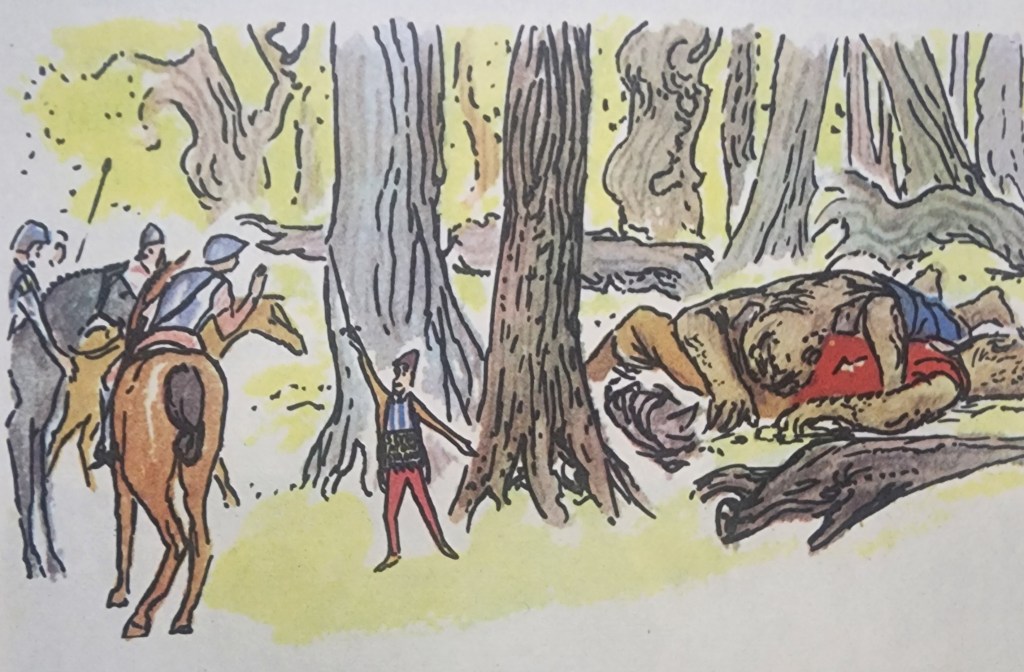

Image credits (L & R) – “The Brave Little Tailor” from “The Beacon Readers Book 6, William Tell”
Consider the Roma folktale “Stefan and the Dragon”. A Dragon which is talkative (as they happen to be!) threatens to eat Stefan, a farmer. The Dragon is supremely powerful and can fly, but of course, is stupid. Stefan outwits the dragon and also gets it give him its gold (dragons always have gold don’t they, with no economics involved). Stefan is supremely lucky, because the Dragon is stupid, for his ideas are simplistic in the extreme and would withstand no scrutiny at all!
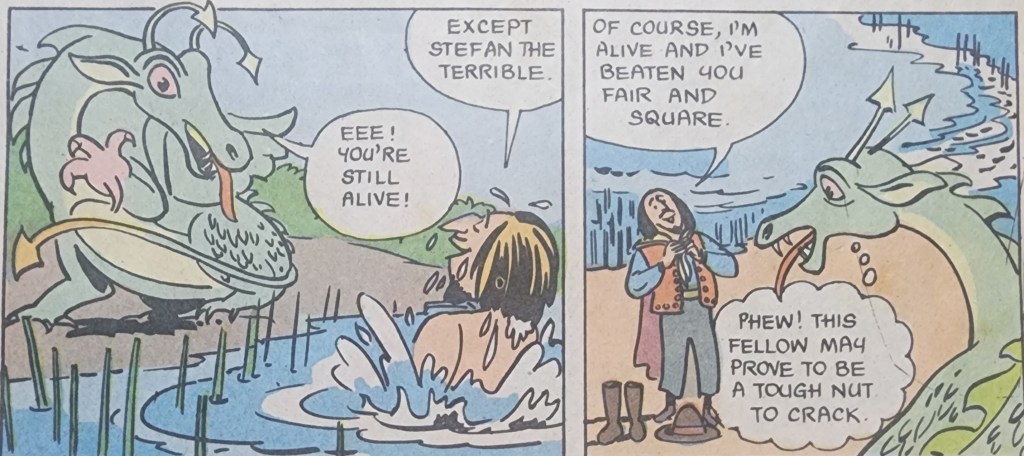
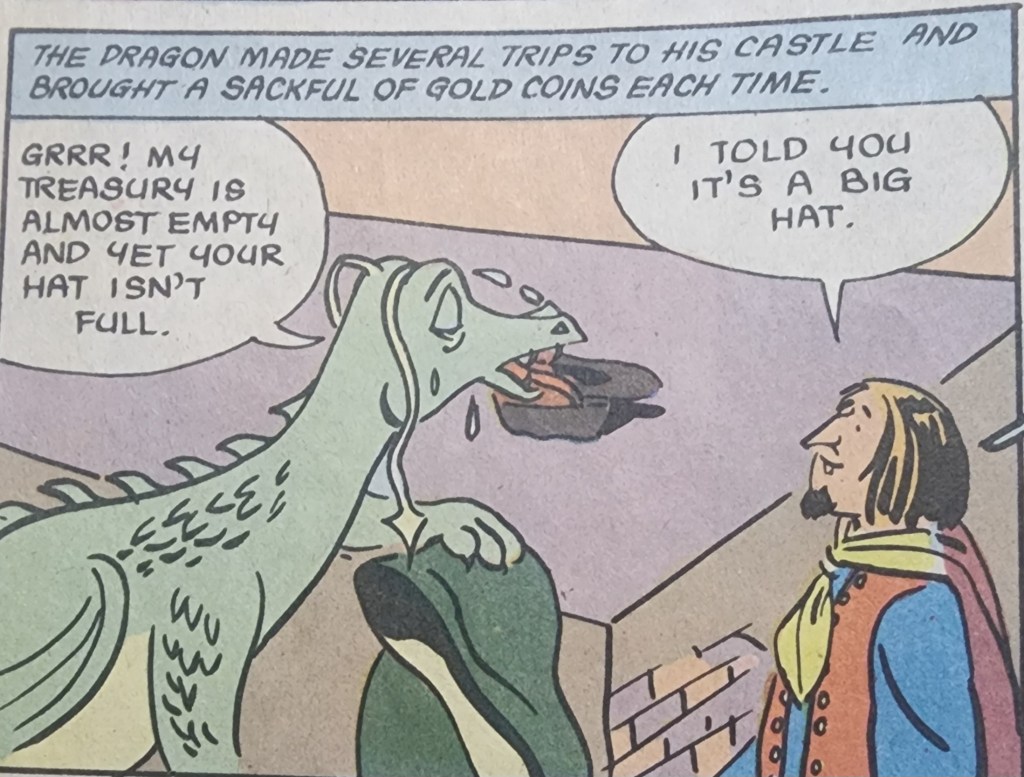
Image credits (Top & Bottom) – “Stefan and the Dragon” from Tinkle Comics 184
Consider a tale of Pandit Ramakrishna of Tenāli in the court of Vijayanagar, more commonly called Tenāli Rama. A story related to Tanāli Rama was the key for the previous article and established deception as a norm. There is another story related to him which involves wrestlers, establishing a link between a debate and a “martial debate”, a duel in other words! :-)
A very strong and capable wrestler challenges the court of King Krishnadevaraya of Vijayanagar to a duel. The court wrestlers are not sure they can prevail over the challenger. So, the honour of king and court are at stake. As usual Pandit Ramakrishna takes up the challenge to defeat the wrestler. There are multiple versions of what he does to win the wrestling challenge. I will share the two I am familiar with. Both involve deception and luck.
Tenāli Rama identifies where the challenger is staying. A day before the duel, at a place near the residence, he sets up a charade. Rama is acting like he is training for the upcoming wrestling duel. But the wrestlers he is practicing with are in on the plan. They enact elaborate displays to show that they are in serious trouble against Rama and defeating them is child’s play for him. This whole act happens at a distance where the wrestler cannot see all the details clearly, but can get an idea of what is happening. Watching this display, he feels he is outmatched and either accepts defeat or runs away before the actual duel with Ramakrishna. Either way, the honour of Vijayanagar is saved. Rama was lucky of course. If the wrestler had stayed despite the act or moved in for a closer inspection, the deception would be rendered useless and Rama would have lost. But his luck held and he won a wrestling match with his wits! This is one version of the story.
In another version, Tenāli Rama challenges the wrestler to a feat of strength on the day of the duel before the wrestling match, to prove his strength. The wrestler accepts. Rama says that since he is supposedly far stronger than Rama is, he should perform with his eyes open what Rama does with his eyes closed (or is it that Rama is so strong that he can perform with his eyes closed what the challenger will need both his eyes for? I cannot recollect). Rama then proceeds to close his eyes and pours sand over the eyelids. :-D He then asks the wrestler to do the same with his eyes open, which of course he cannot do. Thus, Rama wins and it is a case of brain defeating brawn. The wrestler does not think to refuse the challenge to a feat of strength as it was ONLY supposed to a wrestling duel. If he had he might have won, but maybe he was so used to challenges he accepted out of habit. So, it was a case of luck again, albeit considerably less than in the other cases; it could be more about knowing your opponent here.
This version of the story leads us to another story where “feats of strength” are required before a duel. In the story “The Clever Court Jester” (the Jester is always clever and a saviour isn’t he! (I have never heard of a she as a jester)), a Giant threatens to take over a kingdom if he cannot be defeated in a wrestling match. If he is defeated though, he will give a lot of gold to the king (Giants also always have gold, maybe they are the pioneers of protection rackets :-P ). The Jester comes to the kingdom’s rescue as expected. He challenges the Giant to 3 feats of strength and outwits the “stupid” Giant to win the gold.
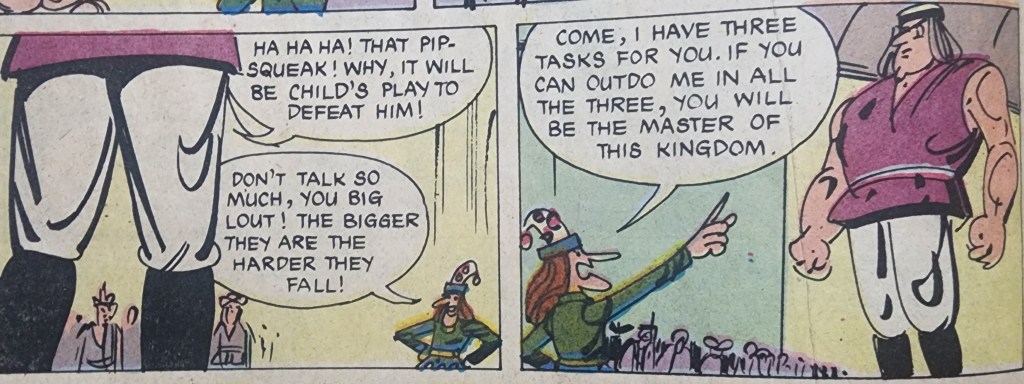
Image credit – “The Clever Court Jester” from Tinkle Comics 176
The Giant then invites the Jester to his home for further challenges. The Jester accepts, outwits the Giant some more, reinforcing the stupidity of the latter and wins even more gold. All through, the Jester is lucky because the Giant is stupid and never looks closely at what is going on. Did the Jester know the Giant was stupid and was this information available to him alone and no one else in the King’s court? We do not know, but it is possible, as everyone but the Jester is worried. We are never told that the Jester knew, so we can safely attribute his victory to deception, aided very heavily by luck.
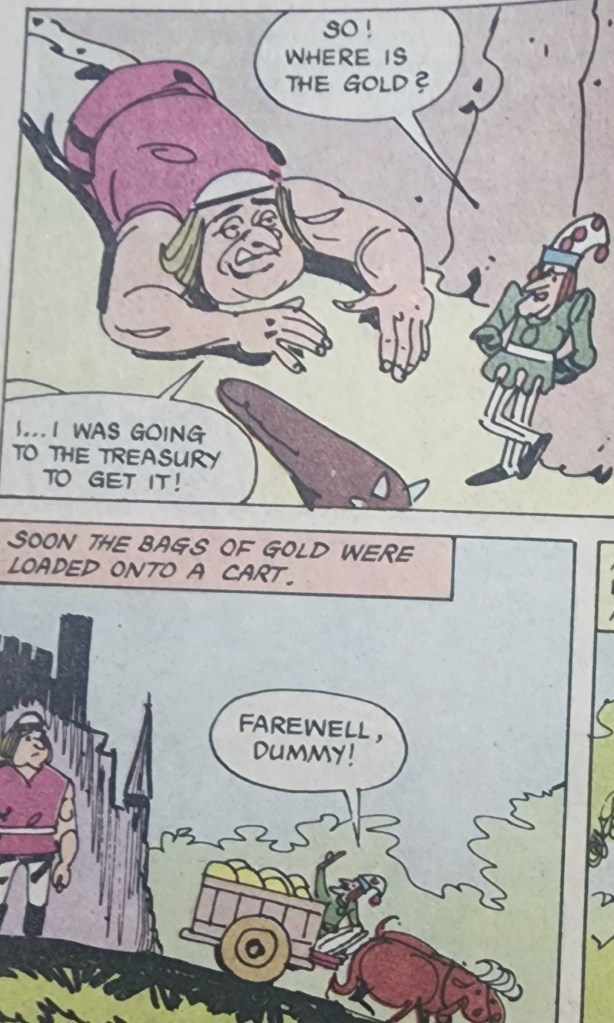
Image credit – “The Clever Court Jester” from Tinkle Comics 176
This same beat relating to a physically stronger opponent being defeated at physical challenges by a weaker individual due to the use of superior intellectual abilities goes on and on and on. I am sharing a host of additional examples below. I am not going into the details of most as the point is already made, but I would recommend reading the stories. They are short and great fun, and instructive in many ways.
In “The Dreadful Guest”, in Russia, a talkative (surprise!) and stupid (surprise surprise!) Dragon gate-crashes the Tsar’s banquet and is defeated by being outwitted (it is told a variant of “look behind you” *eye rolls*). The stupidity of the Dragon is the luck of the dragon slayer Alyosha Popovich.
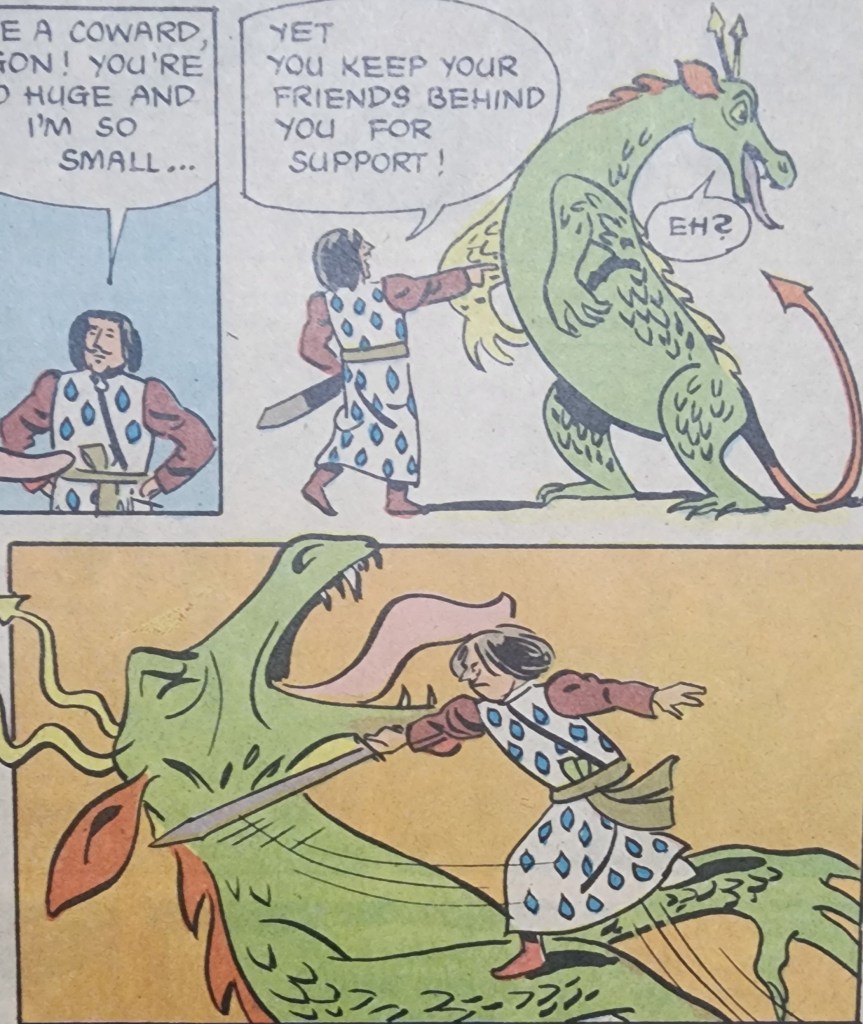
Image credit – “The Dreadful Guest” from Tinkle Comics 178
In “Smudgeface”, a story based on a fairy tale, the protagonist Smudgeface, captures two dangerous animals, a boar and a bull and becomes a minister! Based on the manner in which he captures the animals, which the people and the king call “monsters”, the lack of brains here seems not of the animals but of the humans! Smudgeface got lucky in having to be an administrator for a very simple folk!
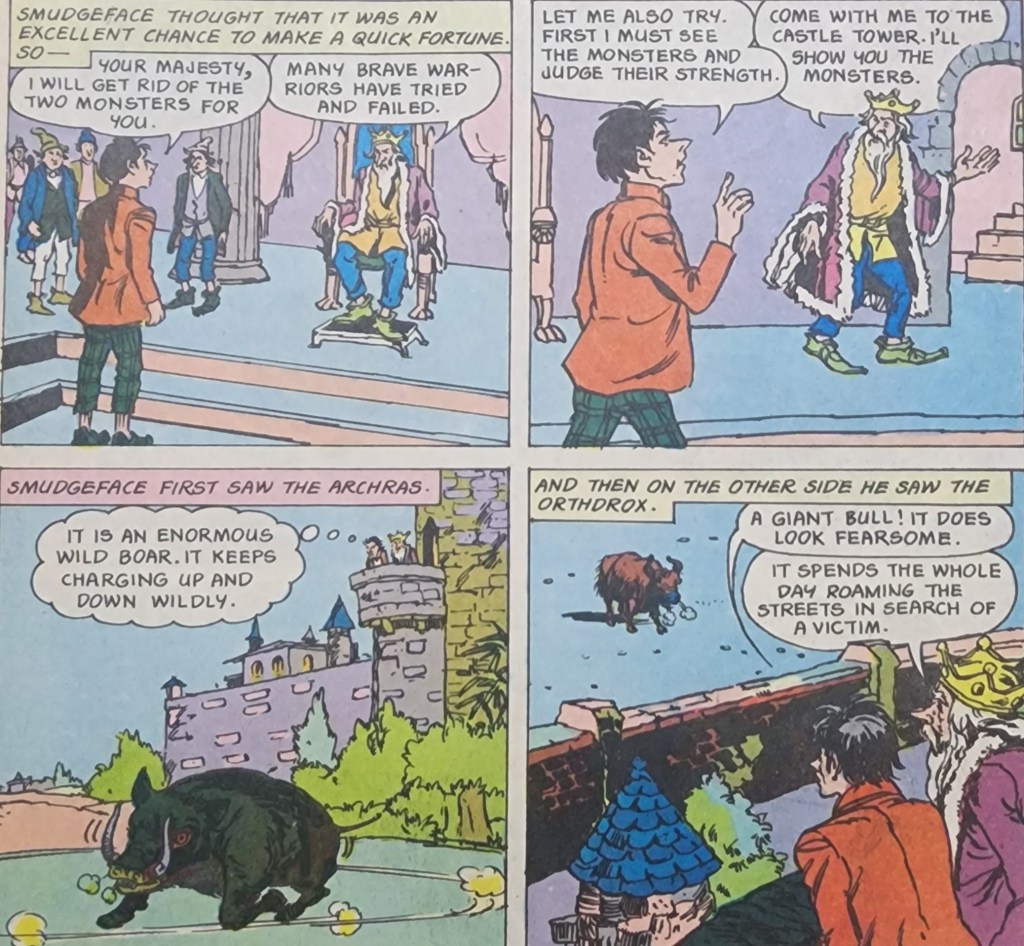
Image credit – “Smudgeface” from Tinkle Comics 299
In the Irish folktale, “The Tailor from Galway” (tailor again!), Tom, the tailor, outwits a Giant with normal siege tactics (which no one else in the Kingdom of Dublin could think of!) to build a castle in JUST THREE DAYS. :-) He later outwits the same Giant to scare him away from the kingdom. He receives the hand of the Princess in marriage (as one is entitled to perhaps, *eye rolls*). Tom’s luck is the stupidity of the Giant and the extreme inability of everyone else in the kingdom!

Image credit – “The Tailor from Galway” from Tinkle Comics 275
In the story, “The Resourceful Woodcutter”, Gopu the woodcutter outwits remarkably stupid bandits to escape death, gets them arrested and wins reward money. All actions happen and succeed through luck alone!

Image credit – “The Resourceful Woodcutter” from Tinkle Comics 201
Now we move on to stories where the main character does not do much, but reaps rewards. This happens due to the actions of others or a lack of ability on the part of the main character.
In the Burmese (Myanmarese) folktale “Lucky Po”, Po, a poor man, who is also hard of hearing relieves four Ogres (Giants) of their gold by scaring the living daylights out of them. He does this with no effort and due to his disability. This is perhaps the epitome of luck, as the lack of ability became an advantage compounded by the stupidity of the Ogres. Of course, where there are Giants, there is always gold to be had!

Image credit – “Lucky Po” from Tinkle Comics 189
In the story “Una and the Red Giant”, Una is the wife of Sigrun, who is the strongest Giant in the land. The Red Giant (dun dun dun) wants to challenge Sigrun, who is too gentle to fight. So, Una outwits the Red Giant with food and adjectives! Peace and gentleness reign in the end. :-D Sigrun wins without having to fight, by literally leaving things to his wise wife (LUCKY for him)!
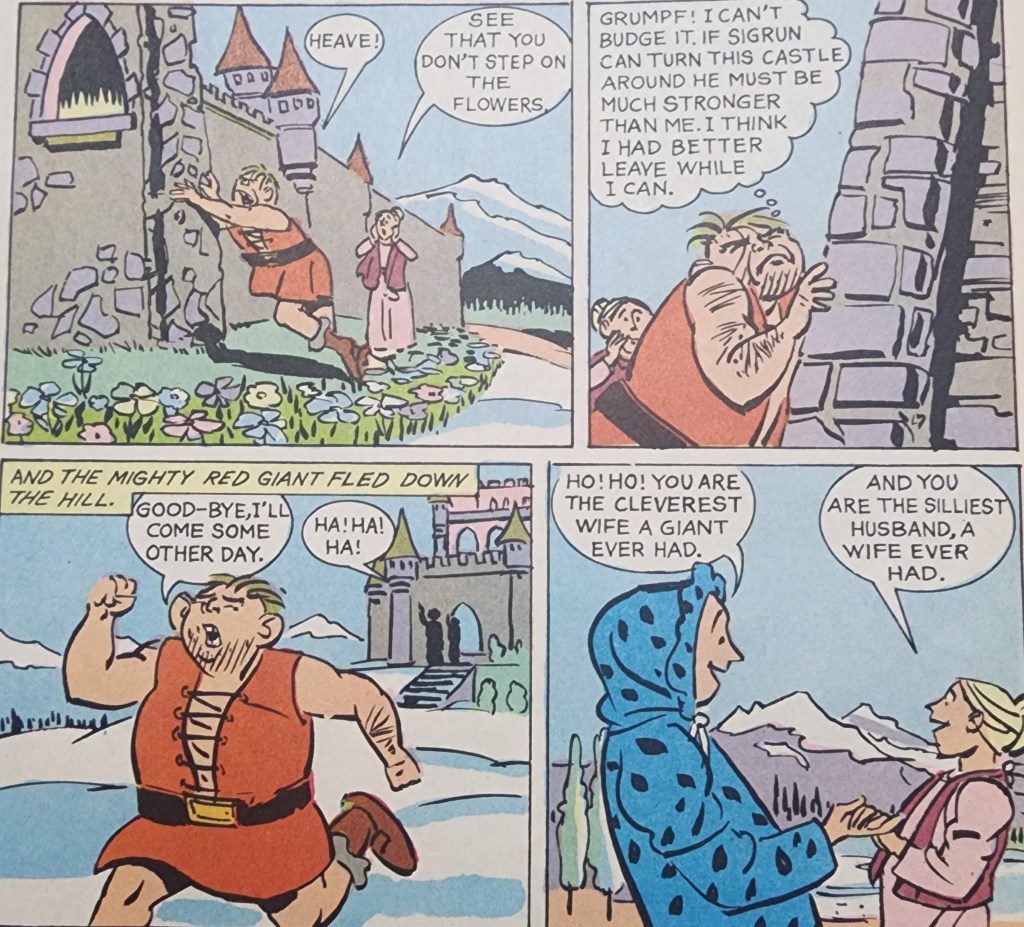
Image credit – “Una and the Red Giant” from Tinkle Comics 266
In the story “The Drummer”, based on a fairy tale, David, the drummer, has to rescue princesses from an evil Witch. To do so, he outwits, wait for it, Giants! But this is only a part of the story. Later he has to overcome the Witch. In this, one of the princesses he has to rescue, rescues him three times! The other princesses are supposed to exist but play no role in the story. So, David is rescued by the princess and in turn rescues them. :-) Of course, he is handsomely rewarded for his efforts. David is lucky because the Giants are stupid and the Princess already knows how to defeat the Evil Witch!
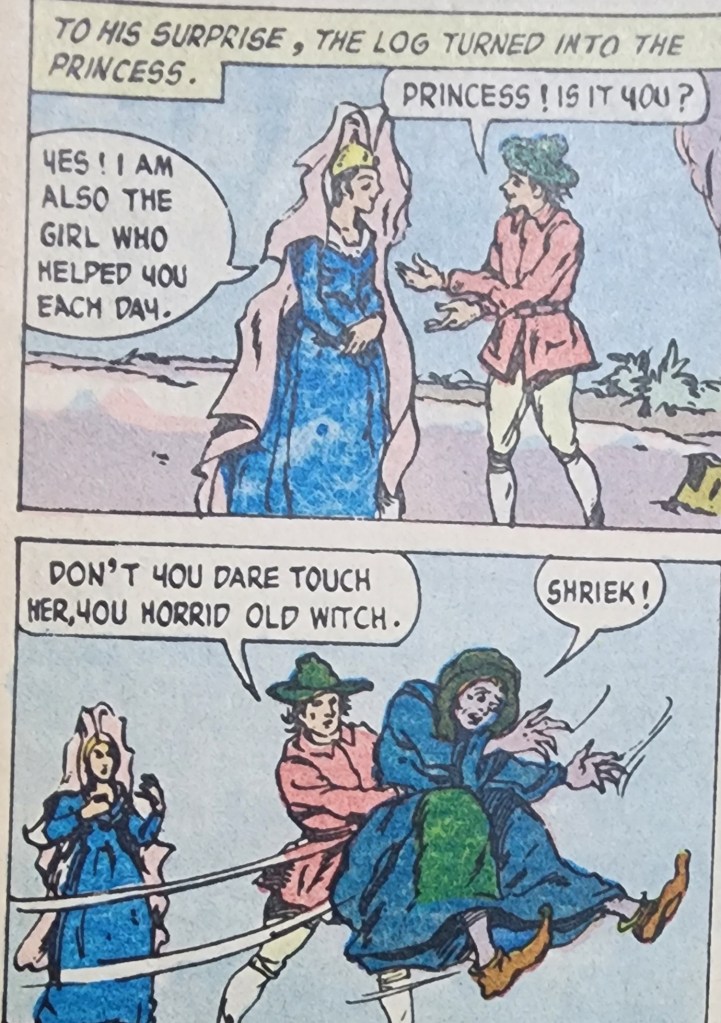
Image credit – “The Drummer” from Tinkle Comics 307
In the last two stories above, there is an interesting segue. Character and effort of an individual leads to luck. Sigrun is gentle and hence a loving wife rescues him. David is gentle and puts in a lot of effort at things he has never attempted before, which leads to luck and reward. This leads us to one more example.
Consider the story, “The Tailor and The Hunter”, based on a German folktale (of course the hero is a tailor, no spoilers there). A tailor and a hunter go on an adventure. The Tailor is kind hearted, while the Hunter is haughty. Due his kindness, the Tailor gets lucky in several instances including in slaying a Dragon (duh!). The Hunter goes home empty handed after trying to deceive his companion while the Tailor weds a Princess in the end! The Tailor accomplishes everything only with luck, while the Hunter, a physically more capable individual, is relegated to being a villain.

Image credit – “The Tailor and The Hunter” from Tinkle Comics 284
So, we have looked a dozen stories to see how deception is the key to great achievements. And the deception would never work but for a lot of luck. But we are not done yet. Stories never end, do they?
There is an Indonesian folktale, set in Sumatra, called “The Victory of the Buffalo”. In this tale, a village is facing an attack by the army of King Sanagara, unless they give in to his suzerainty. They do not want to surrender, but cannot fight the powerful army either. So, they choose to use their wits, brain over military brawn. They make an agreement with the King that a fight between buffaloes will decide the fate of the village, instead of a fight between the army and the villagers, thus staving off bloodshed. The deal is that if the King’s buffalo wins, the village will surrender, but if the buffalo from the village wins, the King will leave them alone.
The King obviously finds a large powerful animal which cannot be defeated. The villagers resort to their wits again to overcome the lack of a powerful buffalo. They find a buffalo calf which is a few days old, separate it from its mother and starve it for a few couple of days. They also attach sharp iron horns to its tiny ones.
On the day of the fight, the calf mistakes the large buffalo to be its mother and runs to it to suckle, as it is starving. The King’s buffalo sees no threat in the calf and makes no move to attack. The iron horns on the calf badly injure the larger animal when the former tries to suckle. So, the calf defeats the larger animal and the village retains its independence.
This is deception and luck on two fronts! The iron horns were neither detected nor objected to. The larger animal choose not to harm the calf. This behaviour is not always what can be expected. Lastly, the King agreed to a buffalo fight and on losing, kept his word. The villagers got lucky with King Sanagara being a man of his word. But the efforts of the villagers, the planning they put in and identification of their own weakness, all played a part and they could be said to have earned their luck. Additionally, this shows that luck can be factor even when animals fight, even if it is at the behest of humans!
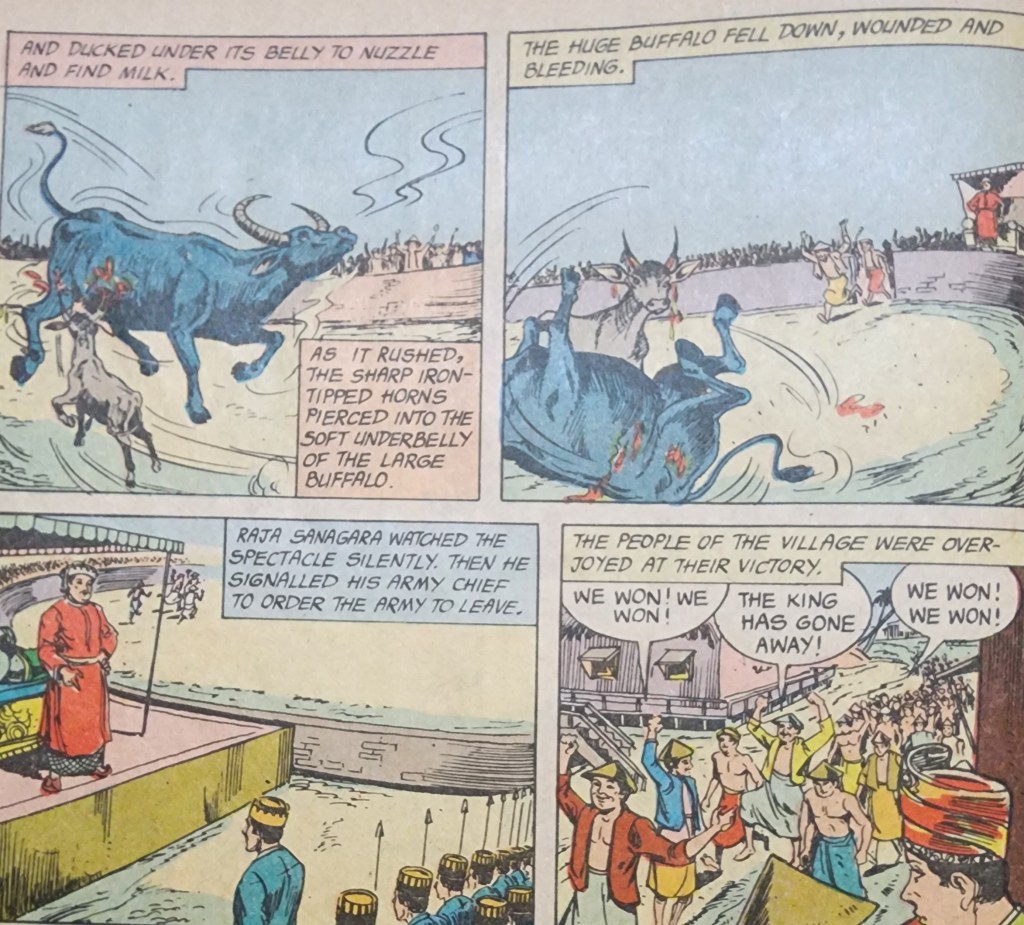
Image credit – “The victory of the Buffalo” from Tinkle Comics 225
Considering that we are discussing deception in warfare and luck saving the day, let us look at another story. The story “How the Ohias were outwitted” is based on an African folktale which describes how the gentle and outnumbered tribe of the Lumas defeated the tribe of the Ohias in the fight for the waters of the lake Lumai. The Lumas tied torches to sheep and made the Ohias think they were outnumbered during a night attack. This convinced the Ohias to surrender and retreat. This is a classic military deception trope used in many stories across cultures. The same is shown in the Hindi movie “Bajirao Mastani” and the Telugu movie “Baahubali 2”, with cattle being used instead of sheep. The side being outwitted would have won if only they had looked a little more closely. But the effort was commendable and the luck of the winning side held out, perhaps deservedly so2.
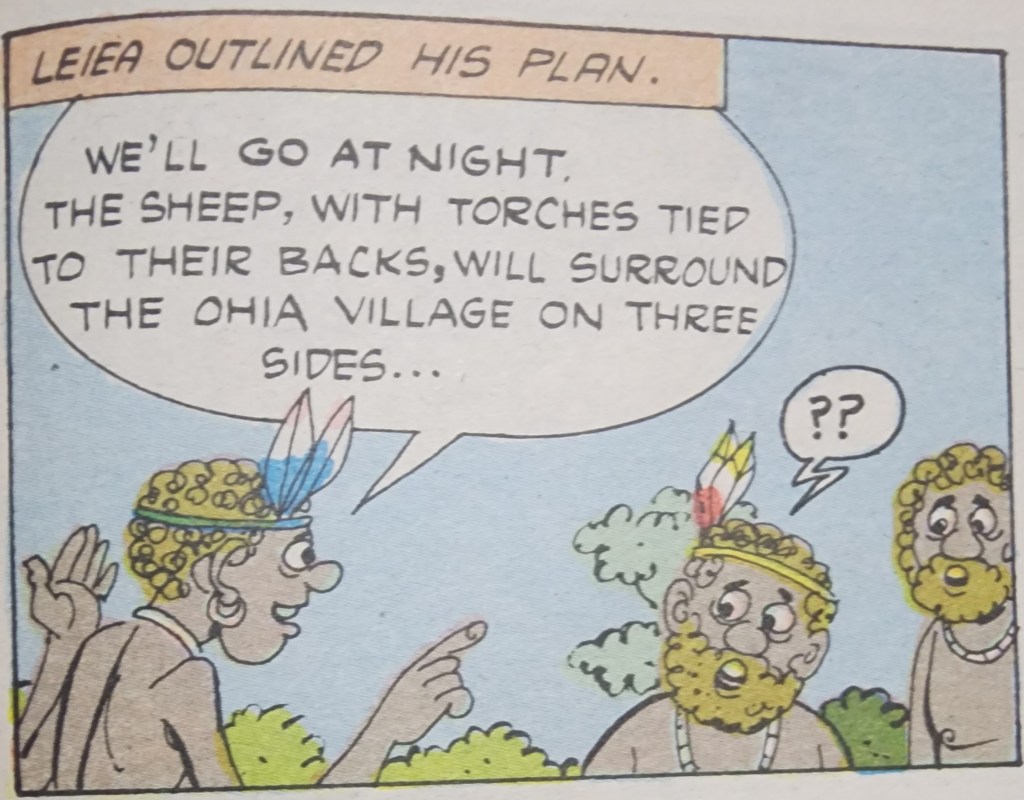
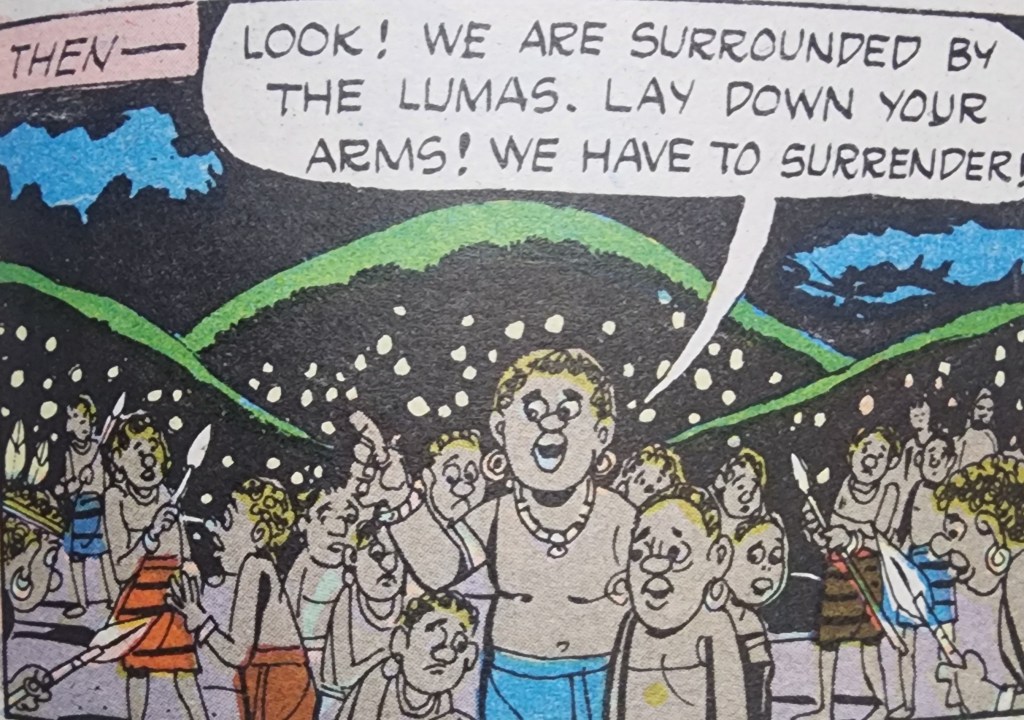
Image credits (L & R) – “How the Ohias were outwitted” from Tinkle Comics 286
So, one important aspect of overcoming an adversary is to use deception and this idea is prevalent in so many stories because it is accepted as a common sense approach to a conflict. As observed in all the examples above, deception involves the use of wits, or intellectual abilities to counter physical abilities. I had discussed this aspect in an earlier article titled “Might is Right, always”. A link to the same is seen in the notes below3.
Why is this notion of “brain over brawn” prevalent across cultures? We get a partial answer in another story. In the story titled “The Stronger Strength”, two students of Sage Vishwamitra, Madhur and Rahul have a dispute over what one should pursue, strength or intelligence. Vishwamitra settles this with a demonstration. No one can break a branch that Rahul can. But 5 students together can do what Rahul can. However, only Madhur can answer difficult questions. No matter how many other students put their heads together, they cannot replicate the same. So, strength can be overcome with numbers, but intelligence is singular and cannot be overcome by numbers. Thus “intelligence is superior to strength”. This could be why “brain over brawn” has become a truism.
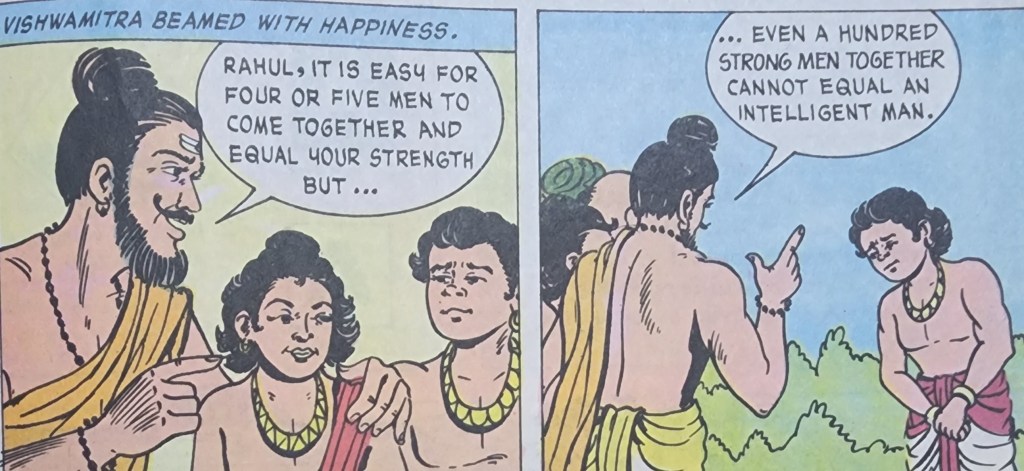
Image credit – “The Stronger Strength” from Tinkle Comics 308
The reason I mentioned that this was a partial answer is twofold. Firstly, there is a thread through all the stories that the strong individual is not very smart, to the point of having no common sense and being downright dumb. This is never true in reality. Physically capable people can be as intelligent as anyone else. Plus, being strong and physically capable requires intelligence in the real world, for that ability requires planned effort, among other things. The reason the opposite can be shown in stories is because monsters, who are born strong with no effort to build the strength, fill the role of physical superiority (Giants, Ogres, Dragons, Witches, Boars, Bulls, Big Cats, Bandits etc.).
The second reason is that in the current times we live in, technology has reached a stage where intelligence or knowledge is no longer singular. Just as brawn can be overcome with numbers, brain power can be easily overcome with technology. The story of Vishwamitra’s students might have held true in the past, but is no longer something that can be relied upon.
But one thing is true from the stories. The stories suggest deception to counter physical strength and also the strength of numbers. This is another way of saying that one should not give up and apply oneself with every ounce of knowledge (individual or collective) to overcome the adversary. This application will reveal a path that likely involves deception. It must be said, “use deception” only means doing something that the opponent(s) does not expect. If there are 10 people with a knife, bring a gun with a magazine of 15 bullets is roughly what the idea suggests. This again harks back to “Might is Right”. One needs to identify the might & weakness of the opponent and the self, then apply them appropriately to achieve the best outcome for oneself3.
There is a character named Cadsuane Melaidhrin in the popular fantasy series “The Wheel of Time” by Robert Jordan (James Oliver Rigney Jr.). In the 9th book of the series “Winter’s Heart”, this character makes an interesting observation. This observation comes after she and another of the “good” characters in the series have to be anti-heroes. Cadsuane is nearly 300 years old and worldly wise. She says something to the effect that every fight is always unfair. I do not remember the exact words she uses. But the gist of it, as I would say it is this. If a fight were fair, it would be a sport. The objective of every fight is to make it as unfair as possible to the other side, so that one’s own side wins with minimal damage to achieve what is in one’s own best interest. When this is understood, deception is par for the course. If deception is par for the course, brain and brawn become the same, for brain is just another variety of brawn. There is no difference anymore.
Once we accept that deception and intellectual abilities are just another form of strength, we can see very clearly what happens when luck is not present with the help of two stories. One story is from the Panchatantra, called “The Camel who was beguiled by his companions”. The other is a story called “The King’s Choice” from Tinkle Comics. The story from Tinkle comics is clearly inspired by the one from the Panchatantra as I see it. The ending is changed for reasons I do not know, but the two different endings perfectly demonstrate how luck is needed for deception to succeed. The “luck” might be as simple as there being no unknown factors influencing the end result. I am not stating that luck is the most important factor; just that a lack of it is detrimental to the effort that went into the deception.
In both the stories, a crow, a fox and a leopard are the close associates of their king, the lion. A camel becomes a part of their group. There comes a time when the lion cannot hunt due to an injury. This leads to all of them being close to starvation. The crow, fox and leopard conspire to make the lion kill the camel, but the lion does not like the idea. So, the trio decide to make the camel offer itself up as for the lion. To do this, they decide to offer themselves up as food, following which the camel would do the same out of propriety.
So, after the crow, fox and leopard have offered themselves up as food for the lion, the camel does the same. Here the two stories diverge. In the Panchatantra, the deception is successful. The lion accepts the camel’s offer to its horror. The camel is killed and the other four fest on it. In “The King’s choice”, the lion accepts all offers and says that he will eat them in the order in which they offered themselves up. So, the deception fails and the trio take to their feet, while the friendship between the camel and lion endures.
In the story from the Panchatantra, the fox separately convinces the lion to accept only the camel’s offer, but this detail is not there in the story from Tinkle Comics. Irrespective of this detail, the observation holds. If the camel was lucky, the conspiracy would have failed in the Panchatantra as well, if the lion had disregarded the fox even after the conversation. But luck sided with the crow, fox and leopard. The opposite happened in “The King’s choice”. Luck deserted the conspiring trio and the camel survived. This should demonstrate the importance, however limited, of luck, in the success of a deception.
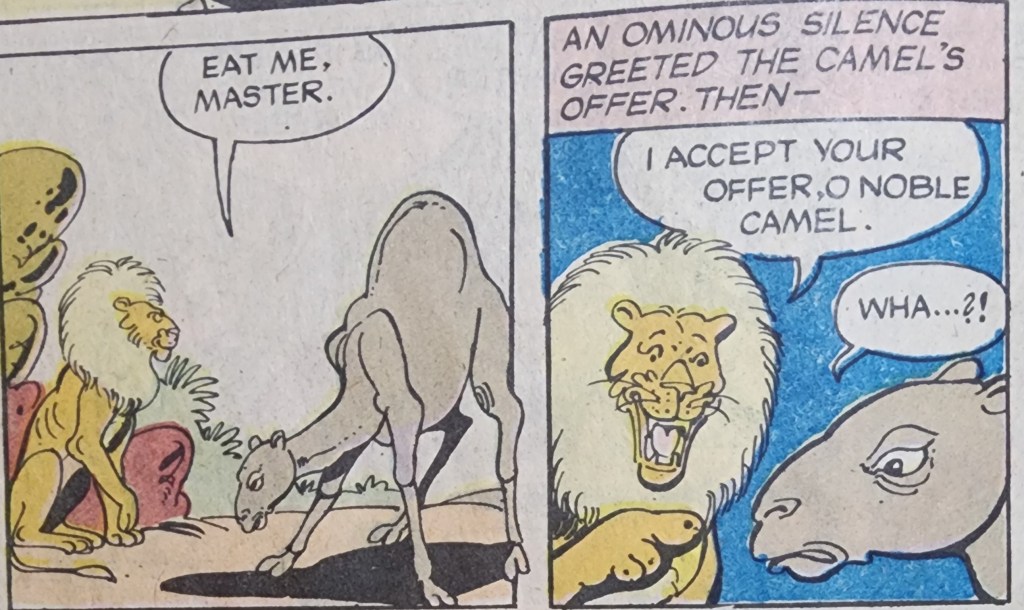
Image credit – “The Camel who was beguiled by his companions” from “Panchatantra: Crows and Owls and other stories” published by Amar Chitra Katha
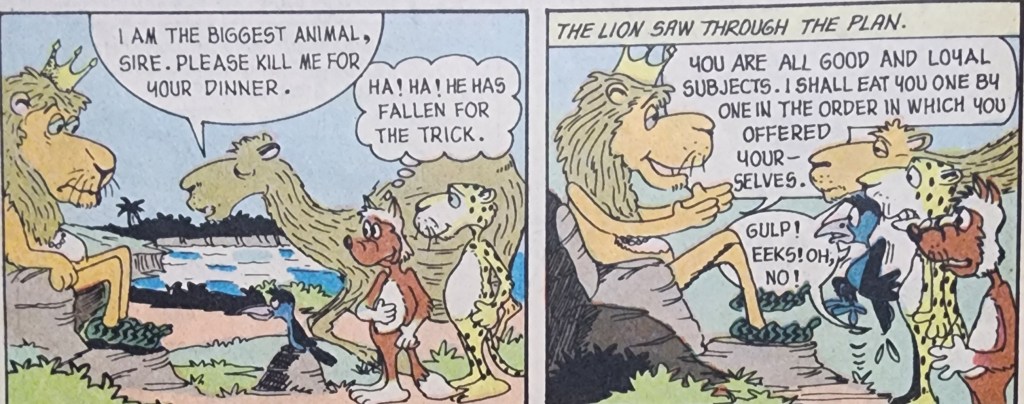
Image credit – “The King’s Choice” from Tinkle Comics 294
Mine is a blog about the martial arts (specifically the Bujinkan) and all things Indian. So, let me now bring in some information from the Bujinkan. I have heard from several senior practitioners of the Bujinkan that Soke (Grandmaster) Hatsumi Masaaki has emphasized on the importance of luck several times over the course of many years. He is supposed to have stated that luck is more important than skill, when it comes to saving one’s life. In military history, Napoleon is supposed to have said that he preferred lucky generals to skillful or good generals4. This is supposedly a reiteration of a statement from a 17th century Cardinal who was Prime Minister of France5, who is supposed to have said that one should ask if a General was lucky and not if a General was skillful. The same statement is also attributed to Dwight Eisenhower6, former US President and Allied Commander in Europe during WW2. Apparently, Eisenhower was so lucky in his career that it was called “Eisenhower’s luck”7.
This is not to say that the person who is lucky has nothing else going for her or him. Nor does it mean that the person has no skill. It is just an advantage that is being referred to. One senior practitioner in the Bujinkan system of martial arts once told me, “To be lucky, one needs to do something uncomfortable”. I think this statement sums it up brilliantly. Doing something uncomfortable is about putting in the effort and being in a situation where one needs luck (in case something goes wrong). This is when luck can manifest.
Effort is the key, effort is the king, in this context. I will elaborate on this with the structure of stories as the context, for this entire article is about stories. Consider storytelling in movies and then think of action movies. One part of action movies that everyone loves is the TRAINING MONTAGE, especially if it is accompanied by memorable and rousing music. Of course, I include the “preparing for war” segments as “training montage” because it is the final step before the fight, and had a lot of training behind it. It is that part of the movie that is watched over and over again. Remember the Rocky (Stallone) training montage? Remember the segment when Dutch (Arnold) readies himself to take on the Predator all alone?
The training montage is also a very short part of the film. Training and preparation is a lot of effort over a very long time. It is a process with incremental steps. And it is really boring to show in real time or even to make the primary focus of the movie. Hence, the montage is a great setup for an awesome climax fight. It is also a great outcome of the character motivations that were setup. After all, movies are about character actions, motivations and emotions, in flow and with action.
It is this slow, long and incremental effort and process of the same that leads to the manifestation of luck. This is what a martial artist thrives on. It is this effort that makes a martial artist akin to a scholar, a researcher or an academic, working on oneself and studying flow. This effort and its process is the lifeblood of the arts and what an artist really looks forward to.
It is this incredible effort that is uncomfortable more often than not, for it is in addition to everything else in life. It is an accepted burden, and this discomfort is what leads to luck. When “deception” is applied as a tool with practiced effort, “luck” is the final ingredient to iron out unforeseen variables. It is what adds the Brain to the Brawn, not just “over” it.
I will conclude this line of thought with one last reference to another set of stories. “Tantri the Mantri” is a beloved character from Tinkle Comics. He is a minister in the kingdom of Raja Hooja. Tantri wants to overthrow the king and become king himself. He makes elaborate plans, and fails every time. This makes Tantri a despicable yet funny character, something like the coyote in the roadrunner cartoon, with one crucial difference.

Image credit – “Tantri The Mantri” from several Tinkle Comics
Even though every plan of Tantri’s fails, the failure leads to Raja Hooja being saved by Tantri himself! So, every failed plan brings him closer to Hooja, who thinks of Tantri as his best friend and confidante, way more than just a minister. Perhaps this is the epitome in the play of luck we have discussed so far. Tantri is despicable, perhaps for this reason his luck deserts him, leading to Hooja being incredibly lucky. Tantri though puts in loads of effort, so he is always lucky in never being caught, and in being rewarded for efforts in the negative! Hooja is lucky because he puts in effort to appreciate Tantri and to also go out of his way to work with all of his suggestions. Tantri is always carrying out deception, which fail and work at the same time. He is incredibly lucky and unlucky at the same time! Stories of Tantri reinforce how effort leads to luck and luck is needed for a successful deception, for deception is a kind of brawn, where the brain takes centre stage.
This concludes this article, but there are a few points stemming from this and the previous article which I will delve into in a future article. They do not fit in here without breaking the flow. One of these points includes the complete absence of morality in many stories, for they are representative of reality, and are not just educational.
Notes:
2 There is a beautiful story about luck written by Mark Twain, called “Thank you Mr. Shark” (I am not sure if this is the actual name or only the name of the adaptation of the story in Tinkle Comics). It does not involve a debate or a duel or a conflict. It just shows how one needs to act on the luck that has come one’s way. Indeed, this subsequent action is what shows that one was lucky, with the benefit of hindsight.
A young man in Australia catches a shark in Sydney and finds a London Newspaper in its belly, courtesy of a man it had devoured in England. This is in 1870 before the telegraph and when sharks swam a lot faster than steam ships. So, thanks to the shark and the newspaper, he is the only one in Australia who knows of the Franco-Prussian war of 1870.
He uses this information to buy Australian wool to trade in Europe, which is in high demand due to the war. So, before the newspapers in Australia can report the war in Europe, he has made a big profit for himself. Yes, there is conflict in the shape of the war in Europe, but a lucky Australian makes the most of it to further himself in life. :-)
3 https://mundanebudo.com/2023/05/11/might-is-right-always/
4 https://www.azquotes.com/quote/1339632
5 https://www.warhistoryonline.com/instant-articles/famous-things-napoleon-said.html
6 https://www.azquotes.com/quote/568694
7 https://press.armywarcollege.edu/cgi/viewcontent.cgi?article=2542&context=parameters


[…] 2 https://mundanebudo.com/2024/02/29/brain-over-brawn-deception-laced-with-luck/ […]
LikeLike
[…] Brain over Brawn – Deception laced with Luck Effort, luck, effectiveness, morality – some thoughts. Also, why do you train? […]
LikeLike