Introduction and some concepts
The logo of the Bujinkan
The purpose of this series of posts is multi-fold. Firstly, it is a resource I can share with people who are not practitioners of the martial arts. Like most of us, a majority of the people we interact with do not practice any form of martial art. Sharing ideas and practices about martial arts might require some “first principles” like definitions, overarching themes and ideas and objectives of the art form. Hopefully this series will be that resource.
Secondly, it is an opportunity for me to look back at my own thoughts about the Bujinkan. The thoughts are a document I can refer in the future to see if I think differently.
Lastly, practitioners of the Bujinkan who are relatively new to the system and longtime practitioners who might need a look back at aspects from earlier years could use this as a starting point for further discovery. There are several practitioners and Sensei of the Bujinkan with a lot more experience compared to me, who share content about the art form and the system. I strongly recommend that everyone consume the content from those sources. This series is possibly an index to search further in those sources.
So, this series in not a deep dive, more like a primer of my thoughts with scope for expansion in each. Most importantly, whatever knowledge can be gleaned from this series is a conversation starter or direction pointer at best; it does not in any way replace actual training in a dojo with fellow budoka and a teacher who can help one progress.
The Bujinkan is a martial art system of Japanese origin. Martial arts, as I see it, are about two things. These are self-preservation and conflict management.
Of these two, self-preservation is the grittier, ancient, down to earth aspect of the martial arts. It is more relevant in situations of physical conflict where bodily harm is likely. Of course, bodily harm can lead to psychological and emotional harm as well. But the self-preservation aspect applies first to the physical aspect and to everything else next.
Conflict management is more relevant in all aspects other than physical conflict with potential bodily harm. Simply put, this is more relevant in day-to-day life in contemporary structured societies. This is because we humans cannot resort to physical violence to resolve, or deal with, most conflicts that we encounter in life. And due to this nature of modern living, the psychological and emotional aspects of martial arts are as important as the physical aspect. In fact, these take precedence in many situations. In my opinion, “Martial Arts” is a synonym for “Conflict Management”.
There are two points to clarify with respect to the above paragraphs. The first is that I use the term “conflict management” instead of “conflict resolution” because I feel a resolution is a special case of management or a potential outcome of the management. Even if it is the desired option, management focuses on what needs doing irrespective of whether it leads to a resolution or not.
The second point relates to the physical and emotional/psychological aspects. Many a time, we hear the terms, “mind over matter” and “matter over mind”. Neither of these is specific to either a physical consideration of the martial arts or the emotional/psychological aspects of the same. Both could apply in both interpretations/manifestations of the martial arts.
The physical aspects of the Bujinkan are the following.
- Ten Chi Jin Ryaku no Maki
- The 6+1+2 schools = The 5 styles of fighting
- The Kuden which includes the themes of the year and the other concepts taught while applying the TCJ & the schools (this is the largest part and also the hardest to document).
- The various weapons and their use, and their use with the learning from the schools and the concepts mentioned in the previous point.
The psychological and emotional aspects include –
- The TCJ and concepts stemming from the historicity of the schools
- The weapons and their use (weapons here include all things in life – tools, tech, networks, people, societal behaviour, culture, customs and traditions, work culture).
- The Kuden and their teachings (themes of the year and all other soke sayings in class, and their interpretations of the many senior practitioners the world over).
- Eventually come the adding or layering of concepts and learnings from one’s own culture, like Hindu/Hinduism (in my case) or any other (philosophy, spirituality, traditional stories, historical personalities and other examples).
- Lastly are the experiences from one’s own life, from work, relationships, hardships, pain, loss, conflicts, and the interaction of these points. These are opportunities to apply the learnings from all other points.
Each of the above 9 points will have posts of their own. I will elucidate further on each, as I understand it at this point in life. At various stages of this happening, we will be turning back to look at the self-preservation and conflict management aspects as well. Also, it is likely that other martial art systems have their own versions of the above 9 points.
As I age further, gain more experience in life, my understanding on some or all of these points might change, or they might not. This document is a snapshot of this moment in my budo life, not a documentation of my entire experience. And oh yes! It is not human to be consistent, so do not expect it. :-P
Self-preservation has three components, as I currently understand it. These are –
- Intuition
- Self-protection
- Evasion (includes escaping a situation)
I use the word self-protection and not self-defence deliberately. Self-defence is a commonly used term with reference to the martial arts. It is fairly likely that every practitioner of the martial arts has been either asked about or assumed to be training the same for developing “self-defence skills”.
I personally do not know if self-defence is ever possible. All self-defence concepts and techniques are developed and have origins based on situations experienced by people over time. While it is probable that the these are likely to work in quite a few cases, it need not do so in all cases. This is because, no situation which has been considered to develop a defence against, needs to necessarily ever occur with anyone else, who has learnt the same. So, applying techniques or concepts learnt to survive a specific situation might not work in a different situation, as the same situation almost never occurs twice or with two different individuals.
Also, consider the words “defence” and “protection”. We never use the word “defence” with respect to the elements. We do not say “defend yourself against the wind”. We say, “protect yourself from the wind”. This holds true with the rain or the sun as well. This is because a defence is against something, while protection is from something. Defence is against an attack, and hence has to happen after or during the act. But protection is at all times (not a reaction to a situation); you are prepared for an adverse situation, not waiting for it to happen. A more mundane example would be wearing a helmet while driving a bike. We do not wear it against an accident, we wear it to protect ourselves if ever there is an accident.
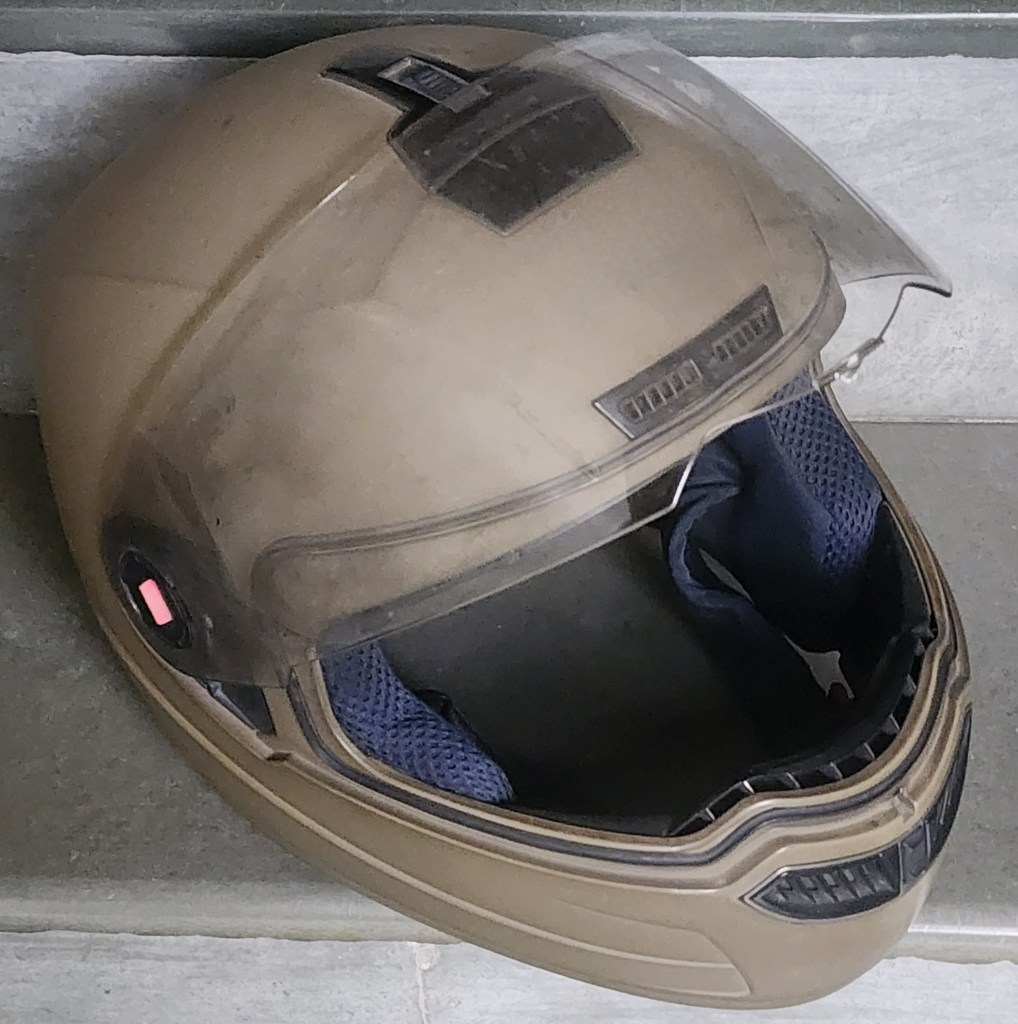
A modern day helmet used with vehicles
This is the same with the martial arts (the Bujinkan in this case. One trains self-protection and not self-defence. One cannot expect a technique learnt to work in a situation, instead one trains concepts and techniques to be able to survive an adverse situation at best and get away with minimal physical injury at worst. Of course, there will be emotional, intellectual, and spiritual injuries as well, that surface after the survival, which need to be protected against as well. These injuries occur in daily life to many people routinely, without any physical attack being present.

A representative Samurai helmet
With the difference between defence and protection out of the way, let us look at how protection works. The first step to protection is to be ready. And readiness starts with awareness. “Awareness” as I use the term, is a synonym for “mindfulness”. This means you are able to be aware of your surroundings, the atmosphere of a space and the feeling it gives you. This might seem like a lot of work, and it is, until after a lot of training, when it hopefully becomes second nature.
This does not mean you are James Bond or Jason Bourne. It is not about over doing wariness or working hard to study one’s surroundings. It means one trains to develop one’s innate instincts to be able to perceive a threat (not determine it). If a threat is perceived, do anything needed to get out of the space without any need to second guess oneself. There is no need to look for or wait for evidence of the perceived threat.
With the above observation of awareness, I hope I have established that “Intuition” is key to self-protection. This ability to develop and trust one’s intuition is called “Sakkijutsu” in the Bujinkan system of martial arts. Sakkijutsu is not magic, it is a consequence of training the Bujinkan (or maybe other martial art systems as well), life experience and wisdom achieved as a combination of the two. Also, this is not specific to physical threats either, it can be an ability to perceive coming troubles at work, in a relationship, in traffic, in the wilderness or any other situation.
The entire notion of Sakkijutsu hinges on the notion that waiting for the physical attack or any other problem to commence is already too late to begin action to protect oneself. Protective measures must have already begun when the problem begins to manifest. Consider it as having worn a raincoat while driving a two-wheeler just as a downpour begins because you saw a cloudy sky, or a weather forecast app told you it would rain. This is better than finding shelter to park under before you get the raincoat out of your bag.
This might sound a little like the “Spidey sense” that Spiderman demonstrates. But “intuitive abilities” are not magic, just a normal human ability. In the comic, this ability is a “super-sense”, as a consequence of being a superhero. But in the real world, Sakkijutsu is a consequence of human evolution and individual training/experience.
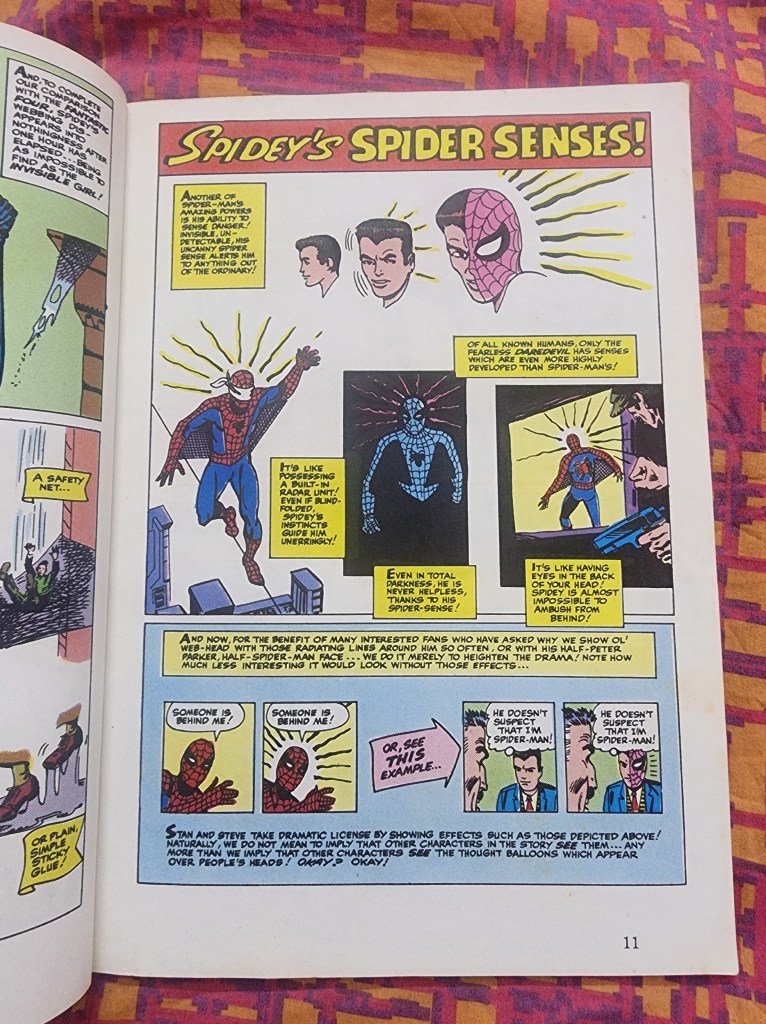
A comic book page describing one of Spider-Man’s superhero abilities. This is NOT Sakkijutusu! Image credit – “Spider-Man: The Secret Story of Marvel’s World-Famous Wall Crawler” published by Marvel Comics
Sakkijutsu is a fundamental tenet of the Bujinkan system as I understand it. But it is not part of the basics that one trains or learns from the first few training sessions. It is something that is learnt over years of training; it cannot be taught in the conventional methods. So, it is part of the fundamentals, but an advanced concept (not a technique) nevertheless.
I am not writing this article, or the series, in a strictly linear manner as might have been observed. Intuition was the first point, but I started with a discussion on self-protection, and then moved on to an advanced concept which I mentioned as a fundamental tenet. I will be doing this back-and-forth multiple times as we go further in this series as well.
The third part of self-preservation trio is evasion. If there is an attack or a threat, evasion is the obvious thing to do, to prevent or at least mitigate any physical harm. Evasion simply means getting out of the line of the immediate attack or not being in the place where the attack is going to have maximum impact. This can happen due to, along with, or lead to self-protection. So, these two concepts are intricately linked. The learning of the basics of the Bujinkan which we will look at in greater detail further in this series will hopefully elucidate this symbiosis better.
A key point when I mention “self-preservation” is the word “self”. Your training may not necessarily help you protect those with you at the time of the attack, except if your intuition allows you to get them away from the place where the attack might happen, before it happens (yes, it does sound like “luck”).
With that introduction out of the way, let us look at the training of the physical aspects of the Bujinkan in greater detail, starting with the next post in this series.


[…] the first post of this series, I had given an introduction to this series and defined some basic concepts that […]
LikeLike
[…] the first post of this series, I had given an introduction to this series and defined some basic concepts that […]
LikeLike
[…] the first post of this series, I had given an introduction to this series and defined some basic concepts that […]
LikeLike
[…] The Bujinkan, as I see it – Series 1, Part 1 The Bujinkan, as I see it – Series 1, Part 2 The Bujinkan, as I see it – Series 1, Part 3 The Bujinkan, as I see it – Series 1, Part 4 The Bujinkan, as I see it – Series 1, Part 5 (of 5) […]
LikeLike