The Schools and the Styles of fighting
Wish you all a happy new year and a wonderful 2025! 😀
On to the post now. 🙂
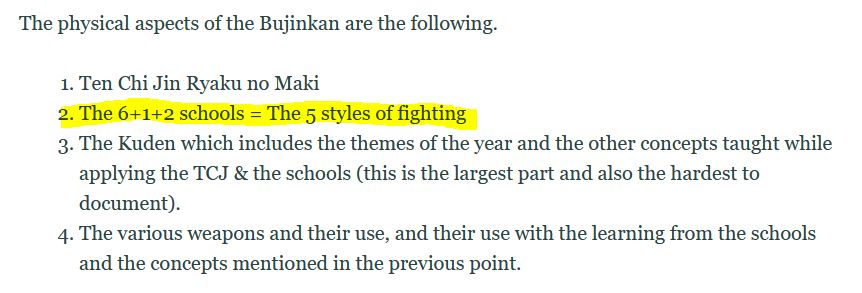
In the first post of this series, I had given an introduction to this series and defined some basic concepts that will be revisited time and again during subsequent posts. In the second post, I had looked in greater detail at the “Ten Chi and Jin”. In this post, the third in the series, I will look at the different schools that make up the Bujinkan system of martial arts. This is the second among the 4 aspects I had referred to as the “physical aspects” of the Bujinkan. These are seen in the screenshot below. The topic highlighted is the focus of this article.
The Bujinkan system of martial arts teaches five styles of unarmed fighting. These styles are fairly universal when it comes to humans fighting humans without firearms and projectile weapons. The Bujinkan system comprises of 9 schools of combat of which six are taught routinely. Of the remaining three, no regular teaching takes place. As I understand it, the schools are less important than the styles of fighting they encompass, as multiple schools can teach similar or related concepts. So, I will focus on the fighting styles and share a few words regarding the schools later in this article.
The five styles of fighting can more realistically be considered to be two styles of fighting, one layer of fundamentals and two other styles which are a combination of the other three, to achieve interesting objectives. The five styles are mentioned below.
- Taihenjutsu
- Daken taijutsu
- Jutaijutsu
- Koppo jutsu
- Kosshi jutsu
Tainhenjutsu – This is the base layer and involves learning the ability to move the body as desired to achieve favourable outcomes in a fight. It could be said that this is comprised of the Ten Ryaku no Maki and quite a bit of the Chi Ryaku no Maki which I explored in the previous article in this series.
In the martial arts, without the correct positioning of the body, nothing can be achieved in a fight. And positioning can only be achieved with the ability to move the body as required in a given situation. Since Taihenjutsu is all about body movement, this is perhaps the most important layer in the Bujinkan. I would suspect that the equivalent of Taihenjutsu is the most important layer in all martial arts around the world.
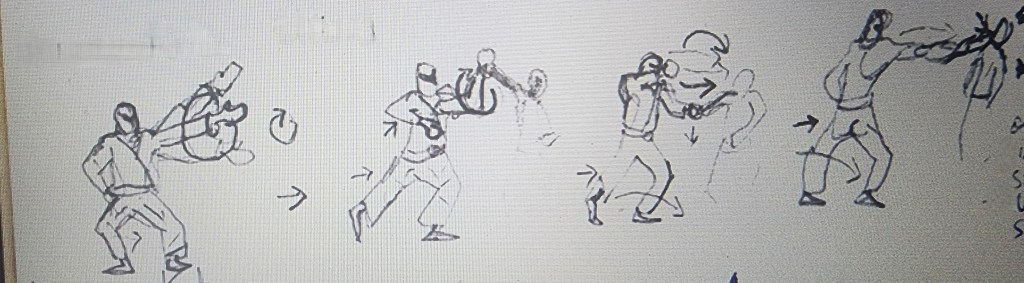
A representation of Taihenjutsu, showing movement and body positioning. Sketch by Keane Amaral
Daken taijutsu – Daken taijutsu refers to the style of fighting that involves striking. By that definition, martial arts like boxing, kick boxing, mushti yuddha, sanda, taekwondo and the like are also expressions of daken taijutsu. Striking an opponent with any part of the body would qualify as daken taijutsu. This is not to preclude locks and throws. It is just that striking takes primacy in this style of fighting.
Striking effectively of course, requires one to be in the right position to execute the strike. Also, one needs to move out of range of any strike the opponent may carry out. This part of daken taijutsu is of course, still taihenjutsu. So, daken taijutsu is an additional layer over taihenjutsu.
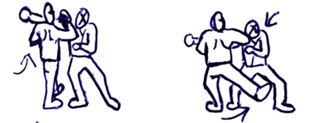
A representation of Daken Taijutsu, showing potential strikes. Sketch by Keane Amaral.
Jutaijutsu – Jutaijustsu refers to the style of fighting that involves grappling, throws and joint locks. Based on this definition, Olympic wrestling, judo, Brazilian Jiujitsu, malla yuddha, kushti, aikido, sumo wrestling and the like, are expressions of jutaijutsu. The opponent here might be grappling or striking or using a combination of both. But the defence has a primacy towards immobilising the opponent using grappling, locking and throwing the opponent. Like with daken taijutsu, jutaijutsu does not preclude striking, but the focus in not towards striking is all.
Again, taihenjutsu is the base layer with jutaijutsu, even more so than with daken taijutsu. Getting an opponent to the ground to mitigate an attack, requires far more efficient body movement and positioning than striking, as physics and leverage play a very important role in the same. So, jutaijutsu is an additional option available to a practitioner of Budo apart from daken taijutsu, after taihenjutsu has been understood and executed.
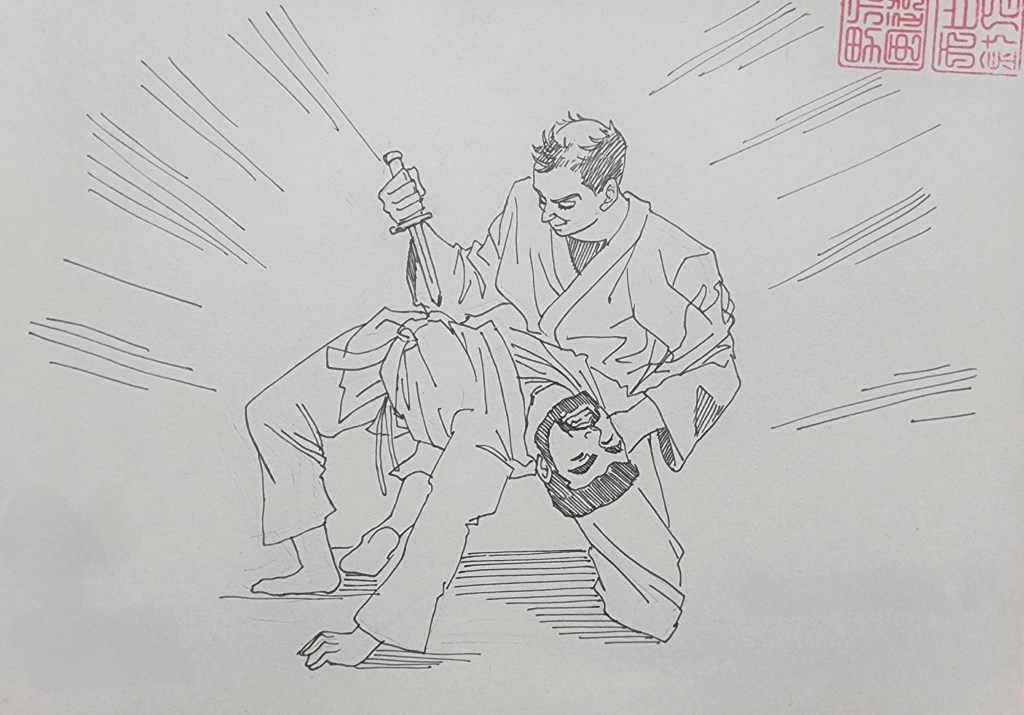
An exaggerated representation of Jutaijutsu, representing taking down an opponent . An image I commissioned in a past Comic Con in Bangalore.
The next two fighting styles are expressions of the combination of the above three layers.
Koppo jutsu – Koppo jutsu is generally explained to be a fighting style that uses striking in a specialized manner. One strikes an opponent to affect the skeletal structure of the opponent. In other words, the strike is applied to displace an opponent from the position she or he was in. Alternatively, the strike could be to take the balance of the opponent. Once the opponent has been displaced or has lost balance, a follow through happens where additional strikes are applied, or a throw or lock can be applied as well. All of this could take the opponent down to the ground or the process could continue until the opponent ceases the attack and retreats.
In my opinion, koppo jutsu is a case of referring to taihenjutsu and daken taijutsu together. So, as a simple definition I would state the following.
Koppo jutsu = Taihenjutsu + Daken taijutsu
But in practice, koppo jutsu is as follows,
Koppo jutsu = Taihenjutsu + Daken taijutsu + Jutaijutsu
The above formulation can be explained as follows. Taihenjutsu is the basis of the movement. A strike is applied (daken taijutsu) while moving (taihenjutsu) to affect the opponent’s balance or position. This is followed with jutaijutsu to mitigate the attack effectively. This is the reason I have put jutaijutsu AFTER daken taijutsu in the above formulation.
Koppo jutsu’s defining feature is to strike with effective movement to affect the physical structure of the opponent. In other words, koppo jutsu seems to me to be designed to defeat the taihenjutsu of the opponent, or, the BASIS/ORIGIN of the opponent’s movement/attack. Any aspect of the earlier fighting styles can be used after this is achieved. So, there is no need for this fighting style to be visually different from daken taijutsu, or even jutaijutsu based on the finishing method applied. The difference can only be experienced by the people involved in the martial exchange that occurs.
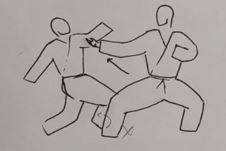
A representation of Koppo Jutsu, showing a strike putting the opponent off balance. Sketch by Vishnu Mohan.
Kosshi jutsu – In simple terms, Kosshi jutsu can be termed as “specialized jutaijutsu”, in my opinion of course. The focus of this style of fighting is to affect the balance of the opponent by attacking her or his vertical or horizontal axis or the intersection of the two axes. Yes, this sounds awesome and farfetched at the same time. In reality, the attack is mitigated by attacking the hips, shoulders, knees and face of the opponent. Of course, the uke nagashi or receiving the attack without injury is very important here.
Uke nagashi occurs simultaneously with attacking the opponent’s balance. One moves the opponent’s hips or shoulders, knees or face while surviving the attack. This breaks the opponent’s balance even as the attack is being completed. The attack to the opponent’s axes (plural of axis, not the tool) can be with a strike or a push, it often is something in-between, which translates as a soft strike. Once the opponent has lost balance, she or he can be taken down with further daken taijutsu or jutaijutsu. If this is not achieved in the first move, the process continues until the attack is mitigated.
I guess it is obvious that taihenjutsu is again the origin of this fighting style. For uke nagashi has to be achieved while attacking the axes of the opponent. So, good, safe movement is the key to get into a safe position to apply an effective attack against the opponent.
In my opinion, kosshi jutsu can be explained as seen below.
Kosshi Jutsu = Taihenjutsu + Jutaijutsu
Here I use jutaijutsu to refer to “the taking of the balance” and not necessarily with a strike. In reality, the formulation could be thus,
Kosshi Jutsu = Taihenjutsu + Jutaijutsu + Daken taijutsu
Here, I add daken taijutsu AFTER jutaijutsu, as the primary objective of breaking the opponent’s axes, & hence balance, is geared more towards jutaijutsu rather than daken taijutsu. But the finishing, after the opponent’s balance is taken, can be achieved by applying additional jutaijutsu or daken taijutsu, as the situation warrants. So, in the above formulation, jutaijutsu and daken taijutsu can be interchanged or added twice! It really does not matter. Here again, a bystander might not see a visual difference between kosshi jutsu, daken taijutsu, jutaijutsu and kosshi jutsu. It is purely something experienced by those physically involved in the martial exchange.
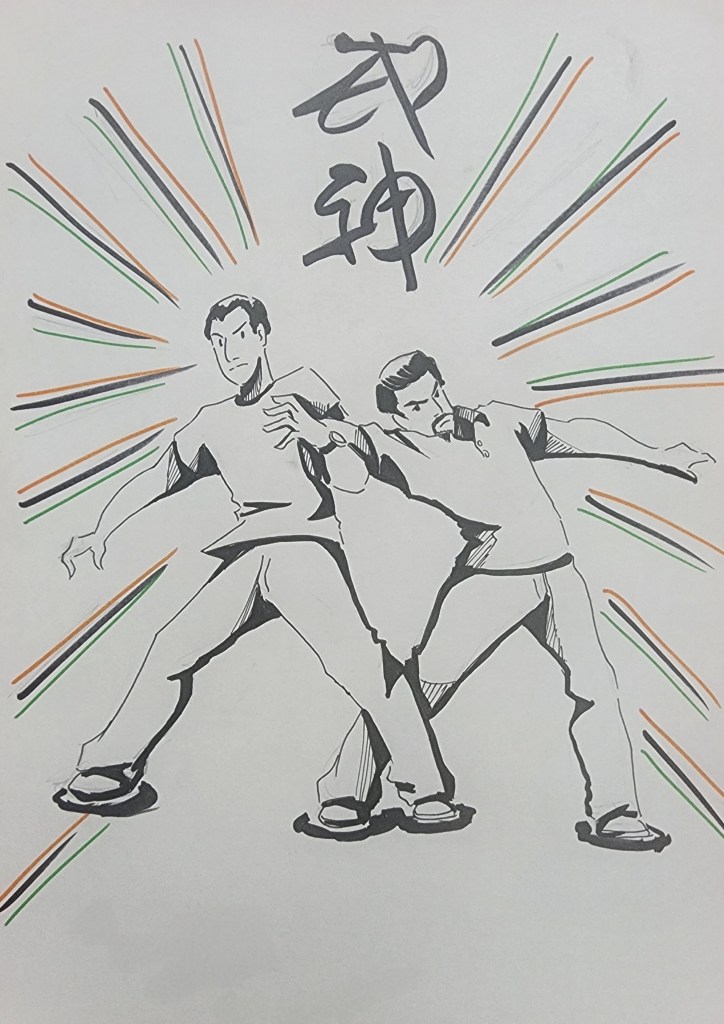
An exaggerated representation of Kosshi Jutsu, representing taking an opponent’s balance by misaligning the vertical axis (the spine). An image I commissioned in a past Comic Con in Bangalore.
I must add a qualifier here. These explanations are based on my learning from my teacher and mentors. It is not even necessarily the opinion of my teacher and mentors. There could be other interpretations of these fighting styles from other practitioners who have a lot more experience as compared with mine. Also, people studying the history, origins and evolution of these styles within the context of even just the Bujinkan could have a different interpretation of these fighting styles.
Now we return the schools mentioned earlier. The Bujinkan system comprises of 9 different schools. I will not expound too much on these, but share a few lines about each. One has to physically train and experience the schools for a deeper understanding. Also, since description of the sighting styles fairly encompasses what could be described in brief about the schools. Also, I will revisit the schools in a future article, when we look at some of the non-physical aspects of the Bujinkan, which involves how historical context shapes what we learn in the martial arts.
There are two schools of Daken taijutsu. These are the Shinden Fudo Ryu and the Kukishinden Ryu. The difference between the two is that the Kukishinden Ryu has a lineage of fighting while wearing armour, while the lineage of the Shinden Fudo Ryu is from fighting in wooded areas. Hence, one would expect to be lightly armoured, if at all, while having more obstacles than in the case of the Kukishinden Ryu.
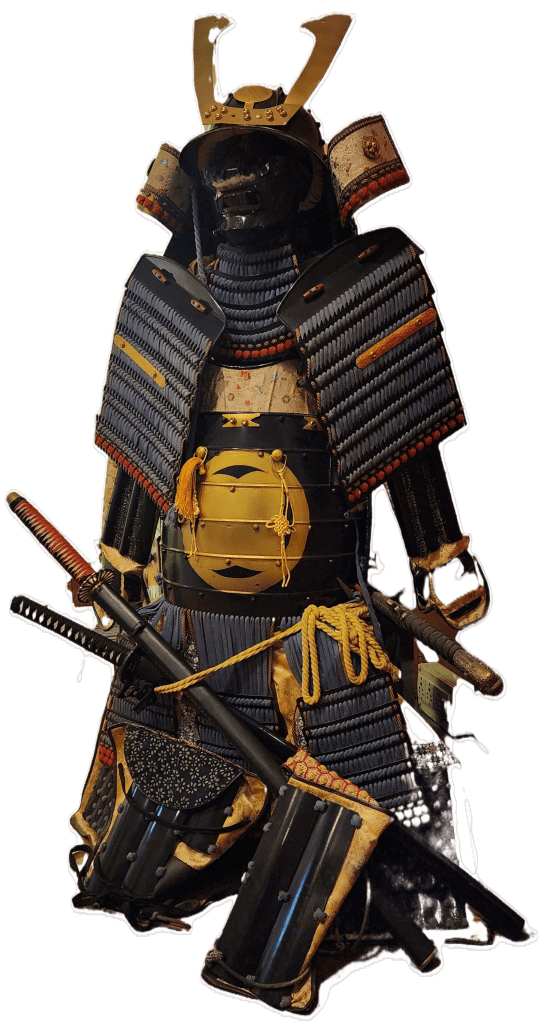
Representative Japanese armour, an example we have at our dojo
Koppo jutsu is represented by the Koto Ryu and the Gikan Ryu. The Koto Ryu is the source of a lot of the basics in the Ten Chi and Jin described in the previous article in this series. The Gikan Ryu supposedly has no densho (scroll/manual) or defined forms/techniques and is not explicitly taught in the Bujinkan.
Kosshi jutsu is represented by the Gyokko Ryu, which is supposed to be the oldest of the schools taught in the Bujinkan. Its historicity is supposed to be from fighting in the small spaces in the interiors of royal buildings and applied by nobles for self-protection.
Jutaijutsu is represented by the Takagi Yoshin Ryu. This school was used by bodyguards of the nobles, and they had a need to immobilize and arrest attackers for later information gathering. Killing the attacker would result in the identity of the person ordering the hit being lost. Of course, this is the objective, it does not mean that assassins were always captured alive.
Lastly, there is the style of Ninpo taijutsu. This is not mentioned in the five styles of fighting as I understand the system. The Togakure Ryu is a ninpo taijutsu school and is taught routinely in the Bujinkan. Based on my experience of the same, it has elements of taihenjutsu (surprise!) daken taijutsu and jutaijutsu.
Two other schools of ninpo taijutsu are a part of the Bujinkan system. One is the Gyokushin Ryu, which does not have a densho, but Soke taught the essence (key points) of this school to a few Daishihan who have shared the same with the rest of the practitioners. The last school of ninpo taijutsu is the Kumogakure Ryu, which also has no densho. I have heard it said that this school had teachings related to disguises, hiding and such. But I have no real knowledge about this school to comment further. This again, is not taught in the Bujinkan despite being a part of the system.
Ninpo taijutsu includes training weapons, espionage, meteorology and use of firearms and explosives, from a historical perspective. These are not commonly taught in most dojos. However, Ninpo Taijutsu is also a source of several concepts that are not just for application in a physical fight. These are aspects I will likely look at in a future article.
So, of the nine schools, six are taught and practiced routinely, while three are not. Of these, practitioners have access to the essence/key points of one, while of the last two, nothing is really known, at least by me.
I am ending the post with something I posted at the beginning of the first post in this series. Seen below is the reason I am posting this series of articles. This segment will be present at the end of each of the posts in this series, just as a reiteration.
The purpose of this series of posts is multi-fold. Firstly, it is a resource I can share with people who are not practitioners of the martial arts. For most of us, a majority of the people we interact with do not practice any form of martial art. Sharing ideas and practices about martial arts might require some “first principles” like definitions, overarching themes and ideas and objectives of the art form. Hopefully this series will be that resource.
Secondly, it is an opportunity for me to look back at my own thoughts about the Bujinkan. The thoughts are a document I can refer in the future to see if I my thinking has changed or evolved.
Lastly, practitioners of the Bujinkan who are relatively new to the system and long-time practitioners who might need a look back at aspects from earlier years could use this as a starting point for further discovery. There are several practitioners and Sensei of the Bujinkan with a lot more experience compared to me, who share content about the art form and the system. I strongly recommend that everyone consume the content from those sources. This series is possibly an index to search further in those sources.
So, this series in not a deep dive, more like a primer of my thoughts with scope for expansion in each. Most importantly, whatever knowledge can be gleaned from this series is a conversation starter or direction pointer at best; it does not in any way replace actual training in a dojo with fellow budoka and a teacher who can help one progress.
 Mundane Budo
[…] detail at the “Ten Chi and Jin”, which is considered the “basics” of the Bujinkan. In the third post, I discussed in brief the 5 styles of fighting and the 9 schools that make up the Bujinkan system […]
LikeLike
[…] detail at the “Ten Chi and Jin”, which is considered the “basics” of the Bujinkan. In the third post, I discussed in brief the 5 styles of fighting and the 9 schools that make up the Bujinkan system […]
LikeLike
[…] as I see it – Series 1, Part 1 The Bujinkan, as I see it – Series 1, Part 2 The Bujinkan, as I see it – Series 1, Part 3 The Bujinkan, as I see it – Series 1, Part 4 The Bujinkan, as I see it – Series 1, […]
LikeLike