Some 25 years ago, I read the book “Every Man a Tiger” by Tom Clancy and General Chuck Horner. This was a non-fiction book published in 1999. It was about the air operation during the First Gulf War, also called the Kuwait Liberation War. General Chuck Horner was the commander of the Allied air forces during that war.
I had read very few books about military history at that time and most of those were about the Second World War. The interest in modern warfare had been kindled in many of my generation in the aftermath of the Kargil War in 1999. It was also in the latter half of the 90s that satellite television had fully taken off and there were several series related to military technology and spy craft on the Discovery Channel and the National Geographic Channel.
At that time, I had only read one book, “Despatches from Kargil” by Srinjoy Choudhary, about Indian military history and that was related to the Kargil War. This book had been published in late 2000. “Every Man a Tiger” was more of a history book than the other because it had been written some 8 years after the conclusion of the First Gulf War. If I recall right, about a quarter or a third of the book deals with the transformation of the United States Airforce (USAF) after the Vietnam War.
This part of the book details how the USAF improved its quality management, adopted new technologies and improved its focus on logistics. This part of the book is dull compared to the parts describing the action and management of the war. But in hindsight, it shows a remarkable level of foresight in the leaders of the USAF in the years between the Vietnam War and the First Gulf War. And this part of the book is what inspired me to write this article.
I had not and still have not read many books about Indian military history. This includes military history post 1947. This is partially because not many military history books were popular in the social circles I grew up in. This in turn could be because this genre was not stocked in the libraries that were frequented back then. It could just be that the genre was not very popular in general.
I always thought that not much had been written about recent Indian military history*. Perhaps this is true in comparison the number of books written about Western military history in the same period. But it turns out that quite a few books were indeed written, and I was not aware of those until they were mentioned on YouTube videos discussing Indian military history. That being said, I have also heard from retired Indian military leaders and thinkers that there are not enough books about contemporary India military history, thinking and strategy. I am sharing a link to a video that specifically discusses this issue.
This video elucidates how Indian military history is not well documented.
But, irrespective of the lack of books for Indian citizens to read about the evolution and improvement of the Indian armed forces, the forces are clearly doing a great job despite all the constraints they face. The evidence of this is in the actions taken during Op Sindoor, which occurred between 7th May and 10th May of 2025. The actions reveal that the armed forces are continuously learning and adding to their repertoire of abilities, processes and technologies.
I am guessing it is extremely difficult to make a movie about the awesomeness of military planning. It is a continuous activity and incremental in nature. It might not make for great viewing in terms of the action and drama of actual fighting involving humans. This challenge is likely to increase going further. This is because war will be taken over to a significant extent by technology, from drones to stand off weapons to beyond visual range missiles to using AI in target acquisition. Pilots will likely be on the ground or far behind drone swarms and the target will never be seen by any operator, except through sensor packages.
During the years since the pandemic, we civilians have seen news about war all the time. It started with the Armenia-Azerbaijan war which introduced us all to drones taking centre stage and legacy systems like tanks and artillery guns being vulnerable. This was followed by the India-China stand-off in the Himalayas, the ongoing Russia-Ukraine war (with Operation Spider’s Web being the latest news-maker from this war), the war in Gaza, the Israeli actions against Hezbollah, the clash between Pakistan and Iran, the fight against the Houthis in Yemen, Op Sindoor and most recently, the war between Israel and Iran (Op Rising Lion).
In India’s case the face off with China was more about maneuvering and not about technological superiority. The one deadly clash that occurred did not involve firearms! But the conflict prior to this, involving Pakistan, did.
Post the Pulwama terrorist attack where 40 CRPF personnel were murdered by a suicide bomber, India carried out an air strike using Mirage 2000 aircraft against a terrorist training centre on Jabbar Top in Balakot in the Khyber Pakhtunkhwa province of Pakistan. Pakistan retaliated the next day with Operation Swift Retort. In this operation, India lost a Mig-21 Bison aircraft while Pakistan lost an F-16. India also lost a helicopter to friendly fire. The pilot of the Mig-21 was taken prisoner and released a short while later. 200 or more terrorists are supposed to have been killed in the first Indian strike.
This short skirmish did not see the use of drones. At this time, India still did not possess the Rafale fighters which carry the long-range Meteor air to air missile. The S400 Triumf was not available for long range air defence either. Both of these were on order but had not been delivered yet. At the same time, Pakistan did not have the J10C Chinese fighter carrying the PL15E missiles. It did not have the Chinese air-defence and cruise missiles either. So, this skirmish was similar to what had been seen in the previous decades.
And then the Armenia-Azerbaijan war happened in 2020, over the Artsak or Nagorno-Karabakh region, which changed everything. This was followed by the Ukrainian defence against Russia with drones and Russia’s adaptation to this new kind of war. This started in early 2022 and is still going on. The defence forces of the whole world learned from these 2 conflicts and air defence became a facet of great importance. The defence was vital against low-cost drones and rockets and also against man-portable guided missiles that target attack aircraft and helicopters.
The Israeli layered defence system, comprising the Arrow AD system, the David’s Sling system and the Iron Dome emerged as an example to learn from. These proved their abilities in the Israeli war against Hamas & Hezbollah starting in late 2023. But the Israeli system was recognized to be very expensive for all countries to emulate. The cost of the interceptors far exceeded that of the drone swarms and cheap rockets and artillery shells they defended against.
Fast forward a year and a half to Op Sindoor and this changed. A new Indian example that could be emulated had been battle tested. I have heard it said that for the first time, the cost of the interceptors that took down drones launched by Pakistan was lower than the cost of the drones themselves. Indian Air Defence systems took down missiles fired by Pakistan and military aircraft as well. I have also heard it said that the layered air defence system India demonstrated between May 7th and 10th came as a surprise both within India and without.
This video is an example of everyone’s surprise at the effectiveness of Indian air defence.
India’s air defence system, based on my limited knowledge, consists of the AAD (Advanced Air Defence – it is an anti-ballistic missile Air Defence system), the S400 Truimf, the MRSAM, the Akash missiles and the Zu-73 and L-70 guns. There are also snipers, shoulder fired missiles and “non-kinetic” systems like lasers and jammers to take down drones.
In this video, between the 28 and 35 minute marks, the speakers discuss “Grene Robotics”, one of the organizations whose equipment was used in Indian air defence during Op Sindoor. Grene Robotics has developed a system called “Indrajaal” (Indra’s Net) for air defence.
The AAD used to intercept ballistic missiles was likely not used during Op Sindoor. The S400 was supposedly used to take down Pakistani aircraft, including one Swedish Saab Erieye 2000 AWACS at a distance of 313 km! This system also prevented the PAF from rising to take on the IAF on the 9th and 10th when Pakistani bases and command centres were destroyed. The MRSAM or Akash is supposed to have intercepted Pakistani Ballistic missiles. The intercepted missile is supposedly the Fatah-2 or the Shaheen. Chinese CM400AKG missiles were also supposedly used against the S-400 but were intercepted as well.
This video explain the events surrounding the CM400 missile.
Large numbers of drones, including those of Turkish and Chinese origin were deployed by Pakistan. Many of these were supposedly taken down by the Bofors L-70 and Soviet origin Zu-73 guns. Both of these are guns that first came on the scene in the fifties and sixties! India also operates other old air defence guns & systems like the Tunguska and Osa, the Pechora and Igla. All of these are very old weapons!
But the game changer as a whole was the Akashteer system. This is a network that connects the IACCS (Integrated Air Command and Control Centre) of the Air Force and the air defence systems of the Army and Navy. This networking ability apparently identifies an aerial threat and designates the correct system to neutralize it. So, expensive systems are not utilized for smaller threats. This system supposedly uses AI to report all threats also ignore ones that can cause no real harm (missiles that might fall in fields are simply ignored and not intercepted).
In this video, the speakers describe at a high level, the “Akashteer” system used by India for air defence.
The major threat that assets like fighter aircraft face as seen in modern warfare are surface to air missiles (SAM) and shoulder fired missiles manned by small groups of soldiers, as seen during the Russia-Ukraine war. The response to this has been “Stand Off” range weapons. These are weapons that have a greater range. These can be deployed from within safe airspaces and stay outside the range of the defensive munitions.
This lesson was clearly learnt by the IAF. None of the Indian aircraft supposedly left Indian air space during Operation Sindoor. Long range missiles like the air launched Brahmos, Rampage, Scalp and SAAW were deployed. So were kamikaze drones like the Skystriker and Harpy (both of Israeli origin, but manufactured in India). This learning prevented a repeat of a post Balakot-like situation. Even though a few fighter aircraft were lost (before SEAD and DEAD operations, one must add), no pilots were lost, and most importantly, all mission objectives were met.
The most incredible observation that comes up from all of the action during Op Sindoor is that the defence planners and strategists in India have done a fantastic job! They have clearly always known the capabilities of the enemy and the evolution of modern warfare. Every evolution and adaptation has been tracked and responded to! The end result is a mission that produced results, that for a civilian layman seem like clockwork! Of course, there must have been several adjustments over the course of the 4 days, but those are data for further learning by the defence forces.
The reason I mentioned the books about military history at the beginning of this article is because I hope there are some great ones about Op Sindoor in the near future. Not just a blow-by-blow account of how the events progressed, but books that detail how Indian defence preparedness evolved in the 5 or 10 years prior to the conflict. It would also be amazing to understand how the surgical strike in 2016 and Balakot related actions in 2019 affected planning and evolution of military actions.
It seems India has always learnt lessons after every conflict, be they a war with neighbours or an insurgency within the country. I am sharing a link to a video that details the same. This is a video by Shekhar Gupta, the Editor-in-chief of “The Print”. But there is also a feeling among us Indians that we do not document our military history and also that we learn lessons only after a crisis.
This video charts the evolution of India’s security architecture over the decades after independence.
Perhaps there is truth to both. But from the number of books I had not heard of and how much detail is coming out on the internet in recent times, both are not entirely true. We citizens I think, are just frustrated that we did not know more. The actions and successes of Op Sindoor certainly indicate that India has been learning continuously. The volume of data about Indian strategic evolution and military advancement in the last few years also indicates that the other lacuna (aircraft number, engine development, submarine numbers etc.) are being addressed.
I have been following content creators on YouTube who track advancements in Indian defence preparedness regularly. They track the technology, the planning, the strategy and the supply chain for these as well. Following them, I have realized that despite feeling the progress is agonizingly slow, forward movement is happening every day! For they simply would not have content to produce otherwise. Three channels I follow on YouTube, all of which produce content in Hindi, are,
There are others like Bharat Shakti and Strat News Global, which focus more on strategic and tactical issues, and less on technical aspects. There are many other content creators who focus on developments in the Indian defence space. Add to this the several retired defence personnel, who have started writing books and creating their own content on YouTube and we are beginning to move towards a resource rich phase for civilians interested in India’s military evolution.
To be more specific about the points in the previous paragraph, the 3 defence YouTube channels I mentioned, were instrumental in me knowing a lot of the systems used by India during Operation Sindoor. These channels might not know and sometimes do not reveal if they know, what is not explicit in the public domain. So, the actual status of the induction or deployment of a weapon system or network would not always be available on these channels, nor would exact technical details and numbers deployed. But the general capability and the progress of development of various systems will be known if one follows these and other such channels regularly.
For example, these channels have always spoken about the progress of the AAD ballistic missile defence. They have also spoken of the MRSAM and the multiple variants of the Akash missile system. I only knew that the MRSAM (Medium Range Surface to Air Missile) was based on the Israeli Barak-2 missile, and was jointly developed by DRDO with Israeli industry because of these channels.
I also knew that that the Indian Nagastra was used in Op. Sindoor and that the Israeli Harpy/Harop and Skystriker drones were produced locally due to these channels. Further, I know the difference between the “Sudarshan Chakra” and “Sudarshan CIWS”! 😊The former is the name for the S-400 Triumf in India and the latter is the “Close in Weapon System” (air defence gun system) being developed by L&T. I also knew the difference between the Akash missile and the Akashteer networking solution. 😊
Further, as we realize more about the development and planning of weapons based on evolving threat perceptions, what is clear is that these days war is almost as much a matching between adversaries, of R&D, Supply Chains, engineering abilities, defence budgets, communication and the actual people on the frontlines, who operate various weapon systems. It almost seems like a never-ending exercise in management, finance and technology even though they are not visible. Only the final operators of the tools of war are visible and the outcome of the deployment of weapons are known.
Of course, none of this is new. All of this has been going on for centuries, all over the world. One can only imagine the efforts needed in managing the men and animals in an Akshauhini mentioned in the Mahabharata. How did one feed and clear the dung of over 21000 elephants! How did one breed, train and manage hundreds of thousands of horses used in the Kurukshetra war!
In the historical era, Alexander’s campaigns are considered a success of his supply chain. In Roman history, we hear of the “Marian reforms”. These refer to the reforms carried out by Gaius Marius around 100 BCE, in the army of the Roman Republic. They are supposed to include changes to the composition of the army and its training. There were also supposedly changes to equipment design and how these were procured. All of this is supposed to have resulted in a more effective Roman army**. This process of evolution is heard of from every culture in all parts of the world.
The outcomes of Op Sindoor have brought to the fore the efforts that go into the procurement, maintenance and equipping of fighter aircraft and drones, beyond just the actual combat in the air. These days, aircraft supposedly never see their opponents, they are only aware of their presence and actions due to electronic sensor packages. These sensor systems can deploy defensive weapons when needed!
This means there needs to be an R&D and manufacturing ecosystem in a country if it has to even survive going up in the air. If the ecosystem is absent or nascent, money has to be found to procure the abilities from other nations, which means a focus on geopolitics! All this means the focus is on integration and that mystical word, “synergy”.
The achievement of objectives is more about the integration of all systems to work together than just having numbers or courage. Numbers and courage matter a lot, but do not guarantee success. I had read a sentence in a “Modesty Blaise” story, “The Warlords of Phoenix”. It goes something like, “guns make a weak man strong, but make a strong a man a giant”. In a contemporary context, this could be “numbers and courage make a weak nation strong, but integration makes the strong nation untouchable”.
Let me use an analogy from the martial arts to elucidate further. Consider training with a spear. The spear is a stick with a pointed metal tip at one end. The stick is called the shaft or haft of the spear. Remove the shaft and the spear is a dagger at worst or a short sword at best. The advantage of range that made the spear vital in the past is nullified. The shaft is also how a wielder interacts with the weapon.
So, the shaft is what makes a spear, not the spear head! But the tip or spear head is what everyone looks at, respects, appreciates and most importantly, fears. Remove the shaft and the fear diminishes greatly.

This is exactly like modern warfare. The drones, fighter aircraft and the missiles are the tip of the spear. But the planning, management, technology, study, and finances are the shaft of the spear. Without these, the tip diminishes greatly in its ability.
Taking this analogy further, the air defence system is like the shield or armour to the missiles and aircraft that are the spear. Historically, the shield and armour have been as important as the spear or the sword. These were used by all cultures and were always a part of a soldier’s kit for most of history. A soldier with a spear and a shield is more devastating as against one with just a spear. And a soldier with just a shield and no spear is even less so.
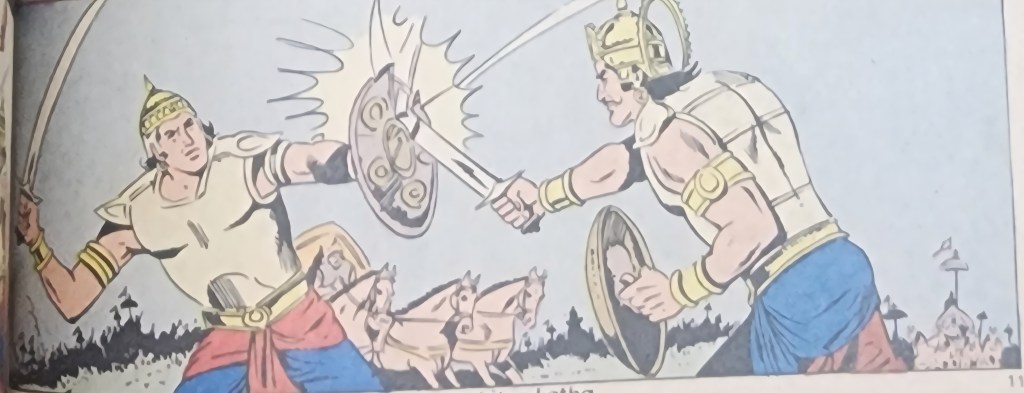
The Shield and Armour are vitally important to a soldier. Image credit – “Mahabharata 33 – Drona’s Vow”, published by Amar Chitra Katha.
So, the defence system and the offensive weapon package together make for a combination that affords a greater probability of mission success. This is the integration that we discussed earlier. A lack of integration, while still capable, is not as effective as the other.
So, one of the things that Op Sindoor has done spectacularly, is to bring the focus onto the parts of conflict management that are not glamourous and are less well known. The management, planning and continuous learning that enable the successful execution of a military operation have been highlighted like never before. And we as a nation can breathe easy as the planners seem to have been doing a great job behind the scenes.
As a last analogy, martial arts training is all about drudgery. One trains for long hours for years on end, despite knowing that the need to apply the learning might never occur. This is also the most preferred situation; one never wants to fight, for the variables in any conflict are numerous. The learning from training in the martial arts are likely applied in walks of like beyond physical combat.
Similarly, the machinery that defends our nation has clearly been going full steam! One can only imagine and marvel at the innumerable hours spent over years, putting together and training with the various aspects that resulted in the success of Op Sindoor! We owe a debt of gratitude to all the individuals who played their parts in this mammoth exercise.
Lastly, just as the martial arts are likely to lead to benefits beyond physical combat, our nation’s defence preparedness will lead to greater economic development due to increased spending on R&D and manufacturing and the many export opportunities that are likely to materialize.
Notes:
* Some other books I have read and heard of about Indian military history are mentioned below. These are beyond the ones mentioned in the article proper.
- 1962: The War that Wasn’t by Shiv Kunal Verma
- 1965: A Western Sunrise by Shiv Kunal Verma
- The Garud Strikes by Mukul Deva
- The Battle of Haji Pir by Kulpreet Yadav
- The Battle of Rezang La by Kulpreet Yadav
- Nimbu Saab: The Barefoot Naga Kargil Hero by Neha Dwivedi and Diksha Dwivedi
- India’s Most Fearless : True Stories of: True Stories of Modern Military Heroes by Shiv Aroor and Rahul Singh
- There are several other books that have out in recent times!
- There is a lot more content on YouTube in the form of podcasts that details recent Indian military history and evolution
** I have heard a statement about Roman military training that goes something like, “the training is like bloodless fighting, while fighting is like bloody training”. I had heard this statement in an old series called “War & Civilization” on Discovery Channel in the late 90s. The series was based on the work of John Keegan.
Similarly, it seems that India’s success in Op Sindoor was as much about the study, planning, research, management and training when there was no fighting, as about the actual fighting during the operation.
 Mundane Budo
a very deep analysis going from modern day warfare to the period of Mahabharata with lots of comparison and references.
LikeLike