19th of April of 2026 is Parashurāma Jayanthi, celebrated as the birth anniversary of Lord Parashurāma. Lord Parashurāma is the 6th avatāra of Lord Vishnu in the Dashāvatāra (dasha – 10, avatāra – incarnation). Lord Parashurāma is perhaps the ultimate representation of an “epitome of the martial arts”. He represents the progression of learning and development of abilities in the martial arts; starting with old fashioned physical abilities to the development of a martial system that resonates in India to this day.
His abilities expanded from close quarters combat to long distance combat. Over time, he became a repository of all the divine weapons that could cause incredible destruction at long distances and over large areas. He created divine weapons of his own! He became a martial arts teacher to the greatest warriors of his age. He played a vital role in both the Ramayana and the Mahabharata!
He was an avatāra of Lord Vishnu for only a portion of his life. Yet he could only ever be contained by either in battle by his own students or another avatāra of Lord Vishnu! He literally went from a vengeful young man to a wise sage! I hope to delve into the great martial prowess of Lord Parashurāma in this article, to identify how these abilities are still practiced in real world martial arts, which almost always have real life applications beyond the dojo.
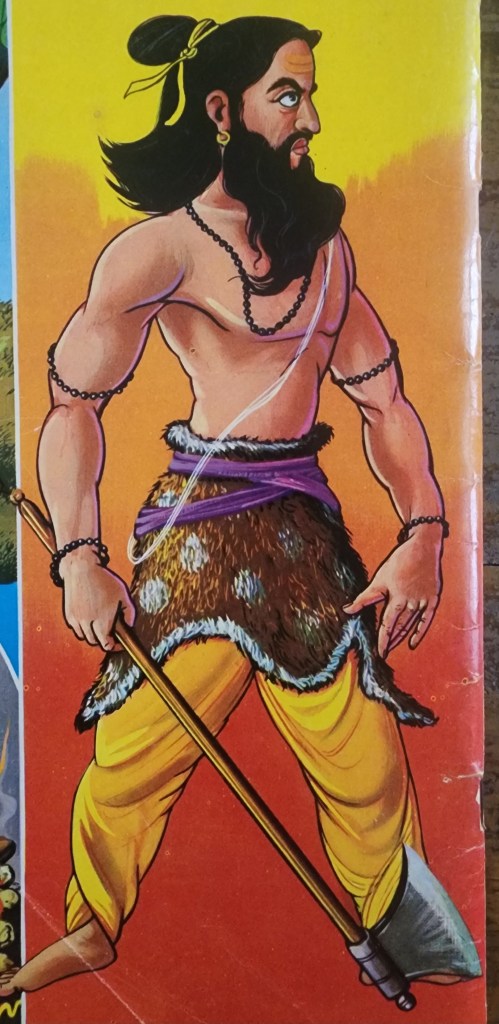
My favourite image of Lord Parashurāma. Image credit – “Bhagavatha”, published by Anada Prakashan.
The “Parashu” in Parashurāma’s name itself describes his martial abilities. Lord Parashurāma’s name is Rama. He was the son of the Rishi Jamadagni and Renuka. Since he was a descendant of Rishi Bhrigu, his name would be “Bhargava Rama”, the Rama in the line of Bhrigu. But he is always known as “Parashu Rama”, or “Rama of the Parashu”.
“Parashu” is the Sanskrit word for an axe. So, when we say Parashurāma, we mean “Rama of the Axe”, or “Rama who wields the Axe”. This is because the weapon most associated with Lord Parashurāma is the AXE. The axe is the weapon that made Lord Parashurāma a feared individual and the weapon he wielded as he fulfilled his purpose as an avatāra. The axe or Parashu wielded by Parashurāma was bestowed upon him by Lord Shiva.
Bhargava Rama, before he became Parashurāma, meditated on Lord Shiva. Being pleased with Rama’s efforts, Lord Shiva instructed him in the martial arts and also handed him the axe that made Rama, Parashurāma. This instruction in the martial arts also resulted in Parashurāma becoming the greatest warrior of his age!
The axe has been used as a tool first and then as a weapon for millennia, perhaps from the early stone age or the Paleolithic age, which lasted from 3.3 million years before present till about 12,000 years before present. Ever since, the axe has never not been in use in human history. It is still used extensively, mainly in working wood and as a tool used by firefighters and other rescue personnel.
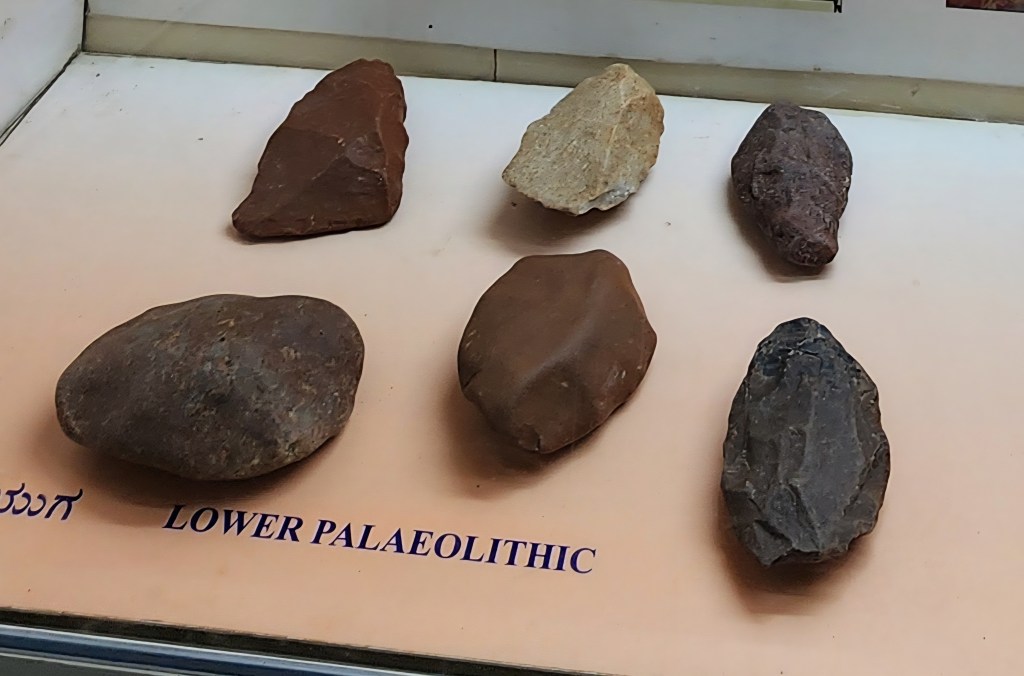
Stone hand axes from the Lower Paleolithic era, displayed at the museum in Aihole, Karnataka
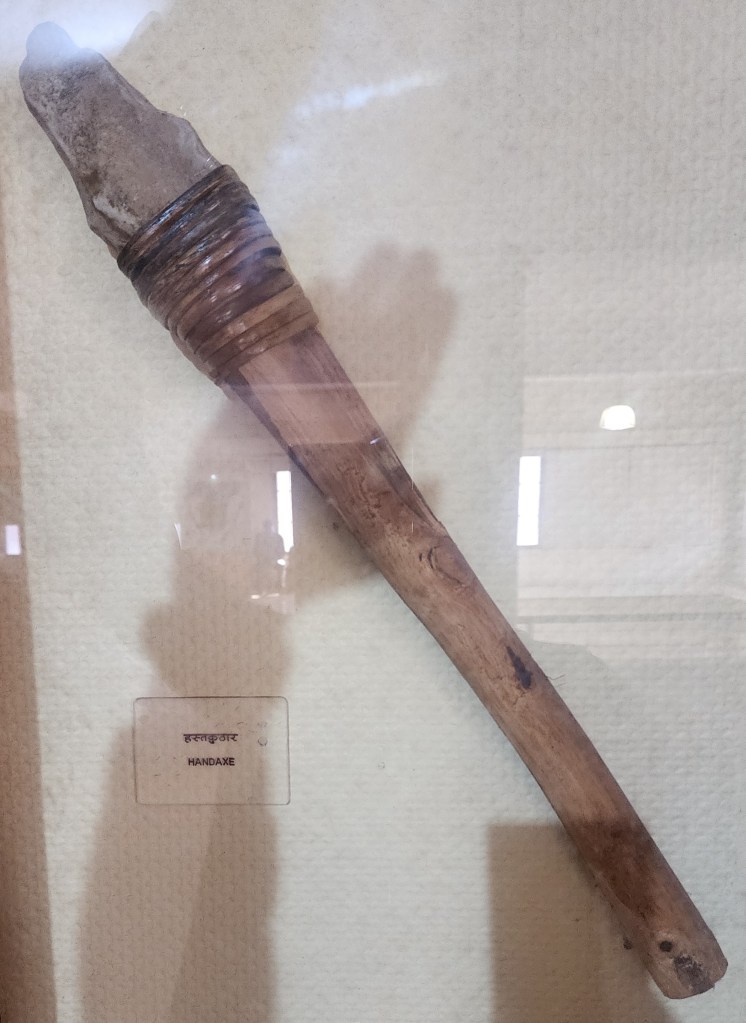
A representation of a stone hand axe from the State Museum, Bhopal
The axe has been used as a weapon in various cultures all over the world. In Japan, a large battle axe was used and referred to as the “Ono”. This seems to have been used to break into buildings or other structures while breaching enemy strongholds. In India, apart from the Parashu, the axe used to fight was called the “Tabar” in Indo-Persian culture and in the regions that is influenced.
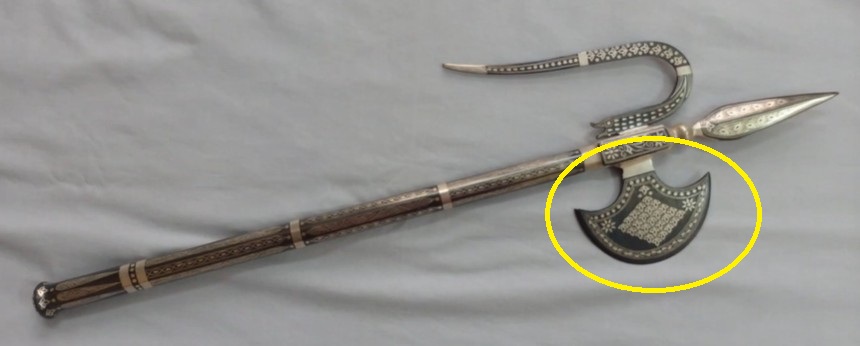
A representation of a tabar. The part encircled in yellow is the axe. The other side of the head is an “Ankusha” (elephant goad). This is a combination weapon.
In Europe, thanks to more historical research than in many other parts of the world, several examples of axes used for fighting are known. The most famous use of the axe that comes to mind, thanks to depiction in pop-culture, is by the Norse cultures, or Vikings. The Vikings used axes of all sizes, from one handed versions to the large “Dane Axe”, which is sometimes claimed to have been able to take down horses!
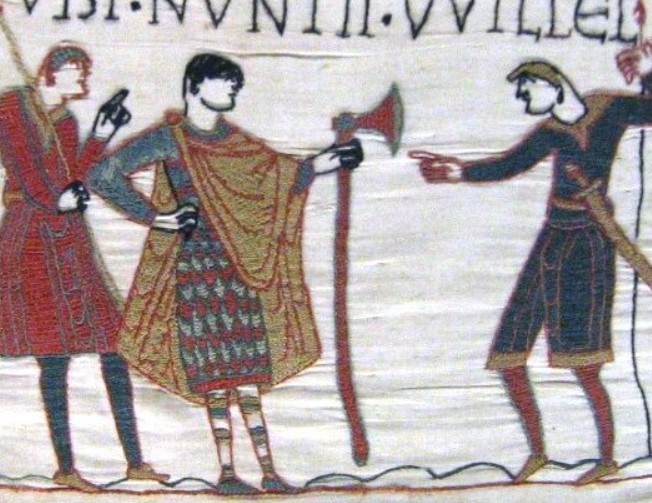
A Dane axe seen on the Bayeux tapestry. Image credit – Wikipedia.
The Dane Axe was the signature weapon of Housecarls, the elite warriors of Norse armies. The Norse expanded their cultural presence all over Europe from the British Isles to France to modern day Russia and Ukraine to even the Byzantine empire that occupied parts of Anatolia, modern day Turkey. The elite royal guard of the Byzantine Emperor, called the Varangian Guard, were mostly Norsemen, between the 10th and 14th centuries. They also carried the Dane Axe. So, this large axe, which stood some 4 to 6 feet tall, was used all across Europe from the North-West to the South-East!
There were other variants of the axe used in Europe. The Francisca, a one-handed axe was used by the Franks (in regions that later became France). This was a weapon what could be used in-hand or thrown at the enemy. Apparently, the Francisca was optimized for throwing. The word for axe in French was “hache”, which gives the modern word “hatchet”, which is a synonym for “axe”.
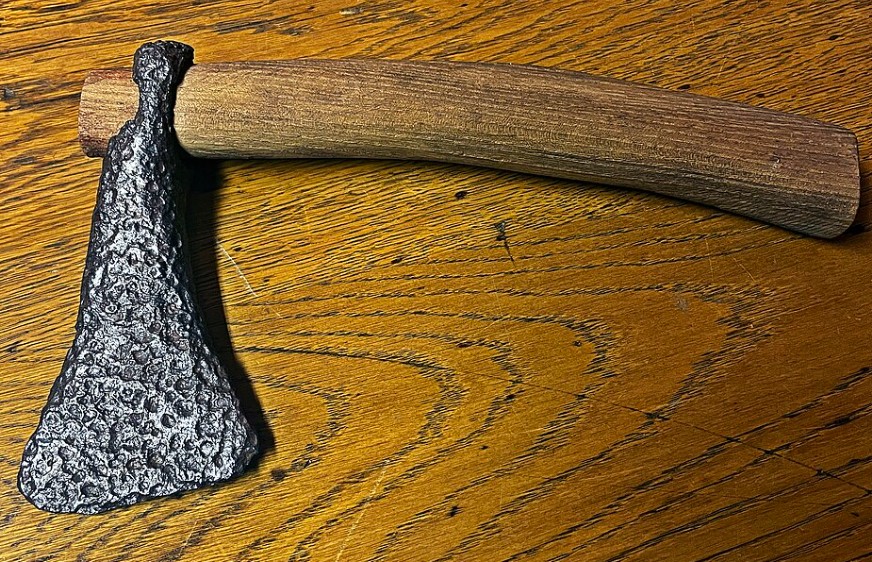
A historic Francisca. Image credit – Wikipedia.
The axe even came to be included in polearms, which were called “Halberds”. Halberds of various shapes came to be in late-medieval and renaissance Europe. Many of these came to include a variant of the axe. A variant of the halberd, called the “Farsa” was also used in India around the time of the Mughal Empire. The halberd almost always included a spear point. This allowed a long weapon to not just pierce efficiently but also have sufficient hacking ability.

A Farsa, from the City Palace Museum in Udaipur, Rajasthan. This is an Indian version of the halberd.
It was the development of the full plate harness (full plate armour) that led to the development of perhaps the most iconic axe in history, the Pole Axe. I have heard it said that this weapon can also be called the “Poll Axe”. Since it was impossible to cut through the plate of the armour of men-at-arms and knights, weapons that caused blunt force trauma through the armour and pierce the gaps in the armour were developed.
This combination weapon was about the height of a man, some 5 to 6 feet tall. It included a wooden shaft and a head that included an axe, a hammer and a spear point. The axe head here could be similar to a conventional axe head we are used to seeing or a “crow’s beak”, which resembles an ice pick.
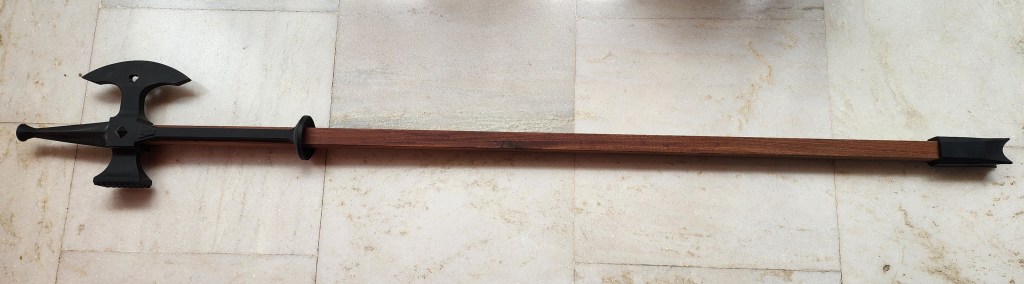
A training version of the Pleaxe
Further west, in the Americas, the Tomahawk used by the Native Americans is another pop-culture icon. This was a small axe or hatchet that could be used single handed, as a tool or as a weapon. It was supposedly thrown as well. Interestingly, there were supposedly tomahawks which could be used as smoking pipes!
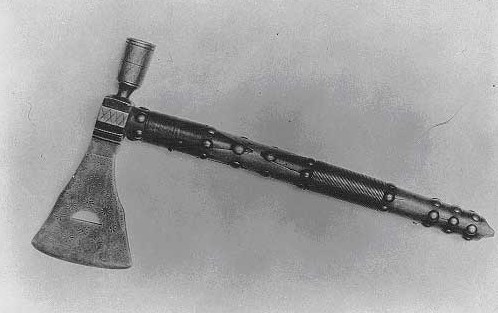
An antique Tomahawk. Image credit – Wikipedia.
Since I have mentioned different types of axes, it must be mentioned that the design and construction of axes vary based on whether it is intended for use as a tool or as a weapon. Of course, an axe designed as a tool can be used as a weapon and vice versa, but there was design optimization. Axes used as weapons were lighter for easier wielding while those used as tools were robust for endurance.
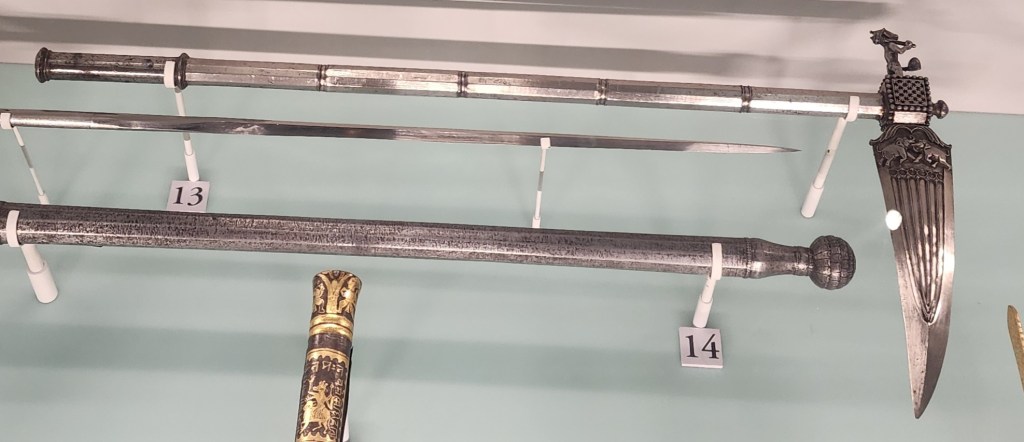
A Crow’s Beak in the City Palace Museum, Udaipur, Rajasthan
The axes used as tools were further segregated as splitting axes and chopping axes. This distinction allowed the wedge of the axe head to be modified suitably. Axes used as weapons were leaner. They tended to be thinner towards the centre and thickened towards the cutting edge for better force transfer. Further, the profile of the axe head also changed based on the application.
There were “bearded axes”, which had the front cutting edge be considerably longer than the rear end or the eye of the axe. This enabled them to hook the weapons and shields of opponents better. There were even axes which had the cutting edge elongated towards the opponent, to allow for thrusting with the same axe head!
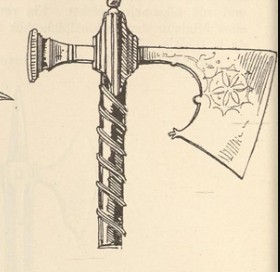
A representation of a Bearded Axe. Image credit – Wikipedia.
I am not sure if there is a description of the specific axe or axes that Lord Parashurāma used. I am also not aware of any specific description of the techniques Parashurāma used to wield his axe effectively. Parashurāma also possessed various celestial weapons that he has acquired from Lord Shiva apart from his Parashu. I am not sure if he used these in conjunction with his axe while he vanquished his enemies. By common sense, It seems likely that he used the axe for close quarters combat while he deployed his Divyāstras (divine weapons) for ranged attacks against larger numbers of enemies.
Parasurāma conducted 21 campaigns against corrupt Kshatriyas, likely rulers who were corrupt or considered unworthy. In these wars he decimated entire ruling families! The bloodletting is supposed to have been so immense that the blood of his enemies filled up 5 lakes! The land where these lakes existed was called the Samantapanchaka. It was later the battlefield of Kurukshetra, where the great war took place during the Mahabharata.
Of the 21 campaigns, the first one is truly remarkable. Kartaveerya Arjuna was a ruler of the Haihaya clan who ruled from Mashishmati, a city on the banks of the river Narmada. He was also called Sahasra Arjuna. Sahasra means thousand. Arjuna was supposed to be “Sahasra Bāhu”. Bāhu means arm. So, “Sahasra Bāhu” means “thousand arms”. Sahasra Arjuna was called so because he supposed to have had a 1000 arms! This is generally taken to mean that his might was immense, comparable to an individual with a 1000 arms.
Kartaveerya Arjuna or Sahasra Arjuna was a great devotee of Lord Dattatreya, due to whose blessings he became a mighty human and a great king. But with time he became an arrogant individual and an unworthy ruler. He and his sons were responsible for the death of Parashurāma’s father, the Rishi Jamadagni. This led to Parashurāma going to war single handedly against Arjuna and his many sons.
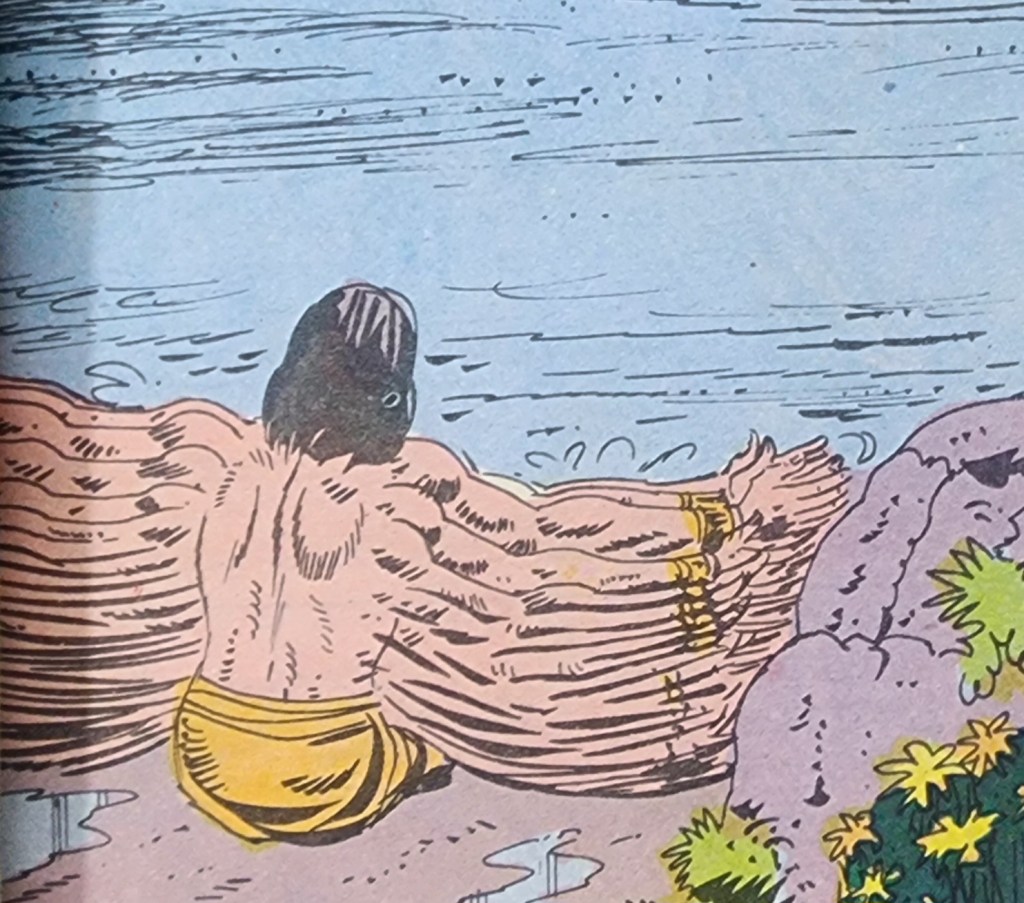
Sahasra Arjuna depicted literally with a 1000 arms, stopping the flow of the river Narmada. Image credit – “Ravana Humbled”, published by Amar Chitra Katha.
Sahasra Arjuna’s fighting abilities are demonstrated by his defeat of Ravana. This is the same Ravana who had conquered all before him and later fought Lord Rama in Lanka after he abducted Devi Sita. Arjuna imprisoned Ravana after the latter lost a duel against him. Ravana was eventually released agreed to a peace with Arjuna. This was after Rishi Pulastya, Ravana’s grandfather, interceded on his behalf.
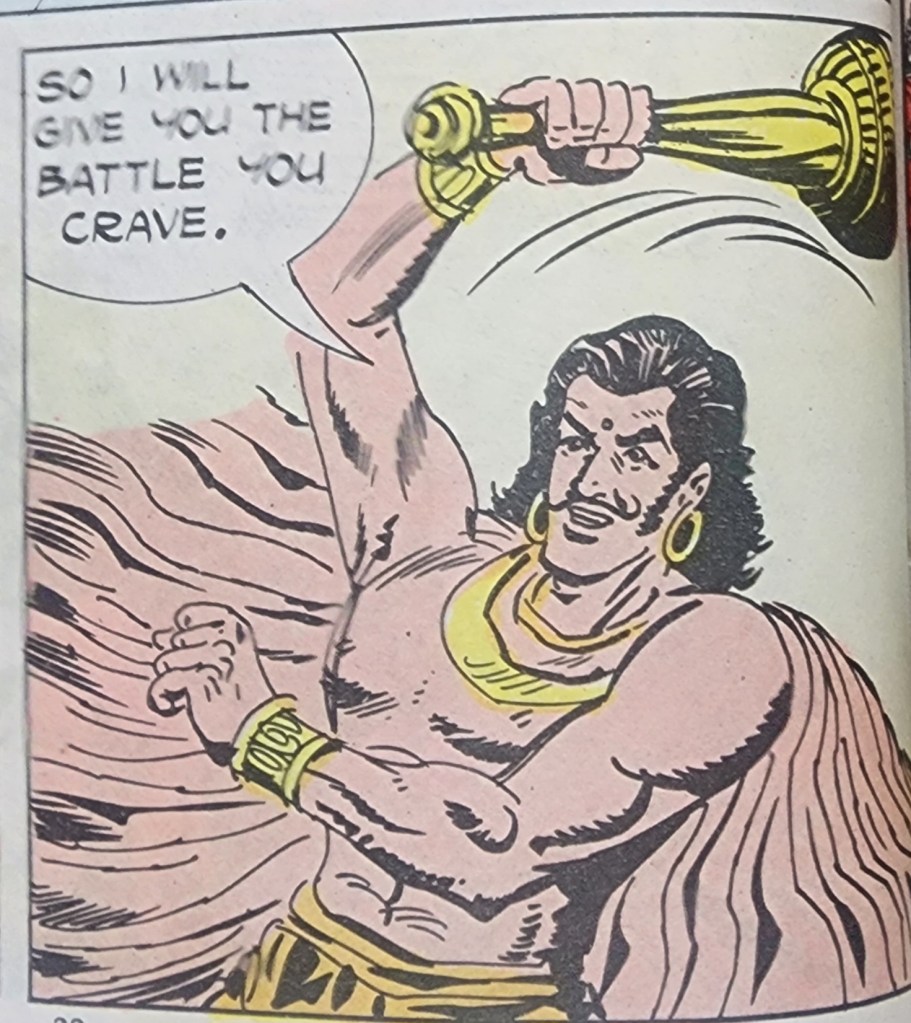
The might of Kartaveerya Arjuna. Image credit – “Ravana Humbled”, published by Amar Chitra Katha.
While common knowledge attributes the adjective “Sahasra Bāhu” for Arjuna to signify might, I differ in my opinion. A great warrior, even while just considering one’s fighting abilities and not tactical or strategic brilliance, is not measured by just physical might. They are also respected for their skill with weapons and in unarmed combat. They can also be great due to speed and agility, apart from just strength.
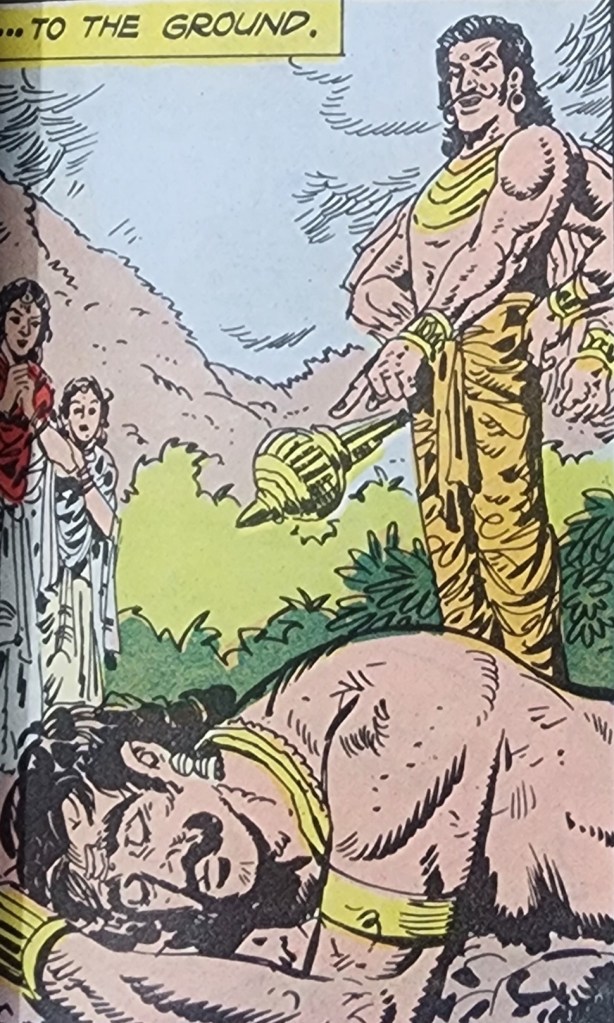
Arjuna knocks out Ravana. Image credit – “Ravana Humbled”, published by Amar Chitra Katha.
So, is it likely that Arjuna was a rare warrior who could wield all manner of weapons with consummate skill? Was he able to move with such ease and grace that an opponent felt like he was fighting several opponents at the same time? I opine that this is likely. Arjuna could move and use multiple weapons with such skill and ability (speed, agility and strength) that it seemed like he had a 1000 arms! Hence, Sahasra Bāhu!
It was this great Arjuna that Parashurāma defeated in his first battle. Parashurāma defeated and killed Arjuna and his sons to avenge his father. After this, he went on a rampage that constituted his 21 campaigns and led to the slaughter of a very large number of people! This act of his was the purpose of the Parashurāma avatāra. He was an avatāra only during this time. But that was not the end of his life’s purpose.
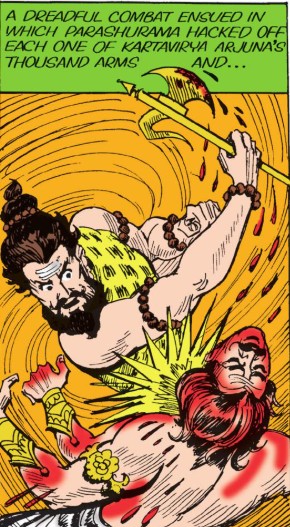
Lord Parashurāma slays Kartaveerya Arjuna. Image credit – “Parashurama” (Kindle edition), published by Amar Chitra Katha.
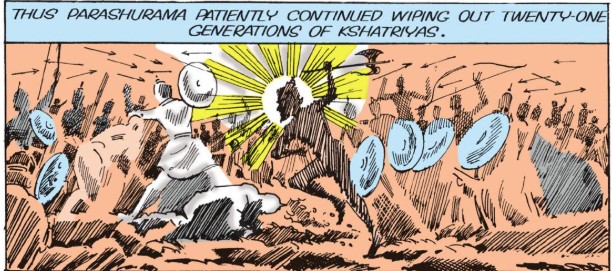
Lord Parashurāma’s 21 campaigns against the Kshatriyas. Image credit – “Parashurama” (Kindle edition), published by Amar Chitra Katha.
Lord Parashurāma is counted among the immortals in Hindu culture. He is believed to be still alive. His next task on this Earth is to be the mentor for the Kalki avatāra, an incarnation of Lord Vishnu that is yet to appear. But between his slaying of Kartaveerya Arjuna and the coming of Kalki, he was instrumental in the happenings of both the Ramayana and the Mahabharta. He is even supposed to be responsible for the current geography of the Indian peninsula! And the creator of one of modern India’s most popular martial arts!
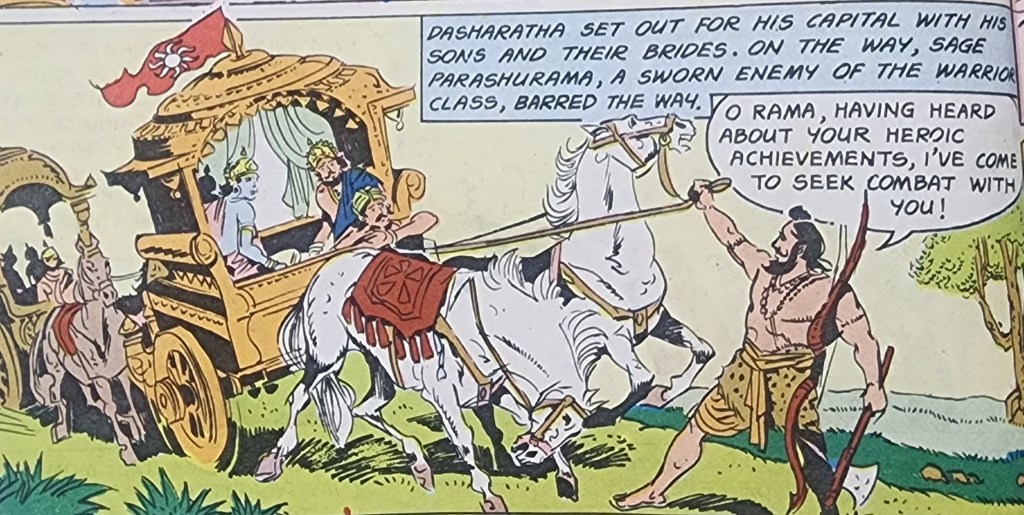
Lord Parashurāma seeks combat with Lord Rama. Image credit – “The Ramayana”, published by Amar Chitra Katha.
Lord Parashurāma’s stature and abilities as a warrior are reflected by the people he interacted with during the Ramayana and the Mahabharata. Parashurāma’s campaign against Kshatriyas ended when he faced Lord Rama. During the swayamvara of Devi Sita, Lord Rama broke the bow of Lord Shiva. Parashurāma, being a devotee of Lord Shiva, was angered by this act and faced off against Lord Rama. But there was no fight. Parashurāma recognized the next avatāra of Lord Vishnu in Rama and withdrew.
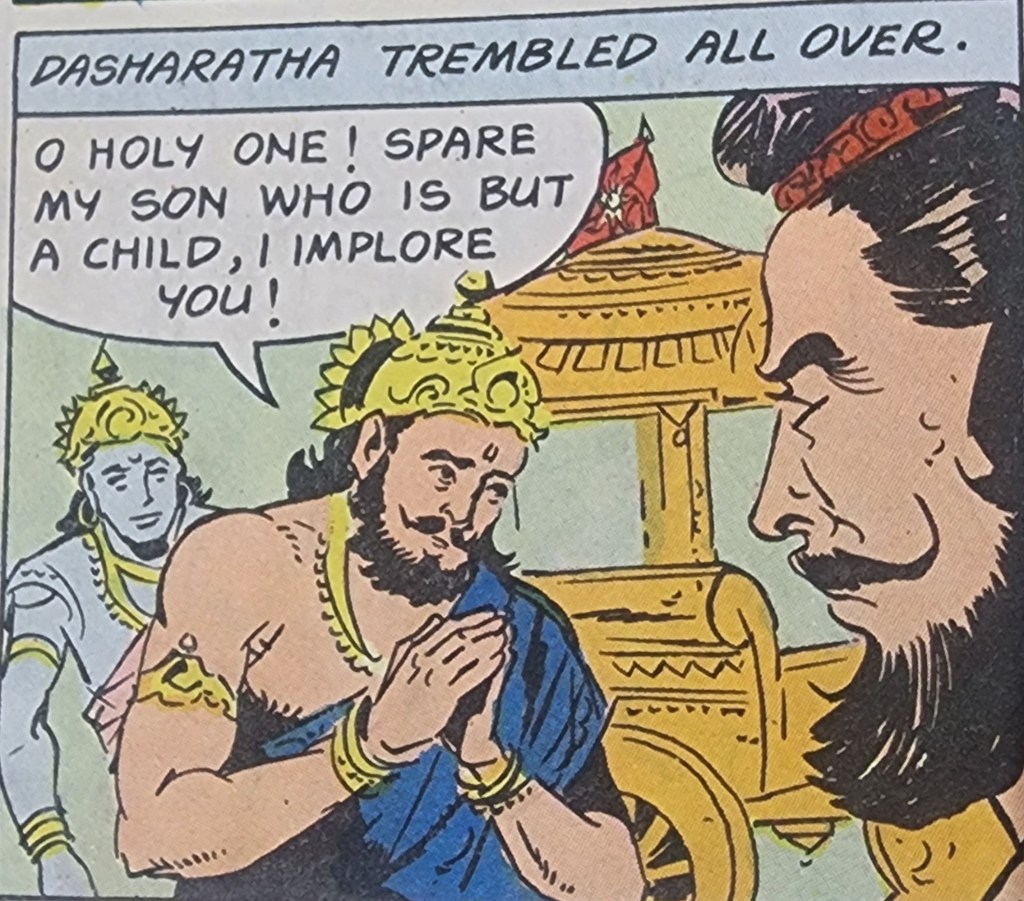
Dasharatha, father of Rama, is extremely worried by the prospect of his son facing Lord Parashurāma in a fight. Image credit – “The Ramayana”, published by Amar Chitra Katha.
Parashurāma was invincible. Rama’s father Dasharatha knew this and was worried when Rama faced off against this great warrior of old. Parashurāma’s withdrawal shows that it took another avatāra of Lord Vishu to stop him from fighting, let alone defeat him! That shows how great a warrior, in other words, martial artist Parashurāma was, even after he was no longer an avatāra!
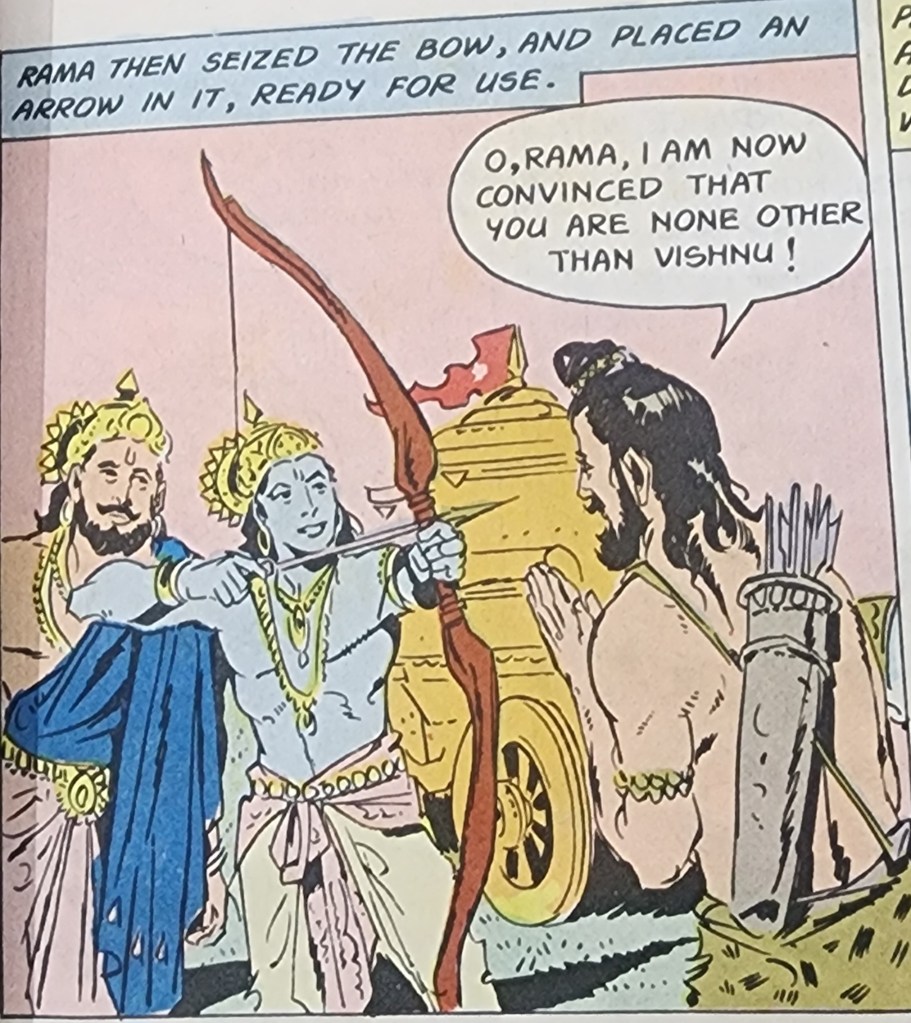
Parashurāma recognizes Rama as an incarnation of Lord Vishnu. Image credit – “The Ramayana”, published by Amar Chitra Katha.
Parashurāma’s encounter with Rama also made him realize that rulers who were committed to Dharma were back in the world. This meant that he could stop his campaign against corrupt Kshatriyas. Parashurāma now focused on yajnas and meditation to atone for the many deaths he had caused. He also gave away all his possessions.
Parashurāma needed land to meditate on and share his knowledge and possessions. To this end, he got the sea to retreat! He is supposed to have hurled his axe into the western sea (today called the Arabian Sea). The sea retreated beyond the point where the axe landed. The land that was reclaimed by the retreating of the sea is supposed to be India’s western coast, all the way from Goa through Karnataka and Kerala. This coast is also called “Parashurāma Kshetra” for this reason.
Parashurāma, after his interaction with Lord Rama went on to become a great martial arts teacher. He was the teacher to 3 of the greatest warriors in the Mahabharata. Bheeshma, the general of the Kaurava armies and the greatest warrior of the era was a student of Lord Parashurāma. Karna, the lost brother of the Pandavas and the king of Anga, was also a student of Parashurāma. Drona, the martial arts teacher of both the Pandavas and Kauravas acquired the knowledge of divine weapons from Lord Parashurāma, which he passed on to his students.
The greatness of Parashurāma as a martial artist is again highlighted by his 3 illustrious students. Bheeshma had to fight his Guru as Princess Amba of Kashi had approached Parashurāma after she had faced great injustice due to Bheeshma. Bheeshma and Parashurāma fought each other to a standstill with their divine weapons. So, another instance where Parashurāma could be contained, came about because of an individual Parashurāma himself had trained! It took a student to stop the teacher, no one else could do it!
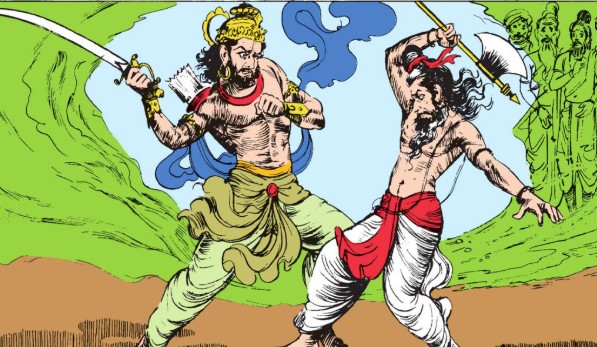
Bheeshma fights his Guru Parashurāma to a standstill. Image credit – “Bheeshma” (Kindle edition), published by Amar Chitra Katha.
Guru Dronācharya acquired all the celestial weapons and learned the means to use them from Lord Parashurāma. He used these with such devastating impact that the Pandavas had to resort to deceitful means to kill him on the 15th day of the Kurukshetra War! With the knowledge acquired from Parashurāma, Drona was invincible, in the same mould as his great teacher! This necessitated the deceit employed against him.
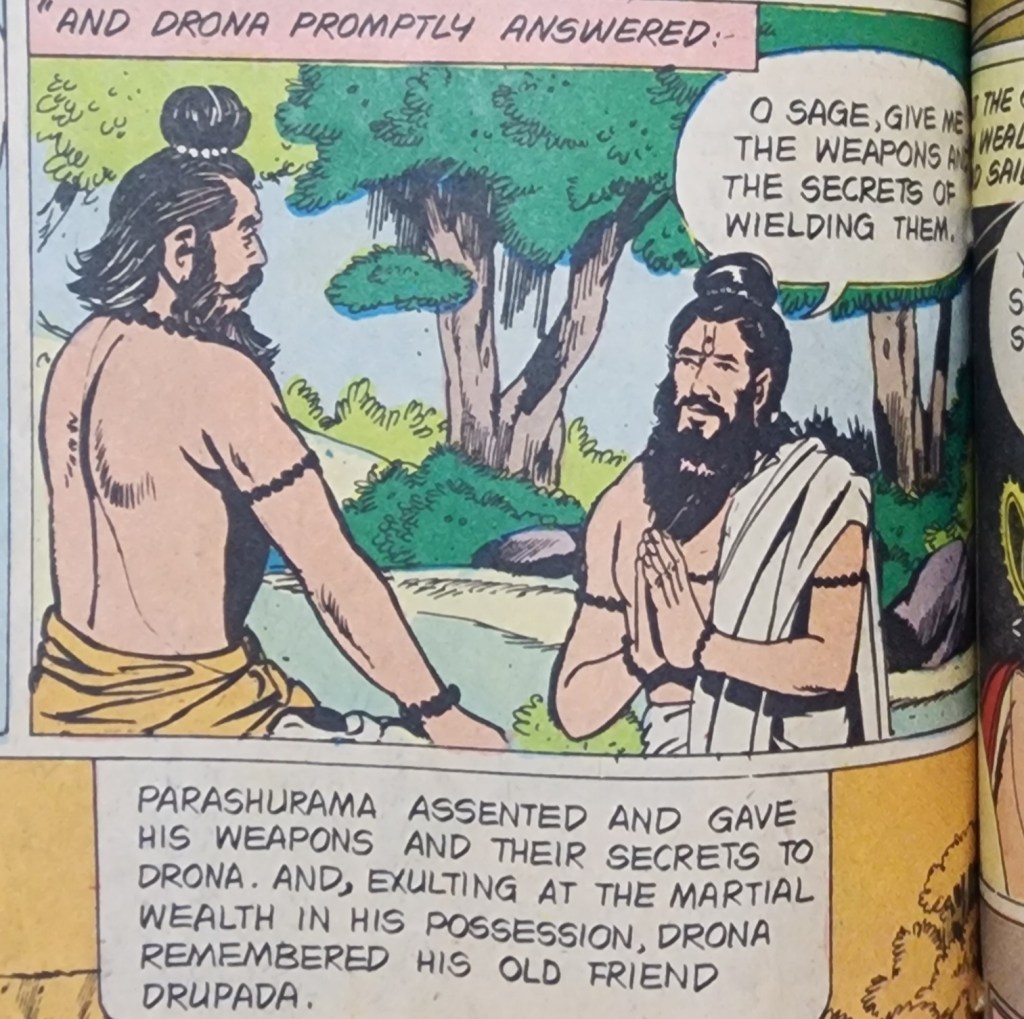
Drona acquires weapons from Lord Parashurāma. Image credit – “Mahabharata – 5, Enter Drona”, published by Amar Chitra Katha.
Most of the divine weapons described in the Mahabharata come from the various Devas, like Indra, Agni, Vāyu, Varuna, Kubera, Lord Shiva, Lord Brahma, Lord Vishnu and the like. But Lord Parashurāma created his own divine weapon! Such was his ability! He created the Bhargavāstra, a weapon of great destructive power, which he bestowed upon his student Karna. Parashurāma also gave Karna his bow, called the Vijaya, which rivalled Arjuna’s (the Pandava) Gandeeva in fame. Karna used both the Vijaya and the Bhargavāstra to devastating effect against the Pandavas before his death on the 17th day of the Kurukshetra War.
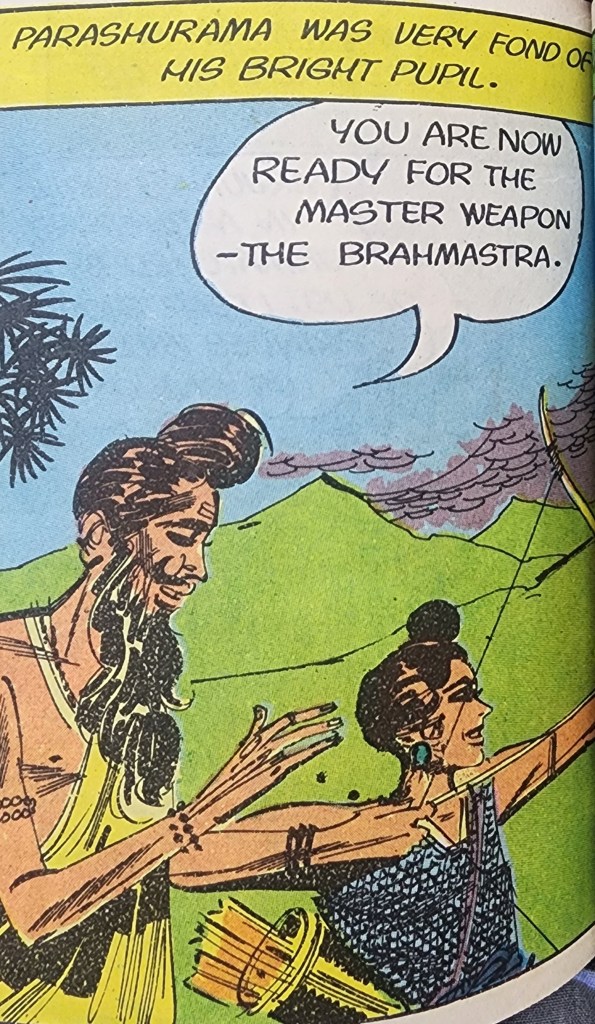
Karna learns from Parashurāma. Image credit – “Karna”, published by Amar Chitra Katha.
The journey of Lord Parashurāma, from a student of Lord Shiva, to an avatāra of Lord Vishnu to his becoming a martial arts teacher of great renown is remarkable. It signifies what is called “Shugyo” in the Bujinkan system of martial arts, and Japanese martial arts in general. “Shugyo” refers to “martial journey”. It is the journey in life through the practice of martial arts that a student of the same goes through.
Lord Parashurāma went through the ultimate Shugyo! He started off as a student of the greatest teacher, Lord Shiva, and acquired mastery over the greatest weapons of his age. He applied his learning to eliminate the greatest threats of his age to Dharma. He then went on to become the greatest martial arts teacher of his age and created the greatest warriors of the next age! He went from student to grandmaster of a martial lineage, while being undefeated all the while!
This act of Lord Parashurāma being a grandmaster brings us to the modern day. He is considered the preceptor of Kalari Payattu, one of India’s most popular martial arts in current times. This is a martial art system that originates in the Southern Indian state of Kerala, which is a part of the Western Coast, the Parashurāma Kshetra referred to earlier. I have heard it said that Kalari Payattu has 2 lineages, a northern and southern lineage.
Maharishi Agastya is considered the creator of the southern lineage while Lord Parashurāma is credited with creating the northern lineage. Kalari Payattu is a complete system, like the Bujinkan system of martial arts that I am a student of. It comprises of armed and unarmed combat and a healing system. The weapons trained include short, medium and long-range weapons.
This brings me to the concluding point of this article. It relates to the application of martial arts in day-to-day life. It was mentioned to me a few weeks ago, by someone close to me, that a practitioner of the martial arts, specifically of the ones with origins in the eastern hemisphere, do not feel anger. In my opinion, this is a fallacy. The practice of the martial arts might lead to effective and consistent anger management, but not a lack of the emotion of anger.
This is a good place to discuss anger management, as Lord Parashurāma was feared for his anger. This was perhaps because he could fly into a rage, especially during his 21 campaigns against corrupt rulers. And his rage could lead to entire armies being slaughtered. But even the great avatāra changed over time. He gained control and atoned for the lives he had taken. He even gave back to society through his students and his creation of martial arts practiced to this day.
I have always felt that martial arts are a synonym for conflict management. The conflict could be internal, due to one’s own emotions, or external, due to interactions with other people and systems of society. A lot of the time, there is no clear solution to the problems or conflicts we face, like traffic or process management in offices, hospitals or anything we might come in contact with. It might also have to do with neighbours, pollution and family.
Violence can never be used to solve problems in a democratic country. And other solutions, if any, might take an inordinate amount of time, not to mention financial expenditure. These situations will invariably lead to any individual feeling anger, routinely.
Now consider training in a dojo or any other setting. A lot of the time, during practice, one might face an opponent with greater physical skills – speed, strength or just sheer size. One might even be up against multiple opponents. And then there are situations with weapons and multiple opponents with weapons! These are situations where one feels anger at the sheer lack of options to survive even in a practice situation. And this invariably leads to fear and then to anger. The anger is at the unfairness of the situation and at oneself, for not being able to deal with it or at being angry after years of training! 😊
These are situations during which one trains to be able to control oneself. That is conflict management and anger management at the same time. One controls oneself to find options to survive and thus influence the situation. When one feels anger in a routine situation, hopefully the martial training comes to the fore to keep a check on it. It is like thinking, “if I could survive a physical attack, this situation where there is no physical threat cannot be worse, can it!”
So, the practice of the martial arts leads to improved self-control. The control a practitioner can achieve depends on the duration of training and the circumstances life has put one through. There is no formula for this. With self-control, it might seem with some people that they never feel anger. But that cannot be a universal expectation.
In about 20 years of training, the only Budoka I have felt feel no anger at all are among the senior most Sensei in the Bujinkan system of martial arts. These are people with over 50 years of martial experience! They are also people who have overcome great travails in life and are over 70 years of age! So, age and wisdom (which is dependent on life experience) are likely to play a big role here.
All the other Budoka I have had the fortune of interacting with, even those training since the 1980s, are not beyond anger. They definitely feel the emotion, but they also have terrific self-control. They never let anger dictate their movements or actions, and almost definitely never their words. They have mastered the martial art to better themselves, not to leave behind a part of themselves (which is what anger is). This at least, is my experience at this point in life.
This concludes this article, where we went from celebrating Lord Parashurāma to appreciating axes from all over the world to considering anger and the martial arts.

