This article is the second part of a series of 2 where I delve into the use of “deception in the martial arts” and in conflict management in general, as can be gleaned from the life of Lord Krishna. Link to the first part is seen below. I would recommend reading the 2 parts in the chronological order, though this part can be read as a standalone post.
In part 1, I had considered in limited detail, the situations where Lord Krishna had deployed deception to manage several conflicts, both with and without the use of Maya (magic and illusions). We had looked at situations where deception and Maya as used by Lord Krishna had failed to achieve the desired outcomes and also cases where deception was used against Lord Krishna with some success. We had also looked at cases where Krishna’s use of deception had succeeded.
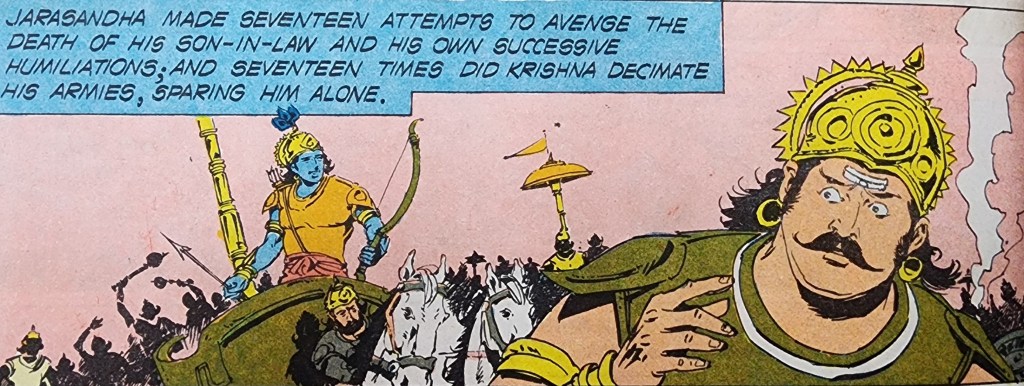
One of the situations which we looked at where deception was the key to Lord Krishna’s success was the 18th invasion of Mathura by Jarasandha, the emperor of Magadha. This invasion was accompanied by a simultaneous invasion of Mathura by Kāla Yavana. We will continue further in this article from this invasion.
The twin invasions of Kāla Yavana and Jarasandha also led to another act of deception. While the Yavana was defeated and his army destroyed, Jarasandha was still on the war path. The forces of Mathura were exhausted and could not face a second attack. Even Balarama did not want to fight another army right away.
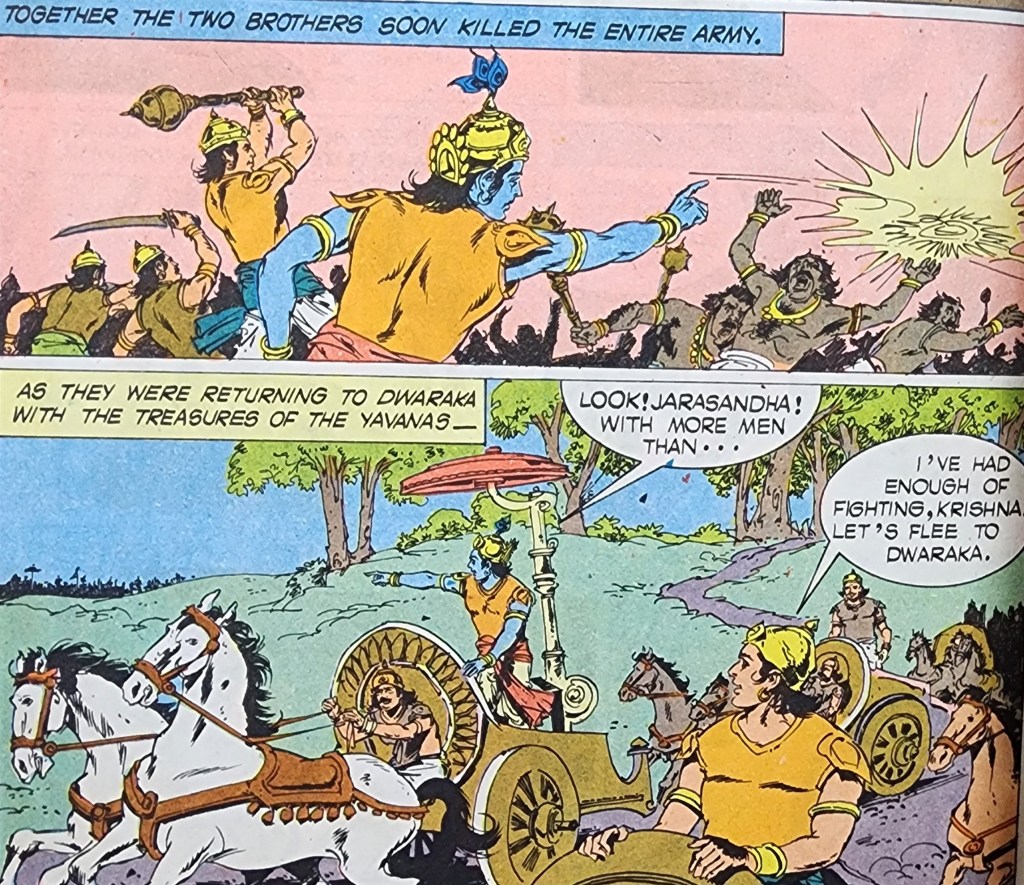
Lords Krishna and Balarama defeat the Yavana army but are exhausted to face the army of Jarasandha immediately after. Image credit – “Krishna and Jarasandha” published by Amar Chitra Katha.
This would be a situation similar to what Harold Godwinson would have faced during the twin invasions of England in late 1066. His army could overcome the Norwegian forces of Harald Hadrada but were defeated by the Norman forces of William of Normandy. Harold had to contend with the two invasions over the course of a few weeks and could not succeed.
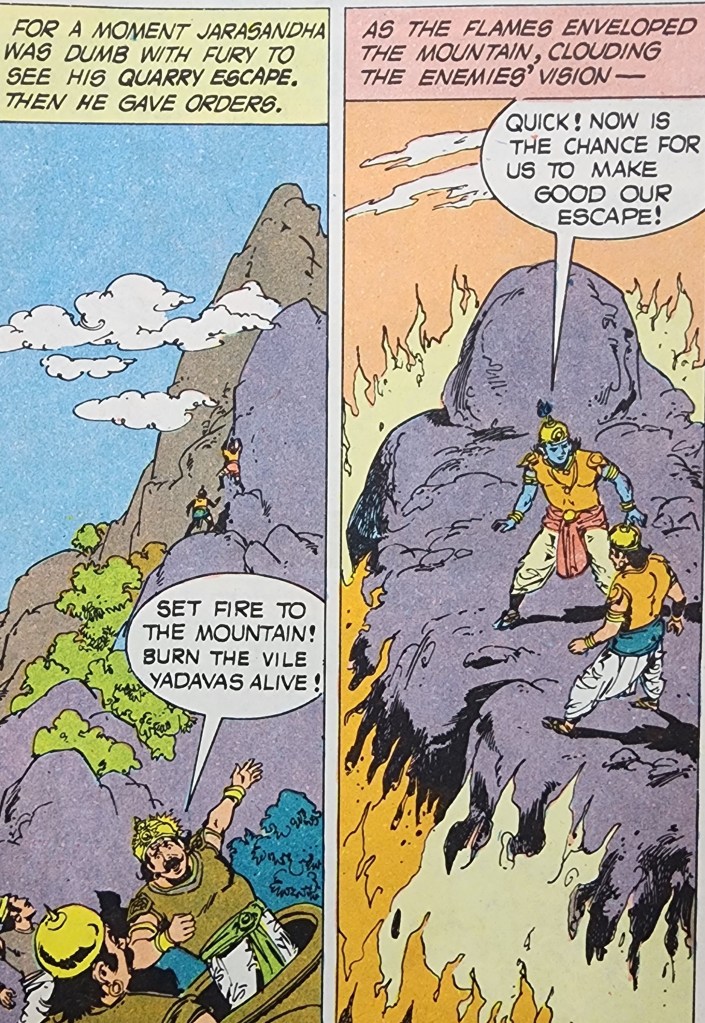
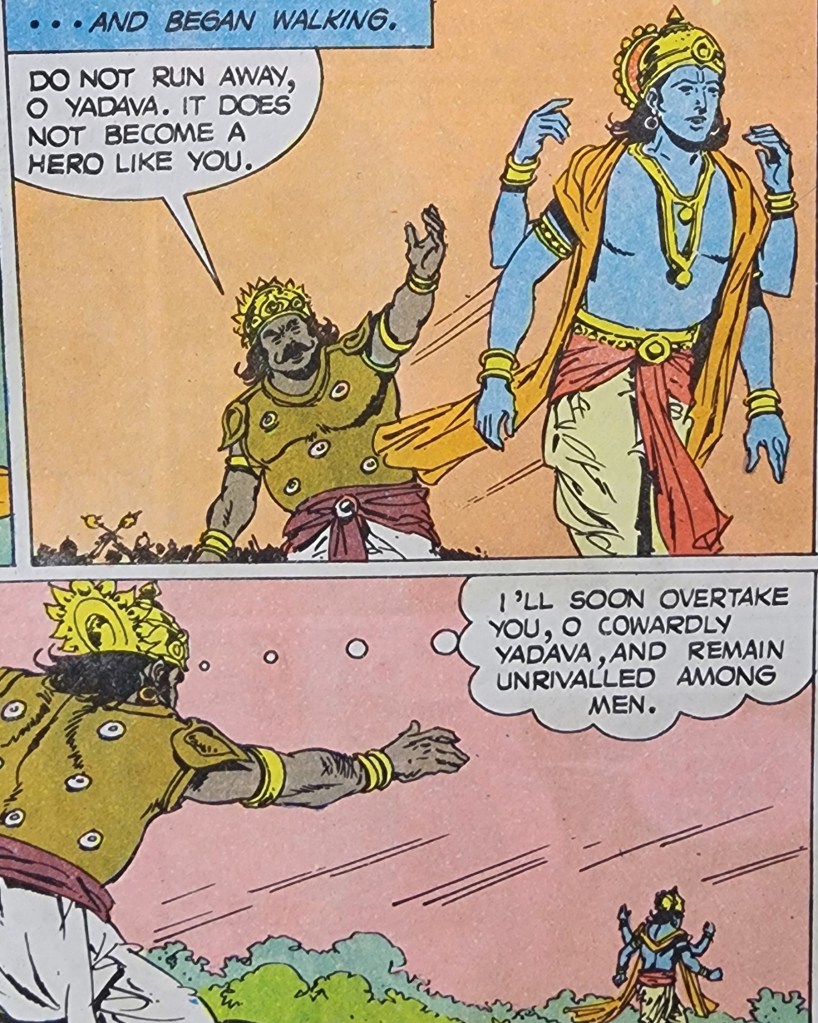
Jarasandha chases Krishna and Balarama as they retreat to Mount Pravarshana and sets fire to the mountain to kill them. Image credit – “Krishna and Jarasandha” published by Amar Chitra Katha.
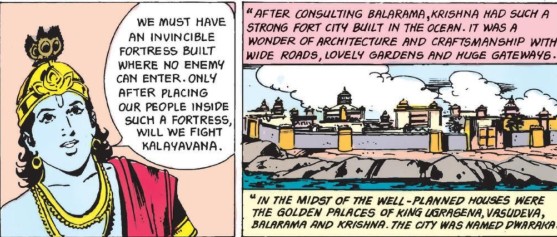
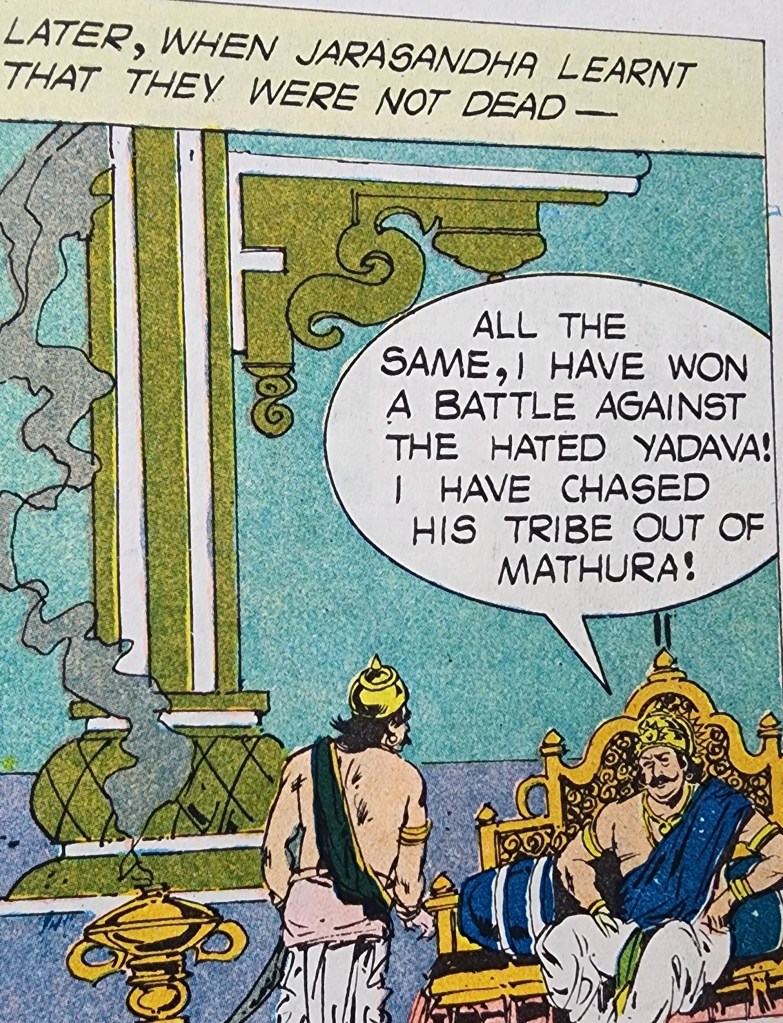
In a similar situation, the brothers Krishna and Balarama again chose escape. They retreated in the face of Jarasandha’s army, which pursued them up the mountain called Pravarshana. Assuming the brothers trapped, the army set fire to parts of the mountain. Krishna and Balarama managed a surreptitious escape, but Jarasandha believed them dead. Much later, when Jarasandha learnt that the Yadava brothers had escaped to Dwaraka, he was content with having chased them out of Mathura.
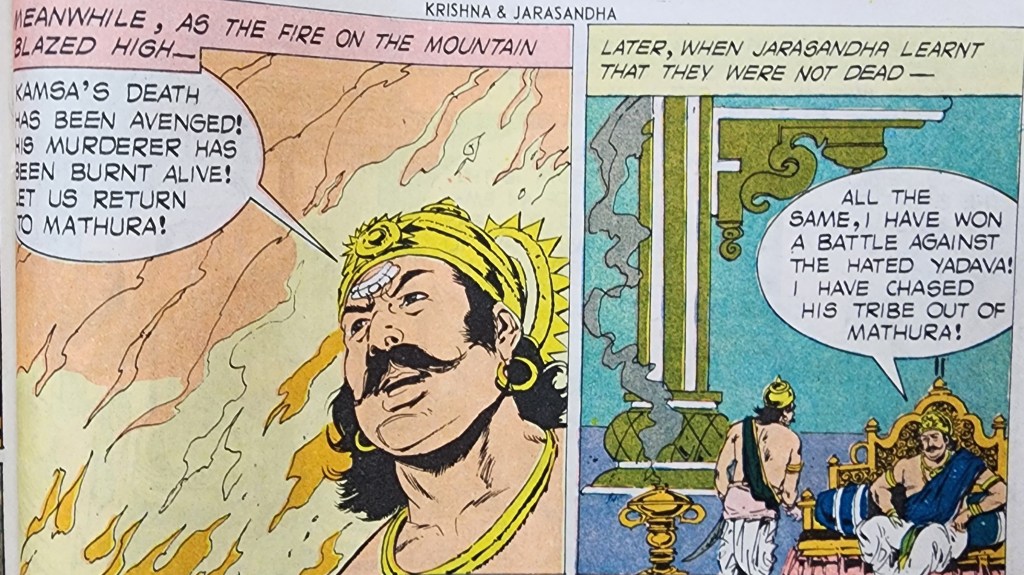
Jarasandha believes Krishna and Balarama are finished, but is satisfied at chasing them out of Mathura when he learns of his failed attempt. Image credit – “Krishna and Jarasandha” published by Amar Chitra Katha.
This bought Lord Krishna to take out Jarasandha’s vassals one by one and build alliances of his own to eventually slay Jarasandha. One of Jarasandha’s allies was the ruler of Pundra (in modern day Bangladesh) whose name was Vāsudeva. Krishna was also called Vāsudeva as his father was Vasudeva. The king or Pundra is referred to as Paundraka Vāsudeva as he was the king of Pundra. Thus, Krishna and Paundraka shared a common name.
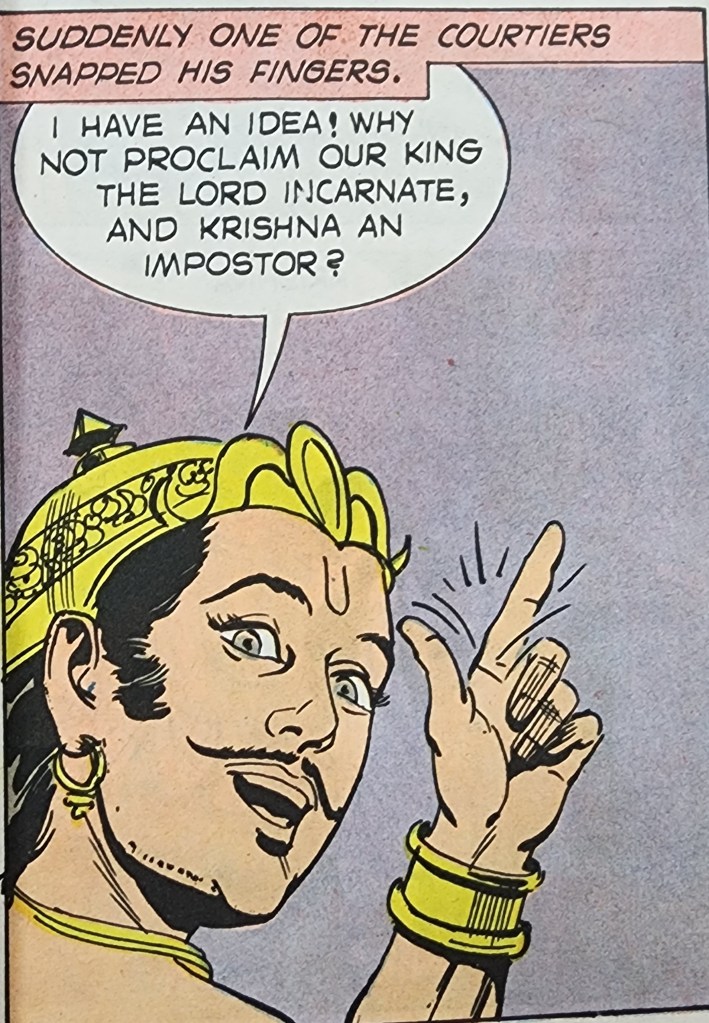
A courtier of Paundraka’s suggests that his king should proclaim himself the true incarnation of Lord Vishnu. Image credit – “Krishna and the False Vaasudeva” published by Amar Chitra Katha.
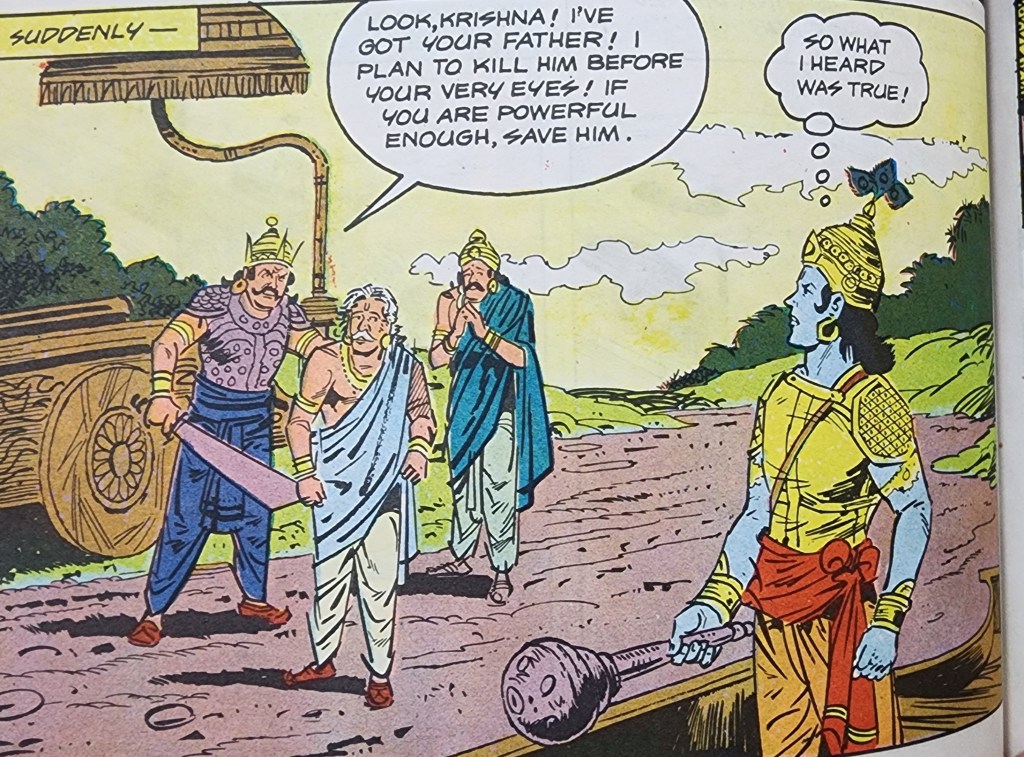
In a bizarre case of early psychological or intelligence warfare some courtiers of Paundraka convinced him to claim that he was the real Krishna! Paundraka started flaunting a peacock feather and a flute to support his claims! Some in his kingdom started believing this fiction and started worshipping Paundraka! This came to a head when Paundraka sent a messenger to Krishna asking him to handover the Sudarshana Chakra and Garuda, the divine being who was Krishna’s vāhana!
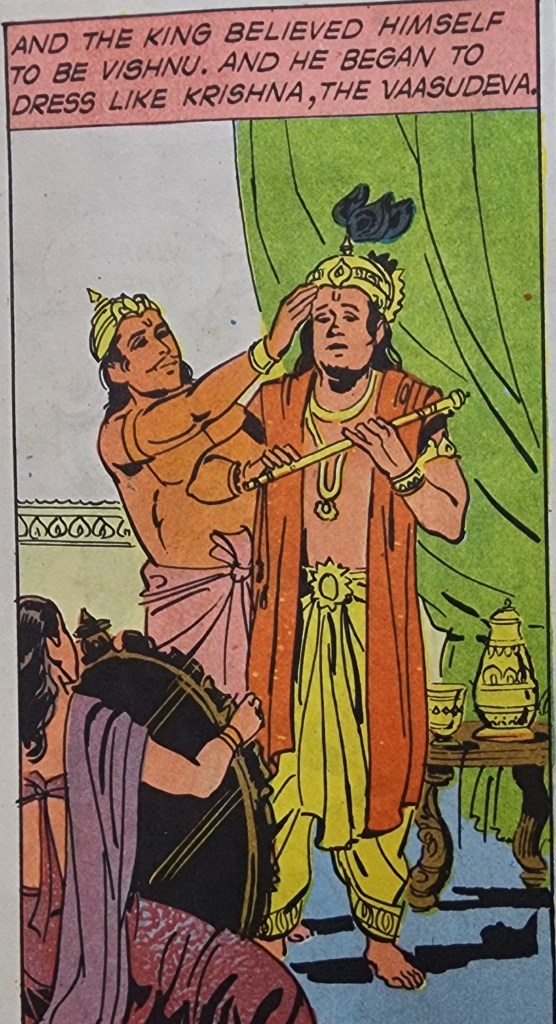
Paundraka believes himself to be the real Vaasudeva and dresses to imitate Krishna. Image credit – “Krishna and the False Vaasudeva” published by Amar Chitra Katha.
Krishna, who was in Dwaraka, acceded to the request! He agreed to come alone on Garuda and hand over the Sudarshana Chakra. The courtiers and the King of Kashi, a friend of Paundraka and another vassal of Jarasandha knew that the situation was fraught for Paundraka. But their king had started believing his own lies and waited with his own army and that of the King of Kashi.
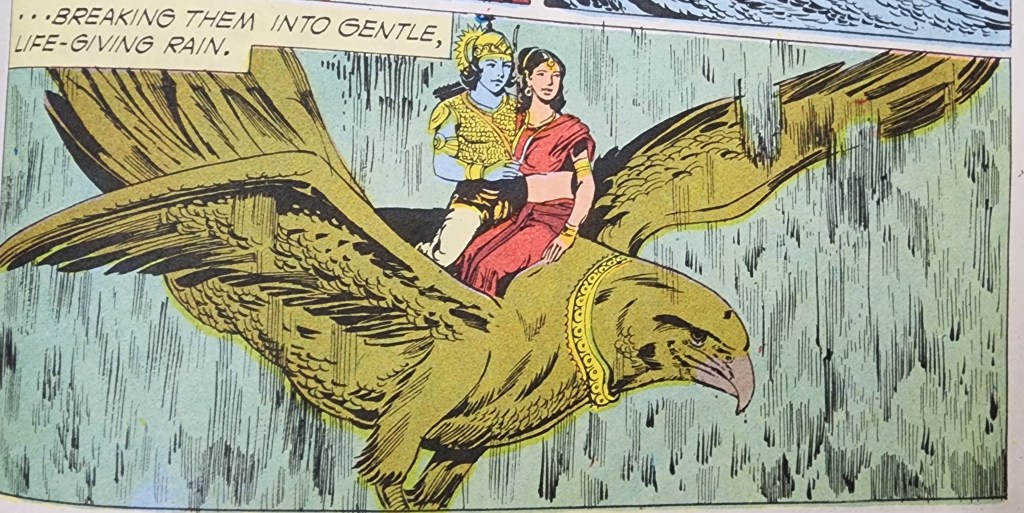
Krishna surprised (read deceived) them all by flying in on Garuda. This gave him an aerial advantage while neither of the 2 armies awaiting him on the ground had this advantage. Using this advantage, Krishna killed Paundraka with the Sudarshna Chakra and killed a large number of enemy troops. Krishna even made Paundraka drop his guard by saying he was handing over the Chakra while in reality it was discharged to kill! Paundraka foolishly hoped to catch the Chakra while it went on to behead him!
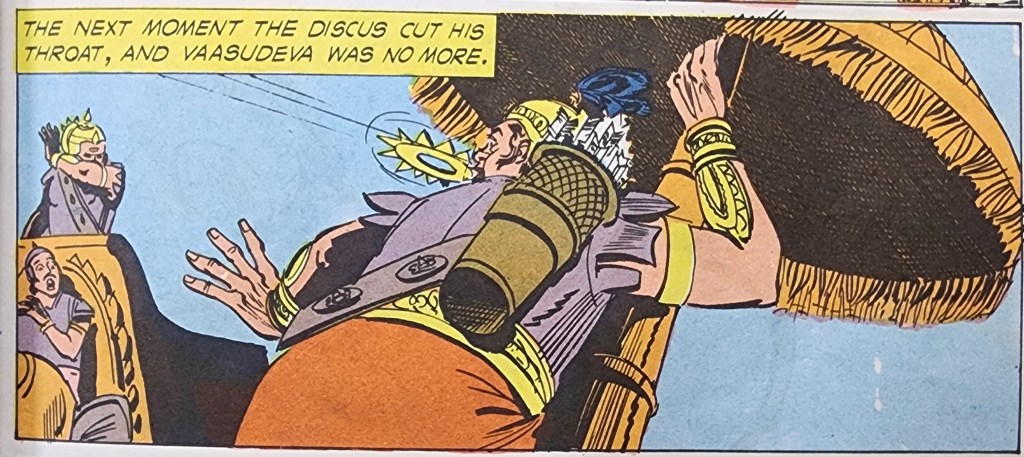
Pundraka is slain in battle by Krishna. Image credit – “Krishna and the False Vaasudeva” published by Amar Chitra Katha.
Here, Lord Krishna used deception by agreeing to submit. This was Menkyo Kaiden. He chose to receive the attack by coming alone. This was Uke Nagashi. In this case though, he did not wait for the attack, he attacked first. He chose to be Uke (attacker) rather than Tori (defender). Krishna also chose an aerial assault over a confrontation on the ground. On the ground, he would be overwhelmed with opposition numbers. This meant that he would have to bring the army along from Dwaraka. The distance between Dwaraka and Pundra, or even Kashi was large and bringing an army meant immense wasted logistics. So, he came alone. This is doing what is best in a situation. This is Issho Khemi. All of these are concepts I delved into in the previous part of this article.
The aerial aspect, where Krishna fought from the sky, brings into focus another important aspect of the martial arts. There is a concept that is regularly referred to in the Bujinkan system of martial arts called “Juppo Sessho”. This refers to fighting in 3 dimensions. While training in the dojo, there are mats on the floor and the ground is flat, most of the times. This might make practitioners lose sight of the variations in height that affect a physical conflict.
“Juppo Sessho” seeks to remedy this misconception. In reality a fight might be on a slope, on uneven ground, on a staircase, or with opponents of vastly different heights (image someone who is 5’6’ training with someone who is 6’7”). One needs to adapt their movements, postures and weapons and the forms used, depending on the terrain and variations in altitude.
This deficiency is exactly what Lord Krishna used while destroying Paundraka. He used a massive height advantage against an opponent who had no conception of what this advantage meant! Add to this the sheer stupidity of a leader and the benefit of deception, Krishna was a giant facing ants, literally!
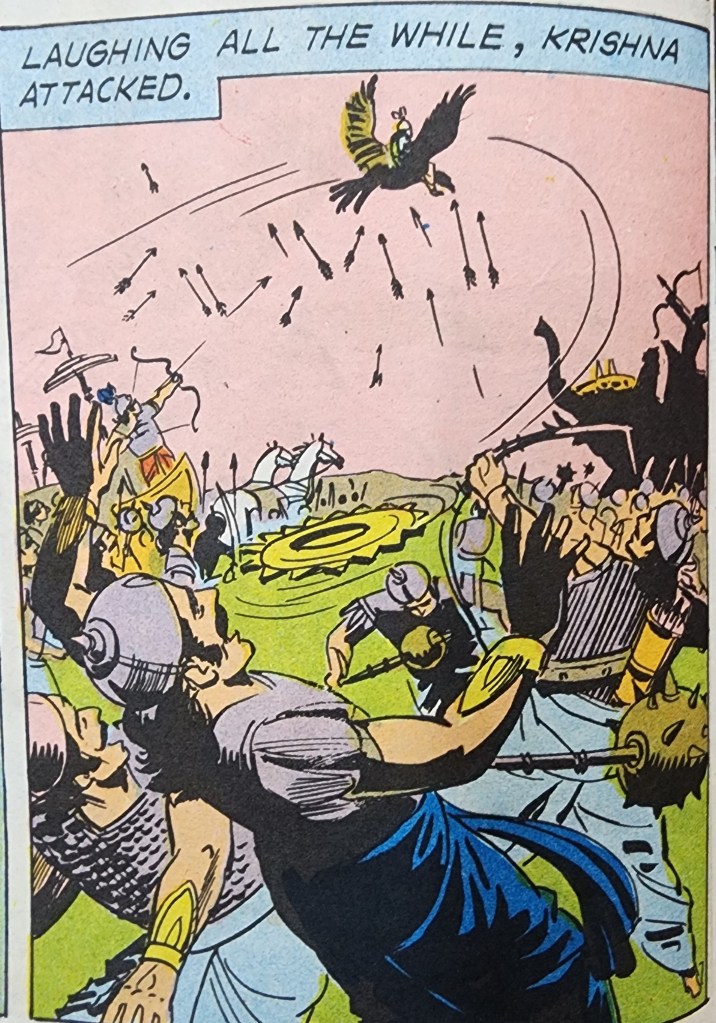
Lord Krishna uses the advantage of an aerial attack to defeat the armies of Pundra and Kashi. Image credit – “Krishna and the False Vaasudeva” published by Amar Chitra Katha.
The advantage of height is starkly visible in modern warfare where aircraft, long range missile and drone swarms have altered the battlefields of the coming decades. The advantage of height is also very well known to every Indian even without having to consider the air force. Indian troops took the heights of Kargil back from Pakistani forces who held the heights. They had to deploy heavy artillery and fighter aircraft to nullify the height advantage.
In 2020, Indian troops carried out Operation Snow leopard during the face off against Chinese troops in Eastern Ladakh, in the aftermath of the clash at Galwan where soldiers from both sides lost their lives. Indian troops captured the heights around the Chinese positions in a rapid night operation. This forced talks and eventually calm was restored slowly, over the course of a few years. But the taking of the heights and the surprise move to attempt this was the start of the thaw between the 2 sides.
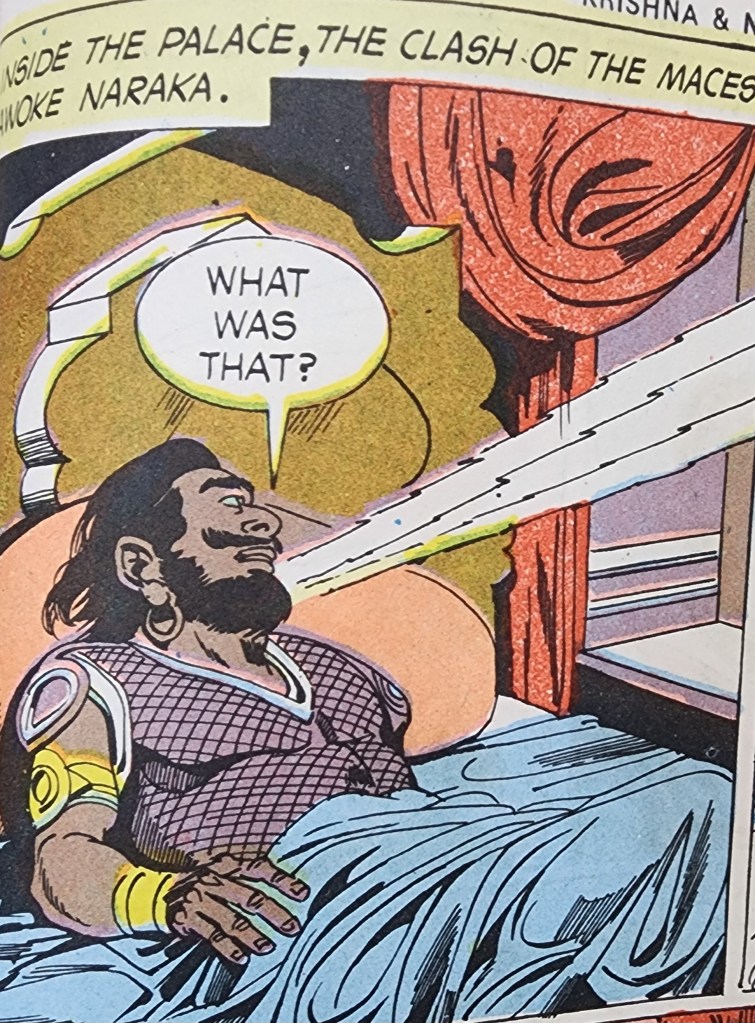
Lord Krishna used the aerial attack again when he attacked Narakāsura. This was very similar to a modern-day aerial night assault against an enemy stronghold. Krishna, with his wife Satyabhama attacked Narakāsura’s sleeping garrison. Narakāasura was also sleeping. A lot of challenges were overcome by Krishna in this attack. But the mission was a success.
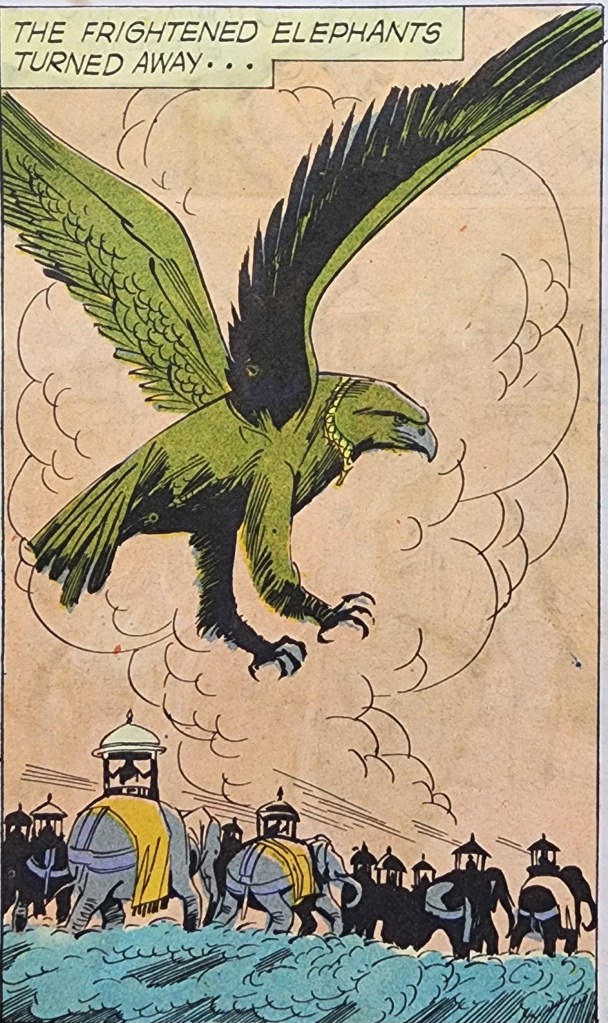
Garuda fights Naraka’s army from the air. Image credit – “Krishna and Narakasura” published by Amar Chitra Katha.
The surprise attack killed Naraka. The distance between Dwaraka and Pragjyothispura (likely modern-day Assam) was great, and this also prevented the costly and time-consuming logistics of marching an army across the lands of multiple enemies! I have explored this attack in greater detail in a separate article, the link to which is seen below.
In the events following the defeat of Paundraka Vāsudeva, Krishna also killed both the King of Kashi and his successor Sudakshina. This eliminated two powerful allies of Jarasandha. Two other powerful allies of Jarasandha were Shishupāla, the ruler of Chedi and Salva, the King of Saubha. One other potential ally of Jarasandha was Vidarbha. Events that occurred in Vidarbha post the Yadava migration to Dwaraka precipitated the slaying of Paundraka and the king of Kashi.
Vidarbha was neutral. But the crown prince of Vidarbha, Rukmi wanted to ally with Jarasandha. So, he wanted his sister Rukmini to marry Shishupāla, who was also an ally of Jarasandha’s. Fortunately for the Yadavas at Dwaraka, Rukmini was in love with Lord Krishna who reciprocated her feelings. The king of Vidarbha, Bhishmaka was not certain about an alliance with Jarasandha and was quite happy to see his daughter wed Krishna. This created an opportunity for Lord Krishna to once again demonstrate his consummate use of deception.
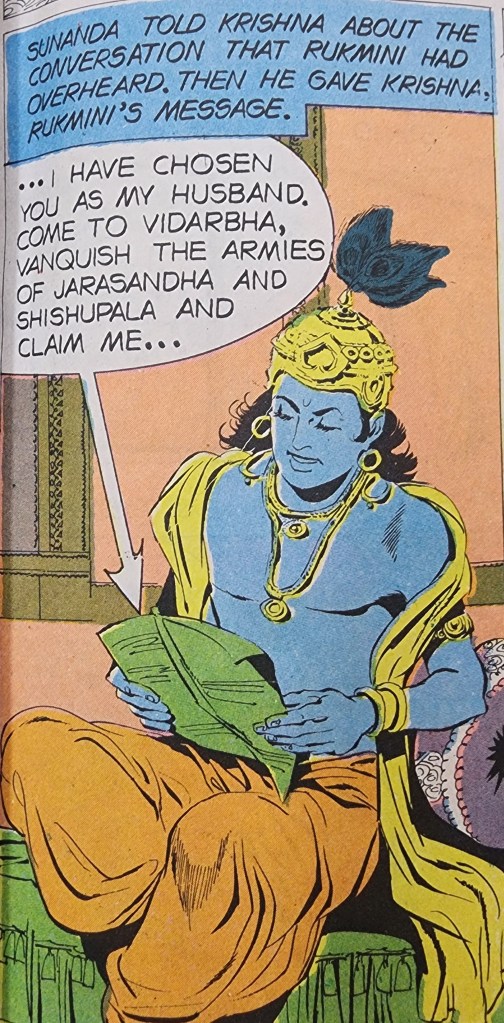
Rukmini plans her own abduction in a letter to Krishna. Image credit – “Krishna and Rukmini” published by Amar Chitra Katha.
Rukmi could convince his father to get Rukmini married to Shishupala. Jarasandha and his allied kings arrived in Vidarbha with their armies as guests, and to prevent any machinations by Krishna. Krishna & Balarama too arrived in Vidarbha with some troops as guests at the wedding. But Krishna abducted Rukmini and escaped to Dwaraka where they were married. Balarama and his troops fought a rearguard action to help Krishna escape.
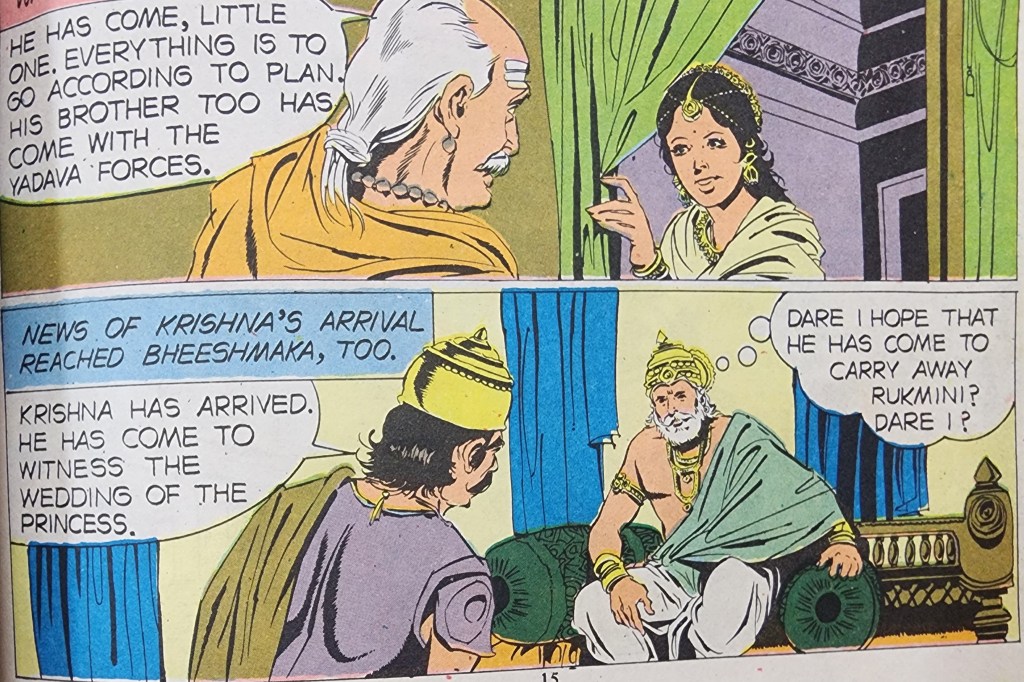
Krishna arrives in peace to attend Rukmini’s wedding. Image credit – “Krishna and Rukmini” published by Amar Chitra Katha.
Of course, the entire abduction was enabled by the actions of Rukmini herself with the tacit support of her father Bhismaka. Rukmini revealed her location and activities that enabled Krishna plan the abduction. Bhishmaka also shared information that helped the Yadava brothers plan their actions. It was more an abduction enacted by Rukmini than anyone else. But Krishna did use his status as a guest at a wedding to achieve his goal. He did deceive the bridegroom and all the other guests!
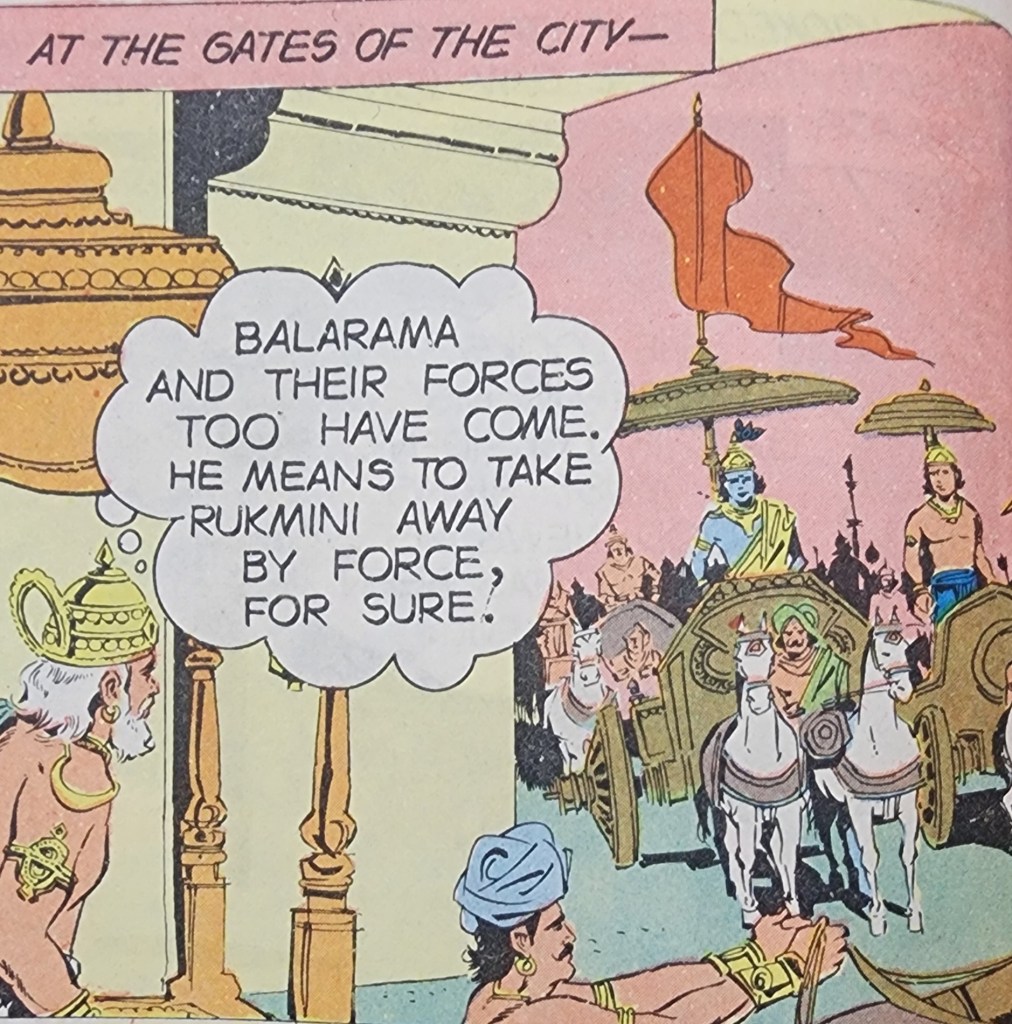
Bhishmaka helps with the abduction of Rukmini. Image credit – “Krishna and Rukmini” published by Amar Chitra Katha.
This deception is what got Paundraka to attempt usurping Krishna’s divine reputation. He was so depressed with the continued success of the Yadavas in general and Krishna in particular, that his courtiers sold him the lie of his own fake divinity. This in turn led to the events I described earlier in this article.
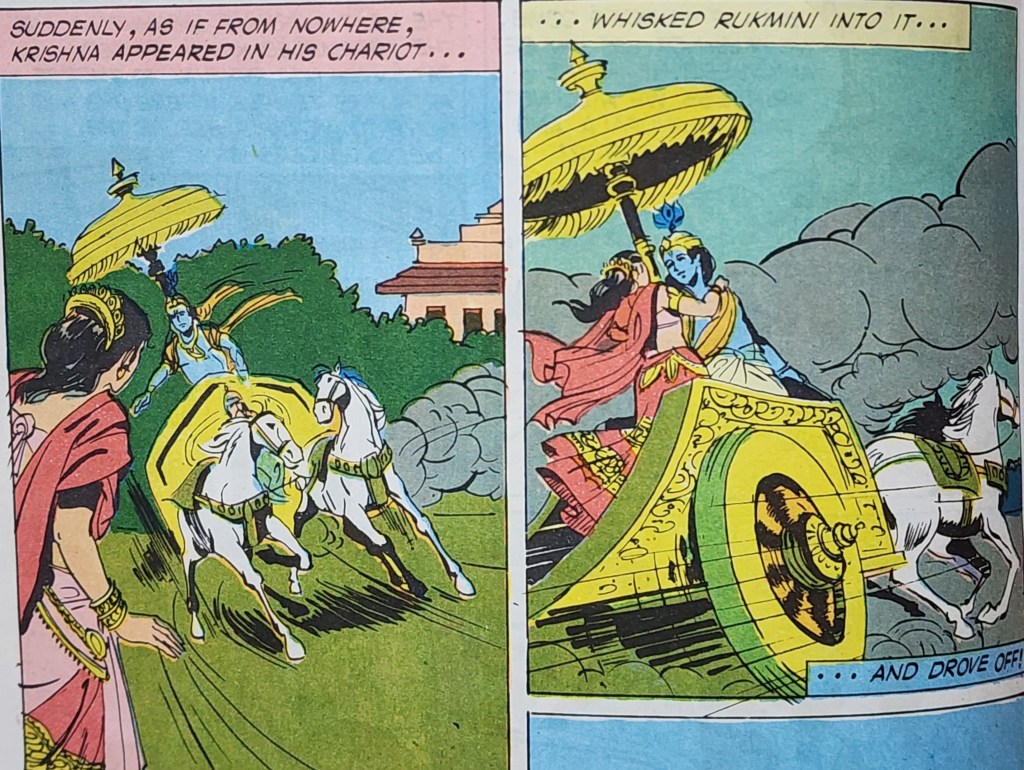
Krishna abducts Rukmini. Image credit – “Krishna and Rukmini” published by Amar Chitra Katha.
Krishna used the status of being a guest to eliminate the last of the allies of Jarasandha. Of course, this happened after Jarasandha himself had been slain by the Pandava Bheema. Yudishtira was performing the Rajasooya Yajna. This was to achieve the title of Chakravarthy for himself. Both Krishna & Shishupala were guests at the final event of the Yajna.
Krishna was selected as the person to receive the first honours among all the assembled kings, lords, elders and sages. Shishupala was infuriated at this choice and insulted Krishna a whole lot. Krishna forgave 100 insults according to a promise he had made to Shishupala’s mother. When this limit was crossed, he beheaded Shishupala with the Sudarshana Chakra.
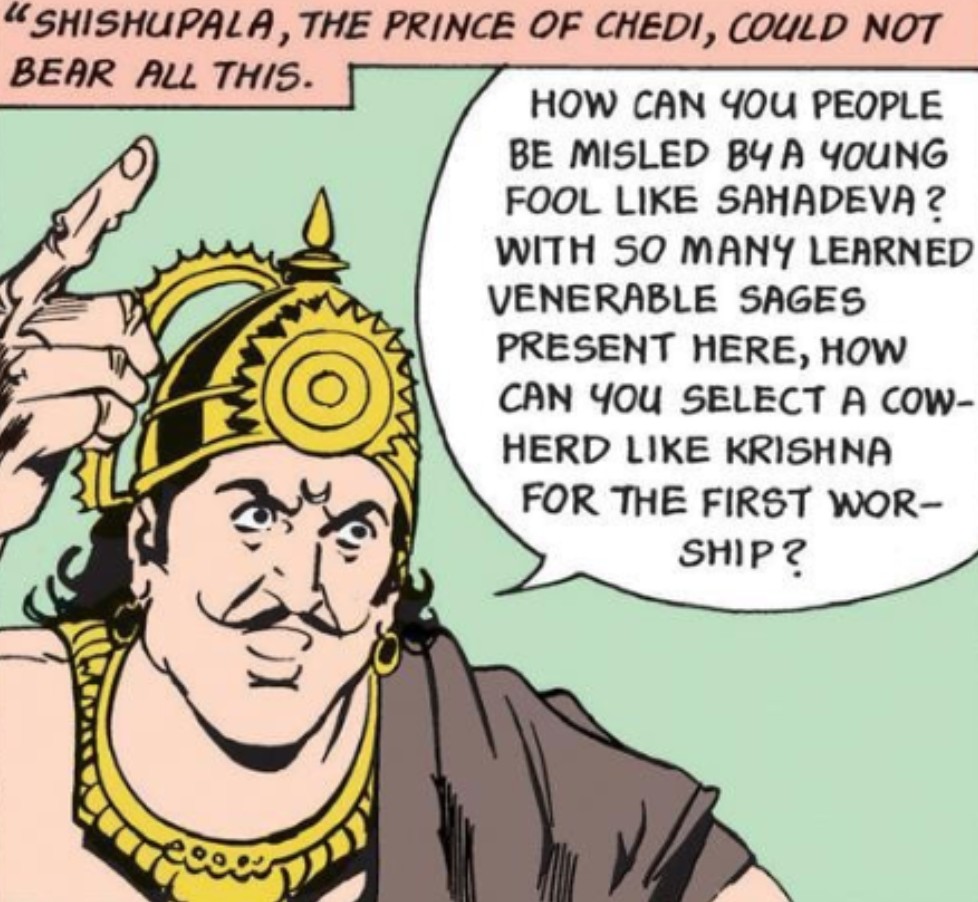
Shishipala insults Krishna at Yudishtira’s Rajasooya Yajna. Image credit – “Krishna – An ally of the Pandavas” (Kindle version) published by Amar Chitra Katha.
Krishna killed an unarmed Shishupala in a pious assembly and not on a battlefield. Observe this; Krishna was a master in the use of the chakra (discus). This is a small weapon that is easily concealed, unlike swords, maces and other sidearms. Of course, Krishna is supposed to have been able to summon the Sudarshana Chakra at will without having to carry it around. But even if this magical aspect is ignored, the discus would be a weapon of choice in this situation due to its size and concealability.
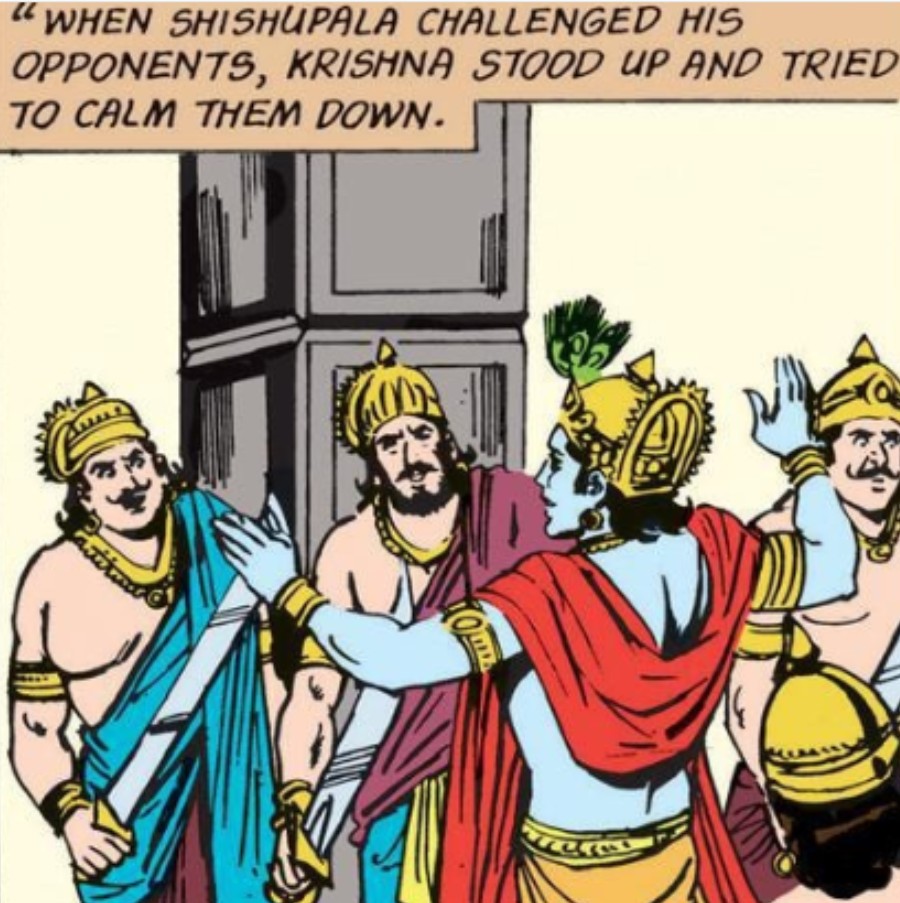
Shishupala challenges Krishna. Image credit – “Krishna – An ally of the Pandavas” (Kindle version) published by Amar Chitra Katha.
Also, Krishna did choose to accept the challenge to a duel that Shishupala threw at him in the assembly. He simply shocked Shishupala and the others in the assembly with his quick action. This was the use of surprise and deception at its best!
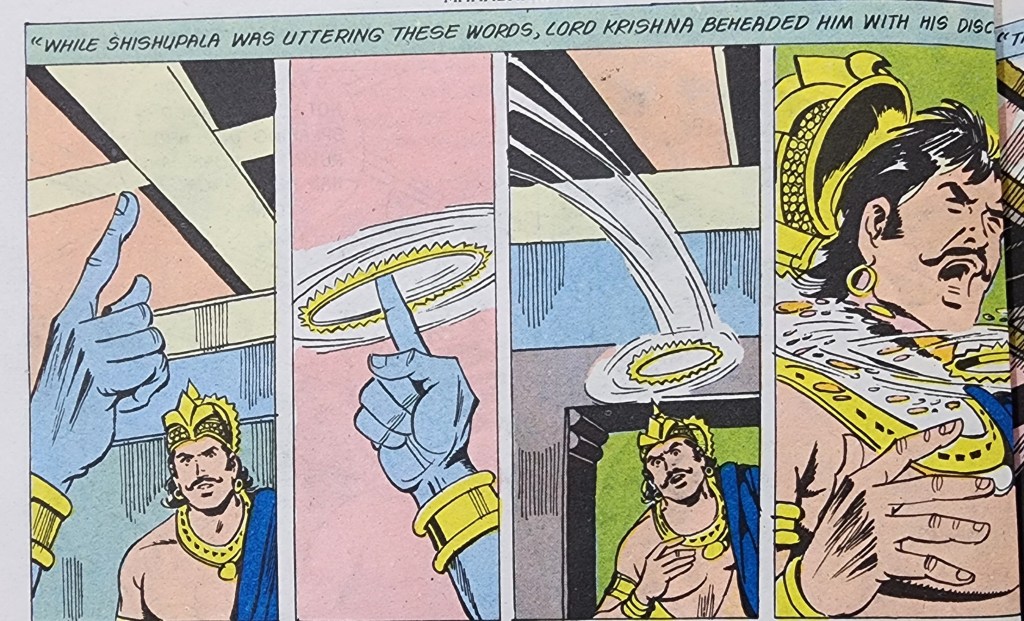
Shishupala is beheaded by Krishna. Image credit – “Mahabharata 17 – Yudishtira’s Rajasooya Yajna” published by Amar Chitra Katha.
In the Bujinkan, we study a concept called “Kakushi Buki”. This translates as “hidden weapons”. In my personal opinion, the discus, given its properties and dimensions, was a hidden weapon that Krishna deployed to sort out the problem of Shishupala, when he least expected it! He had thus eliminated the last of Jarasandha’s allies. The death of Shishupala resulted in the battle against Salva, the King of Saubha, which was described in part 1 of this set of 2 articles.
In the events that led to the slaying of Shishupala, it must be noted that Shishupala was doing a lot of talking, as were a lot of others in the assembly, including Lord Krishna. But Krishna was the only one who deployed a weapon. An exact reverse of this happened earlier in Krishna’s life, when he used just words to pervert others from using their weapons. We will look at this next.
The reasons Krishna was revered by the Pandavas were manifold. One of these reasons would be his contribution to their defeat of Jarasandha. The other would be that the Yadavas and Pandavas had a matrimonial alliance (apart from Krishna being a cousin of Kunti’s (the mother of the Pandavas)). Arjuna had married Subhadra, Krishna’s sister. This occurred before the Jarasandha was killed.
Arjuna was on exile from Indraprashta and on a pilgrimage across the lands of Bharata. His last stop was Dwaraka, where he fell in love with Subadhra, the sister of Lords Krishna and Balarama. The feeling was reciprocated by Subadhra. It is said in some stories that Balarama wanted Subadhra to marry Duryodhana. To prevent this, Krishna suggested to Arjuna that he should abduct Subadhra.
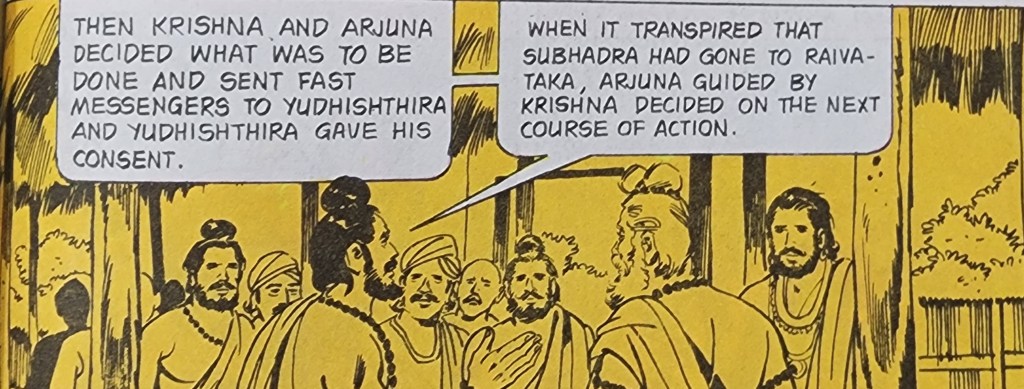
Rishi Vaishampaya narrating to King Janamejaya how Krishna instructed Arjuna to abduct Subadhra. Image credit – “Mahabharata – 14, Arjuna’s 12 year exile”, published by Amar Chitra Katha.
After Arjuna abducted Subadhra, the Yadavas, including Balarama were on the warpath. They wanted to defeat and punish Arjuna. But Krishna talked them out of it in an assembly meant to plan the offensive against Arjuna. In this assembly, while the Yadavas were arming themselves, Krishna used his words to prevent any war-like situation.
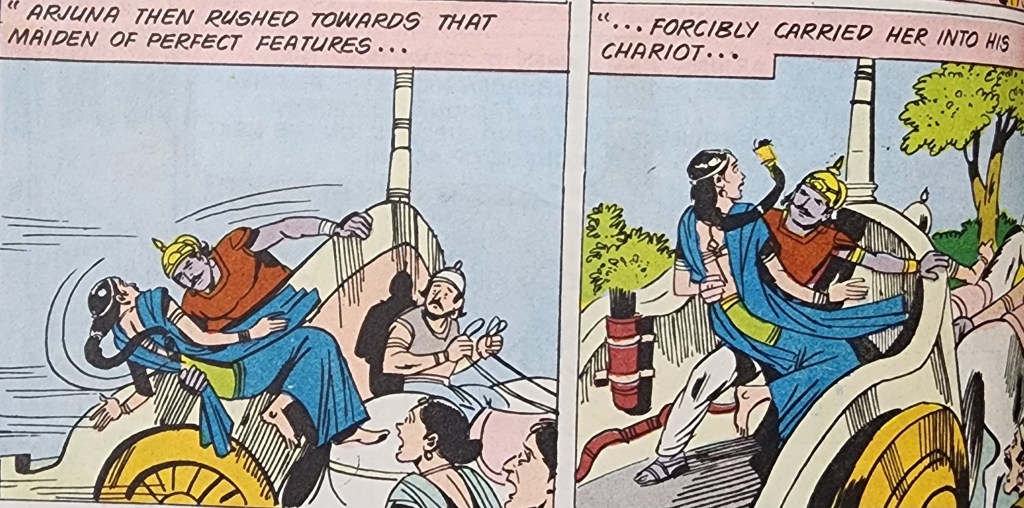
Arjuna abducts Subadhra. Image credit – “Mahabharata – 14, Arjuna’s 12 year exile”, published by Amar Chitra Katha.
He compared Arjuna’s actions to those of his own vis-a-vis Rukmini. He also convinced the assembly that this was the best alliance possible. Of course, this alliance set the pieces needed for Krishna to destroy Jarasandha for good. Here again Krishna was using surprise to his advantage. In an assembly meant to plan a war, he shocked everyone by saying they were in the wrong and got his way. 😊
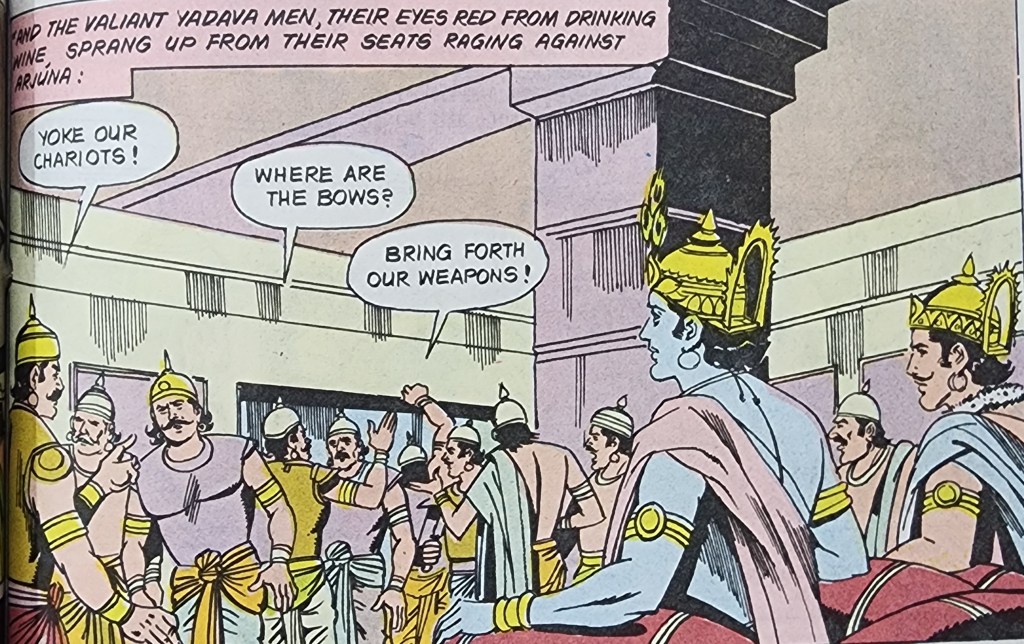
Yadavas on the warpath. Image credit – “Mahabharata – 14, Arjuna’s 12 year exile”, published by Amar Chitra Katha.
This event with Subadhra and Arjuna is an exact reverse of the events that led to Shisupala’s death. Here Krishna used words to get the Yadavas to drop their arms, while at the Rajasooya Yajna, Shishupala and everyone else was doing the talking while Krishna used arms! Krishna’s use of words to win over a situation leads to some interesting observations, which we will look at a little later in this post.
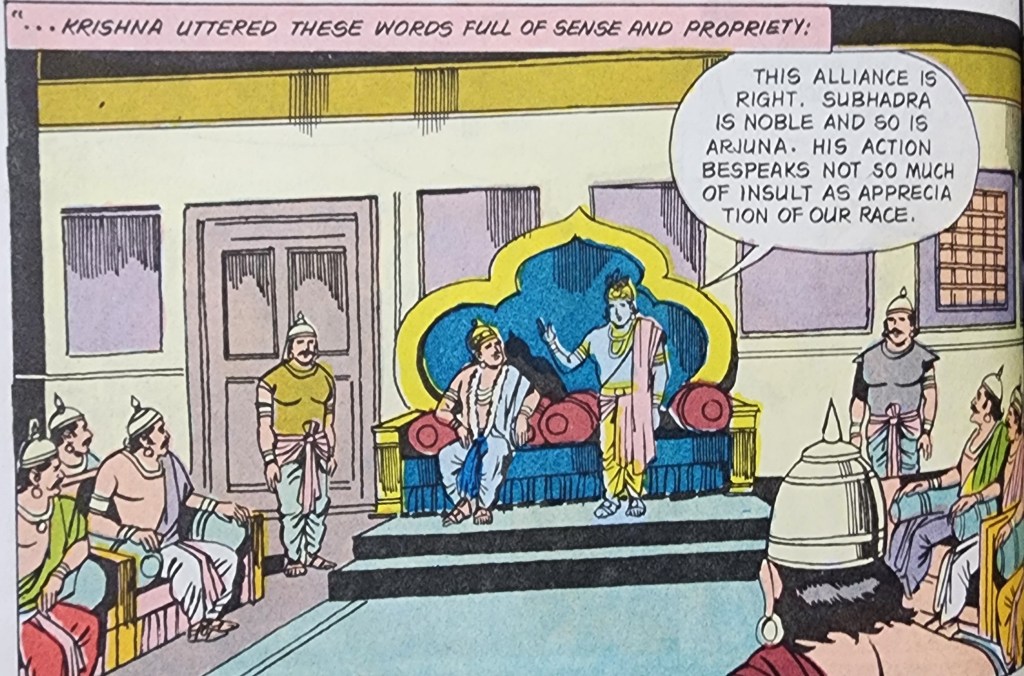
Krishna calms the Yadavas. Image credit – “Mahabharata – 14, Arjuna’s 12 year exile”, published by Amar Chitra Katha.
Similarly, Arjuna’s abduction of Subadhra is an application of deceptive means against the people of Dwaraka. Arjuna was a guest at Dwaraka and he deceived his hosts, with the help of the same people of course (namely Subadhra and Krishna). This is the same means used by Krishna against the people of Vidarbha, where he was a guest and abducted Rukmini as described earlier in this article. Krishna was thus party to deceiving his own people as he initiated the entire abduction of Subadhra!
The Yadava assembly which Krishna calmed was essentially a debate on the next course of action. Krishna’s contrarian view was a shock that won the day. I had mentioned in the first part of this series that I consider surprising an opponent to be the same as deceiving one, for in both cases, the opponent is put on the back foot.
Debates in ancient India all the way till at least the 16th century carried real consequences. The outcome of debates caused social and religious changes in society. It is said that Ramanujachārya’s victory in a debate led to a large number of the populace of the Hoysala kingdom to convert from Jaininsm to Hinduism (Vaishnavism specifically) in the 12th century CE.
Even if not all debates had such consequences, the reputational gain or loss for a court was considerable, as were the economic rewards for those involved in the debates. The story of how Tenali Rama won a debate for the court of Krishnadevaraya, the king of the Vijayanagara kingdom in the 16th century, is well known to a lot of us.
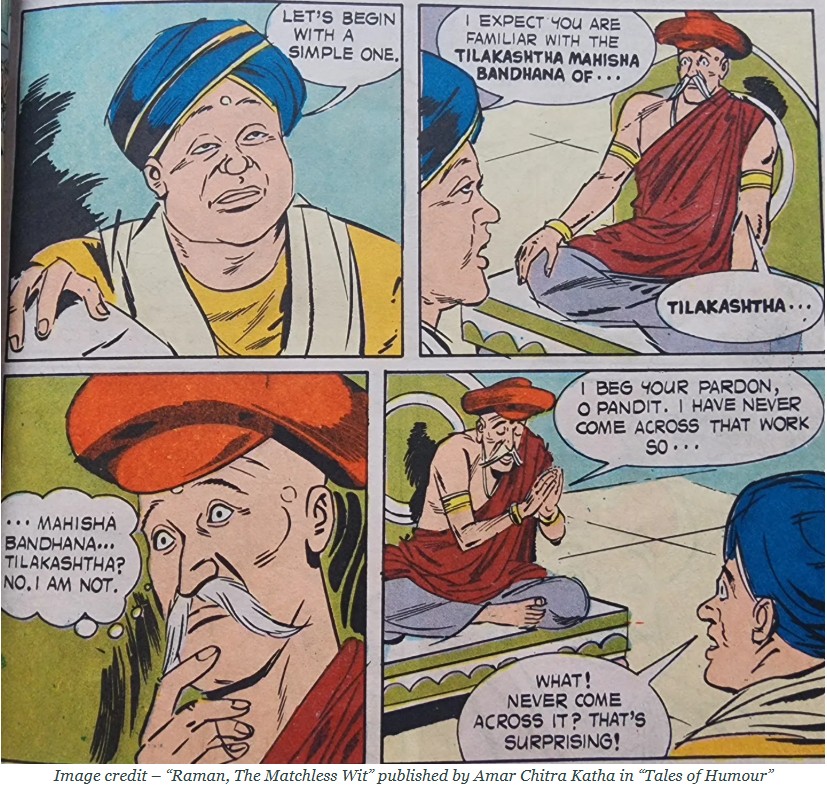
I had written an entire article dedicated to the use of deception in debates a couple of years ago. I am sharing a link below to that article. This use of deception in a debate is applicable to this day when we have meetings at work and in the corporate world, where the choice of words and the spin of narratives drive the movement of money and business outcomes. The same is true in the political arena, as we live in a world where narratives on legacy and social media move the fate of nations (read civilizations) and societies.
Krishna’s actions in ensuring a matrimonial alliance with the Pandavas gave him access to the most potent weapon against Jarasandha, Bheema, the second Pandava known for his physical prowess. Bheema was one of the few in that era who could take on Jarasandha in single combat. This set in motion the events that led to Jarasandha’s downfall at long last.
As mentioned earlier, Yudishtira, to perform the Rajasooya Yajna, needed to defeat Jarasandha. But leading an army against Jarasandha was almost impossible, even with the defeat of allies like Paundraka and the rulers of Kashi. So, Krishna again resorted to an act of deception. He travelled to Girivraja, the capital of Magadha with only Arjuna and Bheema as companions. They travelled disguised as brahmanas.
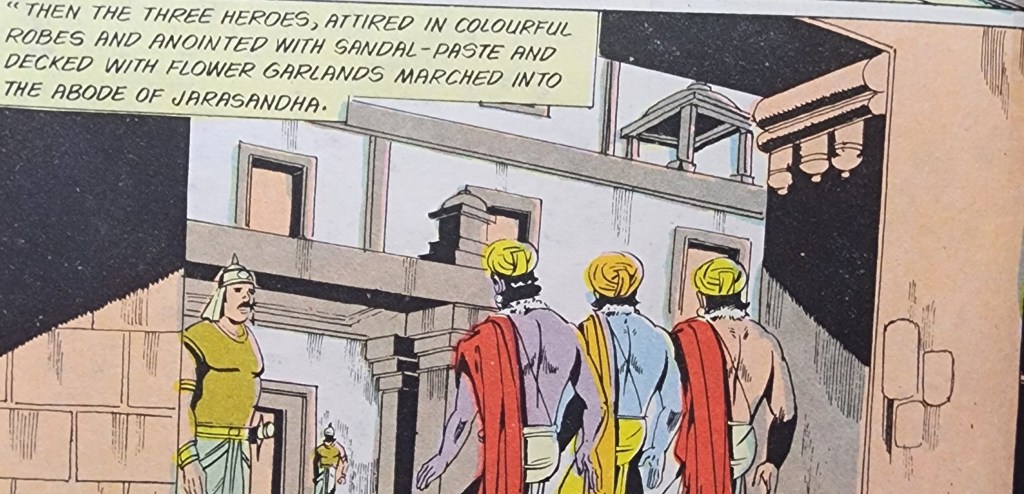
Krishna, Bhima and Arjuna disguised as brahmanas as they enter Jarasandha’s capital unmolested. Image credit – “Mahabharata – 16, The Pandavas conquer the World”, published by Amar Chitra Katha.
The brahmana disguise gave them an audience with the emperor Jarasandha who agreed to grant them their wish. He did this despite doubting the authenticity of the visitors being brahmanas. The confidence of Jarasandha in his own abilities and that of his forces was absolute, he had no concern for his safety and never even considered the possibility of defeat.
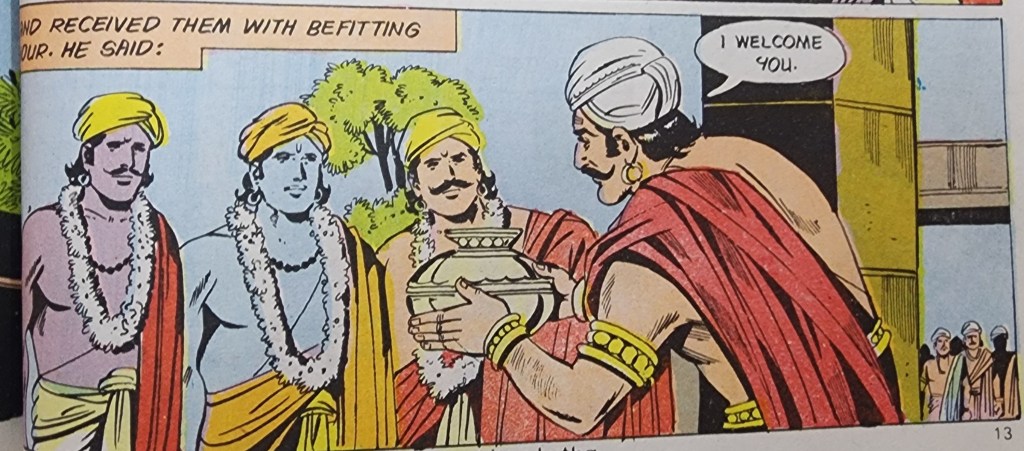
Jarasandha welcomes the 3 disguised heroes. Image credit – “Mahabharata – 16, The Pandavas conquer the World”, published by Amar Chitra Katha.
Krishna asked Jarasandha to take on one of the 3 in single combat. Jarasandha, in his supreme confidence, or perhaps arrogance, chose Bheema, the toughest opponent, even though Arjuna and Krishna were no pushovers in the art of the duel. The duel between Bheema and Jarasandha lasted days! I read in one version that it lasted 28 days and in another that it lasted 15. Either way, Bheema killed Jarasandha in the end.
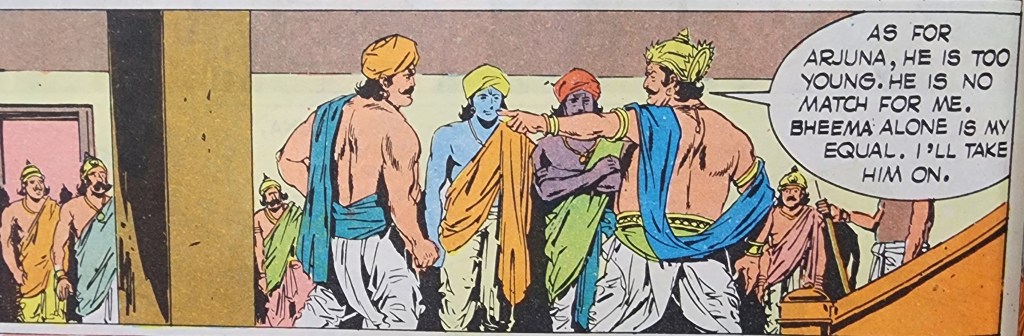
Jarasandha chooses Bheema as his opponent. Image credit – “Krishna and Jarasandha” published by Amar Chitra Katha.
Krishna had used disguises to stop anyone preventing their access to Jarasandha. He had then used his knowledge of Jarasandha’s hubris to ensure that he would face off against Bheema, the one person who could defeat him. This also prevented Jarasandha’s powerful armies from getting involved and protecting the emperor.
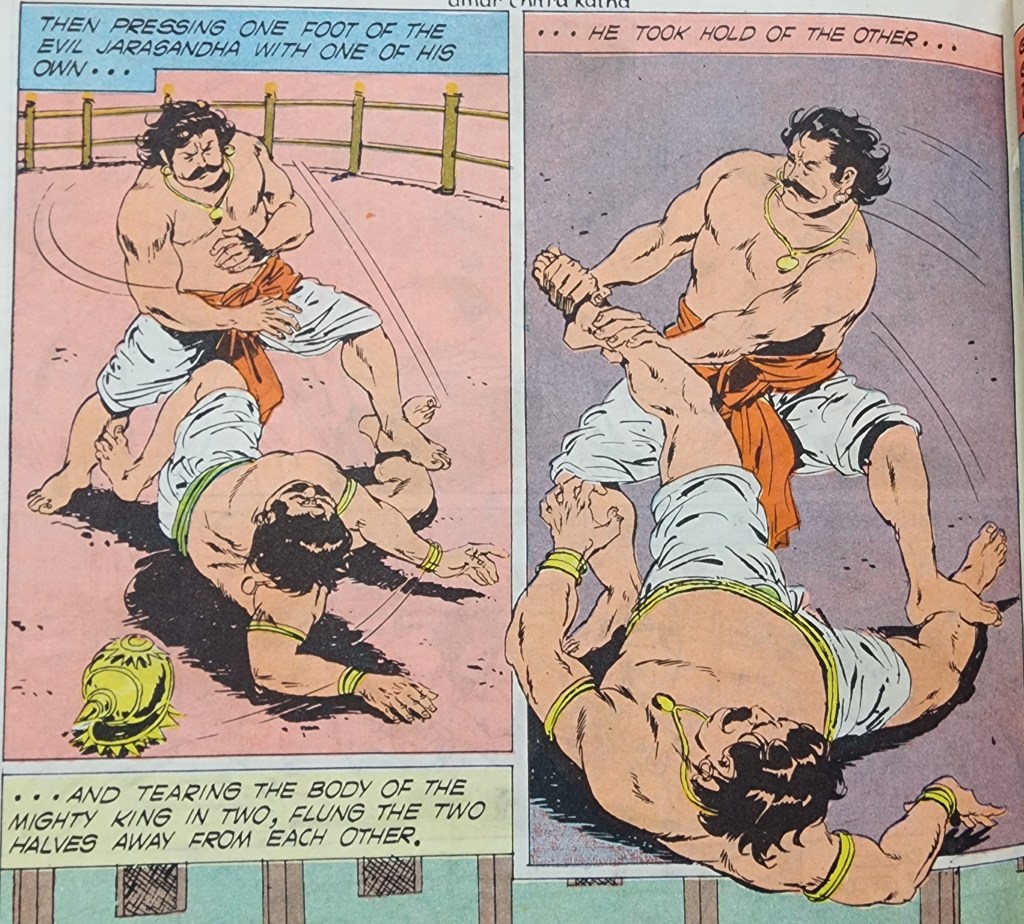
Bheema kills Jarasandha. Image credit – “Krishna and Jarasandha” published by Amar Chitra Katha.
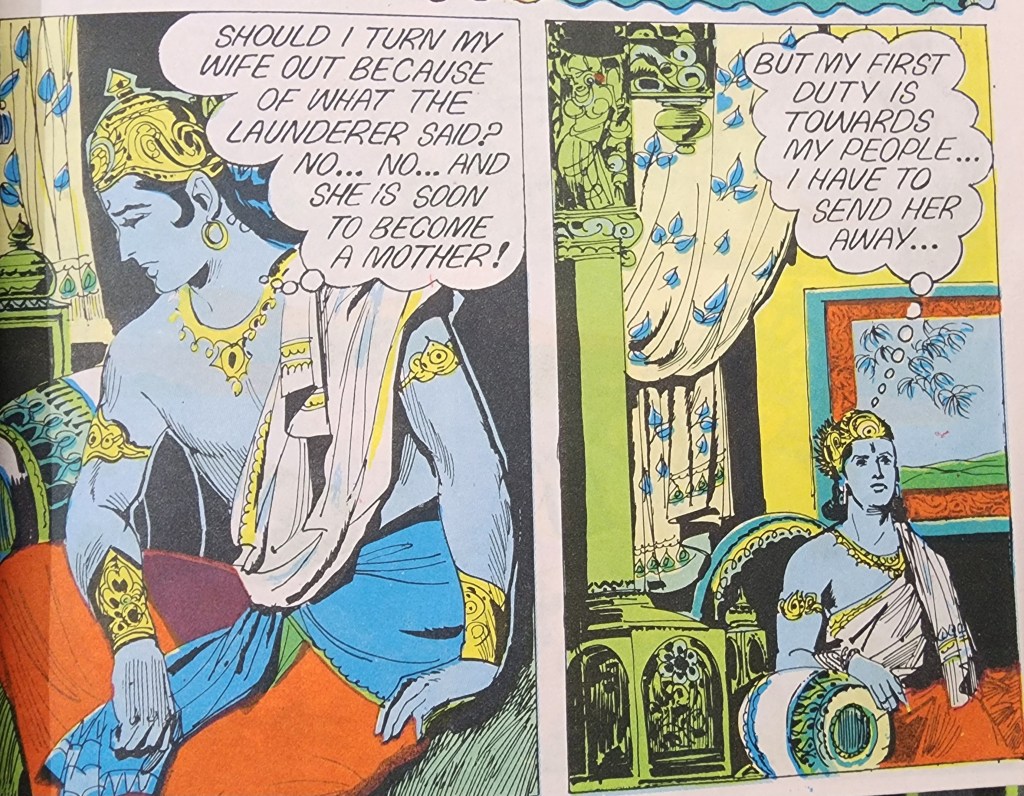
There are quite a few parts of the stories relating to Lord Krishna where Maya or magic is involved, situations where he can achieve things due to his divine nature. This includes the use of the divine Sudarshana Chakra and the presence of Garuda, the divine bird-like entity. But some of the actions carried out by him are simply those of an extremely capable human. These actions point to someone who is always mindful of a situation, aware of all necessary information and is a keen observer of human nature. He was also someone who believed in action and improvisation, not analysis paralysis.
Let us consider these aspects without the need for magic or anything beyond human.
- When Krishna & Balarama used Mount Pravarshana to avoid fighting Jarasandha and ended up making him believe they were dead, it was knowledge of the terrain, not Maya at play.
- When Krishna agreed to surrender the Garuda and Sudarshana Chakra to Paundraka, it was awareness of the character of Paundraka, not magic.
- When Krishna abducted Rukmini, it was an awareness of the political machinations at play and mindfulness of the true desire of Rukmini. There was no magic.
- When Krishna convinced and aided Arjuna to abduct Subadhra, it was again an awareness of his sister’s choice and the political need of the Yadavas; there was no magic involved.
- When Jarasandha chose Bheema as his opponent, Krishna was working on his awareness of the emperor’s hubris, not working any illusions.
This awareness of the situation and objectives coupled with a high level of information of the terrain and people’s motivations drove a lot of Krishna’s successes and are some of the reasons we consider him a God, an avatāra of Lord Vishnu.
If we consider just mundane physical fights, a similarity is seen in some of the tactics used by Lord Krishna and in the duels of Miyamoto Musashi. Musashi is one of the most famous historical swordsmen, who lived in 17th century Japan.
Consider Musashi’s most famous duel, against Sasaki Kojiro. Musashi is supposed to have arrived very late to the designated ground for the duel. This agitated Kojiro and made him angry, perhaps causing him to be reckless. Also, Musashi is supposed to have used a very long bokken as the weapon against Kojiro.
A bokken is a wooden sword commonly used for practice. The bokken Musashi used was very long and carved out of a boat oar. Musashi knew that Kojiro fought with a blade that was considerably longer than the usual swords used by most swordsmen of that time. To overcome the reach advantage of Kojiro’s tachi (sword), Musashi used the long bokken.
Musashi won the duel and later in life, went on to become a famous martial philosopher apart from a great warrior. Now consider the event where Lord Krishna slew Shishupala. Krishna let Shishupala stew in his rage and let him insult him amply. When the number of insults reached 100, the promise he had made to Shishupala’s mother was fulfilled. He then killed Shishupala with a discus. Here, Krishna let Shishupala become agitated and reckless, exceeding the number allowed and used a weapon against which his opponent had no defence! This is much like a long bokken which can overcome the reach of the opponent’s tachi.
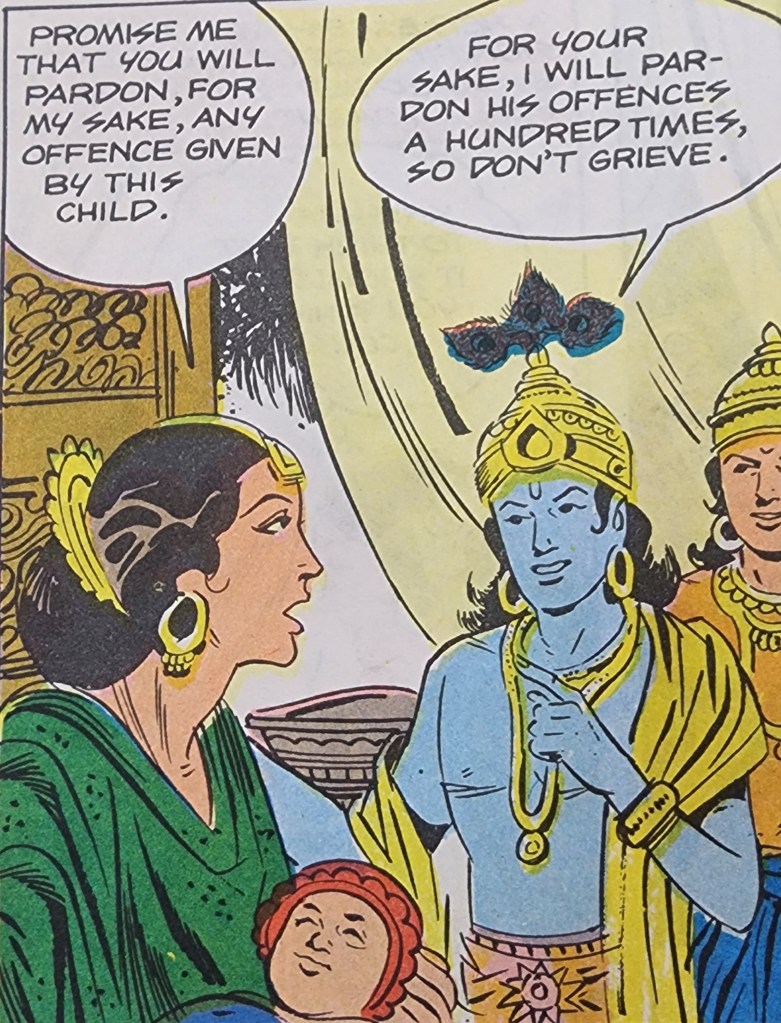
Krishna’s promise to Shsishupala’a mother. Image credit – “Krishna and Shishupala” published by Amar Chitra Katha.
Now consider another fight of Musashi’s, his fight against the students of the Yoshioka Ryu (Yoshioka school of swordsmanship). I am not sure if the fight I am referring to is historical or quasi-historical, but it definitely is informative. Musashi is supposed to have fought single-handedly fought against some students of the Yoshioka Ryu after he had defeated 2 of their senior teachers.
Since he was outnumbered Musashi arrived at the designated location of the fight early and waited for his opponents to arrive. Once they arrived, he attacked without any formal commencement of the fight. He caught them by surprise and gained the upper hand initially. He eventually won this fight as he used the terrain to launch repeated surprise attacks.
This fight of Musashi’s is similar to Krishna’s attack on the combined armies of Paundraka and Kashi. He had brought them to the place where he wanted to fight. He used the terrain to his advantage by taking the aerial route! He then went on to attack and destroy his enemies without any opening lines of discussion and with zero fanfare.
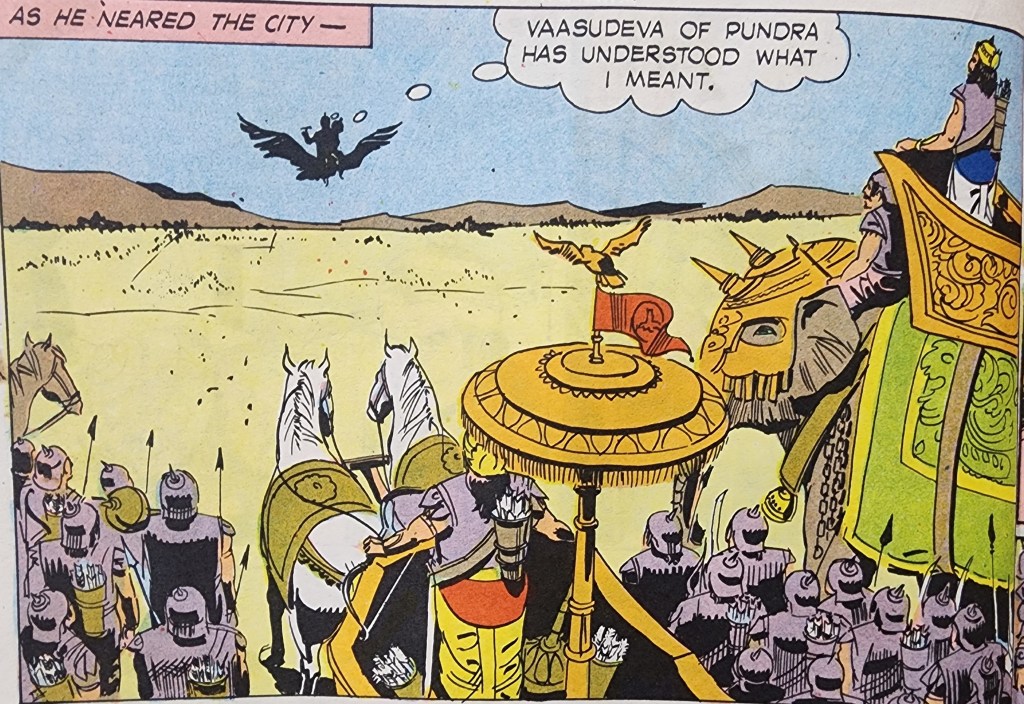
Krishna has the armies of Pundra and Kashi exactly where he wants them. Image credit – “Krishna and the False Vaasudeva” published by Amar Chitra Katha.
As I conclude, I must address 2 points with respect to Krishna’s successes in various conflicts. The first is LUCK and the second is a TEAM TO BACK HIM UP. Let me begin with the role played by luck.
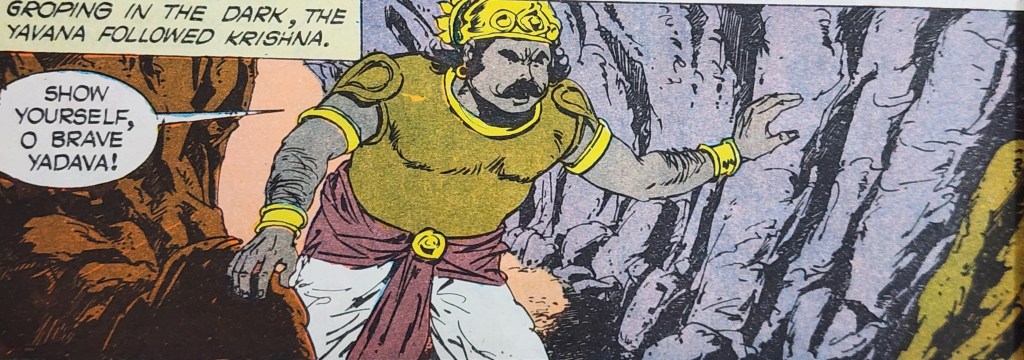
- The presence of Muchukunda near the battlefield where the forces of Mathura fought the army of Kāla Yavana was sheer luck.
- That Rukmini was in love with Krishna and Subadhra with Arjuna was sheer chance having a positive impact on events.
- The combined armies of Paundraka and Kashi having no counter to an aerial attack was luck. This was not the case when Salva of Saubha attacked Dwaraka. He had an aerial component in his attack.
- Paundraka being narcissistic and perhaps dim-witted was happenstance.
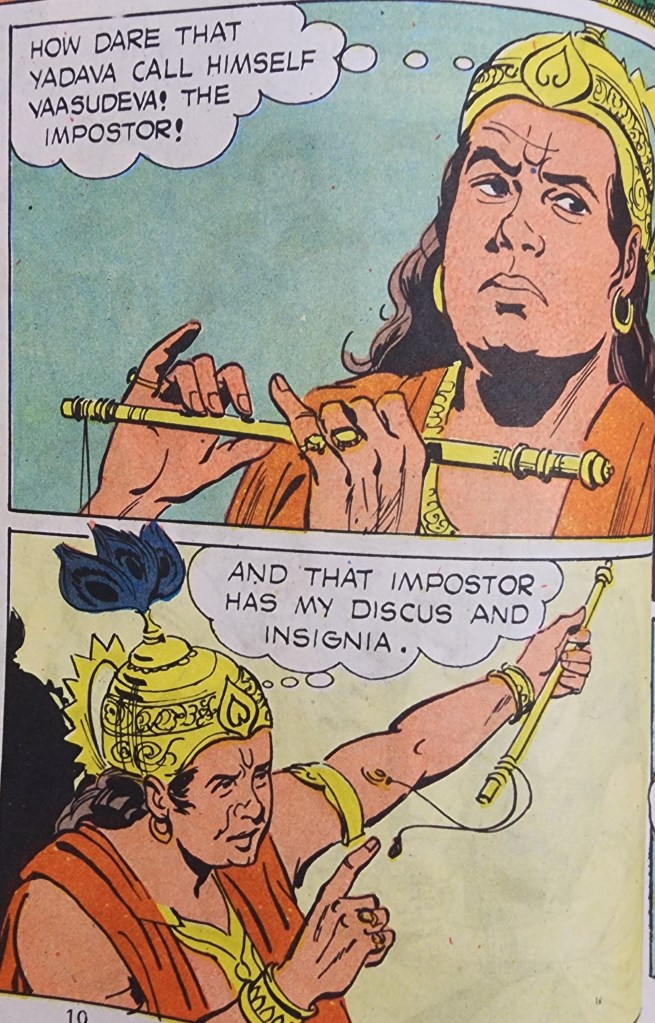
Paundraka is narcissistic. Image credit – “Krishna and the False Vaasudeva” published by Amar Chitra Katha.
If any of these was not the case, events could have transpired very differently, or perhaps Lord Krishna would have found a different solution to the same conflicts. There is no way to tell as these are counterfactuals. But the role played by “Luck” is unquestionable. It could be a case of “fortune favouring the brave”. No one could ever accuse Lord Krishna of not always trying to resolve every conflict (this is bravery in the face of adversity).
I had written a couple of articles some time ago addressing the role of luck in conflict management, which has always been recognized by humankind. I am sharing links to these articles below.
Krishna had a team or at least one extremely capable individual backing him in many of the situations when he was managing conflicts. Consider the following events.
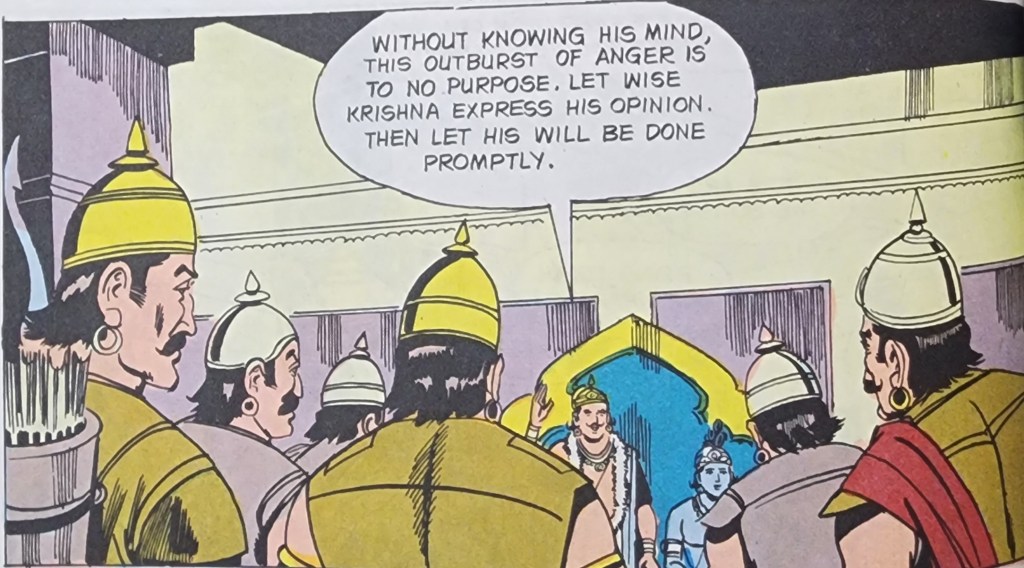
Balrama slows the angry Yadavas. Image credit – “Mahabharata – 14, Arjuna’s 12 year exile”, published by Amar Chitra Katha.
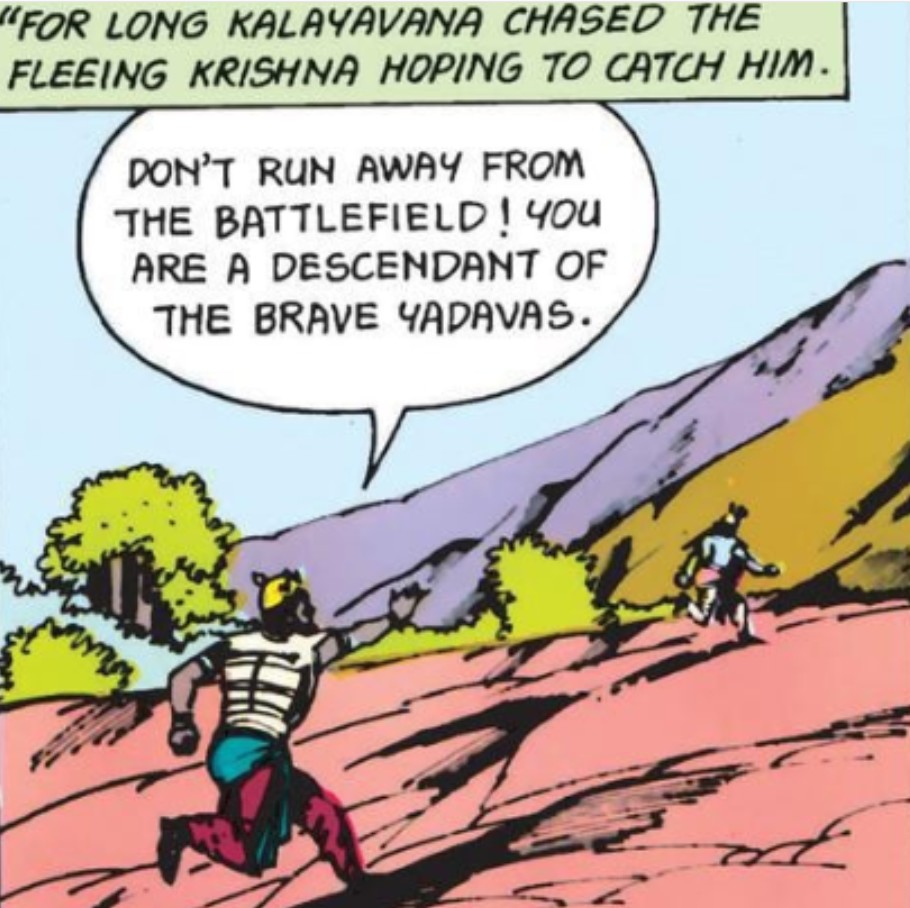
- When Krishna led Kāla Yavana away from the battlefield, he had Balarama leading the troops of Mathura against the enemy forces.
- When Krishna abducted Rukmini, Balarama fought a rearguard action to help Krishna escape to Dwaraka.
- When Arjuna abducted Subadhra, Balarama slowed the Yadavas who wanted to attack Arjuna until Krishna could convince them of their folly.
- When Salva attacked Dwaraka, Krishna & Balarama were away from the city. Pradyumna, Krishna’s son held off the attacks until the brothers got back.
- Bheema and Arjuna were both more than ready to follow Krishna to Girivraja to execute his plans against Jarasandha.
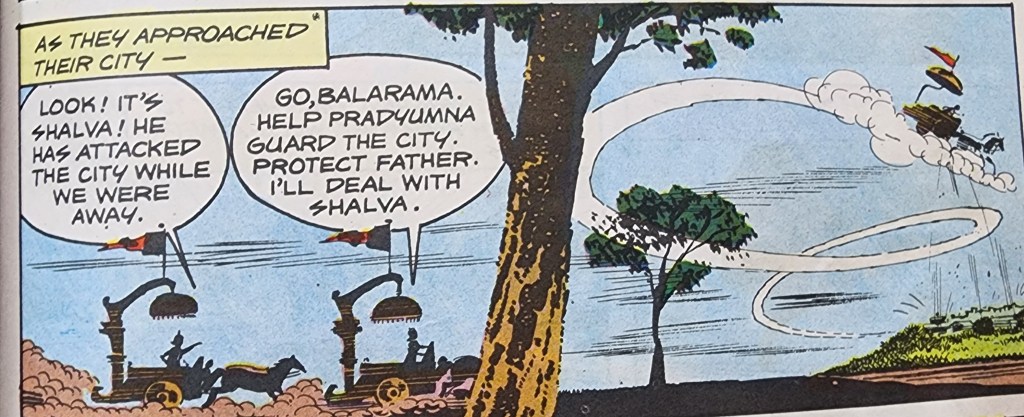
Pradyumna fights Salva. Image credit – “Krishna and Shishupala” published by Amar Chitra Katha.
As can be seen above, his elder brother Balarama always had Krishna’s back. This allowed him to carry out some of the incredible actions he executed. I had written a post a few weeks ago about the martial abilities of Lord Balarama. I am sharing the link to the same below.
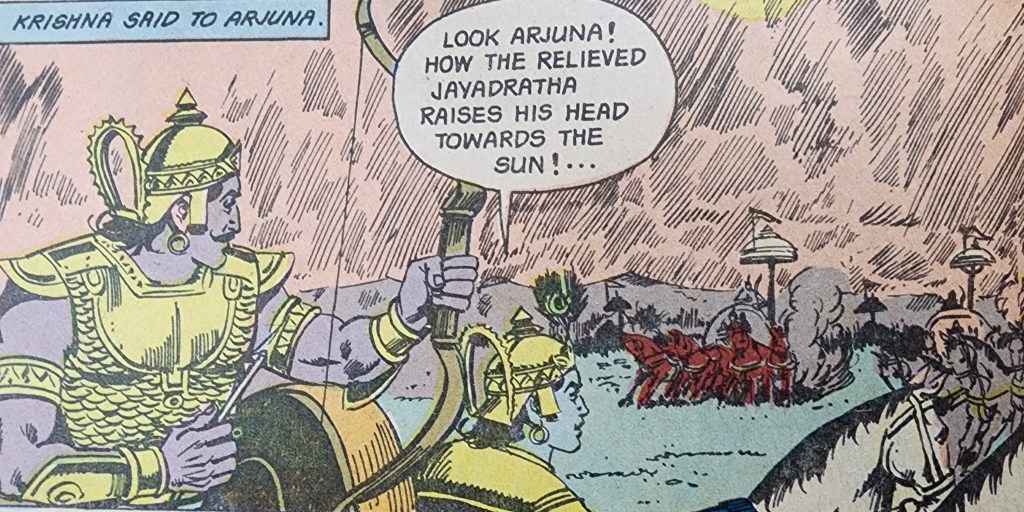
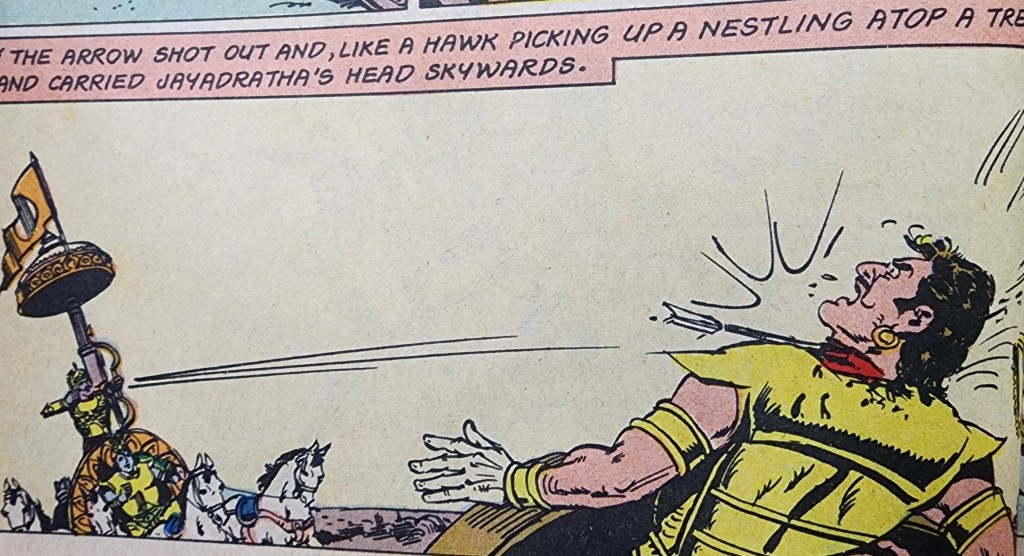
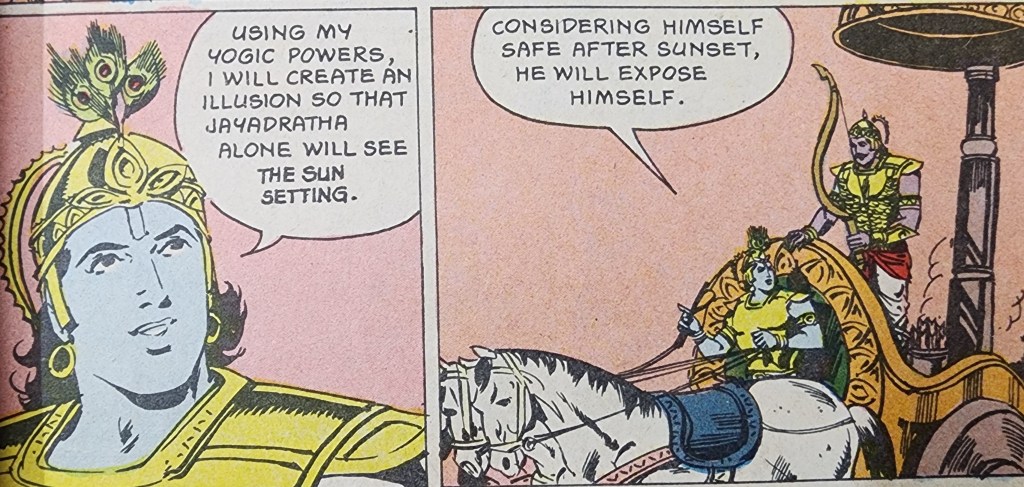
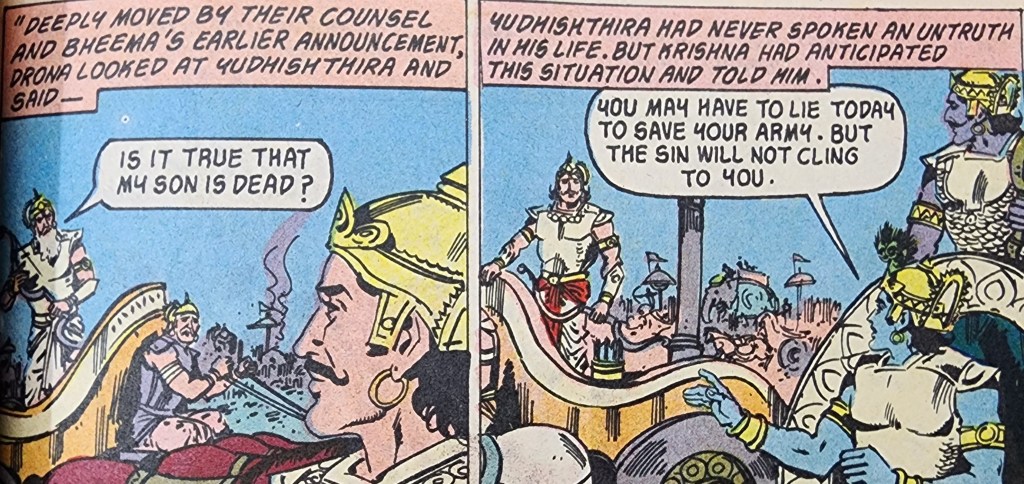
But Krishna did not always have a backup. When he was on his peace mission to Hastinapura to prevent the coming war, he had no one to rely on. Similarly, when he convinced Arjuna to pick up arms, there was no option to let someone else do the heavy lifting, he had to rely on only himself. The same was also true in the slaying of Jayadratha. If Krishna had failed in his deception, there was no Plan B, Itihāsa could have been very different.
This concludes my observations regarding Lord Krishna’s use of deception as a martial strategy, either with or without the use of Maya (magic and illusions). These are aspects we see to this day in warfare and in conflict management in life as a whole.