11th July is celebrated as “Word Horse Day”. This gives us a good opportunity to discuss horses, armour and the martial arts. The most famous horse in Indian history is likely Chetak, the mount of Maharana Pratap in the 16th century.

Seen above is a statue of Maharana Pratap astride Chetak. This statue is from the Maharana Pratap memorial, Moti Magri, Udaipur, Rajasthan. Chetak carried Pratap into many of his battles, including the famous Battle of Haldighati in 1576. Chetak also breathed its last during this battle.

The image seen above shows the armour worn by Chetak when it was ridden into battle. This image is of the exhibit in the City Palace Museum, Udaipur, Rajasthan. The armour includes a saffron tabard as the lowest layer. Over this is a combination of chain mail, overlapping lamellar armour and reinforcing circular plates to protect a lot of the horse’s body. The armour includes a protective plate to protect the front of Chetak’s head. Interestingly, a fake elephant trunk is part of the protection for the head/face.

The above image shows the combination of tabard, chain mail and the reinforcing plates from the side. The stirrup and saddle are clearly visible in this image. Could it be that the armour below the stirrup does not have lamellar plates to protect the rider’s legs from chafing?

The above image shows the lamellar part of Chetak’s armour up close. The small overlapping plates are clearly seen in this image.

The circular metal plates that protect the lower parts of Chetak’s fore and hind quarters are seen up close in the above image.

Observe the armour used by Rajput warriors in the 16th century. It also includes chain mail and lamellar protection for the torso. This shows that the armour for Chetak was remarkably similar to that designed for humans! This exhibit is also from the City Palace Museum, Udaipur, Rajasthan.
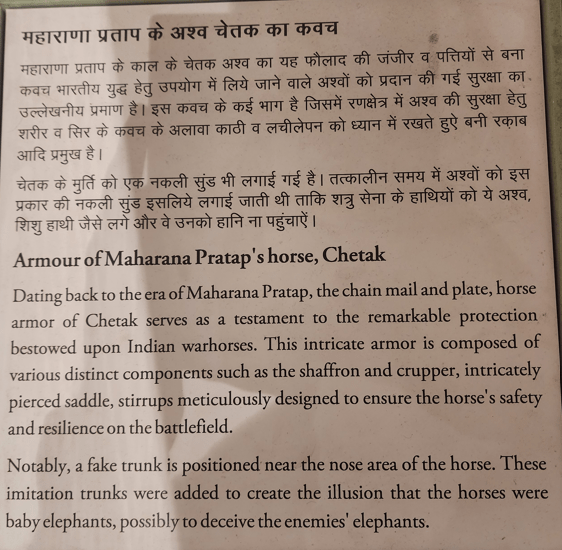
Seen above is the information shared regarding Chetak’s armour displayed at the City Palace museum in Udaipur, Rajasthan.


The 2 images above show a closeup of the protection provided to Chetak’s head and face. Also seen up close is the fake trunk. The guides at the museums say that a fake trunk was affixed to the head of a horse to confuse elephant on a battlefield. Apparently, elephants would assume the horse was a small or baby elephant and give them pause in their attack. I am not sure how true this is or how effective this strategy was. This same information is also seen in the information plaque with information regarding Chetak’s armour.
Chetak, as I mentioned earlier, gave up its live during the Battle of Haldighati in 1576. The forces of Mewar, led by Maharana Pratap fought Mughal forces led by Raja Man Singh of Amber in this battle. The forces of Mewar started very well in this battle when the battle was fought in a narrow pass. Later when the fight moved to a plain, the superior numbers of the Mughal forces took their toll and Maharana Pratap has to retreat.
During the battle, one of Chetak’s hind legs was severely injured. Yet, Chetak carried Maharana Pratap to safety. The horse is supposed to have leapt over a gorge caused by a stream to evade Mughal pursuers. Maharana Pratap escaped successfully, but Chetak was spent after the last leap and breathed its last almost immediately after.
Maharana Pratap is supposed to have been distraught at the loss of his loyal mount. A memorial or samadhi was built for Chetak near the spot where he leapt over the gorge and gave up his life. This samadhi exists to this day and is a popular tourist destination.
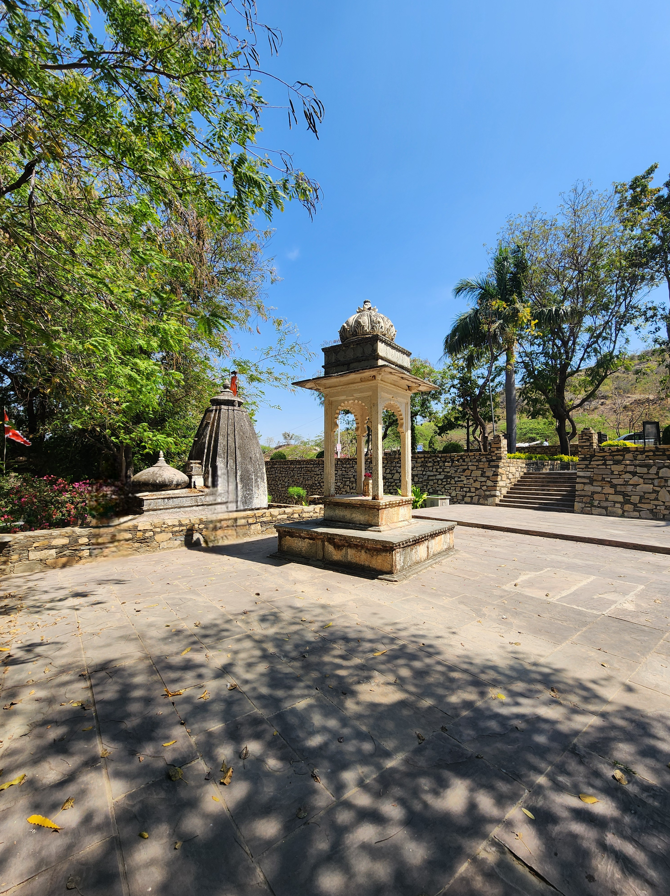
Seen above is the samadhi built for Chetak in Haldighati.
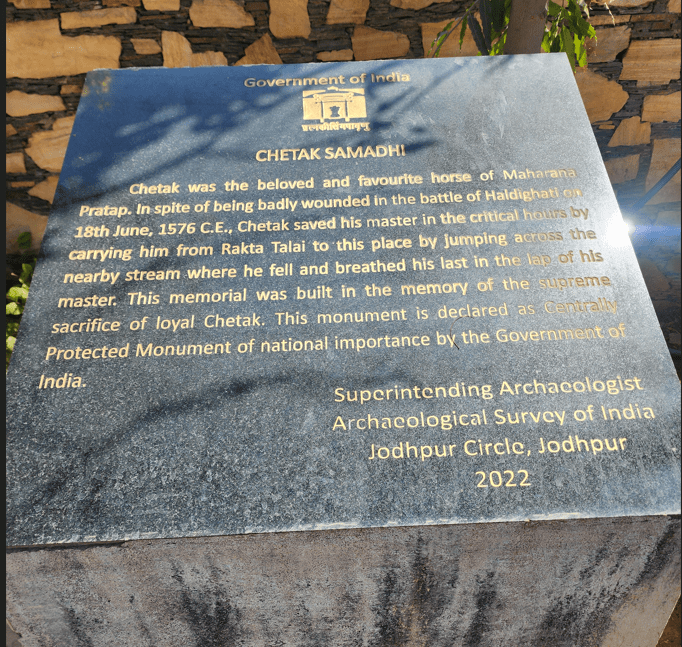
Seen above is the plaque describing Chetak’s samadhi.
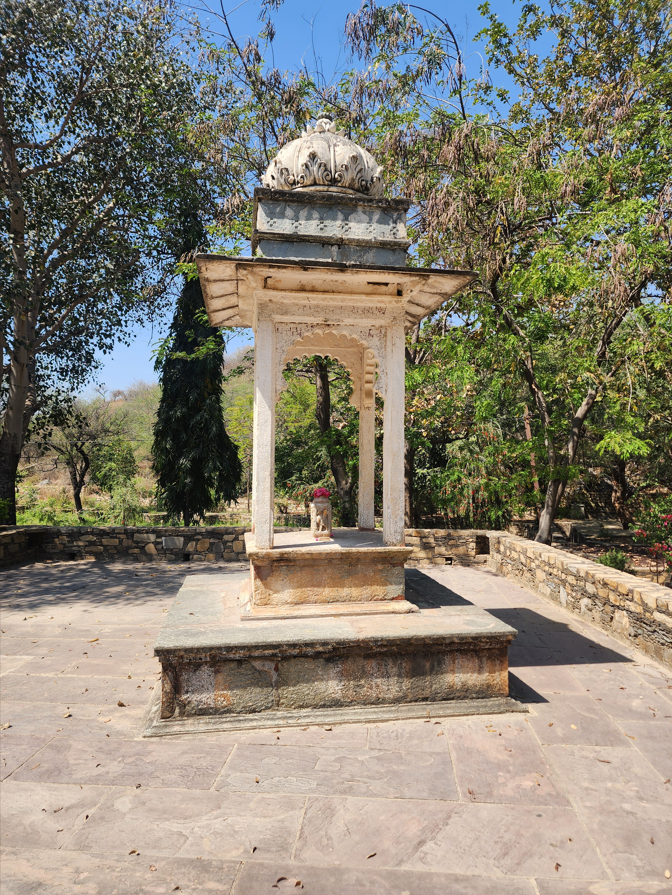

The above 2 images show a close up of the chhatri or cenotaph dedicated to Chetak at the samadhi sthal (place of the samadhi/memorial).
The above video shows the location where Chetak is supposed to have leapt over the gorge. The stream itself is now overgrown and not visible but is clearly audible, as discernible from the video.
It is said that during the battle of Haldighati, Maharana Pratap on Chetak and Raja Man Singh on his elephant came face to face. Chetak is supposed to have reared up on its hind legs to enable its master to hurl his spear at Man Singh. Man Singh survived, but his mahout lost his life to the spear. This supposedly made the elephant go out of control and diminished Man Singh’s ability to command effectively.
But while rearing up on his hind legs, one of Chetak’s hind legs is supposed to have been badly injured by the blades attached to the elephant’s tusks. Many images I saw in Udaipur depict the elephant holding a sword in its trunk. An example of this is seen below. This image is from the Pratap Vijay Smarak, Dewair, Rajasthan.
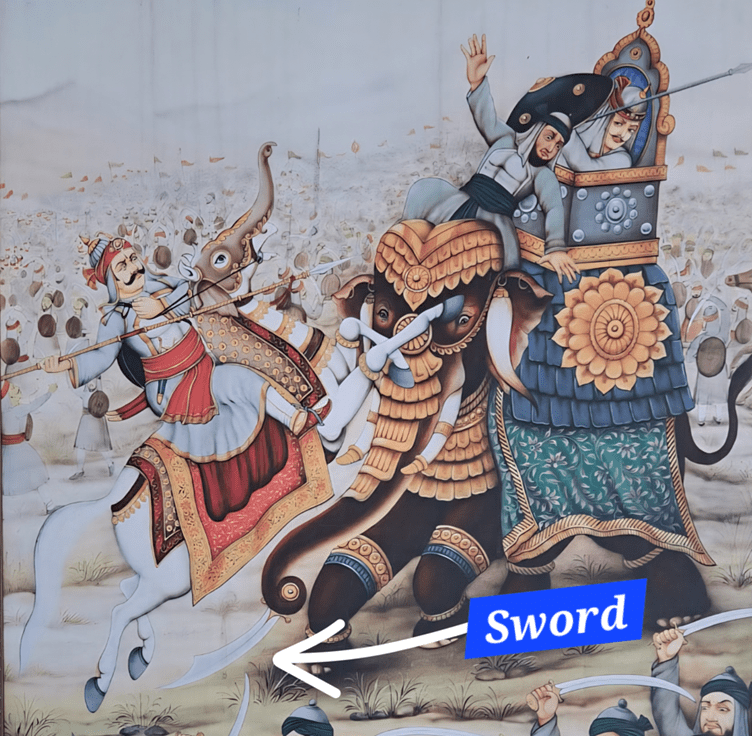
The depiction seen above is not a one off. There are at least 3 depictions I saw of something similar in 3 different museums! Personally, I am not convinced that an elephant held a sword in its trunk. It is more likely that blades were attached to the tusks of the elephant.

The above image shows a display of a surviving sword attached to an elephant’s tusks. This image is from Wikipedia.
Another example of swords mounted on an elephant’s tusks is on display at the Royal Armouries in London. This exhibit is used as an example in the above video. This is an episode of the popular History Channel series, “Forged in Fire”. This episode challenged a couple of master blacksmiths to recreate this sword! I opine that something like this might have injured Chetak at Haldighati, unlike what is depicted in the painting shared earlier.
Another famous horse that finds mention in Indian history is Bucephalus, Alexander’s horse. Bucephalus lost its life during the battle of Jhelum (battle of Hydaspes), when Alexander’s forces fought the forces of Porus. Alexander is supposed to have built a town in memory of Bucephalus. Google Gemini tells me that this town is identified as likely being Jalapur Sharif in the Jehlum district in Pakistani Punjab.
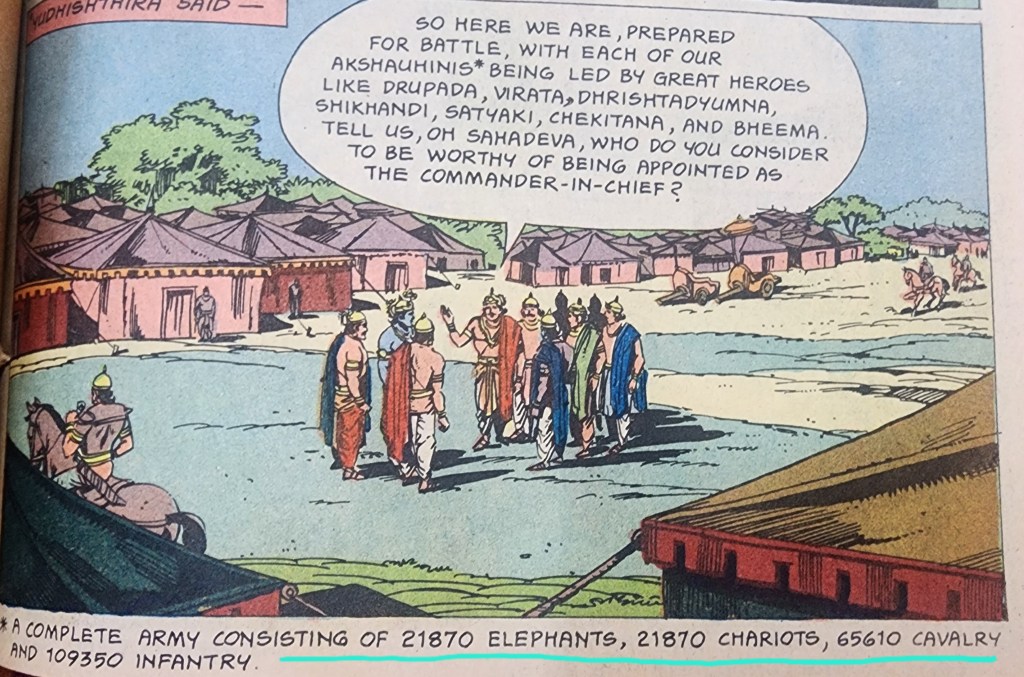
Observe the text at the bottom of the above image, underlined in blue, which shows the numbers making up an Akshauhini. Image credit – “Mahabharata 30 – The War Begins”, published by Amar Chitra Katha.
Horses have always been vitally important in Indian history. The Mahabharata gives some staggering numbers for the total number of horses that participated in the Kurukshetra War! Some details of these numbers are shared below.
- In the Kurukshetra war, there were both cavalry and chariots, both of which used horses.
- 18 Akshauhinis (loosely translated as a “Division”) participated in the Kurukshetra War.
- Each Akshauhini consisted of 65,610 cavalry and 21,870 chariots.
- Each chariot was pulled by 4 horses.
- That brings the total to, {(65610 * 18) + ([21870 * 4] * 18)} = 27,55,620 HORSES IN THE WAR!
- That is 27.5 lakh or 2.75 million horses! That is the current population of Jamaica or Lithuania!

Observe the text at the top of the above image, underlined in yellow, which shows the number of horses per chariot. Image credit – “Mahabharata 30 – The War Begins”, published by Amar Chitra Katha.
In recent times, the Marathas come to mind when cavalry is mentioned. The Marathas captured a very large part of India by being excellent light horsemen whose maneuverability was respected by all their opponents. Even among the Rajput warriors, I personally feel that the design of the spear they used was influenced by their cavalry habits. I had written a post about this, which is shared below. I opine that the rings or bands at different points along the length of the spear could partially be due to its intended use as a lance from horseback.
Of course, the world has seen great cavalry and equestrian cultures all over the world throughout history, starting with the Scythians and Hunas (Huns) to the Mongols and the Hussars, all of whom inspired awe. The performances of mounted horsemen to this day are special, be it with tent pegging, mounted archery or any number of stunt performances all over the world.
In current times, owning and maintaining horses is extremely expensive. So, even though equestrian sports have survived and evolved, martial arts from horseback have diminished and are not practiced much. We no longer practice fighting from horseback, let alone fighting other cavalrymen. We do not know much about the nuances of fighting with swords or spears from horseback as against using the same while on foot.
Even in the Bujinkan system of martial arts, which I am a student of, it is said that cavalry techniques were a part of the disciplines practiced historically. Of course, there was no Bujinkan back then, and cavalry techniques were a part of the Ninja Ju Hakkei which informed the Togakure Ryu.
Historically, there are 18 segments of the Togakure Ryu, of which only a few are practiced regularly in modern times. One of the 18 segments of was “Ba Jutsu” (“Ba” refers to horse and jutsu is “art/practice of”) which included horse riding and cavalry techniques. Ba Jutsu, as far as I know is not actively practiced in the Bujinkan or even just in the Togakure Ryu anymore.
2026 is the Year of the Fire Horse. I had written an article in February of this year exploring the relationship between the horse, knowledge and the martial arts from a Hindy perspective. I am sharing that post below. The earlier article juxtaposes with this one, which is purely about the physical aspects of fighting with respect to a horse.
I will conclude this article with a reference to Chetak’s enduring legacy in modern India. From the 1970s through to the late 90s, Bajaj Auto produced a scooter brand called “Bajaj Chetak”. This scooter was named from the mount of Maharana Pratap himself. It was an extremely popular model of scooter and was widely seen on Indian roads. It has not been reinvented as an electric scooter. Chetak thus lives on in collective Indian memory.
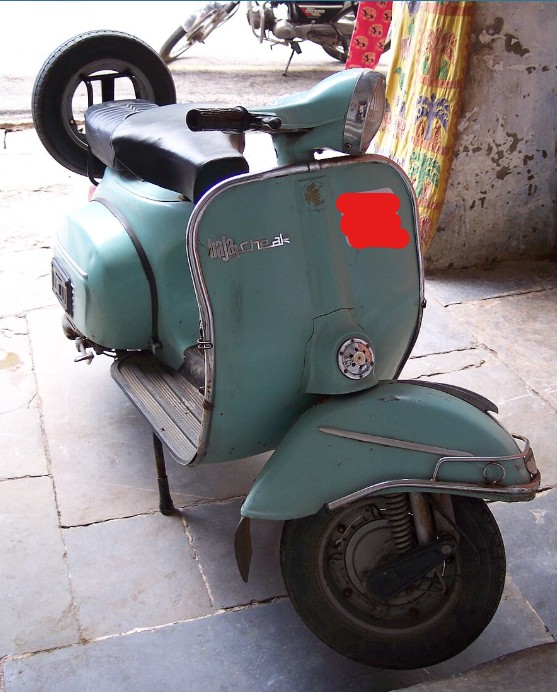
An early and iconic model of the Bajaj Chetak. Image credit – Wikipedia.
 Mundane Budo