Over the years of training the Bujinkan system of martial arts, one will invariably study the different schools that form a part of the system. There are 9 schools that the Bujinkan is comprised of. Of the 9 schools, 6 are practiced regularly in dojos around the world. These 6 schools are mentioned below.
- Togakure Ryu
- Gyokko Ryu
- Takagi Yoshin Ryu
- Koto Ryu
- Kukishinden Ryu
- Shinden Fudo Ryu
When we train each of these schools, we learn the evolution of these schools. This consists of the conditions in which these schools had their origin and how they evolved over the years. The origin of the schools pertains to a region and its geography.
As an Indian, the terrain where the schools had their origin does not come to mind immediately. The terrain and climatic conditions in India are quite different (at least in large parts) from that in Japan, where these schools had their origin and evolution. But the geography and climate which influenced and perhaps defined the schools for a very long period of time is important. To help my fellow Indians identify terrain and conditions similar to the those that led to the birth of these schools, I am writing this post.
I will share images and examples from Indian history which are approximations of the geography and physical conditions in which the 6 schools mentioned above were created and evolved over time. I have used, as far as possible images and videos of places where actual combat occurred. All the images are videos in this 2-part series are taken by me during visits to these locations.
In Jan 2025, I had written a more detailed post about the schools form a part of the Bujinkan system of martial arts. The link to this post is seen below. Do refer to this link for more information about the schools.
TOGAKURE RYU
I have heard from my teacher and mentors that the Togakure Ryu, at least in part, evolved from the way troops fought inside castles. The long deep kamae (physical posture) and linear movement in the Togakure Ryu is supposed to be an outcome of having to move linearly in narrow passageways. Castles, like many forts and palaces around the world, had narrow passages to defend them better. This same feature was true for walkways along fort walls. I am sharing images from the Udaipur City Palace the Kumbhalgarh Fort below.
The Udaipur City Palace was built with defence in mind, for the kingdom of Mewar, the capital of which was Udaipur, was at perpetual war with the Mughals, Afghans and other neighbouring Sultanates for centuries. Mewar’s earlier capital Chittorgarh was brutally sacked thrice between the 14th and 16th centuries.
Kumbhalgarh, was smaller than other major centres of Mewar, and was never held for long by her enemies. It seems to have been built mainly for defence, with a 36 km long wall (supposedly the 2nd longest in the world after the Great Wall of China). The walls have wide walkways in places, but the stairs up and down the walls are narrow and easy to defend.
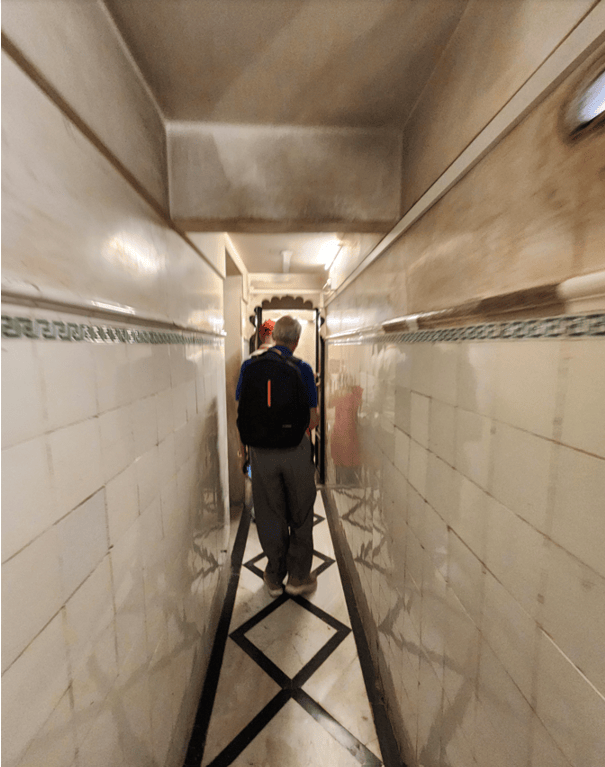
The above image shows a narrow passageway in the City Palace, Udaipur, Rajasthan. Two people will have a really hard time walking next to each other in this corridor. And there are no deviations to duck into. So, anyone who enters will be at risk from the moment they enter until they exit. Of course, with sturdy and big shields one can safely traverse these passages. But the passages can be barricaded and attackers can have a hard time fighting defenders, even in small numbers, especially if they are using pole weapons, to slow down the attackers.
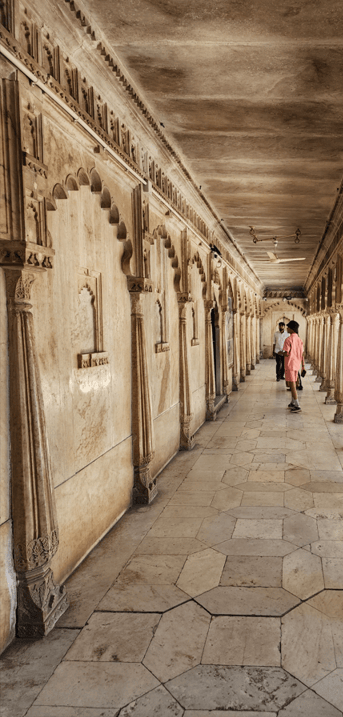
Seen above is another corridor from the City Palace, Udaipur. This one is much wider than the one in the previous image. Maybe 6 to 8 soldiers can walk next to each other here. But this also means a larger number of troops can hold corridors like this, in formation and full kit, like spears, swords, shields, armour and missile weapons.
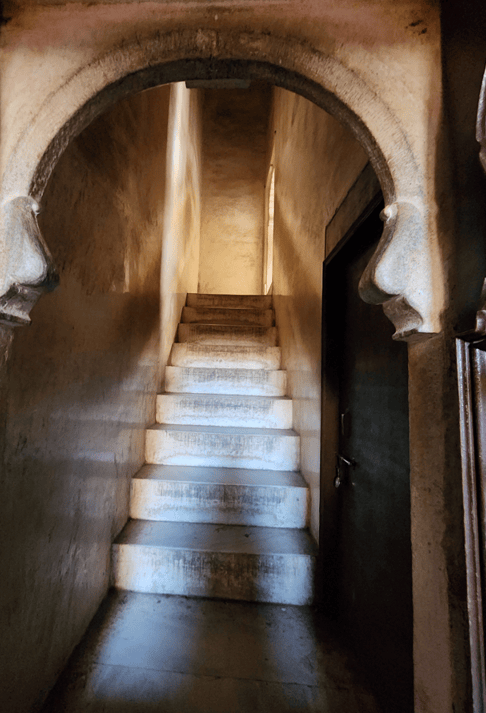
This is a narrow staircase from the Kumbhalgarh Fort, Rajasthan. Not only is it narrow, one also cannot see what is on the other side of the doorway to the right at the top. This uncertainly adds to delaying attackers and gives defenders opportunities to fight back.
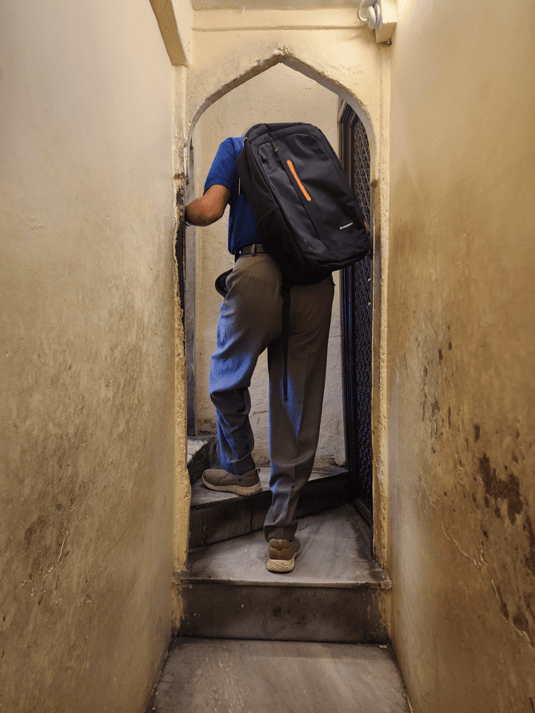
This image shows the entrance to another narrow staircase. Here, one needs to duck at the doorway, making one all the more vulnerable. This image is from the City Palace, Udaipur.
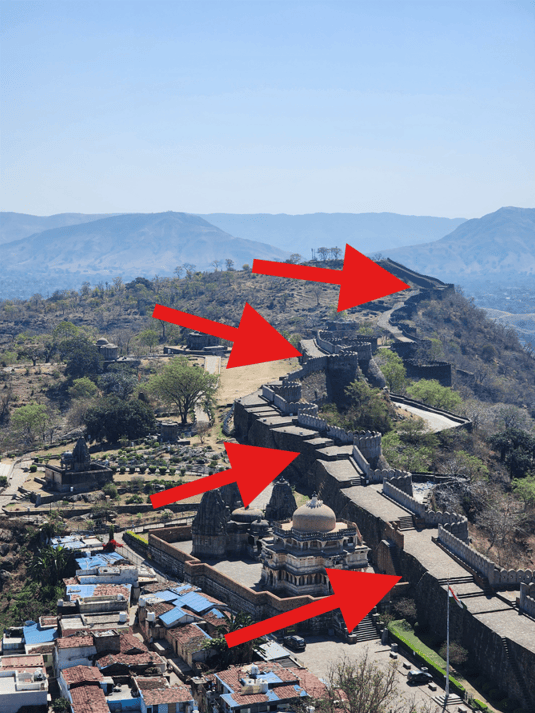
The above image shows the wall of the Kumbhalgarh Fort, indicated by the arrows in red. The wall stretches for 36 km, with varying widths. What is seen in the image is the widest part. It is said that 4 horsemen can ride alongside each other on the walkway. I would estimate that 8 to 10 soldiers can do the same. While this is much wider than the narrow passageways and stairways seen in the previous images, this is still not very wide. Considering that a fall off the wall would injurious, if not fatal, the lack of space is a considerable challenge to fighting on top.
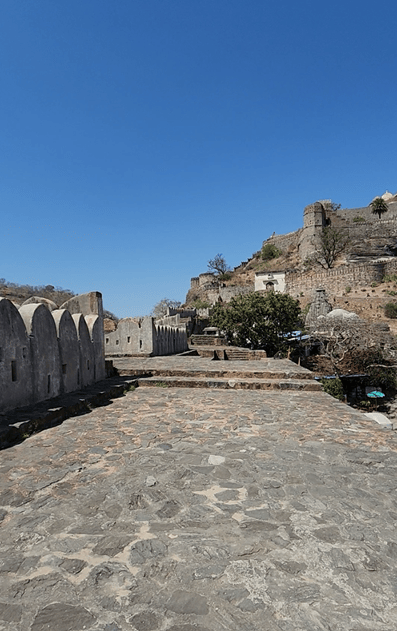
This image shows the walkway on the wall from the previous image, a “ground level” view if you will. Not only is the path not wide, the occasional steps also make the ground uneven while fighting.
GYOKKO RYU
The Gyokko Ryu, from what I have heard, is perhaps the oldest school in the Bujinkan system. The Gyokko Ryu is a system of very close quarters fighting, with just about a half-arm distance between the opponents. I have heard that this was a consequence of the Gyokko Ryu evolving from fighting in small spaces, like chambers and rooms in castles and homes in historic Japan.
It is also said that this system was used by women, mainly of the court, to protect themselves in case the castle was breached and their quarters were attacked. This seems logical as the Gyokko Ryu was already adapted to be applied in small spaces.
Considering that palace passages were narrow spaces themselves, some of the concepts of the Gyokko Ryu would be applicable in the spaces where the Togakure Ryu would be applicable. Of course, there is not strict distinction in where a specific system of fighting should be applied. It depends on the opponents, the situation and what one actually is capable of or trained to do.
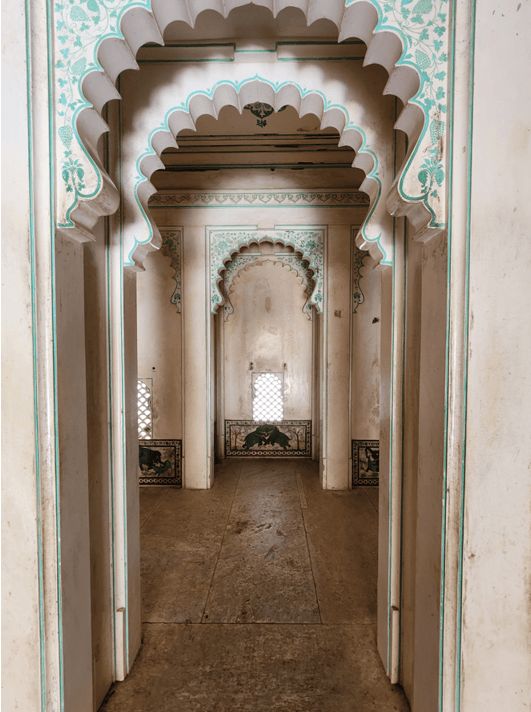
The above image shows a room from the Kumbhalgarh Fort. It is not very big. Even the royal chambers of this fort are not very large. The guide there said that this fort was a “fallback option” for the rulers of Mewar. When Chittorgarh was attacked or Udaipur was threatened, they retreated to Kumbhalgarh while planning a counterattack.
Kumbhalgarh was well defended by terrain, by the Aravali hills, which were forested as well. So, taking this fort was a lot harder than attacking the other 2 major centres of Mewar. Considering this “fallback” feature of Kumbhalgarh, the living quarters are small compared to other palaces. And fighting in these chambers is kind of what the Gyokko Ryu was designed for!
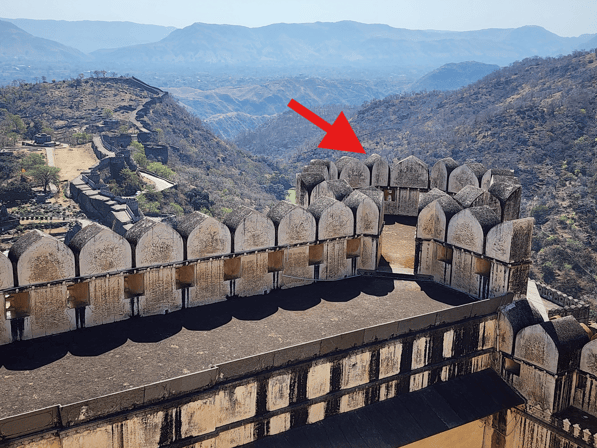
This image shows the walkway and watchtower at one of the higher points of the Kumbhalgarh Fort. Small cannons could also be placed here. Consider fighting in just the watchtower indicated with the red arrow. It is a confined space where fighting would be in very close quarters. While the walkway could be considered to be conducive to the Togakure Ryu and the Gyokko Ryu, the tower itself would be ideal space for the Gyokko Ryu.
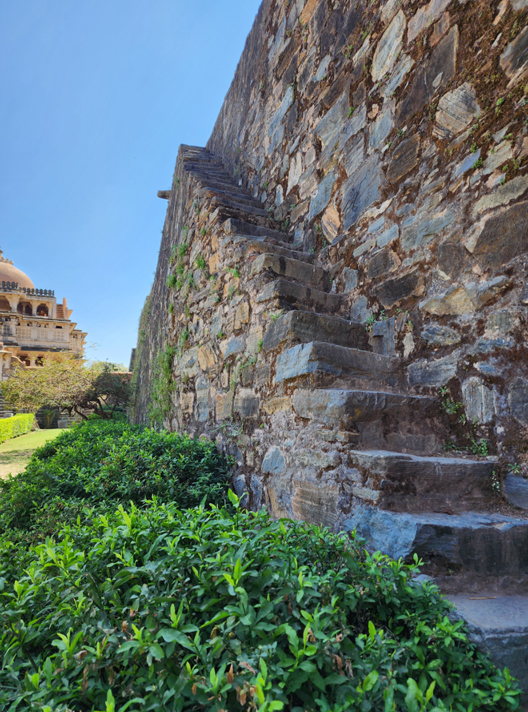
This image shows the staircase up to the walkway of the main outer wall of the Kumbhalgarh Fort. It is so narrow that only one person can climb up at a time and her or his shoulder would scrape the wall doing so! I would say it is nearly impossible to fight on these stairs! It is pretty much suicide, if even a slight slip occurs.
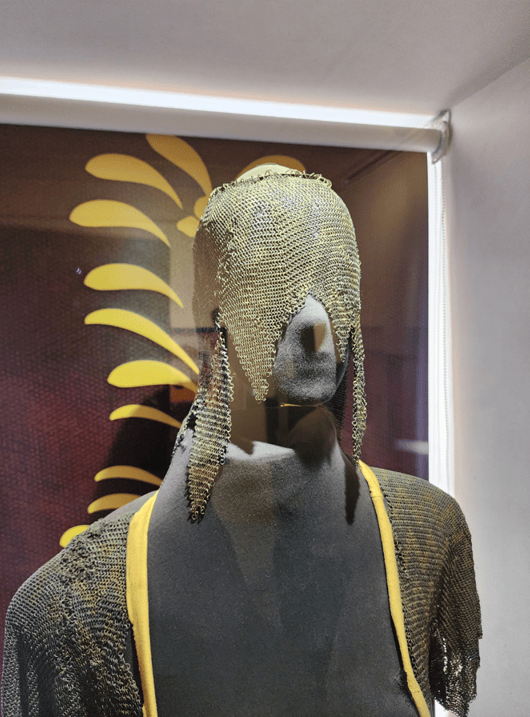
Considering that the evolution of the Gyokko Ryu involved women in combat, here are 2 examples. Seen above is the chainmail armour of a female palace guard from the City Palace museum in Udaipur. The women’s quarters, or Zenana Mahal, had guards who were women. These fighting women wielded spears, swords, shields, early firearms, knives and bows and arrows.
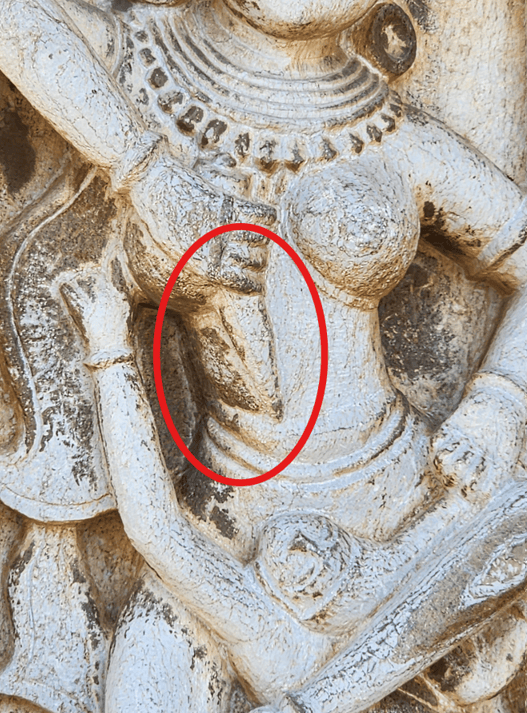
This image shows a carving on the Vijay Sthamb (Tower of Victory) in the Chittorgarh Fort. It is a close up showing a woman mid-flight. She is wielding a dagger and is poised to strike at an opponent she has trapped with her legs. This is a classic example of close quarters combat. She is in grappling distance and is utilizing a short-range weapon. The dagger is seen encircled in red.
TAKAGI YOSHIN RYU
The Takagi Yoshin Ryu is another school that has a link to palace culture. I have heard it said that this school evolved, at least partially, from the skills developed by bodyguards while defending their patrons, who tended to be aristocrats and wealthy folk. The techniques in this school include those that involve taking down and restraining individuals, something akin to arresting individuals. This was supposedly to capture potential assassins, spies and similar criminals, so that they could be questioned for information later. Restraining individuals in turn involves some movements that are expressions of grappling.
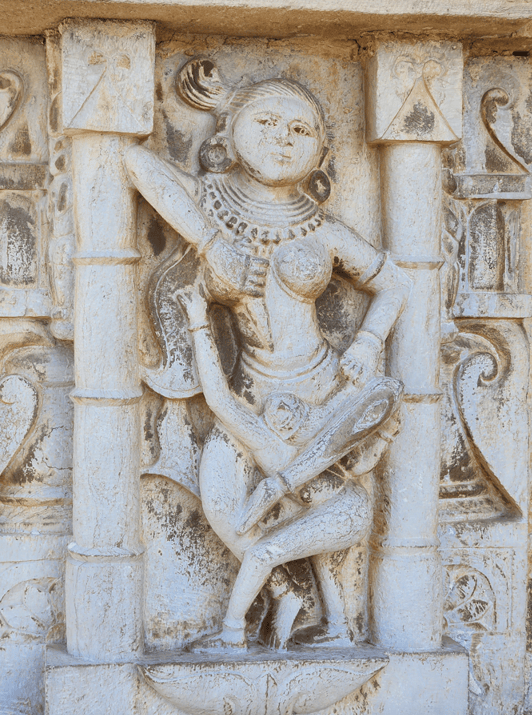
The above image shows a carving on the Vijay Sthamb in the Chittorgarh Fort. This is the carving, the close-up of which was seen in the earlier image. I considered it a display of an expression of the Gyokko Ryu earlier due to the use of the dagger and the close quarter fight that is shown. However, this image can also be considered an expression of the Takagi Yoshin Ryu.
The woman in the image has restrained, or perhaps trapped, another individual with her legs. It seems like the trapped individual is struggling and using his right arm to maybe fight back. But the woman is wielding a dagger, poised to strike. What we cannot tell is if the dagger is a threat, promising injury or worse if the person does not surrender, or if it is the moment before she strikes the fatal blow. If it is indeed a threat, the trapped individual could be interrogated later!
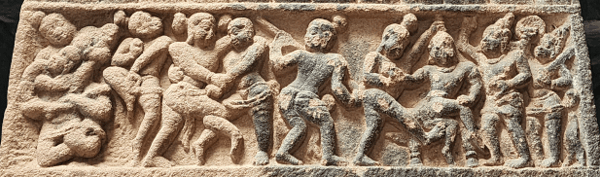
The above image shows a panel from a temple in Pattadakal, Karnataka. This carving dates to the 8th century CE. India has a very long tradition of wresting and grappling arts. This tradition includes the martial systems of Malla Yudhha, Kushti and Pehalwani.
This panel shows people trying to trap and take done one another. Individuals are trying to restrain arms, trip the other over and grasping about the waist. In the far-left panel, one individual is attacking another from behind, using legs to apply a body choke (tai jime) and a choke on the neck with the hands.
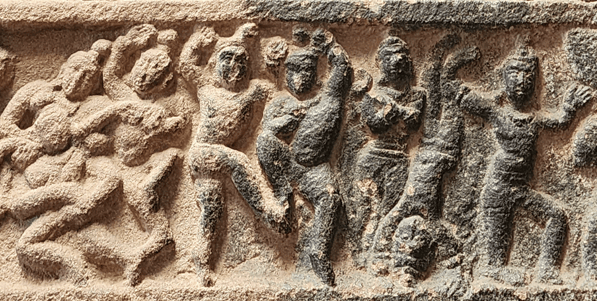
This image also shows a panel from Pattadakal, Karnataka. This panel also shows scenes of grappling and an attack from the rear. Towards the right side is an individual either performing a head stand in celebration or has been flipped over by his opponents.
I will conclude part of this 2-part series here. We will delve into the Koto Ryu, the Kukishinden Ryu and the Shinden Fudo Ryu in the next part.


[…] The Bujinkan schools from an Indian perspective – Terrain, People & Evolution – Part&nbs… […]
LikeLike