This post is the second part of a 2-part series. The link to the first part is seen below.
I would encourage everyone to read both parts. However, if you are here, there is no need to read part one before coming to this post. To enable this, I am sharing the introduction to this series, which is also seen with part 1, below. This gives a reader a fair idea to go ahead with this post and visit part 1 later.
Over the years of training the Bujinkan system of martial arts, one will invariably study the different schools that form a part of the system. There are 9 schools that the Bujinkan is comprised of. Of the 9 schools, 6 are practiced regularly in dojos around the world. These 6 schools are mentioned below.
- Togakure Ryu
- Gyokko Ryu
- Koto Ryu
- Shinden Fudo Ryu
- Kukishinden Ryu
- Takagi Yoshin Ryu
When we train each of these schools, we learn the evolution of these schools. This consists of the conditions in which these schools had their origin and how they evolved over the years. The origin of the schools pertains to a region and its geography.
As an Indian, the terrain in different regions of Japan, where these schools had their origin and evolution, does not come to mind immediately. But the geography and climate which influenced and perhaps defined the schools for a very long period of time is important. To perhaps alleviate this issue, I am writing this post.
I will share images and examples from Indian history which are rough approximations of the geography and physical conditions in which the 6 schools mentioned above were created and evolved over time.
In Jan 2025, I had written a more detailed post about the schools form a part of the Bujinkan system of martial arts. The link to this post is seen below. Do refer to this link for more information about the schools.
We had looked at the Togakure Ryu, the Gyokko Ryu and the Takagi Yoshin Ryu in part 1, the link to which is seen above. We will look at the remaining 3 schools in this post.
KOTO RYU
The Koto Ryu is a sister school of the Gyokko Ryu (which we looked at in the previous part) in some ways. Over the course of history students from the two schools have been handed over the responsibility of the Soke (Inheritor – Grandmaster) for the other when there was a need. Gyokko Ryu is an expression of Kosshi Jutsu whereas Koto Ryu is an expression of Koppo Jutsu.
The Koto Ryu is not necessarily specialized towards close-quarters combat. It favours slightly greater distances between opponents, a “middle distance” if you will. The Koto Ryu also favours individuals moving in and out of the range of opponents. The distances change from short to long alternatively and as necessary. This is not unlike fighting with sword and shield. The use of the sword takes one closer to an opponent while defending with a shield allows one to move out of the range of an opponent’s attack.
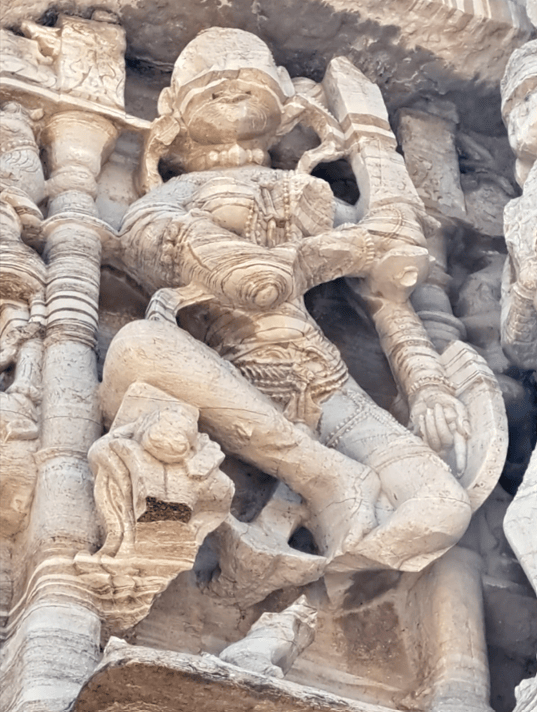
The above image shows a woman wielding a sword and a shield. This is a carving that is present on the Keerthi Sthamb (Tower of Glory) in the Chittorgarh Fort in Rajasthan. This lady is wielding a short sword. So, her fighting style could be relatable to the Koto Ryu, even if this school does not specify the weapons to be used. As someone wielding a short sword and a shield, she would dart in and out of the range of an opponent, for attack and defence, movement which is emblematic of the Koto Ryu.
KUKISHINDEN RYU
The Kukishinden Ryu, based on what I have learnt, is characterized today by arms and armour. Quite some weapons we train in the Bujinkan these days come from the Kukishinden Ryu. Supposedly, a lot of the techniques in the Kukishinden Ryu are descended from situations where the opponents used armour to protect themselves. The methods used to put an opponent at a disadvantage when she or he is protected in armour differ from when opponents are unarmoured.
The Kukishinden Ryu is also supposed to have a heritage of use at sea. Sailors are supposed to have used the Kukishinden Ryu on ships, or large boats in the past. This included pirates and naval troops. This is not to say that the Kukishinden Ryu was not applied on land. I have never seen this school be practiced in modern day on boats. This aspect, while discussed, does not overly inform the manner in which the school is practiced.
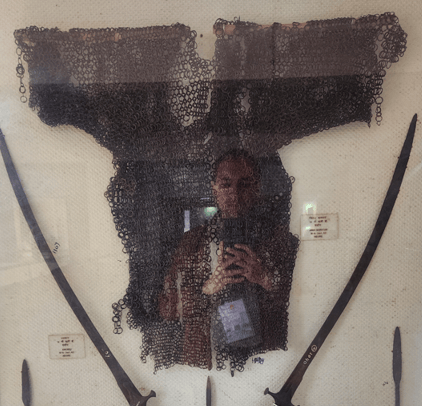
The above image shows a chainmail shirt displayed in the State Museum in Bhopal, Madhya Pradesh. This is perhaps the most commonly used form of armour over several centuries across most of Eurasia. The protection chainmail provided against cuts and slashes affected the way soldiers moved since they could ignore attacks that were purely cuts. This armour did not give the same degree of protection against thrusting attacks.
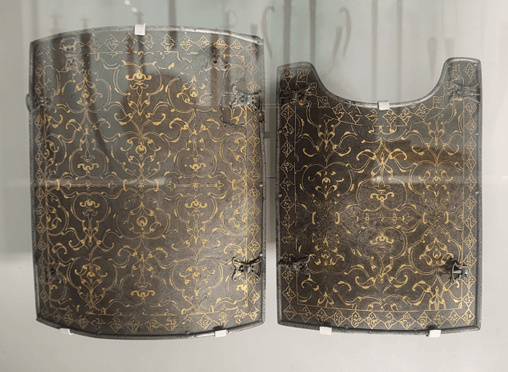
The above image shows the plates worn by soldiers on top of chainmail shirts. These were worn on the front over the chest and on the back. This display is from the City Palace Museum in Udaipur, Rajasthan. These plates added protection against thrusts in addition to the protection against cuts that chainmail afforded.
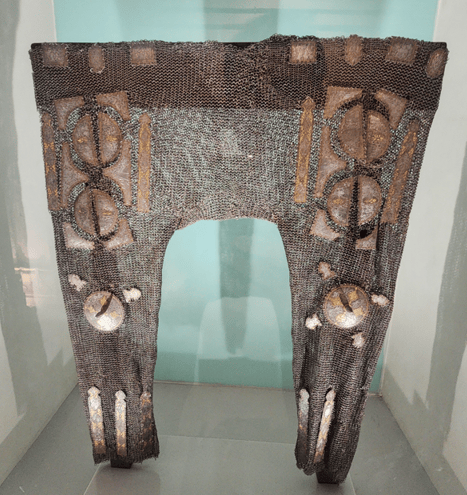
This image shows chainmail leggings which also have plates for added protection. These are also displayed in the City Palace Museum, Udaipur, Rajasthan. Observe the round plates over the knees. The have wicked spikes! I wonder if kneeing an opponent with the spikes was a good idea though. If the kick is against an unarmoured part of an opponent, it would be effective. But if it was against armour, the damage would not be great.
The chance of the spike getting caught in the opponent’s armour or causing pain to the one kicking needs to be considered, before concluding that spike was a smart addition! Also, could it have been placed there for a psychological advantage over an opponent? For it looked scarier than it was effective? I guess that is food for thought.
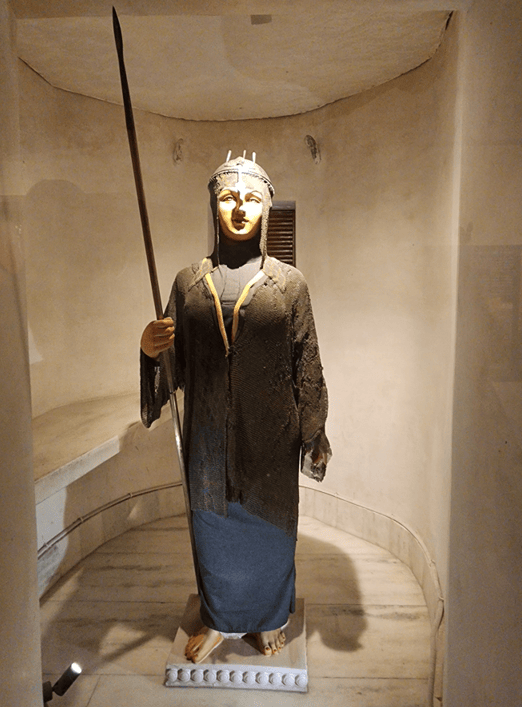
This image is also from the City Palace Museum, Udaipur, Rajasthan. It shows a female guard of the women’s quarters (Zenana Mahal). This guard is armed with a chainmail shirt, helmet and a spear. These guards, as discussed with another image in the section for the Gyokko Ryu, also used swords, shields, daggers and early firearms. The spear forms practiced in the Bujinkan also have their roots in the Kukishinden Ryu. In a way, this image captures very well the essence of the Kukishinden Ryu, weapons and armour.
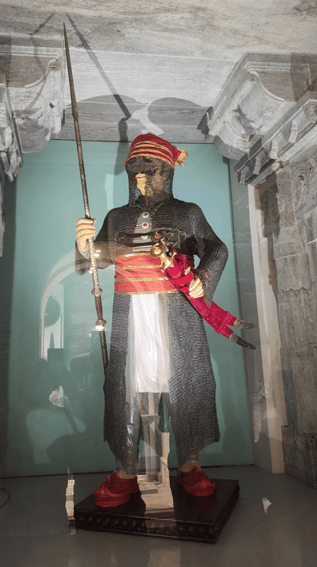
This image shows some arms and the armour used by Maharana Pratap. Pratap is perhaps the most famous ruler of Mewar and among the best-known warriors of historical India. In this display he is seen with a chainmail surcoat on top of a set of overlapping plates over his chest. The chainmail is fastened with a cummerbund.
Also seen in the image are his famous twin swords and spear, which was supposedly his favourite weapon. This display is also from the City Palace Museum in Udaipur, Rajasthan. The Kukishinden Ryu also has its own school of sword fighting. The kind of kit seen in this image is what would have been emblematic of elite warriors in India in the 16th century, which corresponds to the Sengoku period in Japan. This era was the high noon of mediaeval combat in Japan.
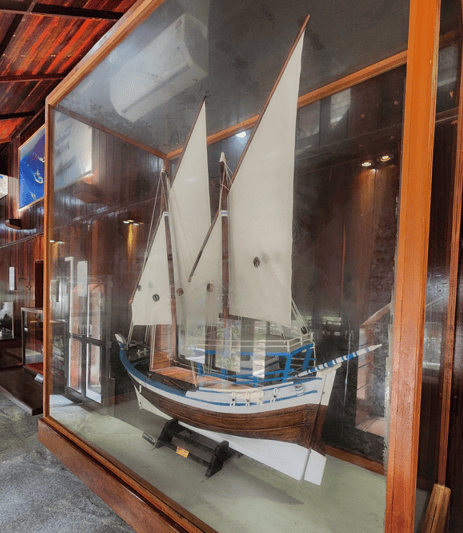
The above image shows a “Toothkudi Ship”. The image is from the Maritime Heritage Museum, Mahabalipuram, Tamil Nadu. This was a type of ship used historically on the East Coast of India.
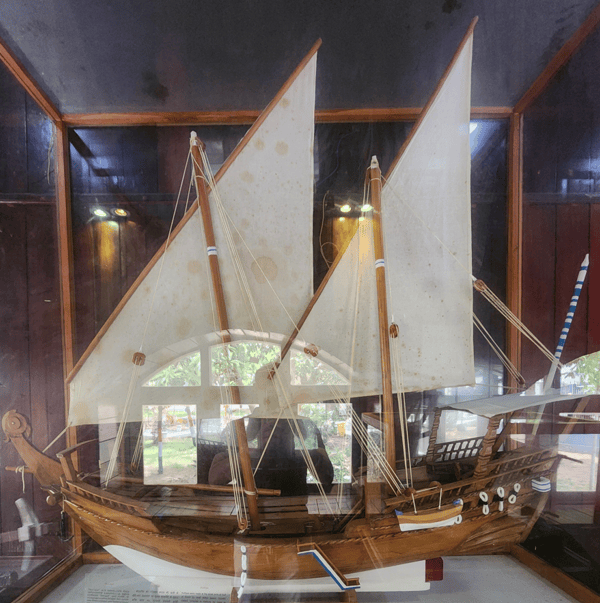
This image shows a “Kottiya”. This image is also from the Maritime Heritage Museum, Mahabalipuram, Tamil Nadu. This was a type of ship used historically on the West Coast of India.
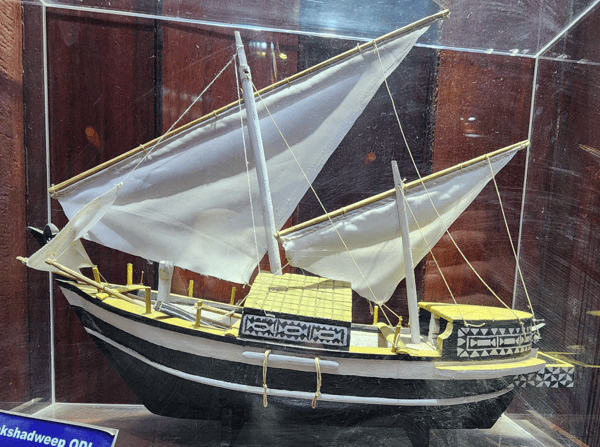
This image shows a model of a “Lakshadweep Odi”. The image is also from the Maritime Heritage Museum. This was a type of ship used historically on the on the Southwestern coast of India.
All the 3 types of ship seen above are what are classified as “Dhows”. Variants of this design of ship have been in use in Indian waters for almost 2 millennia, right up until the 20th century and were the mainstay of trade activities. The martial arts used by pirates and private guards of cargo and merchants would have likely applied their craft on boats of this kind.
SHINDEN FUDO RYU
The Shinden Fudo Ryu is a school that is supposed to have developed through combat in wooded areas. This school also has no defined physical postures (kamae), perhaps because keeping any defined physical posture in uneven terrain that forested areas present, is not practical.
The other oft observed aspect regarding the Shinden Fudo Ryu is that it uses open palm strikes. This supposedly is akin to the wings of birds which do not form fists! This attribute also harks back to the natural world which seems inextricably linked to the evolution of this school. In other words, the terrain seems to be the most important among the defining aspects of this school.
Many battles in Indian history have been defined by the terrain. One example is the Battle of Saraighat in 1671, where the river Brahmaputra played an important role in the victory of the Ahoms over the Mughals. Another example is the 3rd Battle of Panipat, in 1761, where the plain ground benefitted the use of mobile camel mounted artillery of the Afghans over the heavy artillery of the Marathas.
But one battle where the wooded terrain specifically aided one side was the Battle of Dewair in 1582, when the Rajput forces of Mewar defeated the Mughal Army in the Aravali Hills in Rajasthan. This Battle was fought in the hills and gorges of Dewair which is in the midst of the Aravali Hills, which are covered in dense scrub forest, which diminished the advantage provided by Mughal numerical superiority.
I am sharing videos and a photo of the terrain where this battle was fought. There is only a memorial built to commemorate this battle at the location. Nothing else has come up and no development has changed the terrain in nearly 450 years!
This video shows the entire area (Dewair ka Darra) where the Battle of Dewair was fought, from the top of the memorial that has been built. This shows the difficulty of the terrain for large bodies of troops to maneuver in.
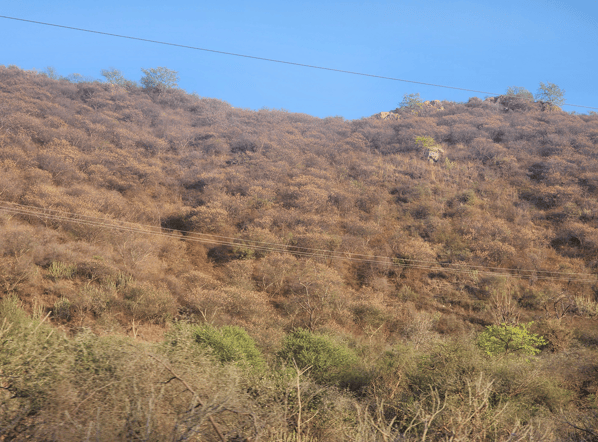
This photo is from the road leading to Dewair. The density of the scrub and thorn forest on the slopes of the hills is clearly visible here.
This short video shows how poor the visibility is along paths with dense vegetation all around.
This video shows the terrain along the road close to the actual Gorge (Darra) of Dewair. Some of the sudden plunges in the rocky terrain are visible in this video.
The above photo and set of videos are a wonderful example of fighting in uneven terrain in wooded areas, very similar to the geographies that gave us the Shinden Fudo Ryu!
This brings me to the end of this two-part series of articles that show, from an Indian historical perspective, where the origins of the regularly practiced schools of the Bujinkan lie.

