Sep 4th, 2026, is Krishna Janmāshtami, when we celebrate the birth of Lord Krishna. Lord Krishna’s life is full of stories which serve as case studies to learn from. Literally every aspect of his character has been written about by several people. This post will also stick to the concepts and learnings that can be gleaned from the life of Lord Krishna. I will as usual stick to the martial aspects and the learning from them that I see in the stories associated with Lord Krishna.
Even if one is to consider just the martial aspects in the several conflicts that Krishna managed over the course of his life, this article would be too long. So, I will stick to one specific attribute related to the martial arts in this article and delve into the examples of its application through stories of Lord Krishna. This attribute I am focusing on is “Deception in martial arts”, which can be read as “Deception in Conflict Management”. Even with this limited focus, this exploration will be split over 2 parts.
Lord Krishna used deception, sometimes with illusions (Maya) to get an upper hand over opponents in war and negotiations. This happened multiple times over the course of his life. Deception was used against him as well. There were times when his use of deception failed and occasions when he was deceived by the illusory means deployed by others as well.
I will list the few occasions when any of the above situations occurred, with a few observations of my own. I will attempt to layer my knowledge of deception in the Bujinkan system of martial arts to identify how the concepts in the stories related to Lord Krishna could be real world tactics, without the magic part of the Maya.
I consider “surprising the opponent” to be the same as “deceiving the opponent” when I consider examples where I believe deception was deployed against opponents.
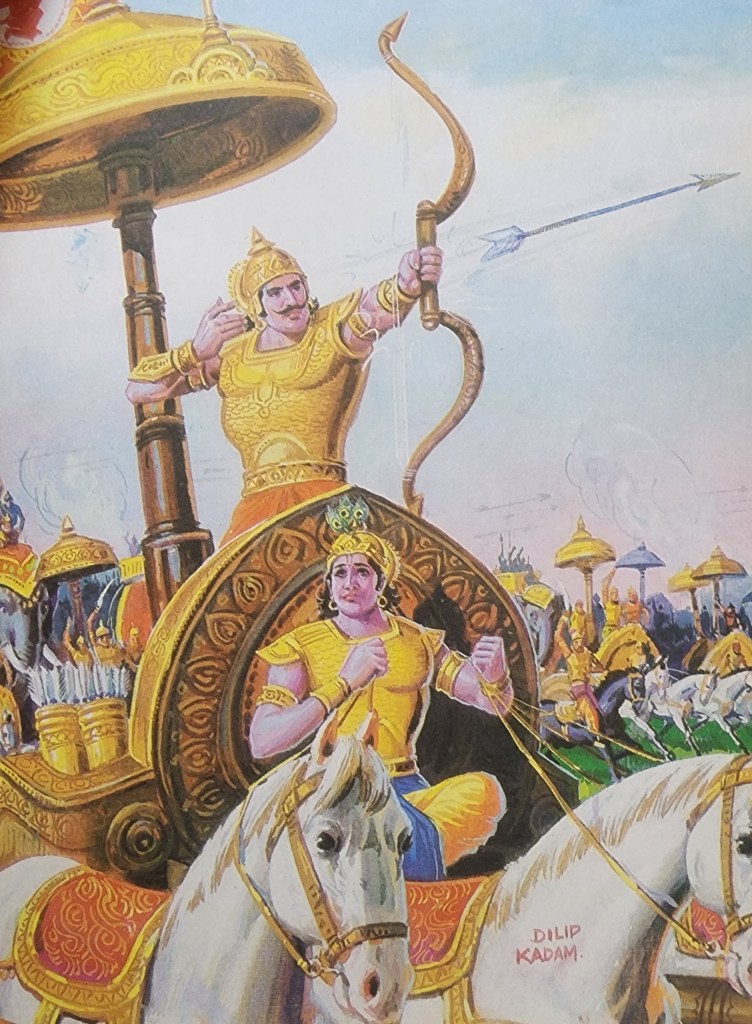
Lord Krishna in perhaps his most iconic role as Arjuna’s charioteer during the Kurukshetra War. Image credit – “Mahabharata 30 – The War Begins”, published by Amar Chitra Katha (this is the cover image).
In the Bujinkan system of martial arts, Soke Hatsumi Masaaki used to share yearly themes that used to inform the training for a given year. This practice lasted from 1992 (some say 1988) through 2019. The theme of the year for 2007 was “Menkyo Kaiden”. “Menkyo Kaiden” has 2 meanings as far as I know.
The first is the license that a Grandmaster hands out to one of his senior students. This license grants the student the license to teach and build upon the teachings of her or his teacher. The teachings that can be built upon are usually specified, like a specific weapon or a defined form of fighting and need not encompass all that a given teacher has taught.
The other meaning is the one that Hatsumi Sensei used as the theme of the year. This one referred to “transmitting falsehoods into the mind of the opponent”. This essentially meant causing confusion in the opponent however one can, in simpler terms, “deceive the opponent”. The difference in the 2 meanings of “Menkyo Kaiden” was brought about by the use of different Kanji when Sensei Hatsumi wrote the characters.
Another term that means something similar is “Kyojitsu Tenkan Ho”. This translates to “transmitting truth and falsehoods alternatively to an opponent”. The “kyojitsu” refers to alternating truth & falsehoods. “Tenkan” is a revolving door and “ho” is way or path. So, this could mean that the opponent is made to receive truth & falsehoods regarding one’s intention and movement through a revolving door, such that he or she has no idea which is the truth and which the fakery. This in essence also leads to confusion in the opponent and gives one an advantage. This is also for all practical purposes, a deception during a fight.
An example of this in a one-on-one fight could be landing a punch a little short of the impact or making a cut with a sword in the air without making contact. The opponent is drawn to block the punch or the cut. The block to the punch, gives the one who threw the “fake punch” an opportunity to take the forearm into a lock or to take the balance of the opponent. Similarly, if a “fake cut” is parried, the action reveals one or more openings in the opponent that can be exploited.
In the real world, deceiving opponents was a continuous attempt throughout the ages. A few examples of this could be the following.
- Many Turkic armies used the feigned retreat to draw their opponents out to more favourable ground or to surround them or to thin out their lines.
- Peshwa Baji Rao 1st convinced the Nizam of Hyderabad that he had a numerical advantage during the Battle of Palkhed in 1728, with fast cavalry movements while the truth was the opposite. The Nizam agreed to terms with very little fighting!
- The Allied forces during WW2 created a phantom Third Army to convince German forces that the attack would occur on Pas de Calais while the real attack came on Normandy.
A lot of these actions have precedents in the stories relating to Lord Krishna. Let me share a few. First let us consider the cases where deception was used against Lord Krishna.
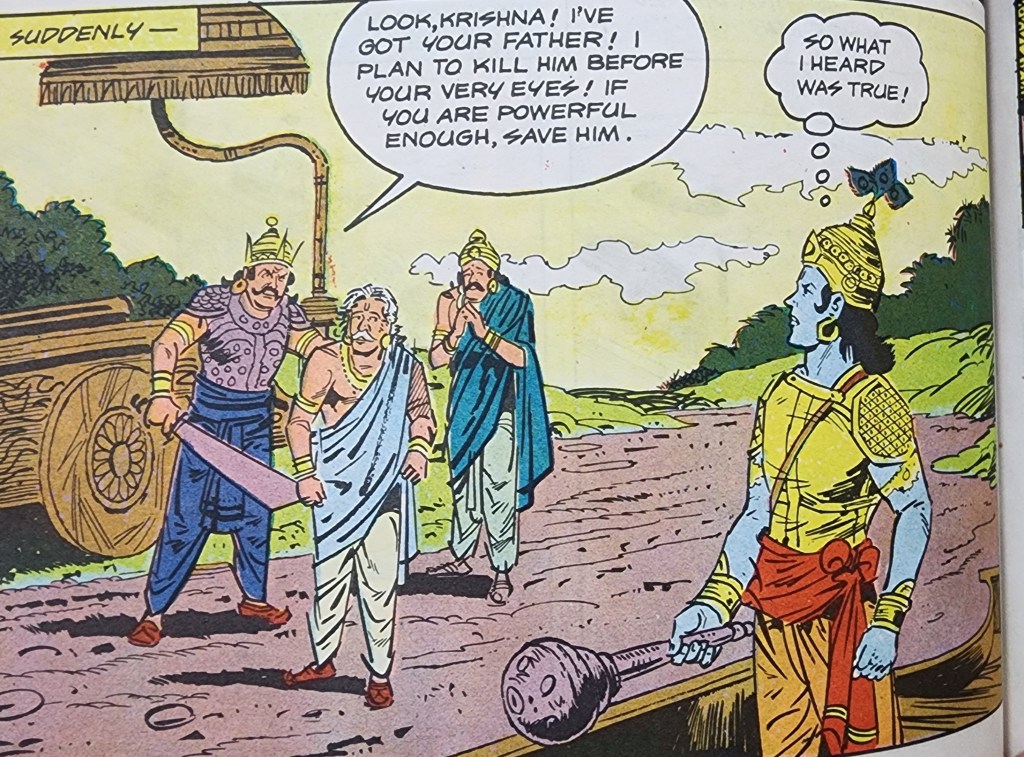
Salva, King of Saubha, uses deception against Krishna. Image credit – “Krishna and Shishupala”, published by Amar Chitra Katha.
Salva, the king of Saubha was an ally of Jarasandha and an enemy of the Yadavas (and consequently their city of Dwaraka). He acquired a flying chariot to counter Krishna’s ability to use Garuda to carry out aerial attacks. But this was not the deception. When Krishna and Salva were fighting, Salva, using Maya, created an illusion of having taken Vasudeva, Krishna’s father, hostage. The trick worked and gave Krishna pause. While Krishna eventually defeated and killed Salva, the illusory deception he used gave Salva a temporary advantage.
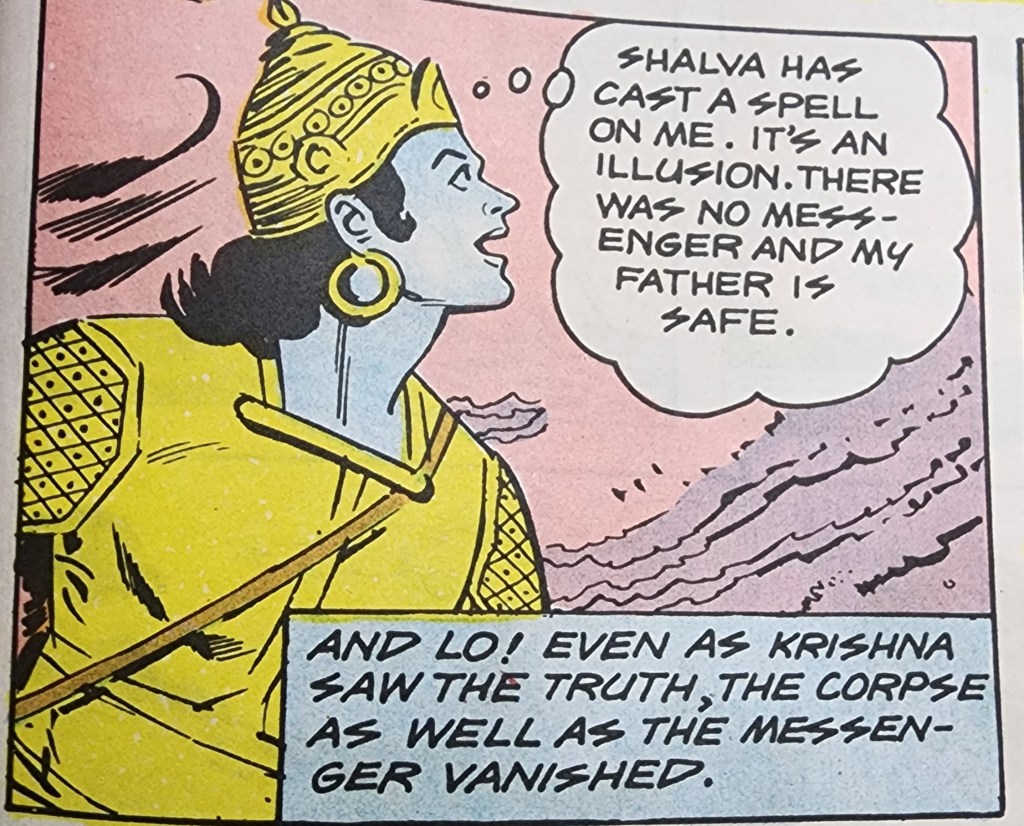
Krishna realizes that Maya has been deployed against him. Image credit – “Krishna and Shishupala”, published by Amar Chitra Katha.
During the Kurukshetra War, the Samshaptakas of Trigarta challenged Arjuna to battle repeatedly. Arjuna had to accept and Krishna, being Arjuna’s charioteer had to go along. This distraction took Krishna & Arjuna away from the Chakrayuha, which resulted in the death of his son Abhimanyu.
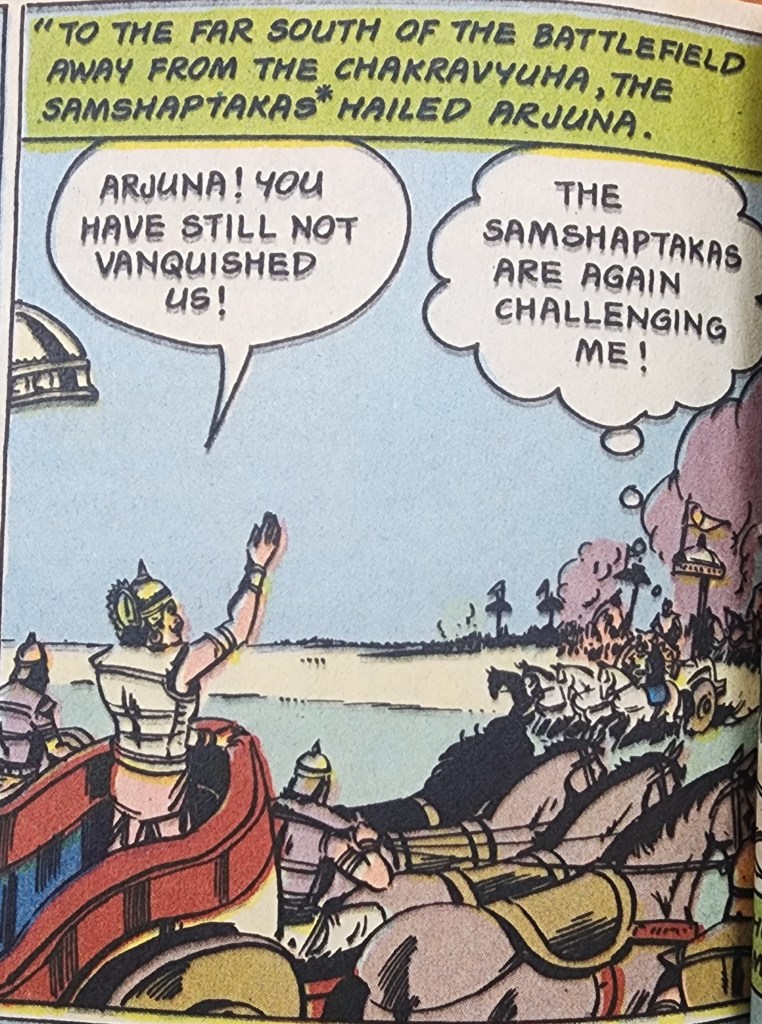
The Samshaptakas distract Arjuna and Krishna from the Chakravyuha. Image credit – “Mahabharata 34 – The Slaying of Abhimanyu”, published by Amar Chitra Katha.
Now consider a case where Krishna used Maya but failed to achieve his objective.
Before the Kurukshetra War, Lord Krishna visited Hastinapura in a peace mission. His objective was to avert the war by convincing Duryodhana to hand over at least 5 villages to the Pandavas, if not Indraprastha itself. During the negotiation, in an act of bad faith, Duryodhana attempted to imprison Krishna. The foolhardy act resulted in Lord Krishna revealing his divine Vishwaroopa in the court at Hastinapura.
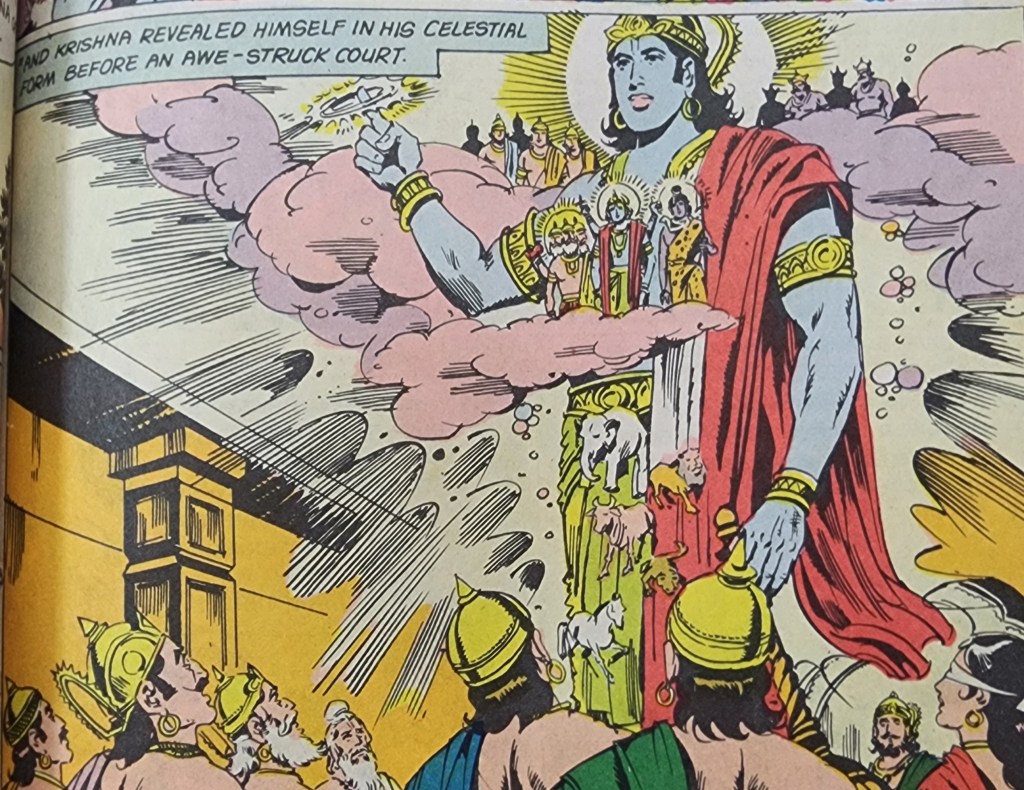
Krishna reveals his Vishwaroopa. Image credit – “Mahabharata 29 – Krishna’s Peace Mission”, published by Amar Chitra Katha.
This form showed that Krishna was Lord Vishnu himself and the master of all creation. The converse of this revelation was a clear message – GOING AGAINST LORD KRISHNA IS FOOLHARDY IN THE EXTREME! But the message was lost on Duryodhana himself, while the elders of the Kuru court got the message and tried to convince the crown prince.
The revelation of the Vishwaroopa can be considered Maya, as it was not information mortals could otherwise visualize. It could also be considered a surprise move in a negotiation, where Krishna scared the other side to come to terms. It could also be considered a psychological weapon being deployed against an opponent to get an opening in the talks. The attempted imprisonment could have been a ruse to deploy the Vishwaroopa as a weapon.
But the Vishwaroopa failed in its objective. Peace was not achieved as Duryodhana chose war, convinced that he would win. Thus, it can be said that Krishna’s use of deception and Maya failed in this instance. But there is another aspect of learning from this part of the Mahabharata, which comes from the Bujinkan.
The theme of the year for the year 2008 in the Bujinkan was “Kuki Taishou” (sometimes spelled “Kuki Taisho” or “Kuki Taishō”). I remember this phrase being translated as “The smile of the Ninth Demon”. I am going to reproduce the description of “Kuki Taishou” by a mentor of mine, Arnaud Cousergue.
Imagine a demon who is incredibly capable in the martial arts and can destroy you at will. This demon is just hanging around, maybe guarding a place. You can choose to attack him. But he will definitely not initiate any hostilities. He also knows that you plan to attack him. He just looks at you, smiles and goes on just being. But you will dare not attack him because you know that it is suicidal. You know this because of the aura of competence and confidence he exudes.
This sense that pervades the demon is “Kuki Taishou”. It is a feeling that is caused in an opponent, which could be similar to a feeling of aggression, that prevents a fight from ever taking place. It is this exact feeling of “let’s not fight” that Krishna induced in all the elders of the Hastinapura court when he revealed the Vishwaroopa. They all realized the futility of a fight against a side Krishna was on. But Duryodhana failed to see this, the mission failed and the rest is “history” (itihāsa).
But this exact technique succeeded with Arjuna. And as we look at that example, we move into examples of cases where Krishna’s use of deception, with or without Maya, achieved its objective.
At the start of the Kurukshetra War, Arjuna lost his will to fight, when the fact that he would be trying to kill his Gurus, Grandsire and cousins hit him hard. Krishna used several methods, from inspiring him, consoling him and rebuking him to get him out of the low he had sunk to. Eventually, Lord Krishna revealed his Virātaroopa to Arjuna. This convinced Arjuna to pick up arms again and even led him to ask queries that touch every aspect of living.
This entire episode is the Geetopadesha, when Lord Krishna shared the Bhagavad Gita with Arjuna. The Virātaroopa that Arjuna witnessed showed that Krishna was Parabrahman and all creation was contained in him. The revelation of this form of Krishna was similar to the episode with the Vishwaroopa.
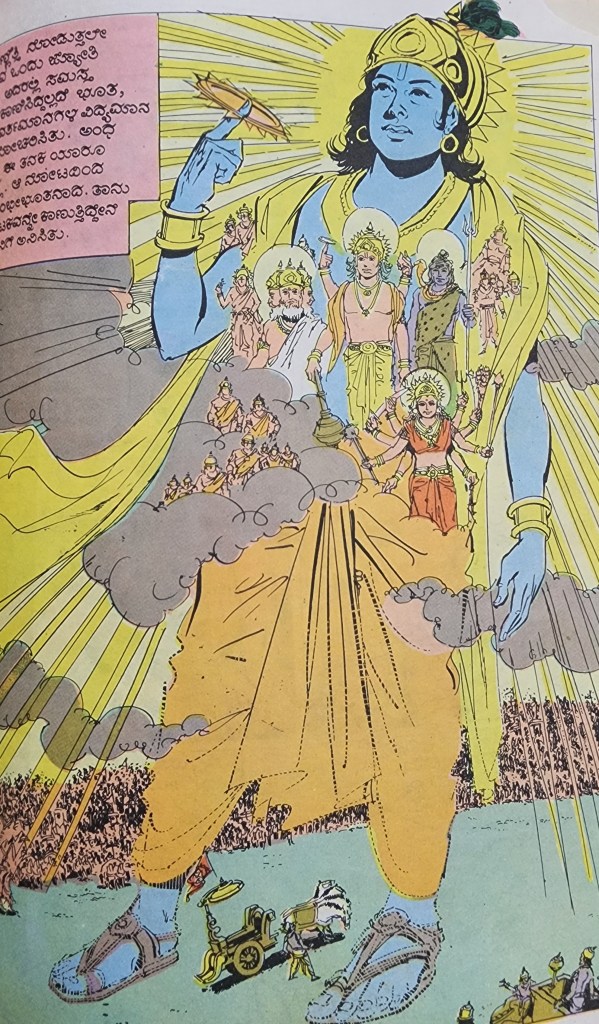
Krishna reveals his Virataroopa to Arjuna during the Geetopadesha. Image credit – “Bhagavadgeetha” (Kannada edition), published by Amar Chitra Katha.
Arjuna also realized the awesome power and entity that Krishna was. He also realized that Krishna was so far beyond him in knowledge that he could simply follow without question. This is the concept of Kuki Taishou at work. The revelation of the Virātaroopa itself involved Maya, for mortals could never witness this form of Krishna’s. This act of revelation was also a surprise, a jolt to Arjuna’s system. Because of the surprise element, we could say that deception was used, albeit with a positive connotation.
If we move forward in the Kurukshetra War, we have the famous episode of Arjuna slaying Jayadratha, the king of the Sindhu region, to avenge the killing of his son Abhimanyu. On the 13th day of the war, Abhimanyu has been killed in the Chakravyuha, as he singlehandedly faced multiple great warriors. Jayadratha had held off the rest of the Pandava forces from assisting Abhimanyu. All this happened as Arjuna was drawn away by the Samshaptakas (as mentioned earlier).
In the grief of the loss, Arjuna vowed to kill Jayadratha on the next day, the 14th day of the war, before the sun went down. Arjuna also declared that if he failed to kill Jayadratha, he would give up his own life! Come the 14th day and Jayadratha was very well protected. Arjuna came close to his objective, but he would not be able to kill Jayadratha before the sun set for the day.
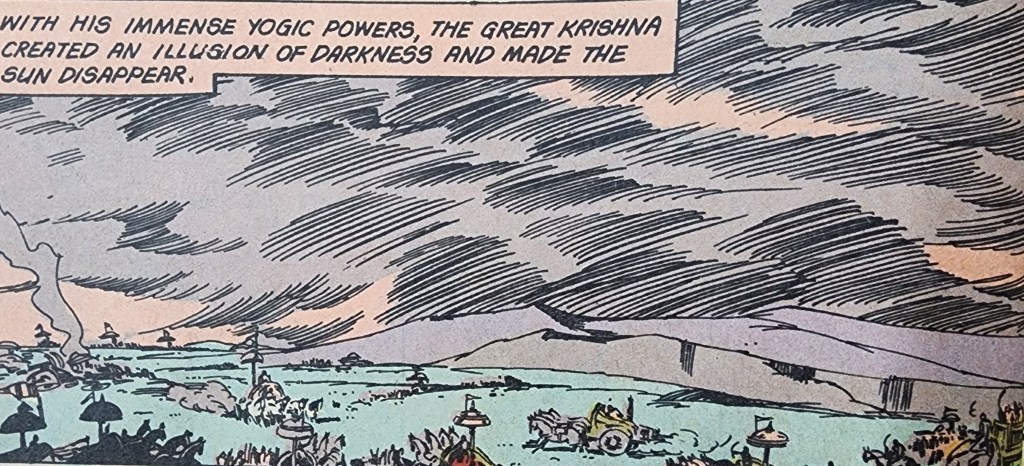
The Sun disappears before the actual sunset on the 14th day of the Kurukshetra War. Image credit – “Mahabharata 35 – Arjuna fulfills his vow”, published by Amar Chitra Katha.
At this time, Krishna caused the sun to appear to have set. Krishna is supposed to have used his Maya to make this happen. But it is generally accepted that a total solar eclipse occurred on that day which seemed like a sun set before the actual sunset. Either way, when the sun appeared to have set, a confident Jayadratha revealed himself.
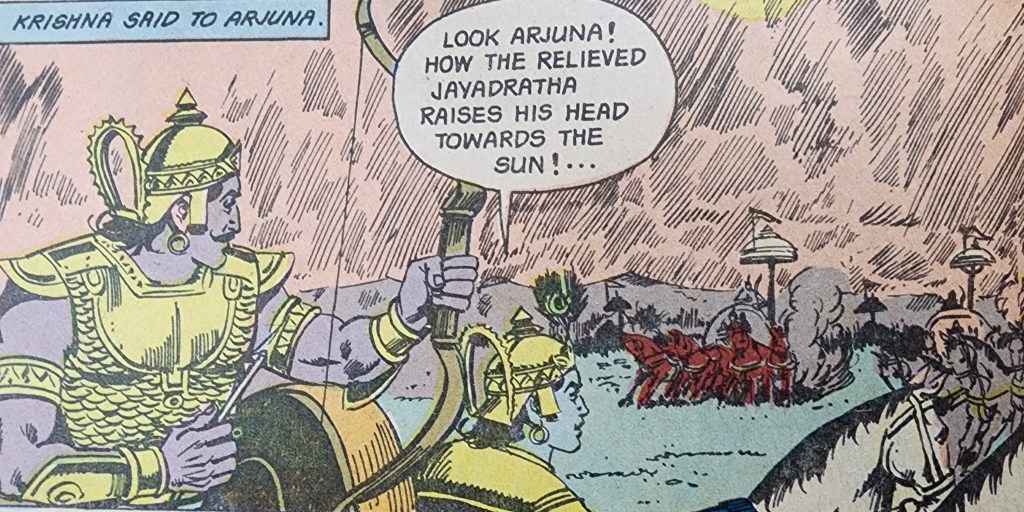
Jayadratha is deceived. Image credit – “Mahabharata 35 – Arjuna fulfills his vow”, published by Amar Chitra Katha.
On Krishna’s suggestion, Arjuna slew Jayadratha. Once the act was done, either the Maya was lifted or the eclipse ended and the sun was visible again. Arjuna had fulfilled his vow before sunset. Irrespective of whether it was a natural phenomenon or Krishna’s powers at work, deception had been used in achieving the objective of killing Jayadratha.
If it was a natural phenomenon, it just means that Krishna’s awareness of all information that could be relevant to the war is mindboggling! His ability to possess information and do whatever it takes to achieve objectives in worthy of emulating to this day! Krishna had hidden even from Arjuna the fact that the sun would appear to have set, just to ensure Arjuna’s despair would be real, and the Kaurava forces would fall for it! This is the definition of “doing whatever it takes”.
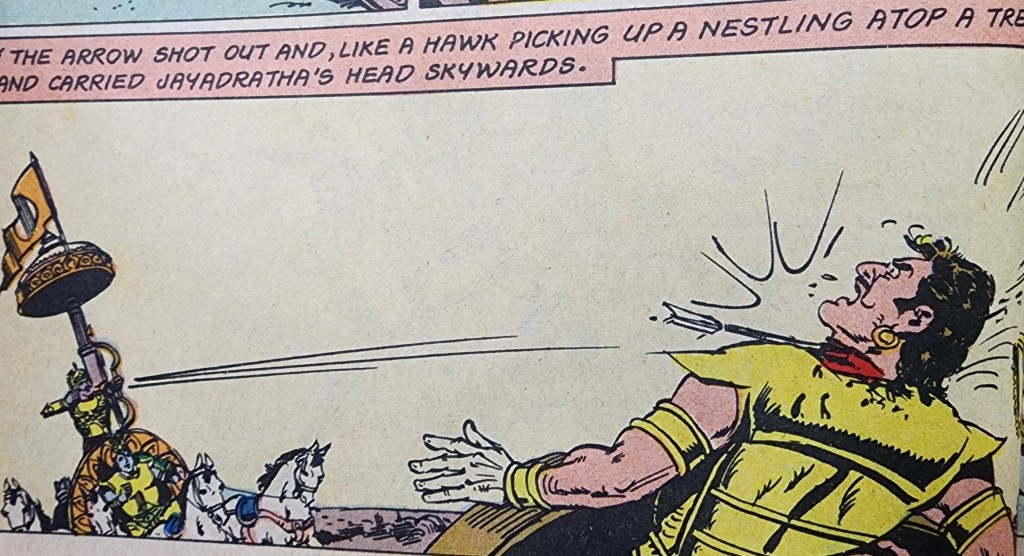
Jayadratha is slain. Image credit – “Mahabharata 35 – Arjuna fulfills his vow”, published by Amar Chitra Katha.
“Doing whatever it takes” in encapsulated in another concept that is routinely discussed and applied to the extent possible in the Bujinkan system. This is the concept of “Issho Khemi”. I have heard 2 translations for “Issho Khemi”. One is, “do whatever is necessary”. The other is, “do just enough”. The second translation refers to not doing too much. A loose example could be overdoing an attack, for it might expose one to a counterattack.
I had explored the concept of “Issho Khemi” in greater detail in an earlier article of mine, the link to which is seen below.
The concept of “Issho Khemi” and the idea of a feigned retreat both came together with the idea of “Uke Nagashi” when Mathura was attacked by Kāla Yavana. Mathura was simultaneously attacked by both Kāla Yavana and Jarasandha. This was the 18th invasion Mathura was facing. Jarasandha had previously attacked Mathura 17 times with his vast armies and resources. Mathura led by Krishana and his elder brother Balarama had successfully led the defence and beaten back Jarasandha each time.
But the simultaneous attack was one step too far. Mathura could no longer take the attacks. Dwaraka was built on the coast of Gujarat and the Yadavas of Mathura moved to Dwaraka to escape the incessant spate of attacks. The population of Mathura was moving to Dwaraka when the attacks came. Krishna and Balarama led the armies of Mathura against Kāla Yavana while the people moved.
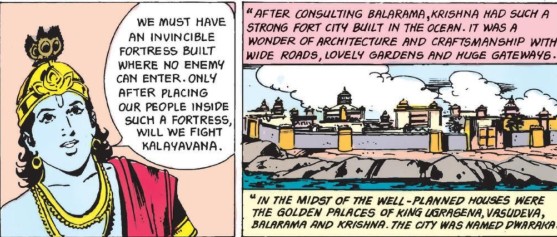
The Yadavas choose strategic retreat over perpetual war against Jarasandha. Image credit – “The Bhagawata, Special Edition” (Kindle version), published by Amar Chitra Katha.
Krishna, by himself, acted like he was running away from the battlefield. Kāla Yavana gave chase alone. Krishna led him into a system of caves. In the caves Kāla Yavana was burned to a crisp when he disturbed the sleep of Muchukunda. Kāla Yavana’s armies dispersed when their leader was killed and a large number of them were killed in the retreat.
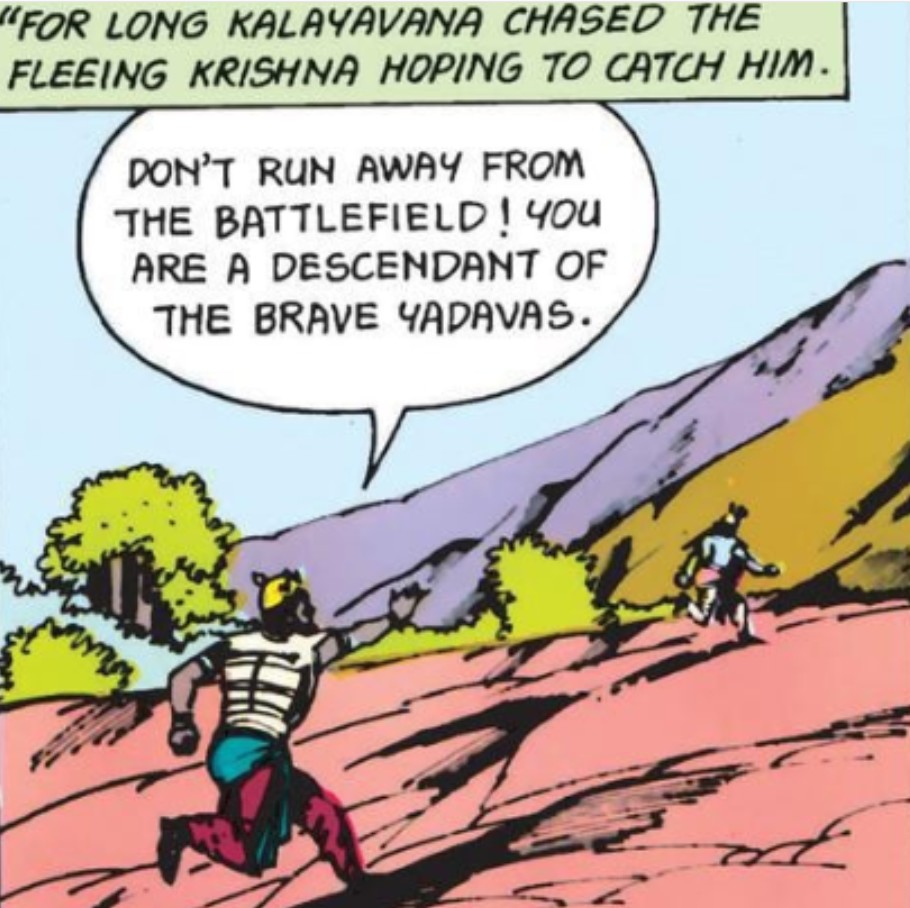
Krishna chooses to “absorb” the Yavana’s attack by feigning a retreat. Image credit – “The Bhagawata, Special Edition” (Kindle version), published by Amar Chitra Katha.
This was a classic decapitation strike where the elimination of the leadership breaks the army. Krishna running away from the battlefield gave him the moniker “Ranchod Das” or “one who runs away from the battlefield”. Leaving the field of battle was anathema to the Kshatriyas of that era! Yet, Krishna did what he had to do to protect his army and his people. This is literally what “Issho Khemi” means, doing what is necessary!
At the same time, the other translation of Issho Khemi is demonstrated by Kāla Yavana. He had no idea of what awaited him in the caves. Yet, in his hubris, he chased Krishna alone! Krishna had local knowledge and used it to his advantage. He knew what Muchukunda was capable of and where he was. He used this information to destroy Kāla Yavana.
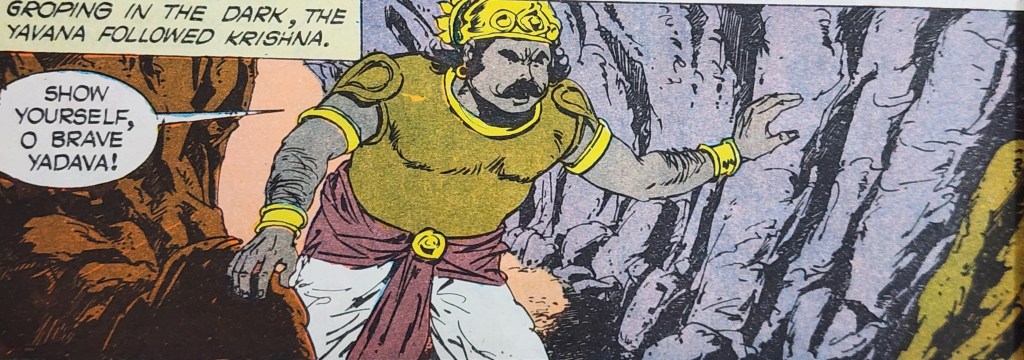
Kaala Yavana over commits in his attack and pays the price for it. Image credit – “Krishna and Jarasandha”, published by Amar Chitra Katha.
The Yavana on the other hand, “did more than necessary”, he “over committed to the attack”. He could have brought more troops with him or let Krishna go while he led his army to victory. He did neither and pushed himself into an attack that exposed his own self to grave danger, and paid for it.
This is similar to the Luftwaffe attacking British cities during the Battle of Britain during WW2. The Luftwaffe initially targeted the RAF (Royal Air Force) but switched tactics to hurt the population of Britain by attacking cities instead. If they had stayed with attacking the RAF, the battle might have gone differently. But they extended themselves to attack cities and ended up losing focus on the main enemy, who made them pay the price for it. Britain successful defended itself in the Battle of Britain and defeated the Luftwaffe.
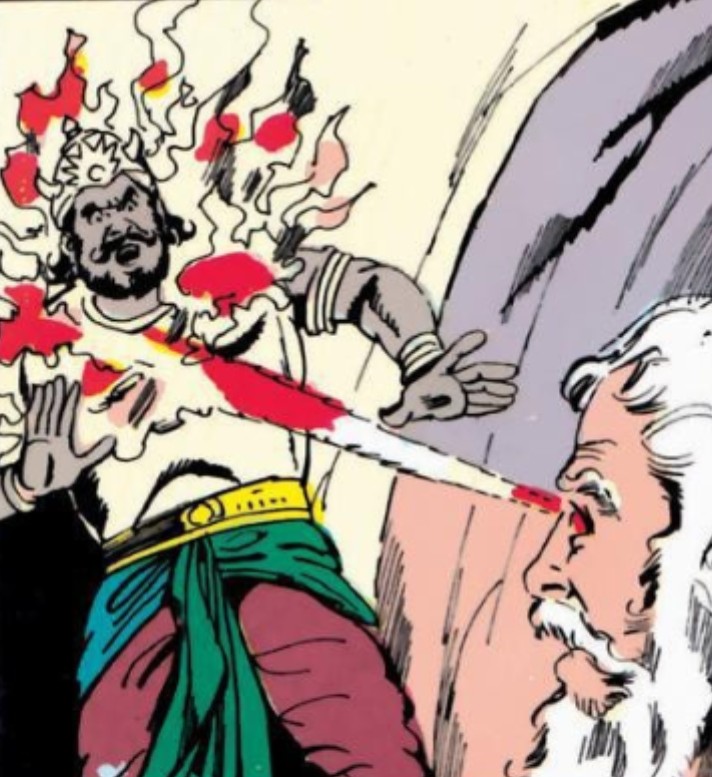
Muchukunda is used by Krishna to kill Kaala Yavana. Image credit – “The Bhagawata, Special Edition” (Kindle version), published by Amar Chitra Katha.
Krishna also demonstrated the classic feigned retreat in the fight against Kāla Yavana. He led the leader of the enemy force away by enacting a retreat and the technique worked perfectly. This act of retreating is similar to what is trained regularly in the Bujinkan as part of the basics. This is the concept of “Uke Nagashi”. “Uke Nagashi” refers to “receiving the opponent”.
One manner of “receiving the opponent” is to “absorb the attack”. This means that if the opponent attacks with a punch, the one being attacked cedes space by moving back. The punch lands in the space where it was supposed to, just not on the target. The target moves back, or away, to protect oneself. Once the attack has been absorbed, the defender can look for opportunities to exploit, as openings might have revealed themselves when the opponent attacks and comes into the range of the defender.
This is exactly what Krishna did with Kāla Yavana. He let the Yavana attack and retreated, ceding space, triggering the chase that changed the outcome of the battle. Similarly, when the Yadavas retreated to Dwaraka from Mathura, they were absorbing the attacks from Jarasandha by moving away from the city that was always targeted. Krishna plotted Jarasandha’s demise from the safety of greater distance. We will come to this incident in the next part of this post.
What the Yadavas did when they moved from Mathura to Dwaraka, has been seen multiple times in world history. Babur, lost Samarkand in Uzbekistan and retreated to Kabul, from where he conquered Delhi and established the Mughal empire in Northern India. If one goes back in time further, the movements of the Xiongnu in Central Asia led to the Yuezhi moving west and south, first to the Tarim Basin and then to parts of modern-day Afghanistan.
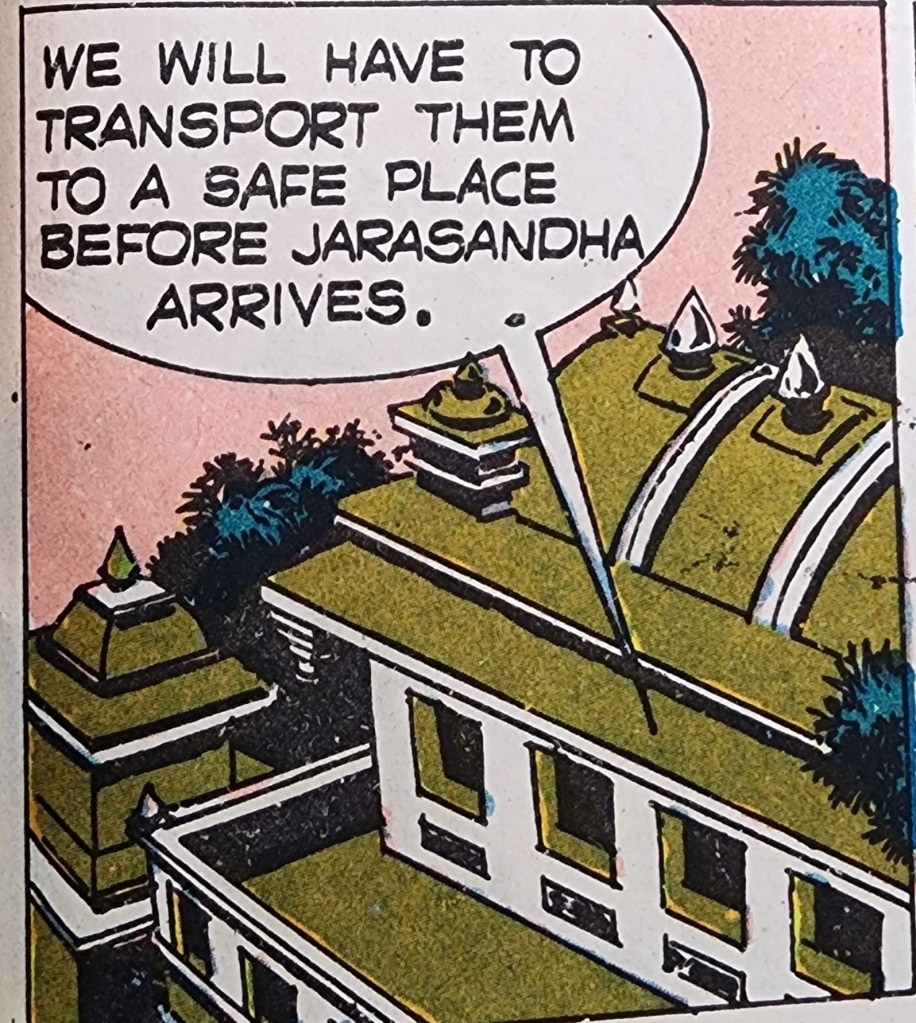
The Yadavas absorb Jarasandha’s attacks by using distance to protect themselves. Image credit – “Krishna and Jarasandha”, published by Amar Chitra Katha.
The Yuezhi later became the Saka or Shaka that invaded ancient Northwestern India. This process of people being displaced from Central Asia continued for another 700 years! The Kushanas replaced the Sakas. A few centuries later, the Hunas (Huns) were pushed out of Central Asia, and they invaded both the Gupta Empire in North India and the Roman Empire in Eastern Europe!
I will stop here in this part one of exploring the use of deception deployed by Lord Krishna several times in his life. We will look at the incidents with Paundraka Vāsudeva, Narakāsura, Jarasandha and Shishupāla in the next part. We will also look at the incidents involving Krishna & Rukmini and the Arjuna & Subhadra in the next part.
WISH YOU ALL A WONDERFUL SHRI KRISHNA JANMĀSHTAMI!


[…] Krishna, Maya, Deception – Part 1 […]
LikeLike