I will continue this article from where I left off in the previous post. We will look at more spears and consider their attributes, with specific focus on the spearheads and spearpoints. In the previous post I had shared a brief introduction regarding spears. We had also looked at images of parts of spears from over a thousand years ago. We also looked at the spear wielded by Maharana Pratap. While this post can be read as a standalone, I would highly recommend readers to have a look at the previous article in this series for a better appreciation of this one.

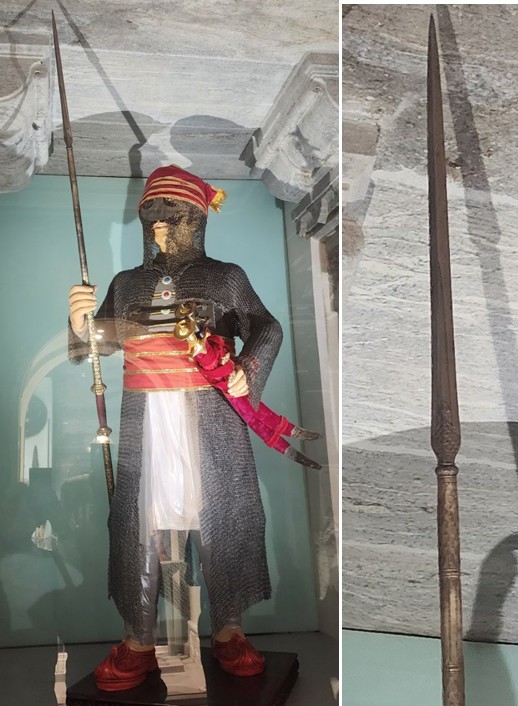
Image 1 – A Rajput spear displayed at the Hall of Heroes, Maharana Pratap Smarak, Moti Magri, Udaipur, Rajasthan.
This exhibit is labelled as a “Javelin”, but I would just call it a spear. This is not behind a wall of glass, so I got some good images of this one. The age of the exhibit is not shared. The spearhead is fairly long and looks like it has a flattened diamond section.
The shaft is all metal in this spear. I am not sure if it is a hollow shaft, but I would suspect that it is, to keep its wight low. Also, considering it is classified as a javelin, the weight of a hollow shaft would enable easier throwing of this weapon.
The rear end has a ball and a spike. This weapon also has rings at different places along the shaft. The centre of the shaft has a section that does seem to exist as the place to hold if this weapon was being hurled. I am sharing a short video of this weapon which shows it in greater detail.
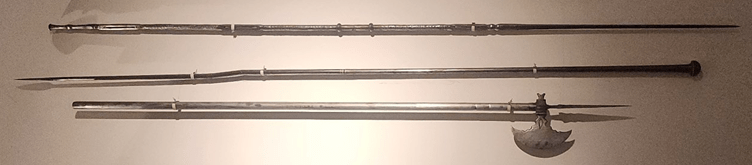
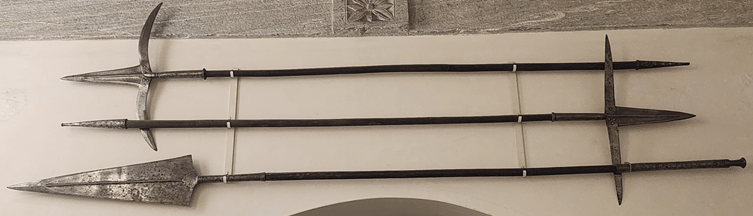
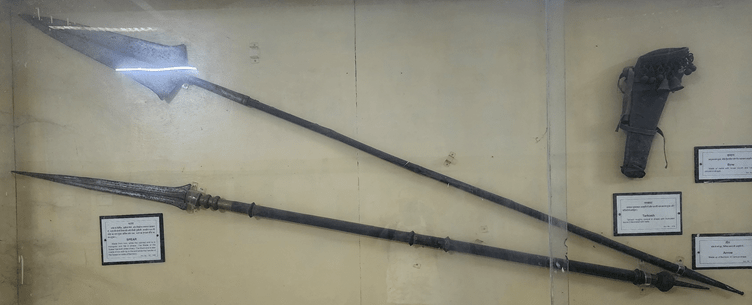
Image 2 – Display of two spears and a farsa (halberd) from the City Palace Museum, Udaipur, Rajasthan.
In image 2, the two weapons on top are spears, the one at the bottom is a combination weapon, called a Farsa (halberd), which combines an axe and a spear. The age of these weapons is also not mentioned in the display, but all 3 are very interesting in construction! All three weapons have steel shafts (I am assuming it is steel, but it is metal for sure). The top spear is about 8 or 9 feet in length while the one in the middle is longer than the one on top. The halberd I estimate to be about 7 feet long.
The spear on top has a very long spearpoint! The shaft is pretty narrow, an inch or lower in diameter. The shaft is decorated with engraving or something like filigree. The spearpoint is close to 3 feet long! It seems to have a hollow ground triangular section for rigidity and tapers down to a very fine point. This is one my favourite weapons among all the pictures I am sharing. 😊
The spear in the middle has crook in the upper third of its length! It almost seems modelled on a bayonet from the early flintlocks! The bayonet in many designs is slightly offset from the barrel of the rifle, and this spear seems to be doing something similar. There is no description in the exhibit explaining the reason for this offset design.

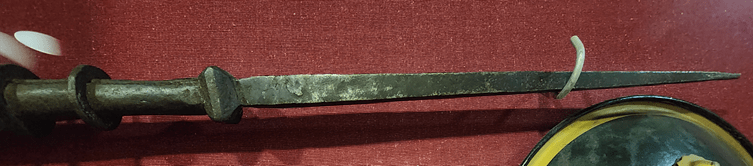
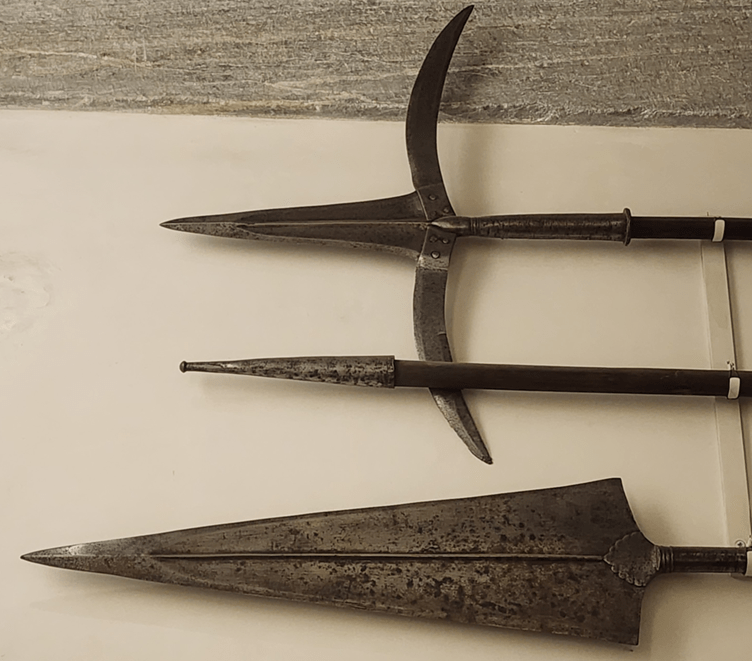
Image 3 – Close-up of the spearhead of the “offset” spear and the rear ends of the spear and farsa seen in image 2.
The “offset” spear has a rather short leaf shaped spearpoint with a midrib. The rear end of the spear at the top is blunt and also narrow, like the rest of the spear and its point. The rear end is similar to the one seen in the spear wielded by Maharana Pratap, seen in the video of the same.
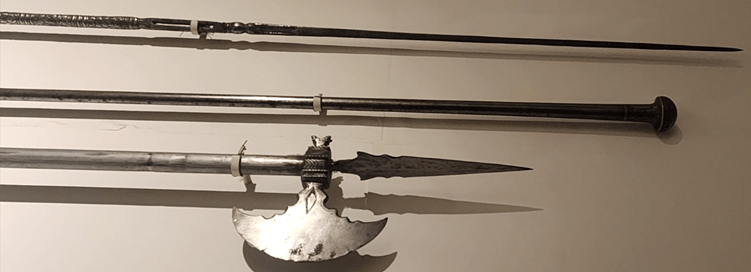
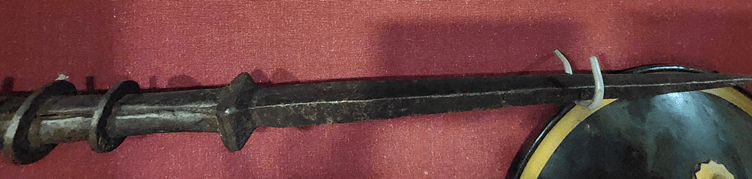
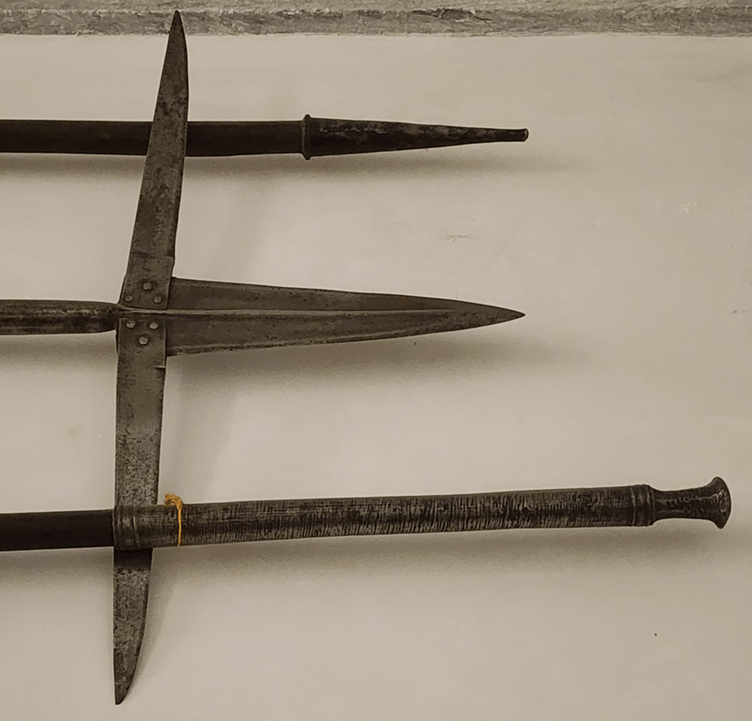
Image 4 – Close-up of 2 spearheads and of the rear end of the “offset” spear seen in image 2.
The very long spearpoint of the spear at the top is almost 3 feet in length. It tapers down to a very narrow point that would be extremely effective in thrusting, given that it has a triangular section. I can almost imagine this to be a lance!
The rear end of the spear with the “offset” in image 14 is large and bulbous. It is the very definition of a Hirumaki I mentioned in the previous post. I am not sure if it is hollow or solid in nature. The Farsa (halberd) has a spearhead like any other spear.

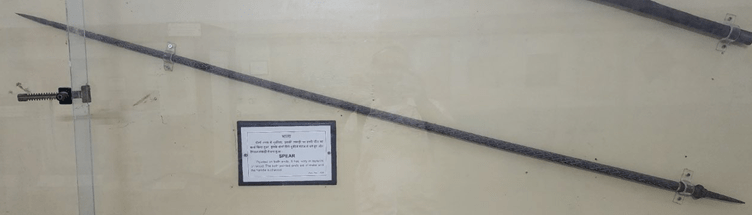
Image 5 – Display of spears from the City Palace Museum, Udaipur, Rajasthan.
The 3 spears seen in image 5 are the most fascinating of all the images in my opinion. Like all the rest, their age is unknown. These exhibits are labelled, “Spears with a channel design”. 😊These are all clearly hollow. It seems that the shafts of these spears are made from a wireframe! My initial thought was that this is to reduce the weight of the weapons as whole. But I have no idea what the real intent behind this design was. It is not mentioned in the museum either.
I also cannot guess how comfortable wielding these weapons would be. Are the shafts smooth and nimble due to a lower weight? Or do the open slots affect the handling characteristics? Do the slots affect the ease with which one can slide the hands and fingers along the shaft? I have no idea.
The spear at the top in this image is 9 or more feet in length in my opinion, while the lower 2 are about 6 or 7 feet long. Observe the rear end of the spear at the top. This is at the far left of the image. It has a double ball and spike configuration. This makes me this think that this would be heavy in the rear, as the spearhead here is quite small (image seen further down).
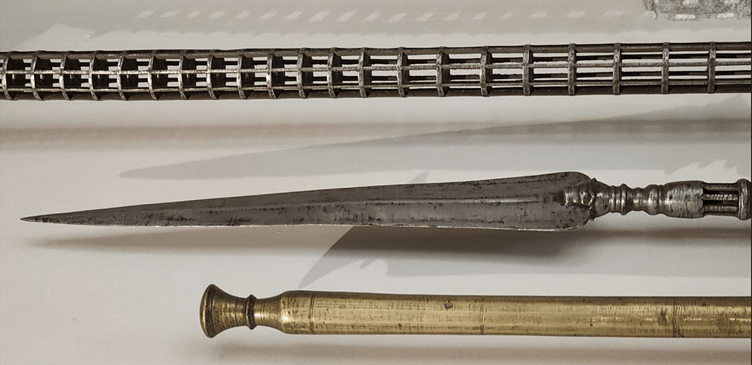
Image 6 – Close-up of various parts of the spears seen in image 5.
Image 6 shows the hollow shaft of the top spear from image 5 up close. The slots are clearly visible. The size of the slots do not seem to be uniform along the length of the shaft. Also seen in image 6 is the spear head of the spear in the middle and the rear end of the spear at the bottom.
The spearpoint is leaf shaped and about 10 to 12 inches in length. It has a midrib for rigidity. The rear end of the bottom spear is similar to ends of the spear wielded by Maharana Pratap and the top spear seen in image 2. The rear end seems to be made of brass based on the colour.
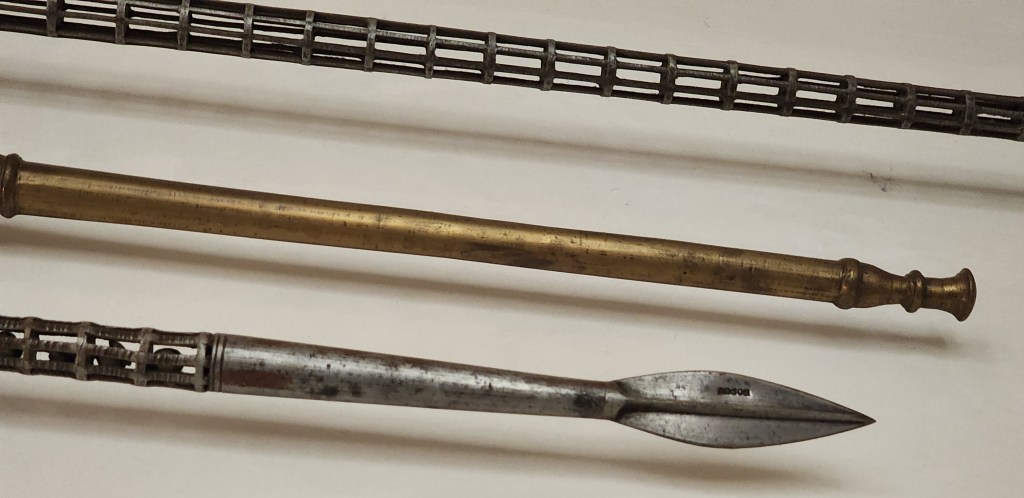
Image 7 – Close-up of the spearhead and rear end of one of the spears seen in image 5.
Image 7 shows the spearhead of the spear at the bottom and the rear end of the spear in the middle. The spearpoint is leaf shaped and small, about 6 inches in length. It has a pronounced midrib. The rear end of the middle spear is almost identical to the end of the spear at the bottom, as seen in image 6.

Image 8 – Close-up of the spearhead of the spear seen at the top in image 5.
Image 8 shows a close-up of the spearhead of the top spear in image 5. The spearhead is very small compared to the length of the spear. The spearpoint itself is smaller still, seeming just like an arrowhead. The point is reinforced, being robust at the tip to enable better penetration.

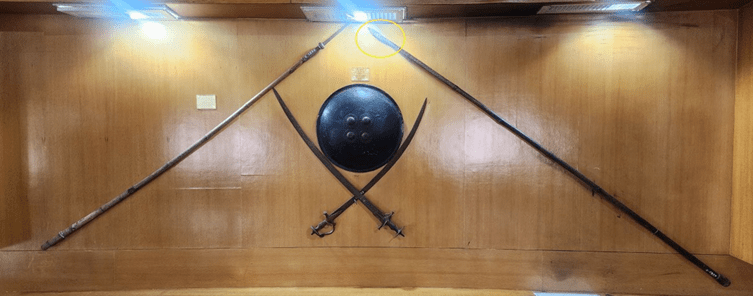
Image 9 – Display of spears from the City Palace Museum, Udaipur, Rajasthan.
The exhibit seen in image 9 is an interesting one indeed! The spears here have an increasing number of spearpoints. 😊The lowest one has a single point, the one in the middle has 2 points and the one at the top has 3 points. That makes the spear at the top a trident or a trishoola and the one in the middle a bident or a pitchfork. I am guessing Poseidon, Hades and Zeus would be proud of this display! :-P
The age of any of the spears in this display is not mentioned. The lowest one about 6 feet long, and ones above are about 7 and 8.5 feet long respectively. The shafts of these spears seem to be bamboo or rattan to me. It is possible that the shafts are not the original ones on which the spearheads were mounted. The trident has no butt cap. The spear and the bident both have a ball and spike for a butt cap.

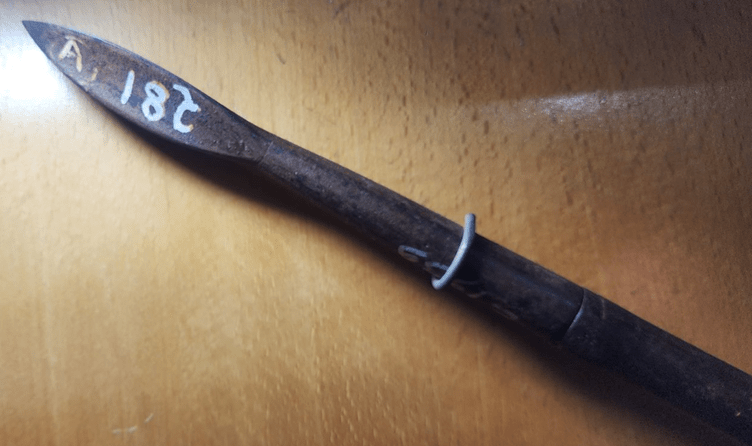
Image 10 – Close-up of the spearhead of the spear at the bottom in image 9.
Image 10 shows the spearpoint on the lowest spear from image 9 up close. This is a robust spearpoint! It has a triangular section which tapers down to a point. This makes it really stiff for effective thrusting. There is also a hollow grind on the triangle to reduce weight.
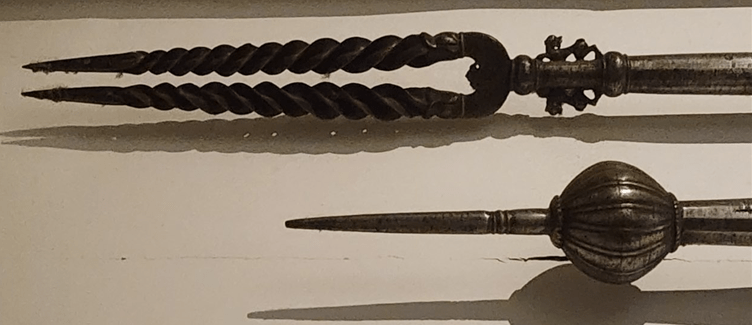
Image 11 – Close-up of the spearhead and rear end of two of the spears seen in image 9.
The image above shows the 2 points of the bident from image 9. It has 2 spearpoints and is constructed to give the appearance of a twisted cord or vine. This would also make the spearpoint robust. The end of the spearhead just below the two spearpoints has a decoration. There are 2 small lions (in my opinion) just before the spearpoints begin.
Seen in the lower part of image 11 is the butt cap of the lowest spear from image 9. It shows the ball and spike clearly. There is a chance that the ball is hollow.
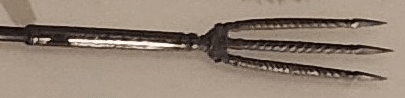
Image 12 – Close-up of the spearhead of the spear at the top in image 9.
Image 12 shows the 3 points of the trident from image 9. The 3 points are maybe 6 to 8 inches long while the spearhead including the socket is about a foot long. The 3 points also give the appearance of a twisted cord. This also likely gives robustness to the points. The tips of the points seem to be triangular in section and look wicked!
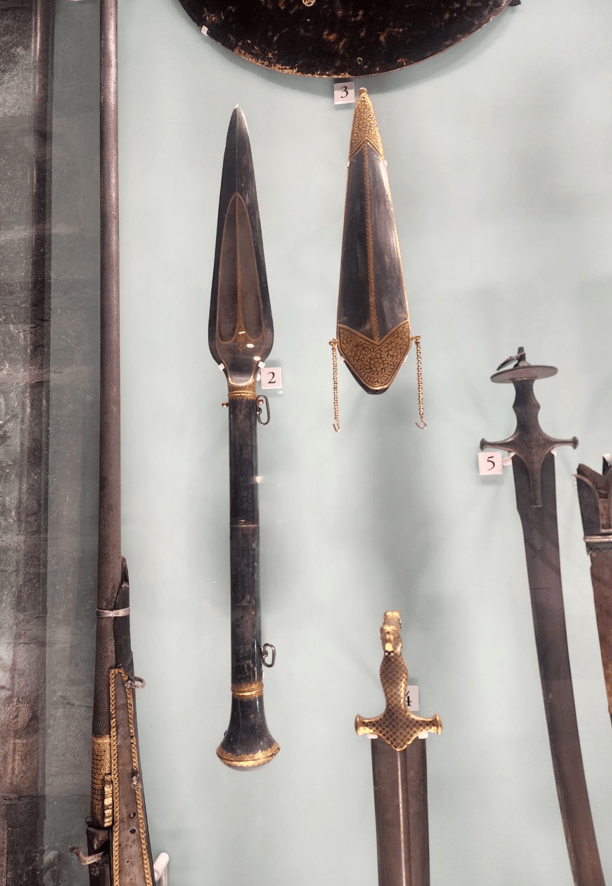
Image 13 – Katar from the City Palace Museum, Udaipur, Rajasthan.
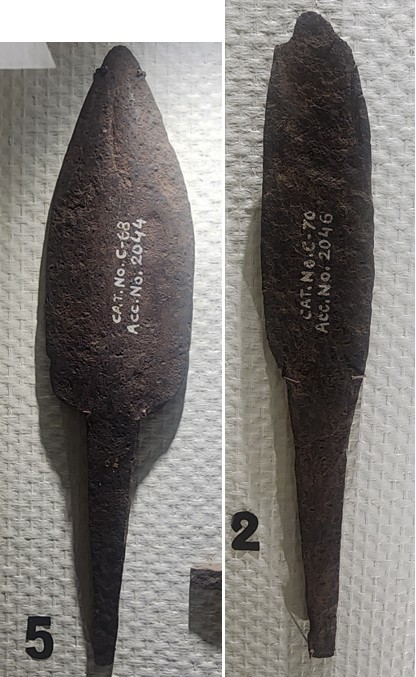
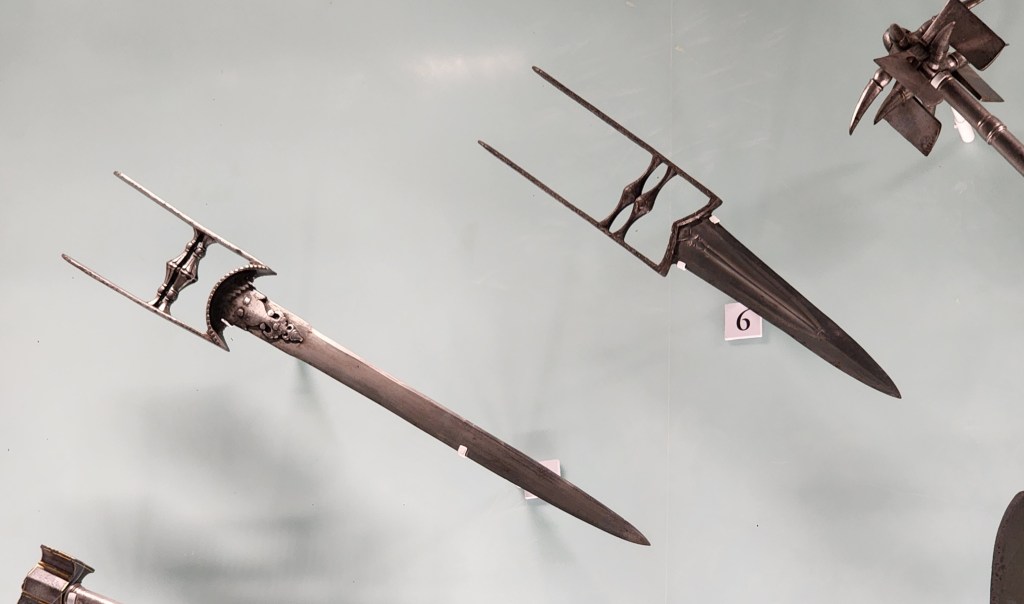
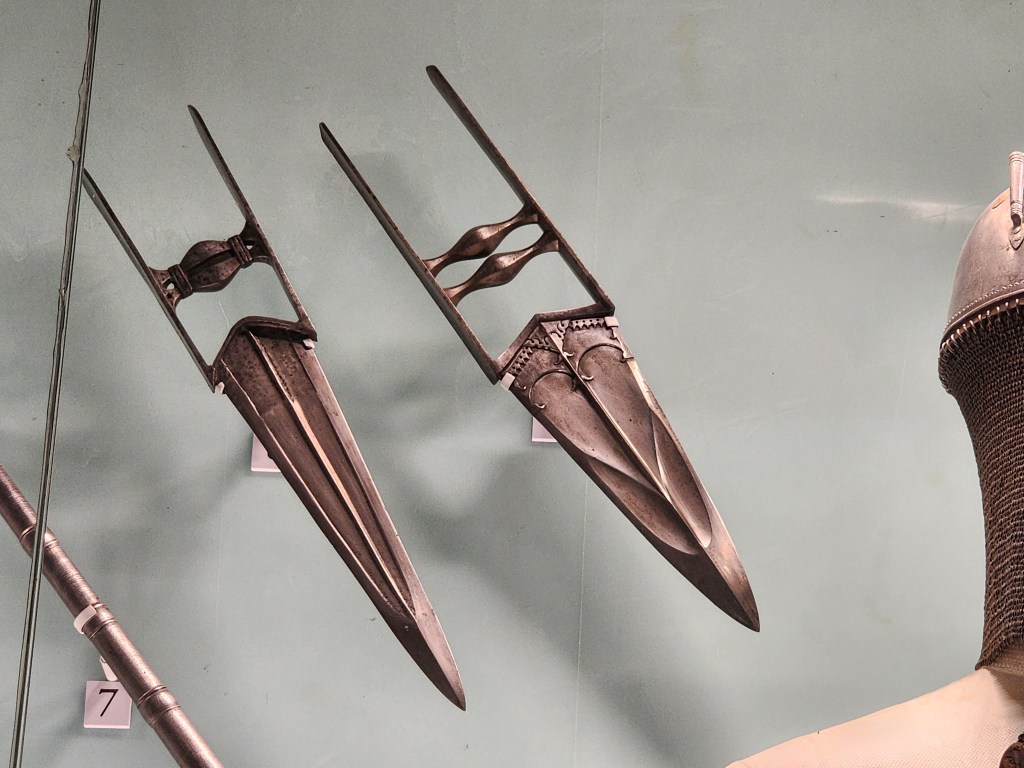
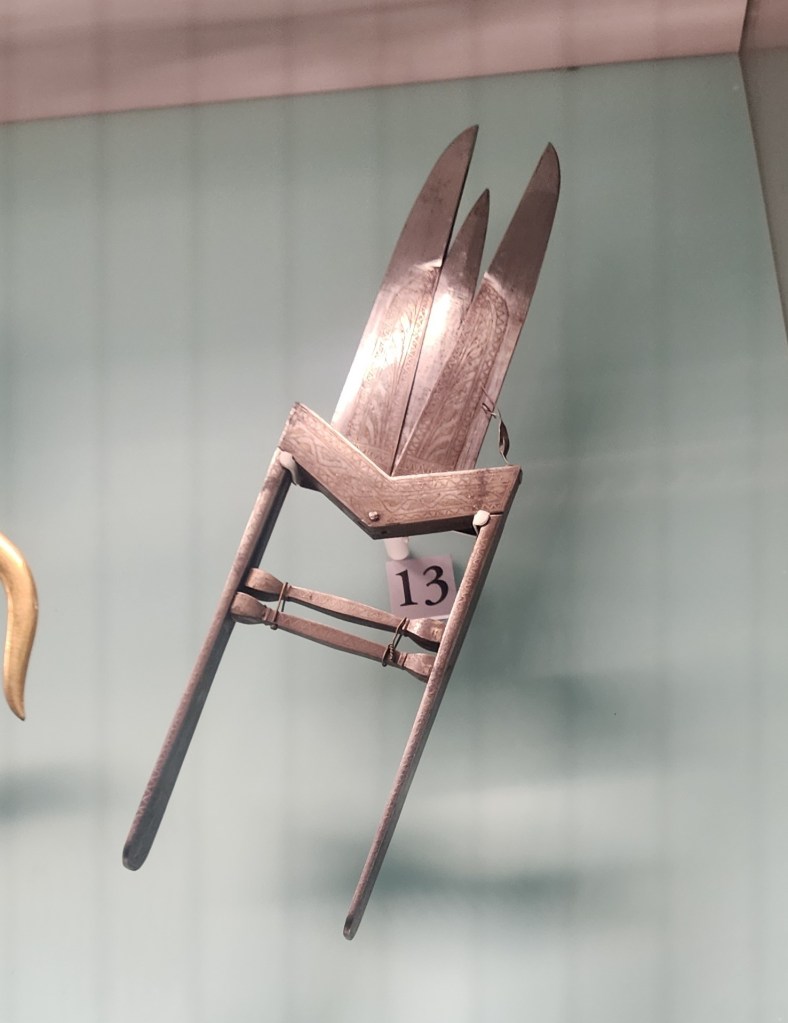
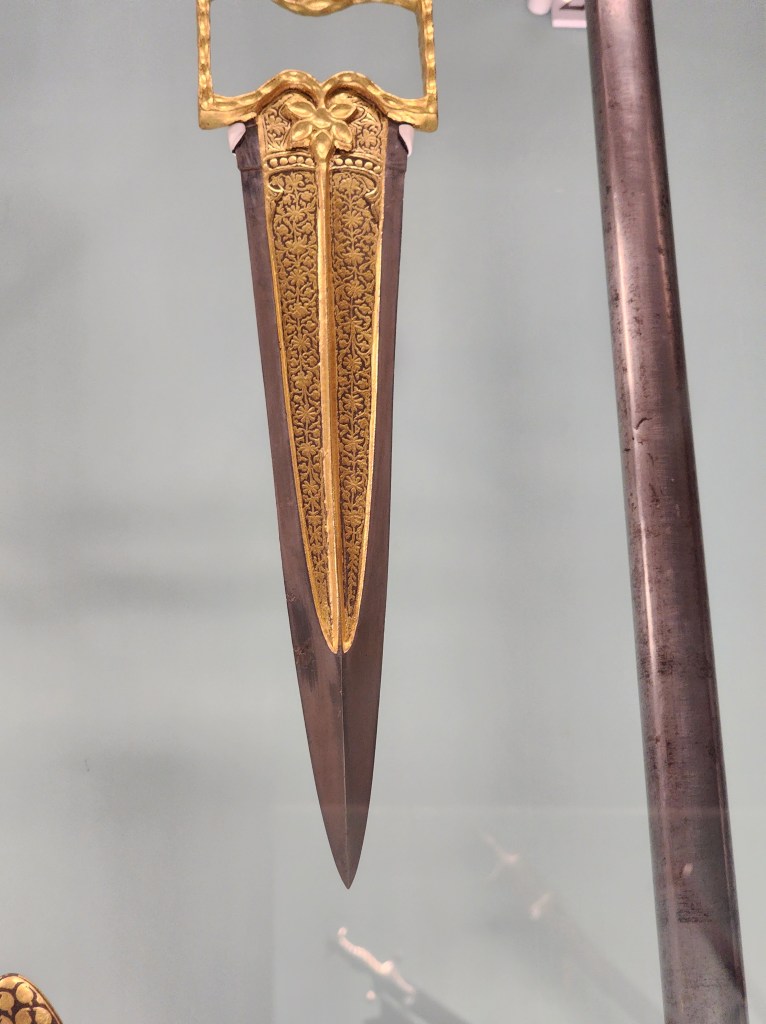
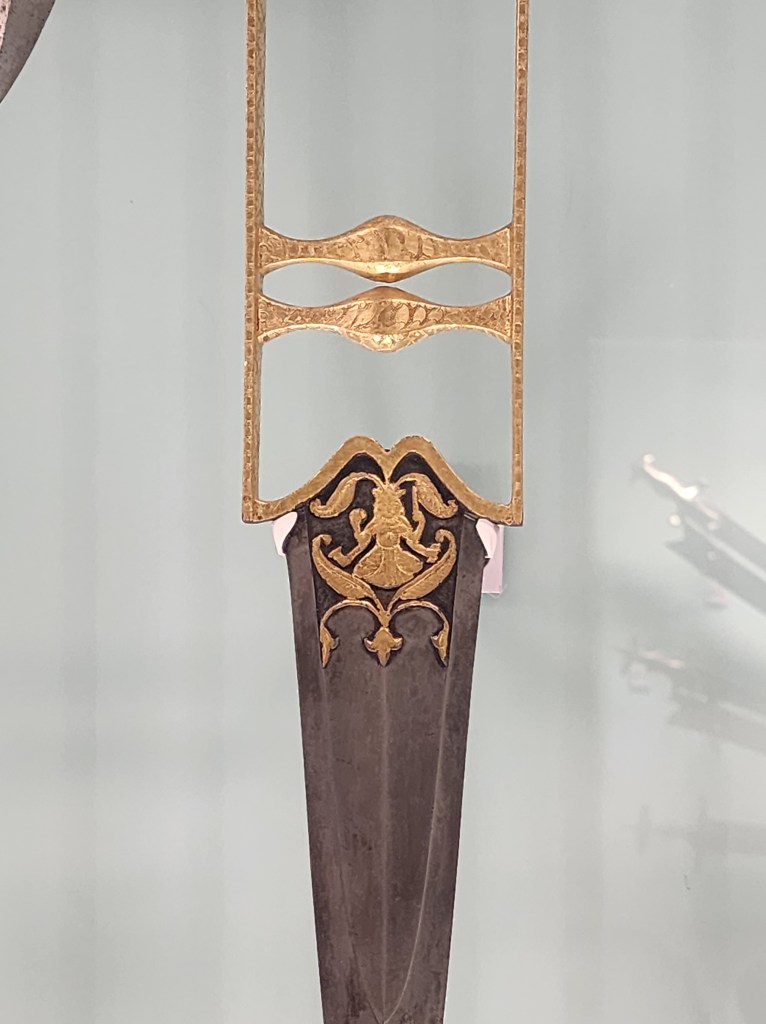
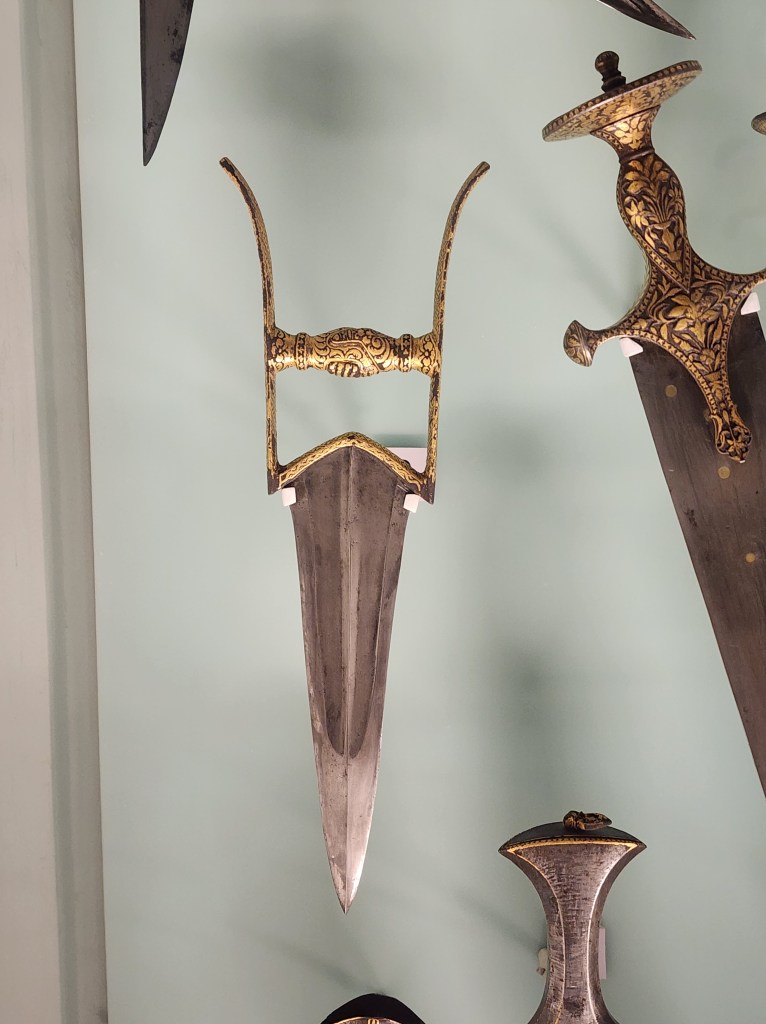
Observe the exhibit numbered “2” in image 13. The label calls it a “Katar”. A Katar is a punch dagger that was popular in many parts of India from the 14th through the 19th centuries, first as a fighting weapon and later as a part of regal attire. This could be a katar, the blade shape does resemble that of a katar. The blade is about 10 inches or a bit more in length and quite broad. The age of this exhibit is not mentioned.
But to my eyes this is a short spear. It is definitely capable of thrusting. The length including the short shaft (should we call it a handle in this case?) is about 2 feet, making the weapon between 2.5 and 3 feet in length. It could definitely cut well, but the length of the handle makes me think it is better at thrusts then cuts. Maybe this was a case where a short spear could double up as a short sword.
The beauty of the weapon makes me think this was likely used as a status symbol, for it exudes wealth and power! This exhibit also brings to mind the Aiel culture from the “Wheel of Time” novel series by Robert Jordan. In the books, the Aiel are a culture that abhors swords. They use spears of different lengths and some of them are short, for close quarters combat. This could easily be one of the short spears used by an Aiel clan chief! 😊

Image 14 – A spear from the Kumarakom Heritage Museum, Vembanad, Kerala.
The Kumarakom Heritage Museum is not a usual museum. It is a small private museum run by small group of people who preserve things from the last 150 to 200 years. The number of visitors is also small. So, many of the exhibits can be touched, felt and handled by visitors under the supervision of a guide, who accompanies every group of visitors. This gives a wonderful tactile experience!
One of the exhibits was the spear seen in image 14. I suspect it is from the late 19th century. It is an all-metal construction, between 7 and 8 feet in length. The shaft is lean and solid, not hollow. The shaft tapers towards the rear end. The spearhead is leaf shaped and about a foot in length. The spearhead reminds me of pop culture versions of the Assegai that was used in parts of Africa.
This spear has the rings at different points along its length. The rings are not placed at even lengths. I am not sure why they are placed at the points they are placed at. But the design with rings is similar to the spear of Maharana Pratap seen in the previous article and the other Rajput spear from image 1. The rear end of this spear is similar to Maharana Pratap’s spear and two of the spears in image 5.
This series on spears will conclude with the next post. I will share more images of spears and observations regarding their attributes. The next article will have more images of spears from cultures beyond India.