Spears have been used by modern humans, human ancestors and close relatives of homo sapiens for a very long time. The oldest known spears are supposed to be 400,000 years old, made by a sister species. Some of the best-preserved spears made entirely of wood, including sharpened points, are supposedly 300,000 years old, found in Schöningen in Germany. The oldest identified spear points made of stone are supposed to be around 500,000 years old.
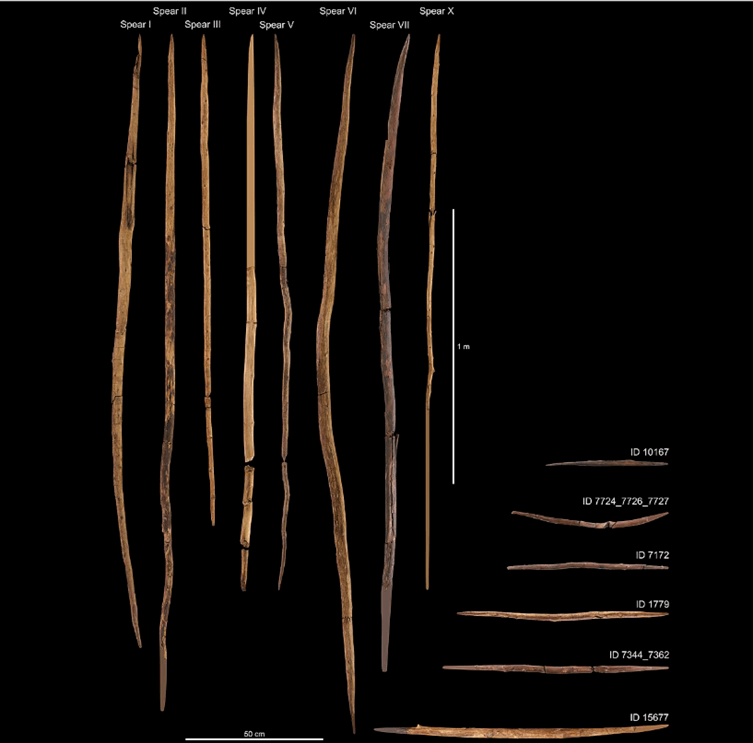
Schöningen spears. Image credit – Wikipedia
Spears likely started out as tools for hunting and evolved into weapons of war. Spears, in their various forms have been in use since pre-historic conflicts all the way through to the 20th century. It is only in the current century, with long range weapons becoming the mainstay for all conflicts, that spears are not in use. The bayonet, that was used all through the 20th century on all kinds of automatic rifles was perhaps the last iteration of the spear.
Spears have varied from simple wooden staves to handheld spears, to javelins to very long pikes to lances of various types. They have been used on foot, on chariots and from horseback. Spearpoints became a part of various combination weapons, like halberds and poleaxes. Long spear points could double up as short swords, as happened in African cultures.
The shafts of spears went through several iterations too, in terms of material, length, decoration and girth. Shafts could be narrow and light, comprising of rattan or wider and stiff, being made of wood or metal. The metal shafts could be hollow as well, to keep the weight of the weapon down. The shaft could be long or short as the situation required.
The points of spears could be made of anything from stone or obsidian to copper, bronze, iron and steel. They could be long or short, sturdy or fragile (for a single use), wide or lean (depending on the opponent it expected to tackle).
In a series of 3 posts, I will share a few images of spears, spearheads and spearpoints I have come across over the last few years. Most are from India, while a few are images of representations of spears from cultures outside India. These 3 articles will be more of images with some observations from me.
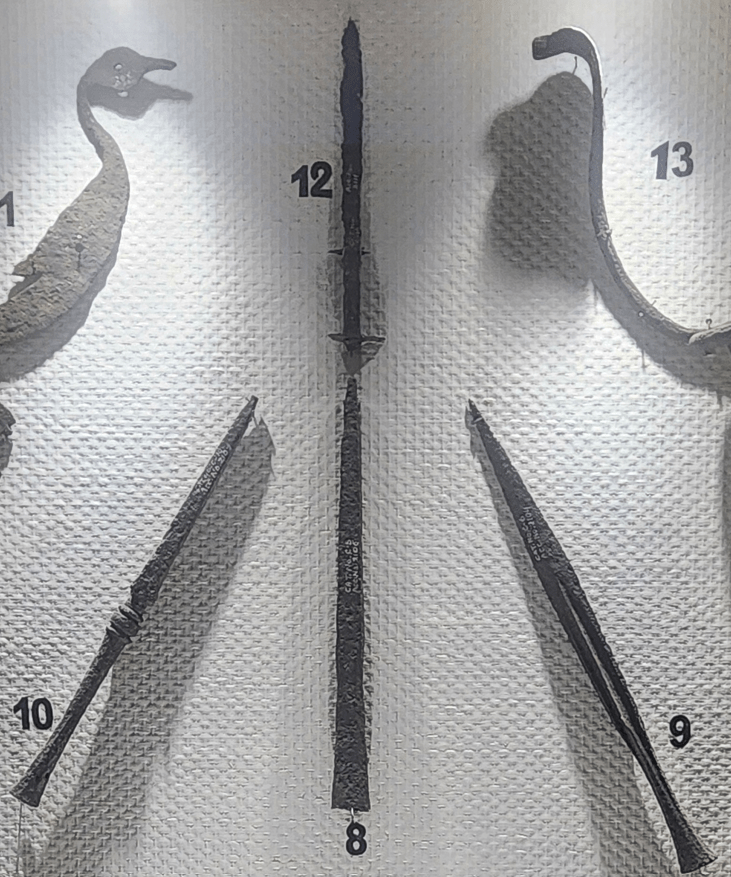
Image 1 – Display of spearheads from the Sanchi Museum, Sanchi, Madhya Pradesh. All of these are from the 11th century CE.
In the above image, through the exhibits labelled 8, 9, 10 and 12, 4 different spearpoints or spearheads are displayed. The exhibit labelled 8 looks like a long triangular spearpoint. The one labelled 12 seems to have two sets of “wings” or barbs sticking out perpendicular to the spearpoint itself. The spearhead labelled 10 has a square cross-section, tapering down to a point. The exhibit labelled 9 is a long leaf shaped spearhead with a groove down the middle in the lower half of the point. Each of these, based on what I estimated when I saw them, is between 12 and 18 inches long.
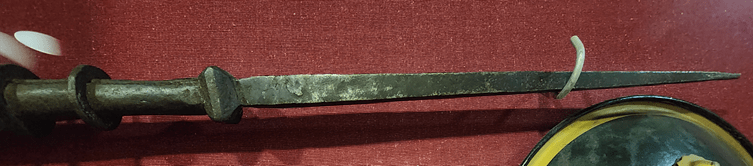
Image 1a – A spearhead displayed at a dojo.
This is an antique spearhead that was rescued from scrapping by our dojo. It is about 18 inches in length and the spearpoint is about 10 inches long. The spearpoint is square in section and tapers down to a point. I am not sure of the metal used in making this spearhead. I suspect that this spearhead is from the 19th century, though the exact age of this exhibit is not known.
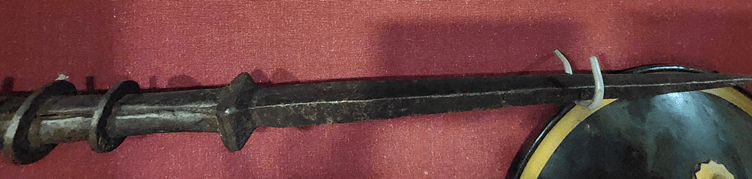
Image 1b – Another view of the spearhead from image 1a.
Image 1b shows the same spearhead from image 1a, from a different angle. This shows the square section of the spearpoint more clearly. The profile of the spearhead in image 1a is remarkably similar to that of the exhibit labelled “10” in image 1. This means that the same type of spearhead was in use for about a thousand years, if not more! That is quite some consistency in human history!
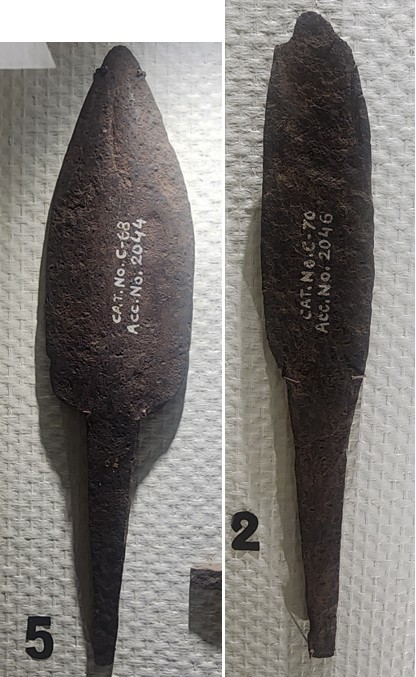
Images 2 (L) & 3 (R) – Display of spearpoints from the Sanchi Museum, Sanchi, Madhya Pradesh. Both are from the 11th century CE.
Seen in the above 2 images are leaf shaped spearpoints. These are much shorter and wider than the specimen seen in image 1. In both the above exhibits, one side is convex (as seen in image 2) and the other side is flat (as seen in image 3). The length of both of these is about 8 inches according to my estimate. The material used in the spearpoints in the 3 images above was not mentioned, but they seem to be either iron or steel.
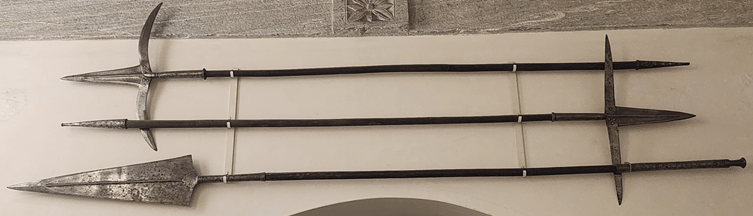
Image 4 – Display of spears from the City Palace Museum, Udaipur, Rajasthan.
Each of the spears seen in image 4 is about 8 feet in total length. The shaft seems to be rattan and about an inch in diameter. I am not sure if the shafts are the original ones on which the spearheads were historically mounted. The age of the shaft and spearheads was not mentioned as part of the display. A close-up of the spearheads is seen in the following 2 images.
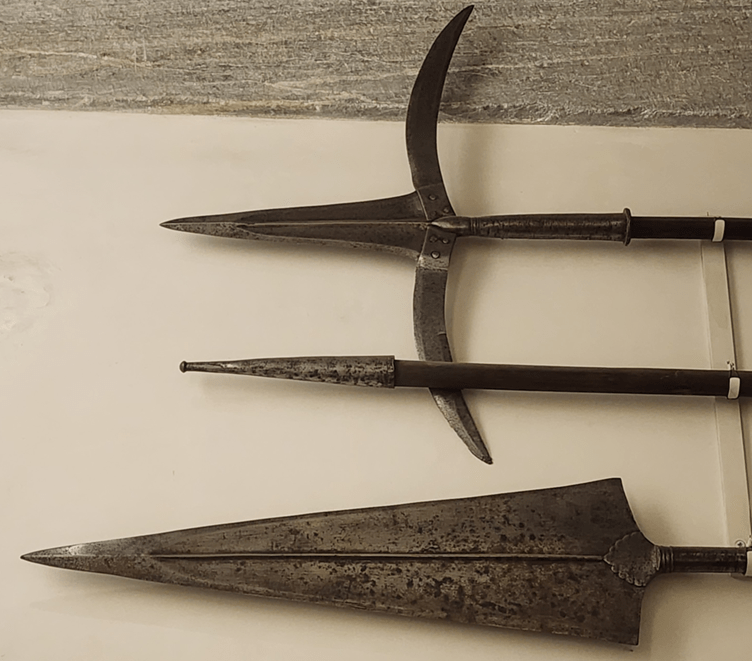
Image 5 – Close-up of the spearheads and butt spike of the spears seen in image 4.
The spearhead at the bottom is big. It is well over a foot long and very wide as well. The point is reinforced to enable better thrusts, which might go through chainmail. This spear with its large head reminds me of Renaissance era European Partisan spears.
The butt spike/cap of the middle spear is seen. The conical shape reminds me of what is called in Japanese spears (yari) as an Ishizuki.
The spearhead on the top spear has 2 wings on the side. The spearhead as a whole reminds me of a Japanese Jumonji Yari, which also have a central spearpoint with 2 wings on the side. The two wings enable with parrying weapons of opponents and also in hooking opponents, whether to trip them or to pull them off horses. The central point is about 10 inches in length while the total length of the two wings combined is 18 inches or more.
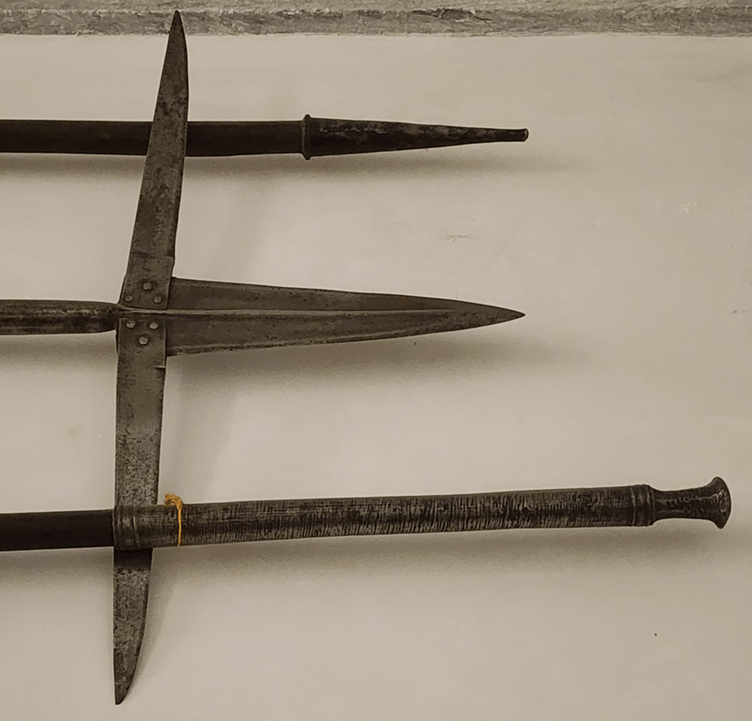
Image 6 – Close-up of the spearheads and butt spike of the spears seen in image 4.
The spearhead in the middle again resembles a Japanese Jumonji Yari. If there was only one blade instead of 2, it would be akin to the Japanese Kama Yari (Kama is the sickle in Japan, which looks a Crow’s Beak axe or an ice axe of modern times). The butt spike at the top is similar to an Ishizuki. The butt cap of the lowest spear, which is the rear end of the one with the large spearhead (reminiscent of the European Partisan) is not entirely conical, but has a blunt, slightly bulbous head. O a Japanese spear, this would likely be called a Hirumaki, which is also a protective counterweight at the rear end of a spear. But unlike the Ishizuki which resembles a spike, the Hirumaki resembles a ball.
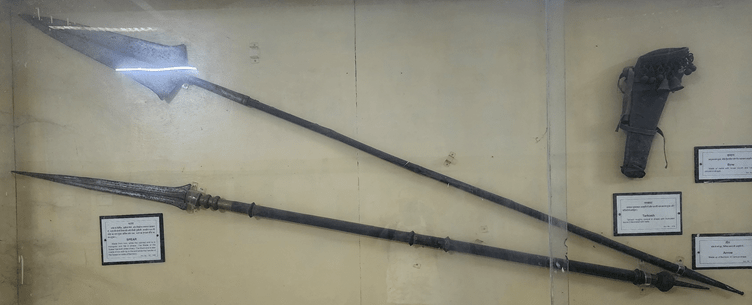
Image 7 – Display of spears from the Government Museum, City Palace, Udaipur, Rajasthan.
Image 7 shows 2 more spears. These are a bit shorter than the ones seen in image 4, maybe 6 to 7 feet in length. The one on top is similar to the one with the single large spearpoint, seen in the previous image. The one below has a narrower, slightly shorter spearhead. It has a proportionately more robust construction due to the robust midrib combined with a narrow profile. The age of these 2 exhibits was not available. My personal belief is that these are likely from the 18th and 19th centuries.
The lower spear brings to mind what is depicted as an “Assegai” in popular culture. The assegai is a spear used in Eastern Africa. Observe the rear end of this spear. The Ishizuki and Hirumaki are combined here! The spike at the end also has the counterweight for improved balance in handling the weapon. This weapon also has rings or bands along its length, which divides the shaft into segments, which are not of equal length. This will be seen in further examples. I will also write a separate article about what I think the purpose of these was.
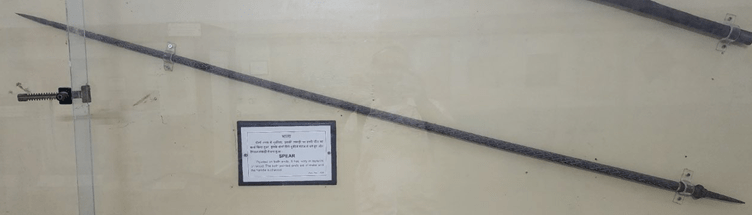
Image 8 – Spear on display at the Government Museum, City Palace, Udaipur, Rajasthan.
The spear in image 8 is also about 6 feet in length. It has a pronounced taper even in the shaft, almost like a needle! Due to the taper in the shaft and a small narrow point, this resembles the prehistoric Schöningen spears. This exhibit seems to have been a prestige piece. It has ivory inlay all along the shaft, though this is not visible in the picture. The butt cap again has both a ball and a spike integrated together.
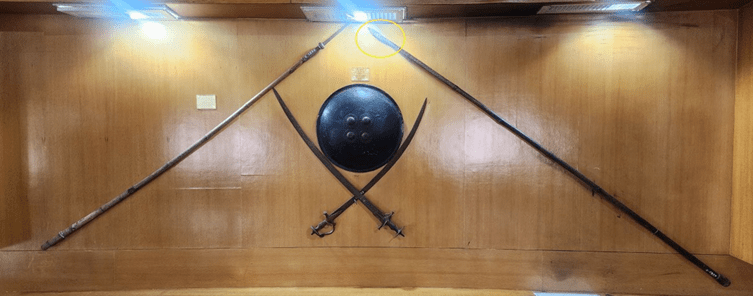
Image 9 – Display of spear and spear shaft from the State Museum, Bhopal, Madhya Pradesh.
In the above image, both exhibits are referred to as spears, though I personally believe that the one on the left is just the butt cap on the shaft. The one on the right is over 7 feet long as I see it. A close up of the spear head is seen below.
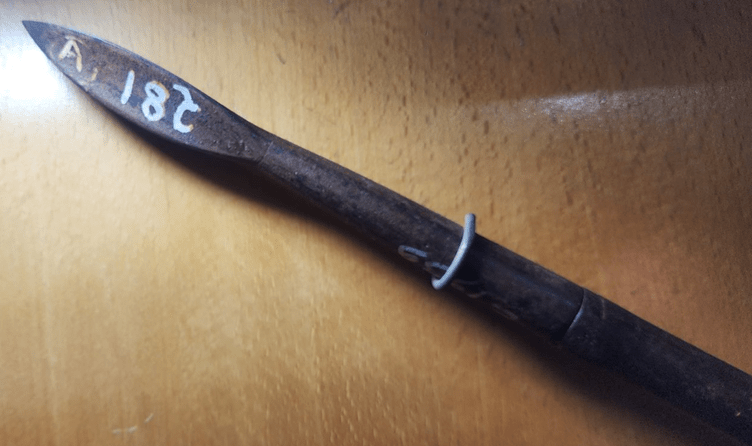
Image 9 – Close-up of the spearheads seen in image 8.
In this spearhead the point itself is pretty short, just a few inches long. The spear head including the socket used to attach it to the spear shaft is about 10 inches or so in length, but the actual spearpoint is about 5 inches only. The spearpoint seems to have a triangular section with a hollow grind as seen in the close-up above.
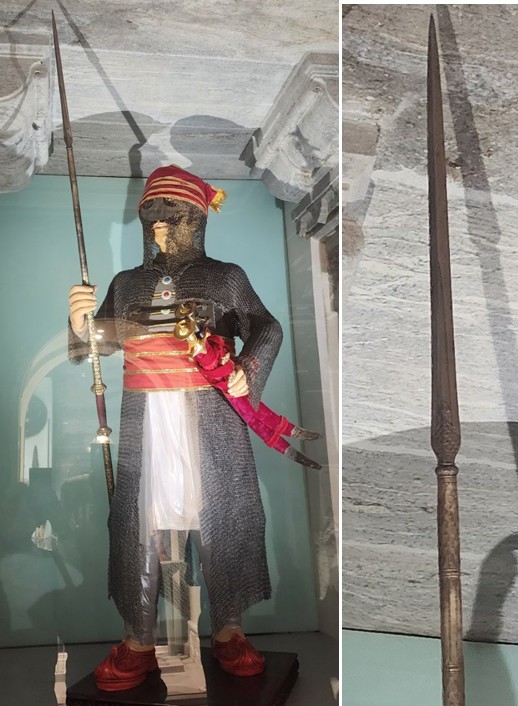
Images 10 & 11 – The image on the left shows the armour, swords and spear used by Maharana Pratap! The image on the right shows a closeup of the spearpoint and a part of the spearhead. This display is from the City Palace Museum, Udaipur, Rajasthan.
Maharana Pratap was supposed to have been 6 feet tall. So, I presume that this spear is around 8 feet long. The spearpoint itself is about a foot long. It is a narrow point, with a flattened diamond section and a bit of hollow grind towards the socket. The socket that attaches the point to the shaft is itself about a foot in length.
The spear shaft is richly decorated as befits a king. This spear also has the rings along its length that I mentioned in reference to the exhibit seen in image 7. This spear also has a distinct section near the centre similar to the ones seen on javelins used in the modern Olympic sport of javelin throwing. The spear and the javelin were supposed to be Maharana Pratap’s favourite weapons. So, if this spear could double up as a javelin there need be no surprise.
A video of the spear is seen below which shows the different sections in greater detail. The rear end of the spear has a cap which is similar to the one seen in image 6. The image and video are not of the best quality due to the reflection from the protective glass and museum lighting. ☹
The above video shows Maharana Pratap’s armour, two swords and spear.
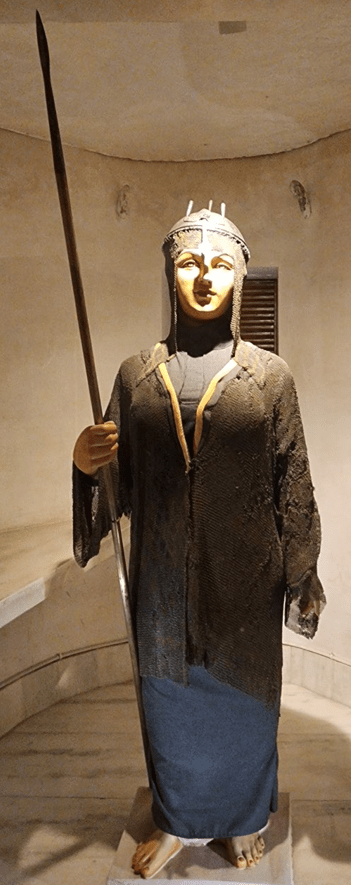
Image 12 – A representation of a female guard of the Zenana, including the chainmail armour and spear she is likely to have worn and wielded respectively. This display is from the City Palace Museum, Udaipur, Rajasthan.
I am sharing this image just to show that women were participants in the trade of arms as well. They wore armour and wielded weapons. The spear seen in this image is similar to the one in images 8 & 9. This exhibit is from the actual Zenana (women’s quarters) of the Udaipur City Palace.
I will continue this series of articles in 2 further posts. I will share more images and observations of spears and their attributes from other cultures in the upcoming posts.
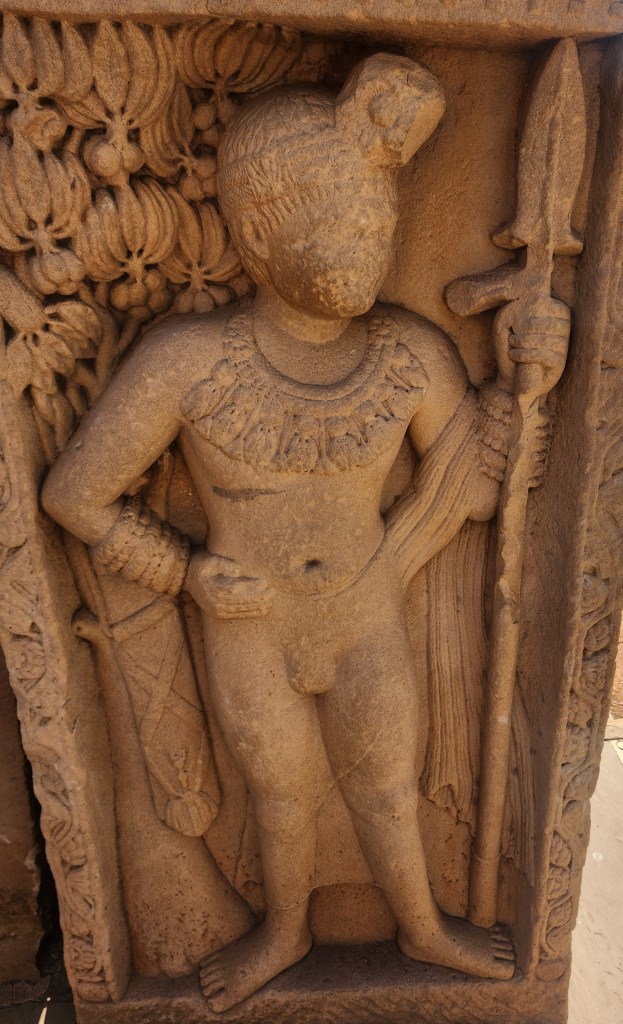
I am sharing the cover image of this article above, just to share information about it.
This image shows an armed doorkeeper, wielding a spear. This carving is from the one of the Torana (Gateways) at the Great Stupa in Sanchi. This individual is wielding a spear taller than himself, with a leaf shaped spearpoint with 2 wings at the bottom. This I think, is the oldest image in my collection of the use of a spear. Hence its choice as the cover image.


[…] Spears, Spearheads and Spearpoints – Part 1 […]
LikeLike
[…] Spears, Spearheads and Spearpoints – Part 1 Spears, Spearheads and Spearpoints – Part 2 (of 3) […]
LikeLike