The Protest and The Stick

We have all seen the protests that were going on 2 weeks ago in New Delhi. The most shocking visuals were the clashes between the protesters (some of whom are students) and the security personnel, the Police and the Rapid Action Force (RAF). The tools used to cause violence were mainly stones and sticks, that we call lathis.

The police Lathi, as I have seen it, is about 3 feet long and comes up to the waist of a person. In the Bujinkan system of martial arts we would call this a Hanbo (han = half), because it is half of a rokushakubo (more commonly referred to as just a Bo), which is a 6-foot staff.

The other tool that was used is the shield, the police riot shield, which is, I think, made of a transparent polymer, which allows users to see through it. The other kind of shield that was used is the one made of cane or rattan. Apart from the shield, some security personnel, at the least the ones from the RAF seemed to have body armour.

The armour included protection for the torso in the front and the back and the same extended down to protect the groin. I think they also had protection for the elbows and knees. Some of them seemed to have shoulder pads as well, for shoulder and deltoid protection. Both Police and the RAF personnel had helmets.
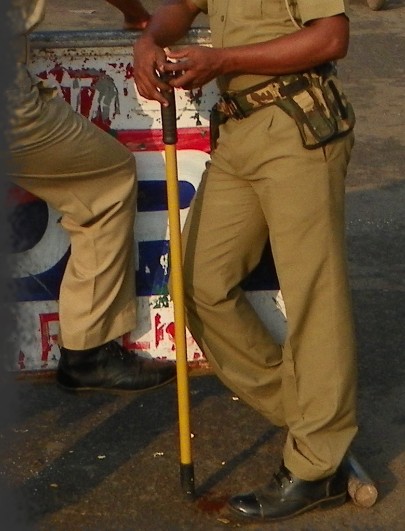
A police lathi. Image credit – Wikipedia.

The clash was mainly between armoured personnel who are trained to deal with crowds against people who were, for the most part, not armoured. But some of the protestors also seemed to have acquired some kind of protection. The protection ranged from something as simple as a handkerchief, all the way to helmets, and lathis or sticks, of their own.

I’ve seen news reports say some protestors had “long lathis”. I’m presuming, this meant that some protesters had something which is longer than a baton (which is the length of a forearm or an arm at best). I don’t think anybody had 4-foot or 6-foot staffs, which would be the equivalent of a Jo or a Bo in Bujinkan parlance.

For protection against tear gas, protesters seemed to have goggles and masks of the simple kind, like N95 and simpler ones. Some seemed to have helmets of their own, apart from lathis. In some protests, not this one in Delhi, I have observed protesters use industrial gas masks!

The most prevalent form of attacks by both the security personnel and the protesters seemed to be the swing. The diagonal swing to strike perceived opponents seemed to the most one deployed by the protesters and those trying to disperse them. The diagonal swing was of two kinds, from the top right to the bottom left and from bottom right to top left. In the Bujinkan, we would call these swings “kesa kiri” (diagonal top to bottom) and “gyaku kesa kiri” (diagonal bottom to top).

The other swing that was also seen was the horizontal swing of the stick, which we would call a “do kiri” in the Bujinkan. Of course, a “kiri” is a cut an “uchi” is a strike or hit. So these would uchi and not kiri, because no one was trying to cut another person with a sword. For example, the horizontal swing would be a “do uchi” and not a “do kiri”. Fortunately, no one was trying to cause serious physical harm or kill anyone in the protests, though there were some injuries which were serious in nature. The two sides were trying to either hold ground or clear ground that was held. Any serious injuries seem to be due to a lack of control and not willful acts of harm.
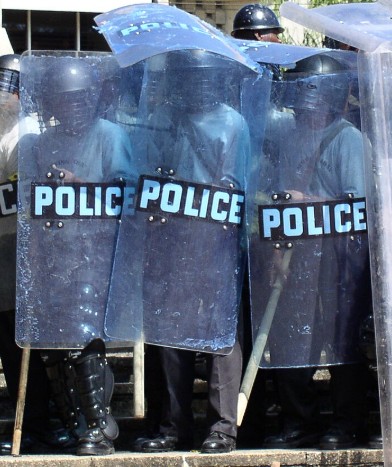
Police riot sheilds. Image credit – Wikipedia.

The sticks or lathis used seemed to be made of rattan or bamboo. Some of lathis seemed to be made of polypropylene. The lathis made of both materials are pretty light.  Back in the 2010–2014-time range, my teacher had gifted Hatsumi Sensei, the then Soke (Grandmaster/Inheritor) of the Bujinkan, a police lathi, because it was one of the most prevalent tools of law enforcement in India.

Some internet searching back then suggested that some 3 million police men and women in India were wielding lathis. This number is likely to be similar to this day. That is a lot of individuals utilizing what is essentially a hanbo in modern times! in India, it has always been the lathi that has been used and not the baton unlike in the USA. The baton is shorter, with a length that is similar to one’s forearm or arm at best, but greater girth. When police or other security personnel resort to charging a crowd with lathis, it is called a “lathi charge”, where as it might be called a “baton charge” elsewhere.

Both the Police and the RAF are trained in how to swing a stick, both when they have protection like a shield and/or body armour. In cases where personnel had no shield the lathi was being swung with 2 hands in some cases. Protesters are just common people, some with sticks, so I am presuming they have no training.

But it is being reported that some protesters were brought in only to cause trouble and add to the violence. It is not easy to tell these days if this was the case, and if true, could some of these individuals have had a modicum of training? There really is no way to tell, simply because they also seemed to be swinging sticks exactly like everyone else, with no clear difference in the form of the swing.

The fact that everyone was only swinging the stick to strike is interesting. This means that only one or two of the techniques of the hanbo, or even that of the jo, that we train in the dojo, were deployed. Even though there are some armoured and some unarmoured opponents, which makes a somewhat ideal case for the use of the forms we practice in the dojo.

Top – A 6-foot staff called a Bo. Bottom – A 3-foot staff called a Hanbo.

I suspect this is mainly because of the objectives of the protesters and the security personnel. The objective of the security personnel is likely only to clear the area of protesters. Therefore, they’re just going on the offensive, which does not give much room for maneuver. Forms that help in taking down and restraining people with a lathi were not needed here. In any case there are simpler ways to put unarmed and unarmoured protesters on the ground without needing to lock them with the lathi.

When the protesters swung the lathi, it seemed more retaliatory than defensive. Also, could it be that they knew that their fellow protesters might not be able to help them in subduing security personnel by using locking and restraining methods with a stick? I suspect it is likely, for they are very likely to had very little training in working as a group, especially with lathis as tools.

The other factor is perhaps the crunch, with the large numbers of people. When protesters build up and they try to break through the barricades that were placed in their path, the points of ingress and the width of the lanes meant that there was a need for constant quick movement of many people. This does not favour any restraining or locking techniques, those will only slow down crowds. If specific individuals are employing these techniques, they become targets, so it seems unlikely anyone will ever consider the forms we train in the dojo.

I don’t think the space constraint was an issue. If one can swing a stick, one can use restraining methods because they take lesser space. Both security personnel and protesters seemed to find niches and spaces where they could swing the sticks without striking fellow group members.

Time constraint was perhaps more of an issue. Restraining individuals and subduing them takes time, and nobody wanted to spend time on that since the objective was either to either occupy a space or clear one.

I suspect it is not necessary these days to arrest anybody immediately or on the spot. That can happen later if necessary. There are drones and cameras with facial recognition, which can identify specific individuals who can be arrested later.

So, it was all about offence on both sides or defensive offence where groups of people were moving back or moving forward. It seemed like a situation where groups surged forward, retreated and the entire thing was repeated multiple times. I do not think anyone has actually seen battles in the early medieval era, but could it resemble this kind of movement?

I am trying to be dispassionate in this post. It is not that I’m not political. I have my own political views. I am as political as anybody else in modern day India. I am very sad about what has happened.

But one can also dispassionately observe how actual violence and fighting seems to take place when there is a large group of people involved. If there were a much smaller number of people involved and one side had a constraint, of causing as little injury as possible to the other side, restraining and controlling techniques with the staff might have come into play. But otherwise, it was pretty much swing and swing as hard as one can.
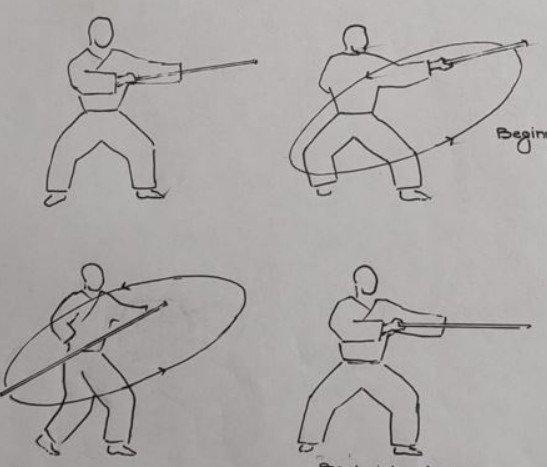
Diagrams showing a potential way to use a Jo (4-foot staff). Specific techniques like this one were NOT observable during the clashes.

I will add a few more observations before concluding. Restraining and locking techniques we train in a dojo are designed for use against armour because one easily can’t get through the same with a strike. Additionally, even though the techniques can be executed fast, it needs the attacker to be really into an attack with no hesitation.

The criterion of the attacker “being into it” was fulfilled during the clashes that took place during the protest. And perhaps restraining techniques, if they were part of the training of the security personnel, might have been used and we might have not seen those used as they were few and far between.

It also seemed at times that the protesters had numbers on their side. The lack of numbers on the side of the security personnel side showed when both sides were aggressive. There were times when security personnel had to beat a hasty retreat, with some of them sustaining nasty injuries.

It could also be a balance between numbers and training. Training involves restraint, because nobody is trying to deliberately cause serious physical damage or death. Everybody involved in the clash was only trying to get a point across. In one case that point may be political and in the other it was situational. The entire situation was about “Control” – crowd control, or control of the narrative, or just “control of that given space, at that given time”, if nothing else.

I am not sharing any videos or photos of the clashes that took place. There are a lot of videos and reels circulating online. Anyone can go and look for them. I’m not sharing these because this article is not about the protest itself. It is about certain observations related to it. Also, at this moment I feel it is not appropriate to share the videos and photos from that tragic event. The wounds of the clashes are raw. It’s a sad situation for all of us Indians.

Chetak & “The Day of the Horse”

11th July is celebrated as “Word Horse Day”. This gives us a good opportunity to discuss horses, armour and the martial arts. The most famous horse in Indian history is likely Chetak, the mount of Maharana Pratap in the 16th century.

Seen above is a statue of Maharana Pratap astride Chetak. This statue is from the Maharana Pratap memorial, Moti Magri, Udaipur, Rajasthan. Chetak carried Pratap into many of his battles, including the famous Battle of Haldighati in 1576. Chetak also breathed its last during this battle.

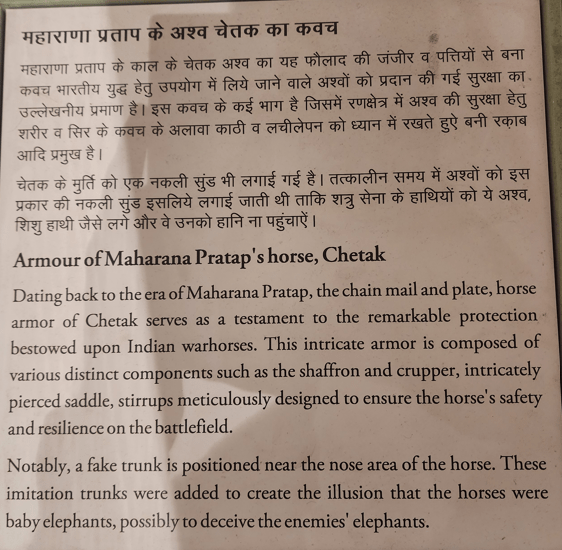
The image seen above shows the armour worn by Chetak when it was ridden into battle. This image is of the exhibit in the City Palace Museum, Udaipur, Rajasthan. The armour includes a saffron tabard as the lowest layer. Over this is a combination of chain mail, overlapping lamellar armour and reinforcing circular plates to protect a lot of the horse’s body. The armour includes a protective plate to protect the front of Chetak’s head. Interestingly, a fake elephant trunk is part of the protection for the head/face.

The above image shows the combination of tabard, chain mail and the reinforcing plates from the side. The stirrup and saddle are clearly visible in this image. Could it be that the armour below the stirrup does not have lamellar plates to protect the rider’s legs from chafing?

The above image shows the lamellar part of Chetak’s armour up close. The small overlapping plates are clearly seen in this image.

The circular metal plates that protect the lower parts of Chetak’s fore and hind quarters are seen up close in the above image.

Observe the armour used by Rajput warriors in the 16th century. It also includes chain mail and lamellar protection for the torso. This shows that the armour for Chetak was remarkably similar to that designed for humans! This exhibit is also from the City Palace Museum, Udaipur, Rajasthan.

Seen above is the information shared regarding Chetak’s armour displayed at the City Palace museum in Udaipur, Rajasthan.

The 2 images above show a closeup of the protection provided to Chetak’s head and face. Also seen up close is the fake trunk. The guides at the museums say that a fake trunk was affixed to the head of a horse to confuse elephant on a battlefield. Apparently, elephants would assume the horse was a small or baby elephant and give them pause in their attack. I am not sure how true this is or how effective this strategy was. This same information is also seen in the information plaque with information regarding Chetak’s armour.

Chetak, as I mentioned earlier, gave up its live during the Battle of Haldighati in 1576. The forces of Mewar, led by Maharana Pratap fought Mughal forces led by Raja Man Singh of Amber in this battle. The forces of Mewar started very well in this battle when the battle was fought in a narrow pass. Later when the fight moved to a plain, the superior numbers of the Mughal forces took their toll and Maharana Pratap has to retreat.

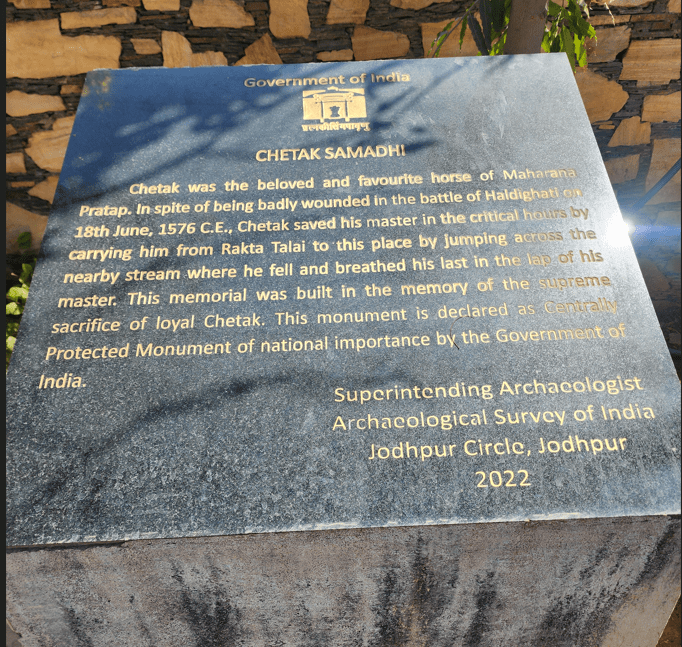
During the battle, one of Chetak’s hind legs was severely injured. Yet, Chetak carried Maharana Pratap to safety. The horse is supposed to have leapt over a gorge caused by a stream to evade Mughal pursuers. Maharana Pratap escaped successfully, but Chetak was spent after the last leap and breathed its last almost immediately after.

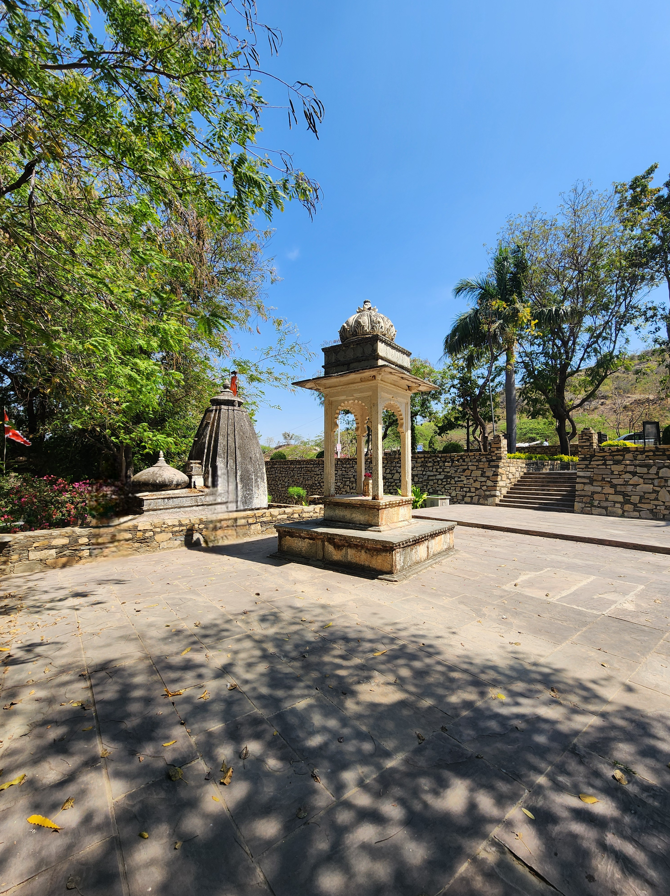
Maharana Pratap is supposed to have been distraught at the loss of his loyal mount. A memorial or samadhi was built for Chetak near the spot where he leapt over the gorge and gave up his life. This samadhi exists to this day and is a popular tourist destination.

Seen above is the samadhi built for Chetak in Haldighati.

Seen above is the plaque describing Chetak’s samadhi.

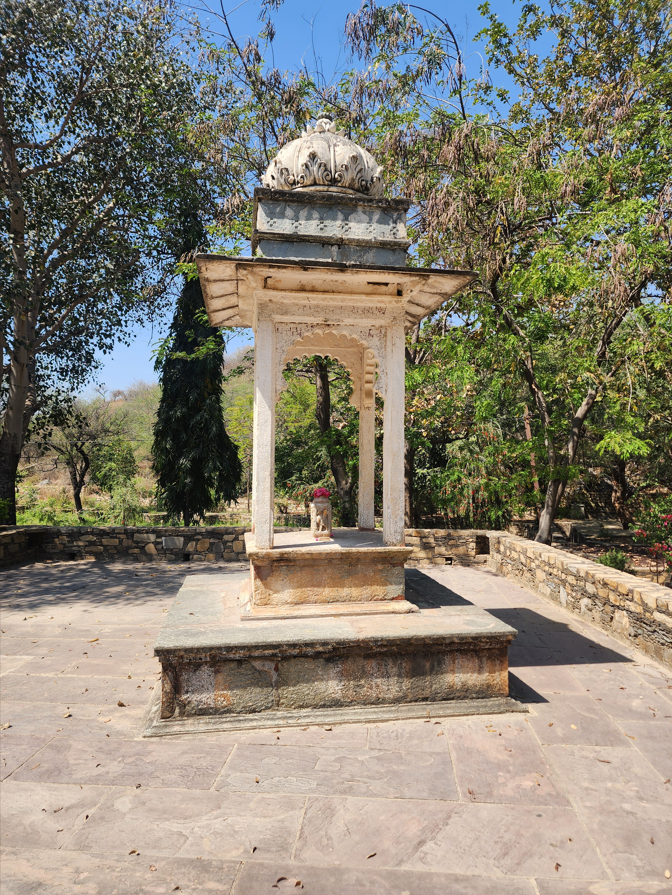
The above 2 images show a close up of the chhatri or cenotaph dedicated to Chetak at the samadhi sthal (place of the samadhi/memorial).

The above video shows the location where Chetak is supposed to have leapt over the gorge. The stream itself is now overgrown and not visible but is clearly audible, as discernible from the video.

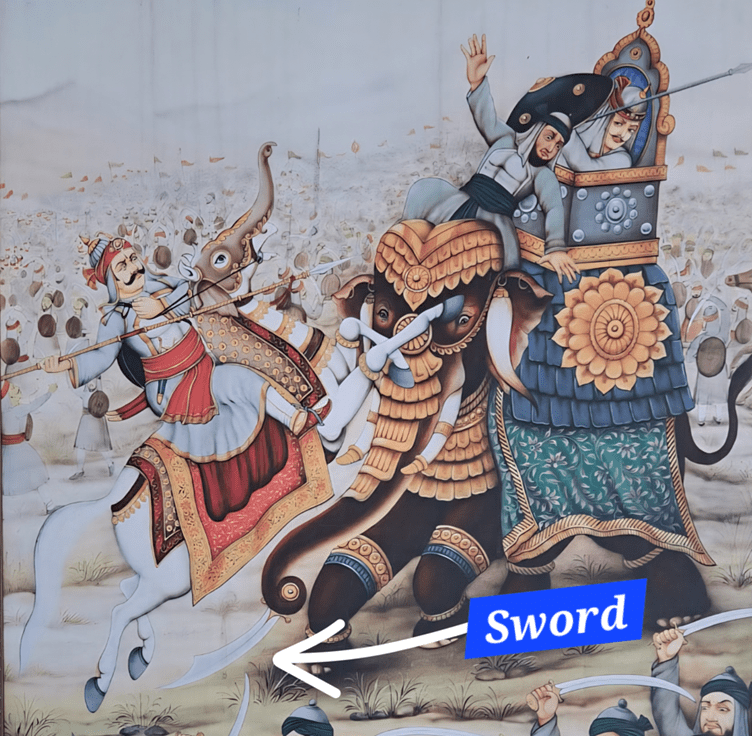
It is said that during the battle of Haldighati, Maharana Pratap on Chetak and Raja Man Singh on his elephant came face to face. Chetak is supposed to have reared up on its hind legs to enable its master to hurl his spear at Man Singh. Man Singh survived, but his mahout lost his life to the spear. This supposedly made the elephant go out of control and diminished Man Singh’s ability to command effectively.

But while rearing up on his hind legs, one of Chetak’s hind legs is supposed to have been badly injured by the blades attached to the elephant’s tusks. Many images I saw in Udaipur depict the elephant holding a sword in its trunk. An example of this is seen below. This image is from the Pratap Vijay Smarak, Dewair, Rajasthan.

The depiction seen above is not a one off. There are at least 3 depictions I saw of something similar in 3 different museums! Personally, I am not convinced that an elephant held a sword in its trunk. It is more likely that blades were attached to the tusks of the elephant.

The above image shows a display of a surviving sword attached to an elephant’s tusks. This image is from Wikipedia.

Another example of swords mounted on an elephant’s tusks is on display at the Royal Armouries in London. This exhibit is used as an example in the above video. This is an episode of the popular History Channel series, “Forged in Fire”. This episode challenged a couple of master blacksmiths to recreate this sword! I opine that something like this might have injured Chetak at Haldighati, unlike what is depicted in the painting shared earlier.

Another famous horse that finds mention in Indian history is Bucephalus, Alexander’s horse. Bucephalus lost its life during the battle of Jhelum (battle of Hydaspes), when Alexander’s forces fought the forces of Porus. Alexander is supposed to have built a town in memory of Bucephalus. Google Gemini tells me that this town is identified as likely being Jalapur Sharif in the Jehlum district in Pakistani Punjab.

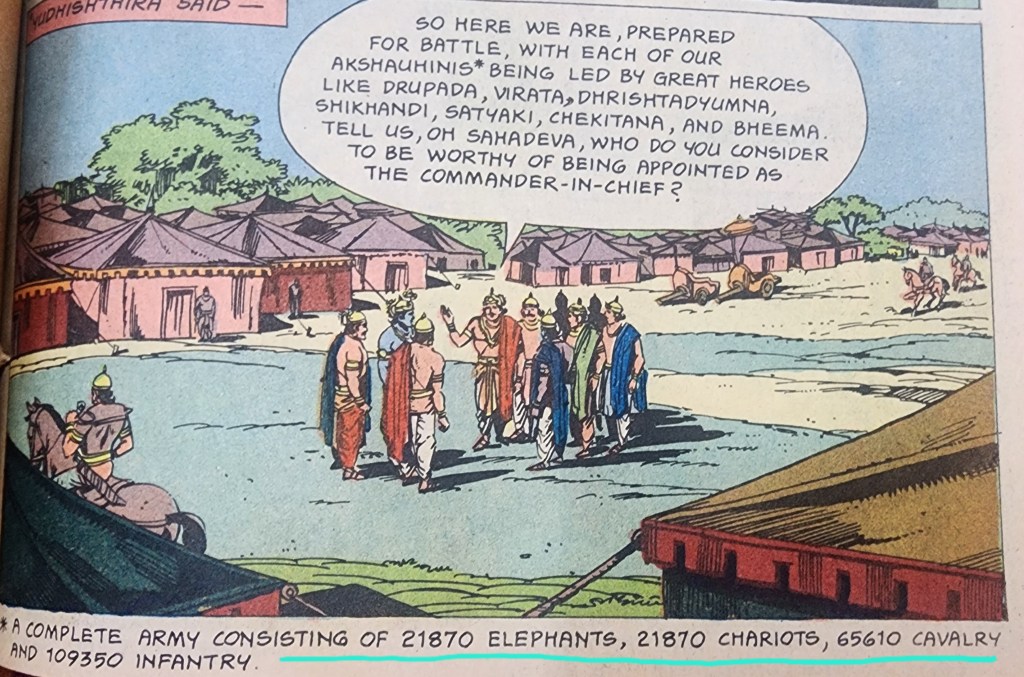
Observe the text at the bottom of the above image, underlined in blue, which shows the numbers making up an Akshauhini. Image credit – “Mahabharata 30 – The War Begins”, published by Amar Chitra Katha.

Horses have always been vitally important in Indian history. The Mahabharata gives some staggering numbers for the total number of horses that participated in the Kurukshetra War! Some details of these numbers are shared below.

  • In the Kurukshetra war, there were both cavalry and chariots, both of which used horses.
  • 18 Akshauhinis (loosely translated as a “Division”) participated in the Kurukshetra War.
  • Each Akshauhini consisted of 65,610 cavalry and 21,870 chariots.
  • Each chariot was pulled by 4 horses.
  • That brings the total to, {(65610 * 18) + ([21870 * 4] * 18)} = 27,55,620 HORSES IN THE WAR!
  • That is 27.5 lakh or 2.75 million horses! That is the current population of Jamaica or Lithuania!

Observe the text at the top of the above image, underlined in yellow, which shows the number of horses per chariot. Image credit – “Mahabharata 30 – The War Begins”, published by Amar Chitra Katha.

In recent times, the Marathas come to mind when cavalry is mentioned. The Marathas captured a very large part of India by being excellent light horsemen whose maneuverability was respected by all their opponents. Even among the Rajput warriors, I personally feel that the design of the spear they used was influenced by their cavalry habits. I had written a post about this, which is shared below. I opine that the rings or bands at different points along the length of the spear could partially be due to its intended use as a lance from horseback.

Of course, the world has seen great cavalry and equestrian cultures all over the world throughout history, starting with the Scythians and Hunas (Huns) to the Mongols and the Hussars, all of whom inspired awe. The performances of mounted horsemen to this day are special, be it with tent pegging, mounted archery or any number of stunt performances all over the world.

In current times, owning and maintaining horses is extremely expensive. So, even though equestrian sports have survived and evolved, martial arts from horseback have diminished and are not practiced much. We no longer practice fighting from horseback, let alone fighting other cavalrymen. We do not know much about the nuances of fighting with swords or spears from horseback as against using the same while on foot.

Even in the Bujinkan system of martial arts, which I am a student of, it is said that cavalry techniques were a part of the disciplines practiced historically. Of course, there was no Bujinkan back then, and cavalry techniques were a part of the Ninja Ju Hakkei which informed the Togakure Ryu.

Historically, there are 18 segments of the Togakure Ryu, of which only a few are practiced regularly in modern times. One of the 18 segments of was “Ba Jutsu” (“Ba” refers to horse and jutsu is “art/practice of”) which included horse riding and cavalry techniques. Ba Jutsu, as far as I know is not actively practiced in the Bujinkan or even just in the Togakure Ryu anymore.

2026 is the Year of the Fire Horse. I had written an article in February of this year exploring the relationship between the horse, knowledge and the martial arts from a Hindy perspective. I am sharing that post below. The earlier article juxtaposes with this one, which is purely about the physical aspects of fighting with respect to a horse.

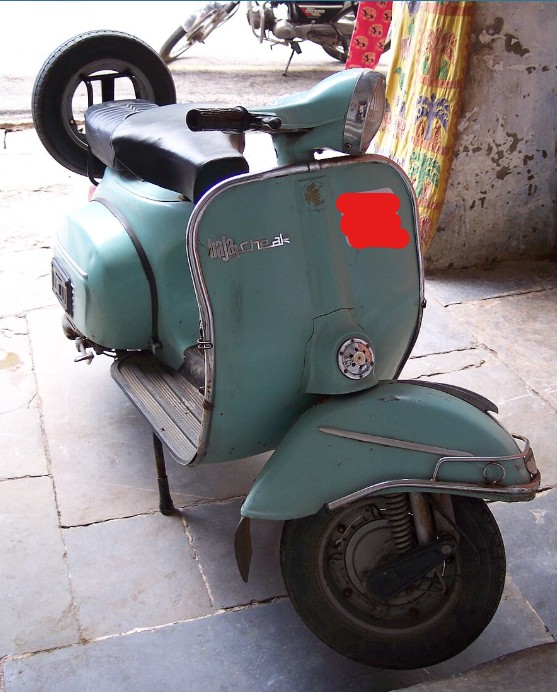
I will conclude this article with a reference to Chetak’s enduring legacy in modern India. From the 1970s through to the late 90s, Bajaj Auto produced a scooter brand called “Bajaj Chetak”. This scooter was named from the mount of Maharana Pratap himself. It was an extremely popular model of scooter and was widely seen on Indian roads. It has not been reinvented as an electric scooter. Chetak thus lives on in collective Indian memory.

An early and iconic model of the Bajaj Chetak. Image credit – Wikipedia.

The Bujinkan = The continuous transition between Lords Rama & Krishna

The stories in Hindu culture are case studies to understand life experiences and perhaps identify paths to follow when times of travail are experienced at various points in an individual’s life. These stories include the various tales depicting instances from the lives of Lord Rama and Lord Krishna.

Lord Rama is called “Maryada Purushōttama”. Lord Krishna is called “Leela Purushōttama”. The word “Purushōttama” is made up of the words “Purusha” and “Uttama”. “Purusha” means human or generically “man”. “Uttama” means excellent or of the highest order. So, “Purushōttama” means an extraordinary or excellent human or an individual who is of the highest calibre.

“Maryada” has multiple meanings, from “respect” and “honour” to “norms” and also “limits”. When we say “limit”, it specifically refers to “self-control”. “Leela” can mean “play (of the divinities)” or “tale” or “story”. A story is nothing but a possible (plausible?) or potential scenario.

I had written a whole post about the “Maryada” aspect of Lord Rama, a link to which is seen below. Lord Rama was a God. He needed to follow no rules that applied to the people he lived with. He was not even subject to the laws that applied to kings who were responsible to their citizens. But he followed every rule that applied to humans diligently, even when it resulted in great personal tragedy. He followed the rules even when the rules were not just, at least by modern standards.

Lord Rama could have broken every rule with absolutely no consequences to either himself or anyone dear to him. He could have protected them with divine abilities. But he CHOSE a life of hardship by foregoing the abilities of the divine. This was his SELF-CONTROL, the ability to stay human by limiting the use of the divine. This demonstrated ability throughout his life is what makes him Maryada Purushōttama.

Lord Rama’s life shows the benefits of self-control despite the pain it causes. This fact is what makes his life a case study. To demonstrate some instances from Lord Rama’s life when he chose hardship due to self-control instead of the loophole divinity provided, are seen below.

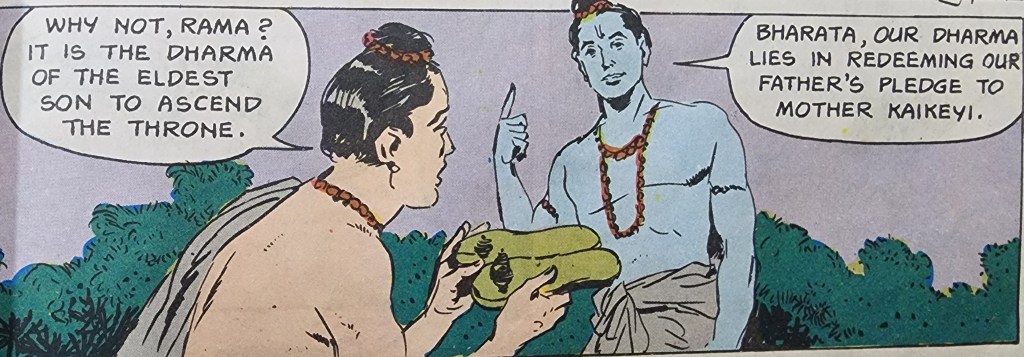
Lord Rama was going to be anointed heir apparent, but he lost this position due to a promise his father had made. He further lost his home and the company of his family in the same sequence of events when he was exiled to the forest. He accepted this loss because it was his responsibility, as he saw it, to uphold the word of his father.

Lord Rama chooses to keep his father’s word despite Bharata requesting him to change his decision. Image credit – “The Ramayana”, published by Amar Chitra Katha.

Even when his father was no more and he could have chosen to reverse the exile, as the person whose word he was upholding was no more, he did not. His brother Bharat, in whose interest he was exiled, beseeched him to return and yet he let the exile continue, for the word of his father was a sacred contract to be upheld. It was like he was the heir apparent to even his father’s promises, even if the consequences of the promise were not in his best interests, and the promise was being extracted in bad faith. Lord Rama was not obligated to do keep his father’s word, yet he did.

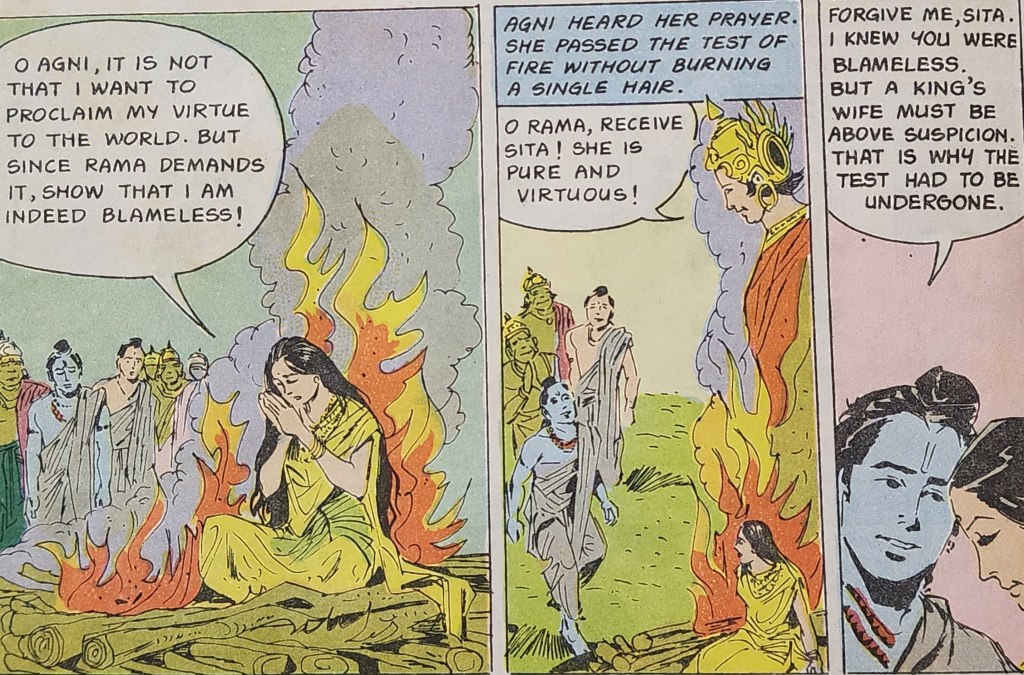
Lord Rama rescued Devi Sita from Ravana. But this came at the cost of a very large number of lives. And despite all the effort, Devi Sita had to endure the Agni Pariksha to satisfy the norms of society as it existed then. He did not stop this either as a God or as a man who commanded enormous respect, because this would put him above the rest of humanity.

Devi Sita has to endure the Agni Pariksha. Image credit – “The Ramayana”, published by Amar Chitra Katha.

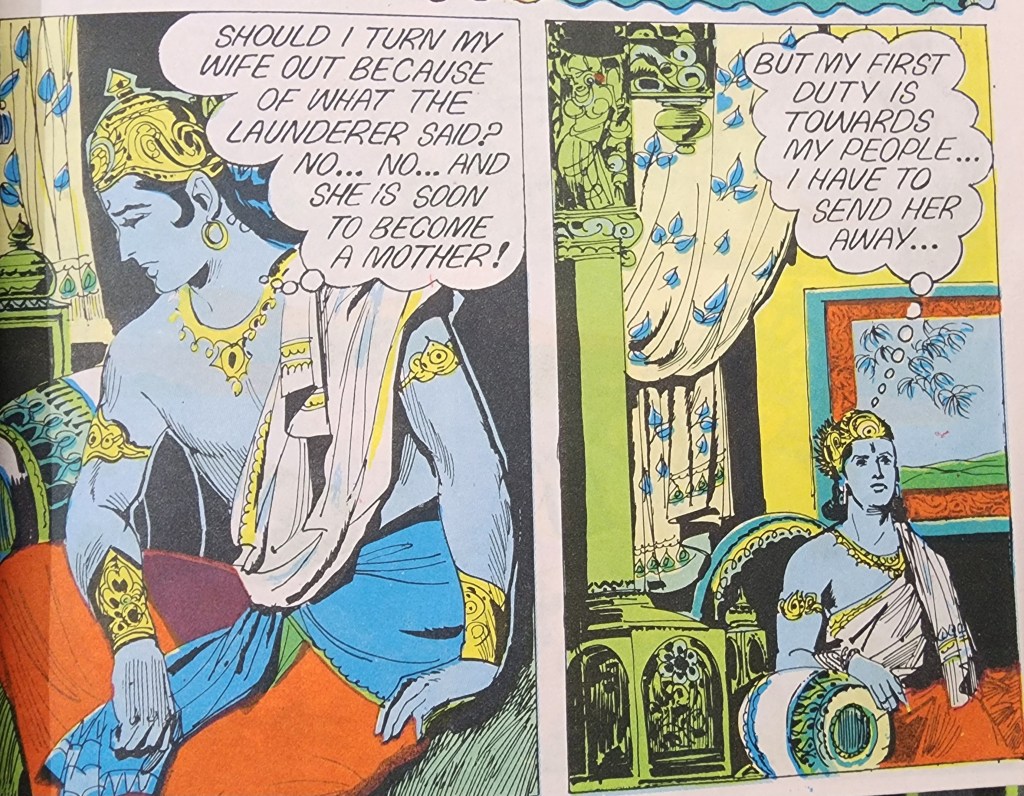
Eventually, he had to abandon Devi Sita again, to prevent setting a wrong precedent to a society that used his life as an example to cover up their mistakes. He never tried to create an exception despite his ability and right to do so. This was despite doing so would be the right thing, as we see it today. He put the sanctity of societal norms above what we would consider the “right thing”.

These events reveal that the purpose of the Rama avatāra was not just the elimination of Rāvana; it was to render a life as a case study in restraint and self-control.

Lord Krishna is the one who shows possible situations and outcomes through the story of his life. The “possibilities” that are shown highlight how rules and norms can be challenged, especially if they seem wrong at any given time. This is despite all of society or any individual of power or even a God choosing to disagree and uphold a norm that is wrong.

Lord Rama chooses to abandon Devi Sita despite knowing it is not the right decision. Image credit – “Sons of Rama”, published by Amar Chitra Katha.

This act of identifying possibilities is the act of upholding Dharma (that which sustains) even when that results in actions that endanger one’s self, reputation and legacy. Some instances from Lord Krishna’s life when he chose to circumvent the “norms and rules” to sustain Dharma, are seen below.

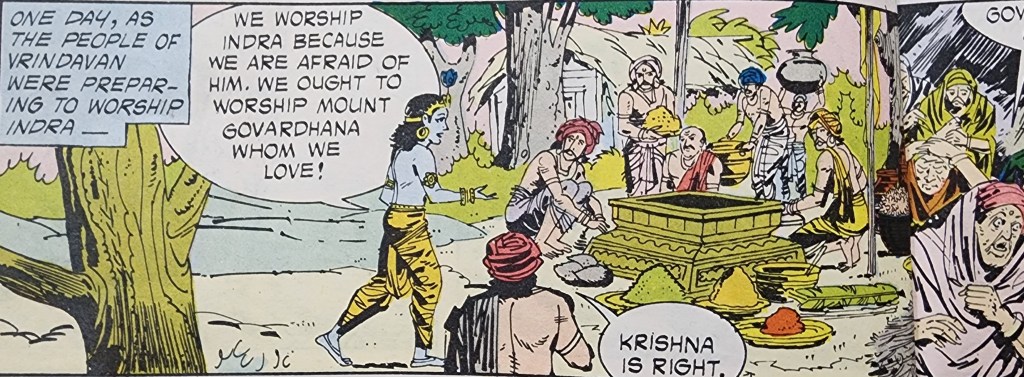
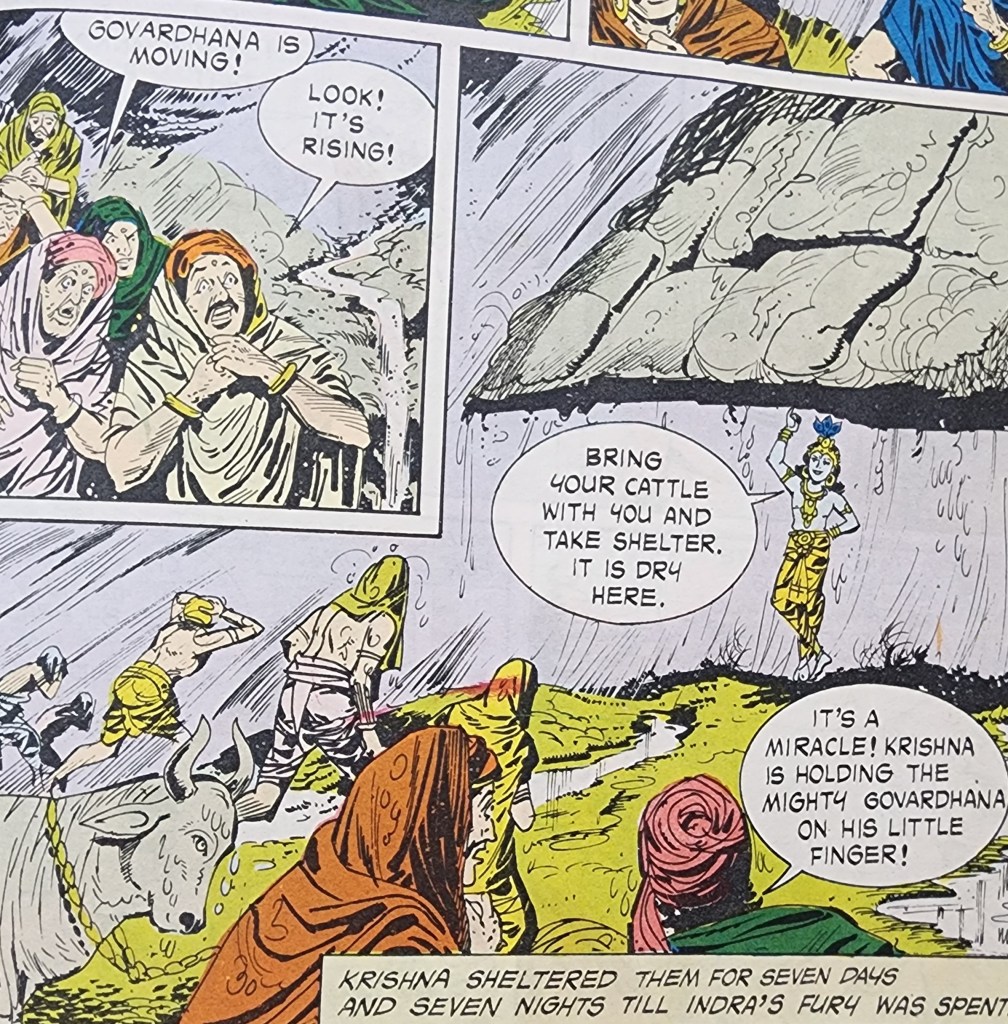
Lord Krishna encouraged the worship of a mountain (Govarhdana) over the worship of Lord Indra, because the worship of Indra was carried out due to fear of retribution and not genuine devotion. This act incurred Indra’s wrath and Lord Krishna chose to employ his divinity to protect his fellow citizens. Not for him were the need to live as a human and suffer unjust retribution.

Lord Krishna suggests that Govardhana Giri (mountain) is worthy of worship over Lord Indra. Image credit – “Tales of Krishna”, published by Amar Chitra Katha.

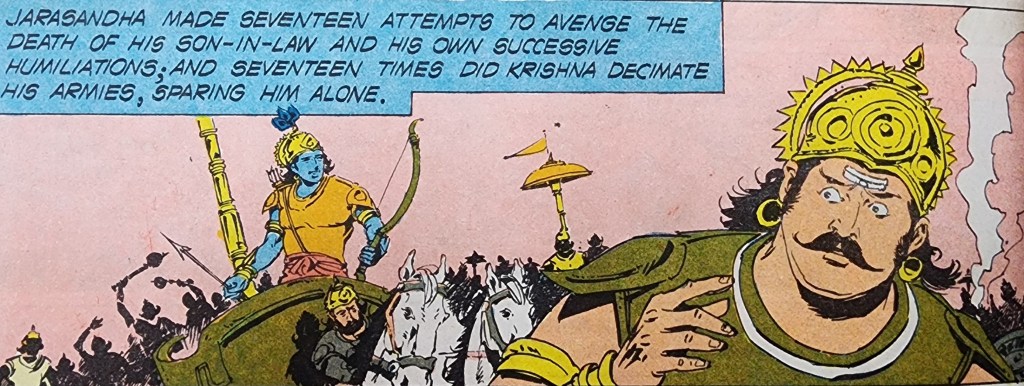
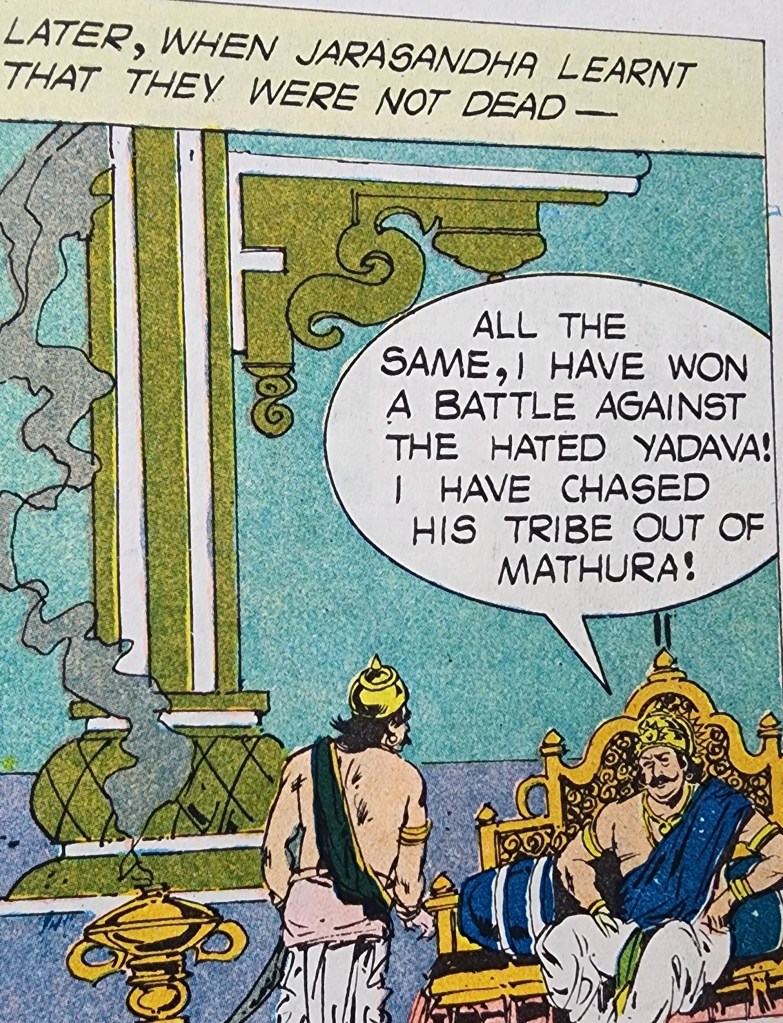
Lord Krishna chose retreat(!) over a need for victory against Jarasandha, the mighty ruler of Magadha. Dwaraka was built on the coast, far away from the reach of Jarasandha. The people of Mathura had to endure several invasions from Jarasandha. While Krishna and his brother Balarama, with their inhuman abilities defeated each of the invasions, prosperity could only be ensured by retreating from the Jarasandha’s sphere of influence.

Lord Krishna holds up Govardhana Giri (mountain) with his little finger! Image credit – “Tales of Krishna”, published by Amar Chitra Katha.

Krishna used deception several times during warfare. This was despite his having to live by the code of the Kshatriyas and fight fair. Some instances when Lord Krishna chose deception to end conflicts are,

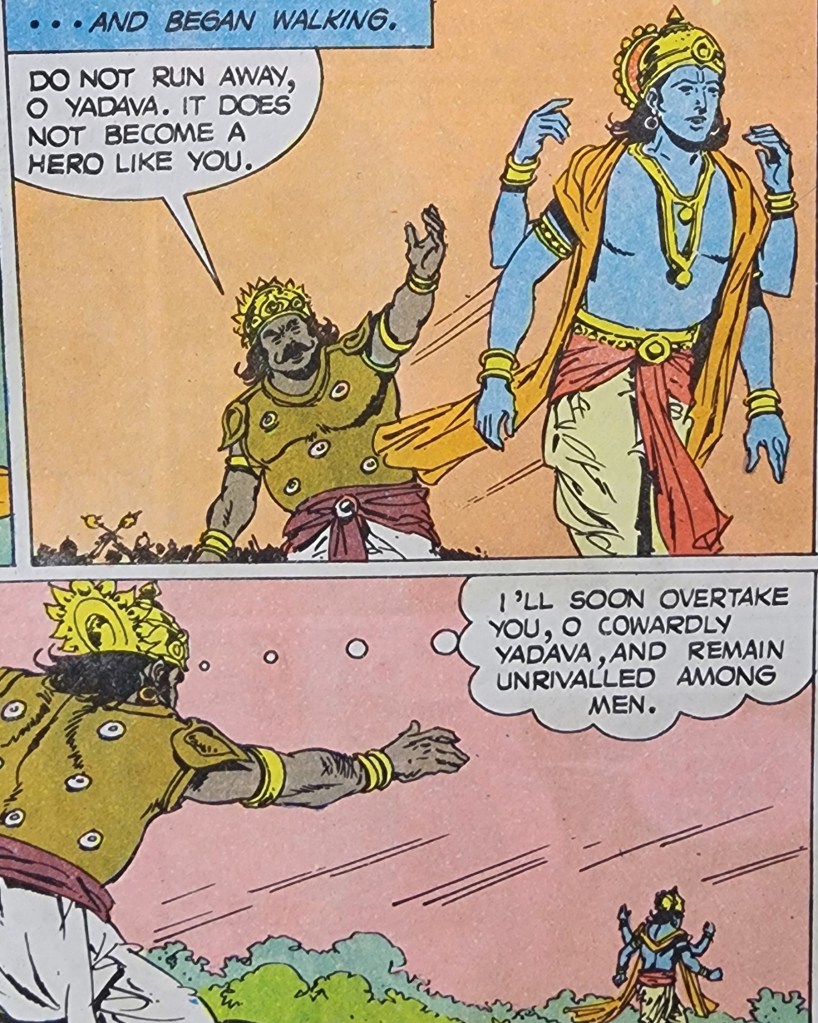
  • Running away from Kālayavana, to lead him into a trap in cave where Muchukunda inadvertently killed him. This act made him earn the epithet, “Ranchod Das”, or “one who runs from a battle”, which is not really a flattering adjective.
  • Krishna used the Pandavas to eliminate Jarasandha, and that was by tricking the king of Magadha into a duel against Bhima, the only person who could defeat Jarasandha, away from the battlefield.
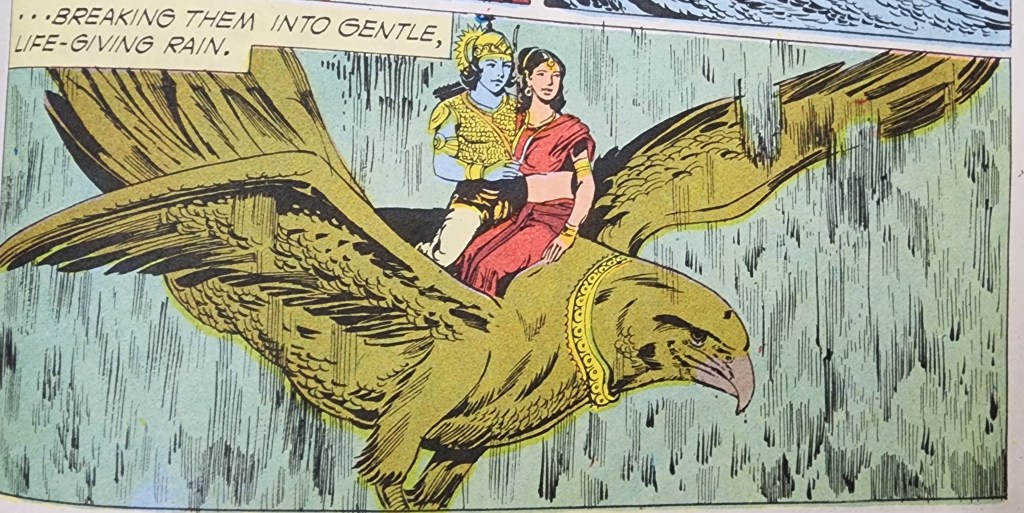
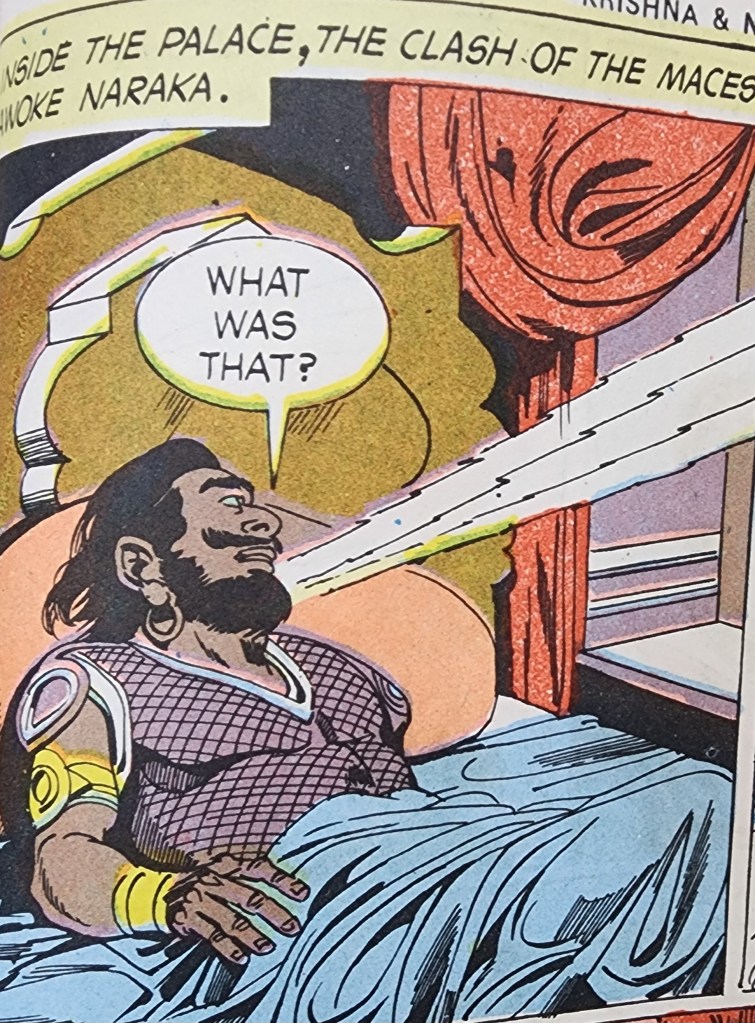
  • Krishna defeated Narakāsura by bypassing his armies and carrying out an air raid on the latter’s palace at night, where Narakāsura was sleeping! Not only did Krishna violate norms by attacking at night, but he also used Garuda, who was a divine being, to circumvent a large part of Naraka’s troops.
  • During his peace mission to Hastinapura, in a last-ditch effort to prevent war between the Kauravas and the Pandavas, Krishna revealed his divine form (Vishwaroopa) to try and convince Duryodhana to make peace. If Duryodhana had been a bit more reasonable, he would have seen the futility of going up again a God.
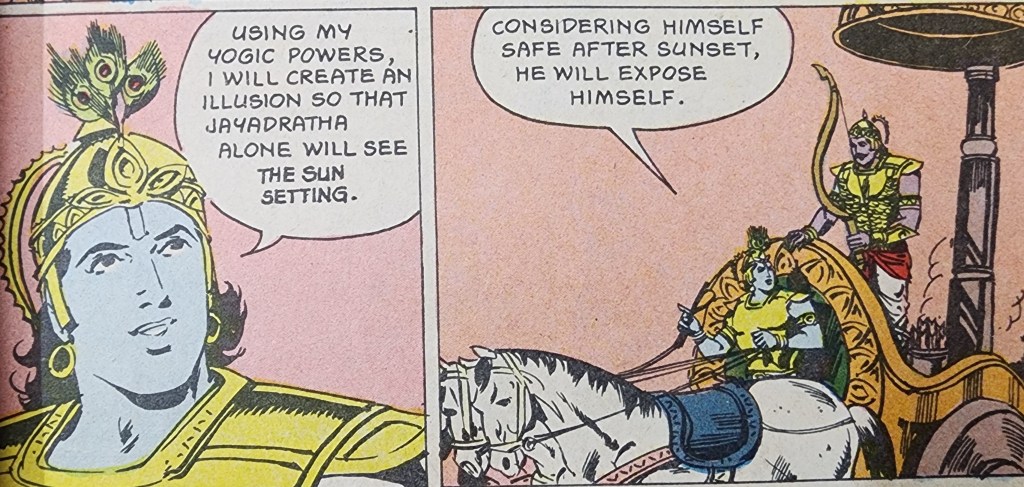
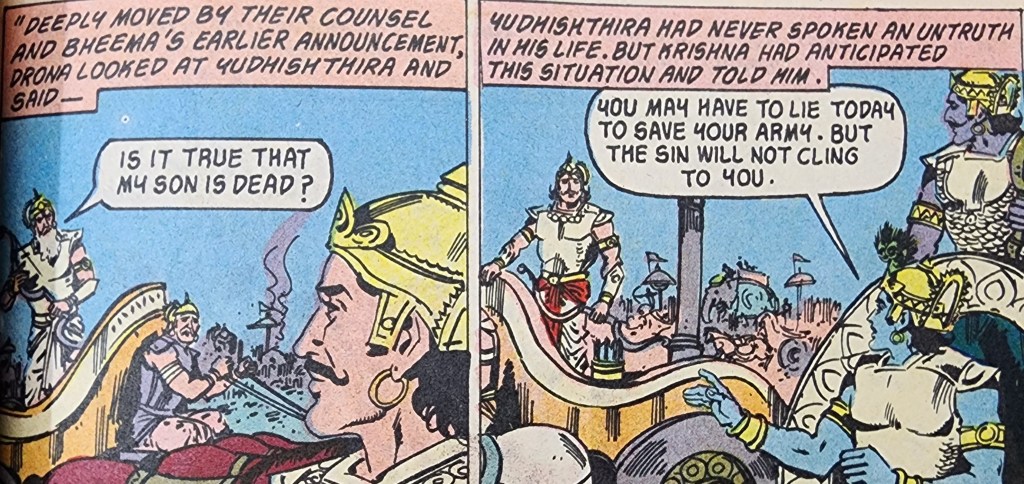
  • Krishna used an illusion to enable Arjuna to kill Jayadratha and a lie to defeat Drona during the Kurukshetra War.

Mathura survives 17 invasions by Jarasandha! Image credit – “Krishna and Jarasandha”, published by Amar Chitra Katha.

Thus, the Krishna avatāra was a case study in the need to uphold the essence of Dharma and not just the rituals and norms that seem to lead to Dharma. Dharma evolves and this necessitates evolution in ways of life; rigidity (rules and norms) itself could become the enemy of Dharma. This vision of what evolution could lead to is perhaps what the many “Leela” of Lord Krishna demonstrate.

Krishna runs away from the battlefield despite being a Kshatriya! Image credit – “Krishna and Jarasandha”, published by Amar Chitra Katha.

The Bujinkan system of martial arts, among many other concepts, emphasizes self-control and a need to adapt. The two concepts are interlinked. In a situation of real physical conflict, one can never apply techniques as they are taught and trained in a dojo. The forms and techniques trained in class are just options that are available to a practitioner, they are “possibilities”.

The form or technique or even just a concept that can be applied in a conflict against a single or multiple opponents, is a choice to be made by the individual(s) participating in the conflict. The consequences of the choices lead to further choices and so on, until the conflict is hopefully mitigated. Each choice is like a “Leela” (though not divine) we discussed earlier in this article.

Krishna and the Yadavas retreat to Dwaraka to survive further invasions by Jarasandha. Image credit – “Krishna and Jarasandha”, published by Amar Chitra Katha.

For example, if there are multiple opponents, receiving the attack by not trying to escape might not be wise. If an opponent is unarmed, strikes against this person might be viable. If the opponent is being violent and high on substances, subduing the opponent might be the need of the hour. One needs to adapt to the situation and “THE SITUATION” changes every INSTANT. This continuous adaptation is to flow with the changing situation.

This is no different than being able to see the “possibilities” at every instant. If one can train oneself to be able to see multiple possibilities at all times and adapt, one is as close to being “limitless” as possible. I am referring to a physical conflict, but the same principles will apply even if one is involved in a verbal altercation or a tough negotiation, which is nothing but a conflict over a favourable deal.

Krishna carries out an aerial attack on Narakaasura, while mounted on Garuda. Image credit – “Tales of Krishna”, published by Amar Chitra Katha.

A key ingredient in being close to “limitless” and able to see several options at all times is SELF-CONTROL. At its simplest level, self-control could simply mean not expecting any form or technique applied in a fight to result in an expected outcome, specifically the outcome seen in a dojo during regular practice. Different opponents have vastly different physical abilities and skills based on their background, genetics and experience in different martial arts. This means doing what needs to be done to survive and not expect anything one does to work in a specific manner.

If any action does not have a desired outcome, one must adapt instantaneously. There is no room for anger at the opponent, doubt in the self because a technique did not work or any analytical paralysis. This stopping oneself at an emotional level and staying in the moment to stay alive and use all opportunities available is SELF-CONTROL. This needs to be applied at all times. SELF-CONTROL and FLOW (BEING LIMITLESS) are both equally important and two sides of the same coin in any situation that needs conflict management.

Krishna attacks a sleeping Narakaasura, violating the norms of war! Image credit – “Tales of Krishna”, published by Amar Chitra Katha.

Thus, one needs to apply the traits demonstrated by both Lord Rama and Lord Krishna during their respective lifetimes. In my opinion, the continuous application of both self-control and flow is like switching between Lord Rama and Lord Krishna incessantly!

So, practicing the Bujinkan and perhaps other martial arts as well, is akin to celebrating the interplay between Lord Rama and Lord Krisha all the time! 😊 Rama to control the self and decide when to limit one’s own “need to do” or “expect something” and Krishna to “stay limitless in going beyond form” and “seeing the endless possibilities in any movement”.

Krishna uses a deceptive illusion to enable Arjuna’s slaying of Jayadratha. Image credit – “Mahabharata 35 – Arjuna fulfills his vow”, published by Amar Chitra Katha.

Krishna convinces Yudishtira to lie, against his nature, to stop Drona. Image credit – “Mahabharata 36 – The Battle at mindnight”, published by Amar Chitra Katha.

An aside – Sanjeev Sanyal, member of the Prime Minister’s Economic Advisory Council, has spoken several times about how the core of Lord Rama’s and Lord Krishna’s lives was the debate between the letter of the law and the spirit of the law. Lord Rama’s life was about living a life as described by the law, even if the law seemed unjust at times, while Lord Krishna’s life was about not following the law when it went against the spirit of the justice or the law itself. What I have described about Lord Rama and Lord Krishna in relation to the martial arts is not very different as concepts go, from this view expressed by Mr. Sanyal. Seen below is a video where Mr. Sanyal is expressing his views.

https://www.youtube.com/watch?v=ITER_dobOB0