We have all seen the protests that were going on 2 weeks ago in New Delhi. The most shocking visuals were the clashes between the protesters (some of whom are students) and the security personnel, the Police and the Rapid Action Force (RAF). The tools used to cause violence were mainly stones and sticks, that we call lathis.
The police Lathi, as I have seen it, is about 3 feet long and comes up to the waist of a person. In the Bujinkan system of martial arts we would call this a Hanbo (han = half), because it is half of a rokushakubo (more commonly referred to as just a Bo), which is a 6-foot staff.
The other tool that was used is the shield, the police riot shield, which is, I think, made of a transparent polymer, which allows users to see through it. The other kind of shield that was used is the one made of cane or rattan. Apart from the shield, some security personnel, at the least the ones from the RAF seemed to have body armour.
The armour included protection for the torso in the front and the back and the same extended down to protect the groin. I think they also had protection for the elbows and knees. Some of them seemed to have shoulder pads as well, for shoulder and deltoid protection. Both Police and the RAF personnel had helmets.
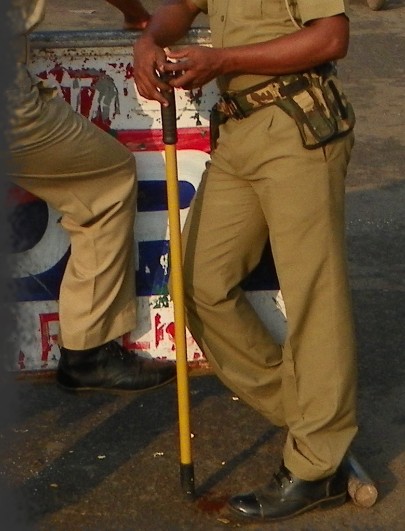
A police lathi. Image credit – Wikipedia.
The clash was mainly between armoured personnel who are trained to deal with crowds against people who were, for the most part, not armoured. But some of the protestors also seemed to have acquired some kind of protection. The protection ranged from something as simple as a handkerchief, all the way to helmets, and lathis or sticks, of their own.
I’ve seen news reports say some protestors had “long lathis”. I’m presuming, this meant that some protesters had something which is longer than a baton (which is the length of a forearm or an arm at best). I don’t think anybody had 4-foot or 6-foot staffs, which would be the equivalent of a Jo or a Bo in Bujinkan parlance.
For protection against tear gas, protesters seemed to have goggles and masks of the simple kind, like N95 and simpler ones. Some seemed to have helmets of their own, apart from lathis. In some protests, not this one in Delhi, I have observed protesters use industrial gas masks!
The most prevalent form of attacks by both the security personnel and the protesters seemed to be the swing. The diagonal swing to strike perceived opponents seemed to the most one deployed by the protesters and those trying to disperse them. The diagonal swing was of two kinds, from the top right to the bottom left and from bottom right to top left. In the Bujinkan, we would call these swings “kesa kiri” (diagonal top to bottom) and “gyaku kesa kiri” (diagonal bottom to top).
The other swing that was also seen was the horizontal swing of the stick, which we would call a “do kiri” in the Bujinkan. Of course, a “kiri” is a cut an “uchi” is a strike or hit. So these would uchi and not kiri, because no one was trying to cut another person with a sword. For example, the horizontal swing would be a “do uchi” and not a “do kiri”. Fortunately, no one was trying to cause serious physical harm or kill anyone in the protests, though there were some injuries which were serious in nature. The two sides were trying to either hold ground or clear ground that was held. Any serious injuries seem to be due to a lack of control and not willful acts of harm.
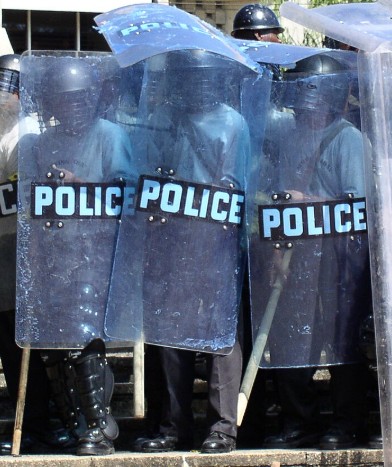
Police riot sheilds. Image credit – Wikipedia.
The sticks or lathis used seemed to be made of rattan or bamboo. Some of lathis seemed to be made of polypropylene. The lathis made of both materials are pretty light. Back in the 2010–2014-time range, my teacher had gifted Hatsumi Sensei, the then Soke (Grandmaster/Inheritor) of the Bujinkan, a police lathi, because it was one of the most prevalent tools of law enforcement in India.
Some internet searching back then suggested that some 3 million police men and women in India were wielding lathis. This number is likely to be similar to this day. That is a lot of individuals utilizing what is essentially a hanbo in modern times! in India, it has always been the lathi that has been used and not the baton unlike in the USA. The baton is shorter, with a length that is similar to one’s forearm or arm at best, but greater girth. When police or other security personnel resort to charging a crowd with lathis, it is called a “lathi charge”, where as it might be called a “baton charge” elsewhere.
Both the Police and the RAF are trained in how to swing a stick, both when they have protection like a shield and/or body armour. In cases where personnel had no shield the lathi was being swung with 2 hands in some cases. Protesters are just common people, some with sticks, so I am presuming they have no training.
But it is being reported that some protesters were brought in only to cause trouble and add to the violence. It is not easy to tell these days if this was the case, and if true, could some of these individuals have had a modicum of training? There really is no way to tell, simply because they also seemed to be swinging sticks exactly like everyone else, with no clear difference in the form of the swing.
The fact that everyone was only swinging the stick to strike is interesting. This means that only one or two of the techniques of the hanbo, or even that of the jo, that we train in the dojo, were deployed. Even though there are some armoured and some unarmoured opponents, which makes a somewhat ideal case for the use of the forms we practice in the dojo.

Top – A 6-foot staff called a Bo. Bottom – A 3-foot staff called a Hanbo.
I suspect this is mainly because of the objectives of the protesters and the security personnel. The objective of the security personnel is likely only to clear the area of protesters. Therefore, they’re just going on the offensive, which does not give much room for maneuver. Forms that help in taking down and restraining people with a lathi were not needed here. In any case there are simpler ways to put unarmed and unarmoured protesters on the ground without needing to lock them with the lathi.
When the protesters swung the lathi, it seemed more retaliatory than defensive. Also, could it be that they knew that their fellow protesters might not be able to help them in subduing security personnel by using locking and restraining methods with a stick? I suspect it is likely, for they are very likely to had very little training in working as a group, especially with lathis as tools.
The other factor is perhaps the crunch, with the large numbers of people. When protesters build up and they try to break through the barricades that were placed in their path, the points of ingress and the width of the lanes meant that there was a need for constant quick movement of many people. This does not favour any restraining or locking techniques, those will only slow down crowds. If specific individuals are employing these techniques, they become targets, so it seems unlikely anyone will ever consider the forms we train in the dojo.
I don’t think the space constraint was an issue. If one can swing a stick, one can use restraining methods because they take lesser space. Both security personnel and protesters seemed to find niches and spaces where they could swing the sticks without striking fellow group members.
Time constraint was perhaps more of an issue. Restraining individuals and subduing them takes time, and nobody wanted to spend time on that since the objective was either to either occupy a space or clear one.
I suspect it is not necessary these days to arrest anybody immediately or on the spot. That can happen later if necessary. There are drones and cameras with facial recognition, which can identify specific individuals who can be arrested later.
So, it was all about offence on both sides or defensive offence where groups of people were moving back or moving forward. It seemed like a situation where groups surged forward, retreated and the entire thing was repeated multiple times. I do not think anyone has actually seen battles in the early medieval era, but could it resemble this kind of movement?
I am trying to be dispassionate in this post. It is not that I’m not political. I have my own political views. I am as political as anybody else in modern day India. I am very sad about what has happened.
But one can also dispassionately observe how actual violence and fighting seems to take place when there is a large group of people involved. If there were a much smaller number of people involved and one side had a constraint, of causing as little injury as possible to the other side, restraining and controlling techniques with the staff might have come into play. But otherwise, it was pretty much swing and swing as hard as one can.
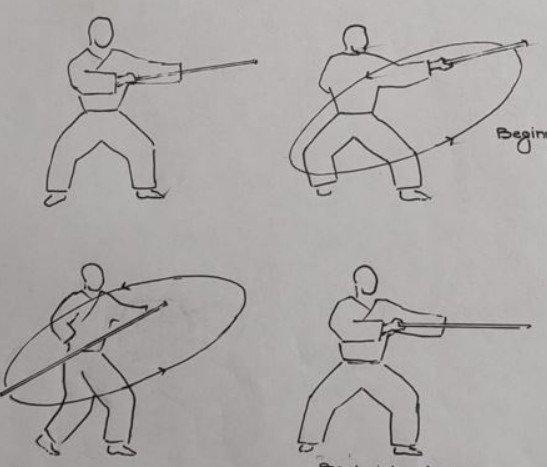
Diagrams showing a potential way to use a Jo (4-foot staff). Specific techniques like this one were NOT observable during the clashes.
I will add a few more observations before concluding. Restraining and locking techniques we train in a dojo are designed for use against armour because one easily can’t get through the same with a strike. Additionally, even though the techniques can be executed fast, it needs the attacker to be really into an attack with no hesitation.
The criterion of the attacker “being into it” was fulfilled during the clashes that took place during the protest. And perhaps restraining techniques, if they were part of the training of the security personnel, might have been used and we might have not seen those used as they were few and far between.
It also seemed at times that the protesters had numbers on their side. The lack of numbers on the side of the security personnel side showed when both sides were aggressive. There were times when security personnel had to beat a hasty retreat, with some of them sustaining nasty injuries.
It could also be a balance between numbers and training. Training involves restraint, because nobody is trying to deliberately cause serious physical damage or death. Everybody involved in the clash was only trying to get a point across. In one case that point may be political and in the other it was situational. The entire situation was about “Control” – crowd control, or control of the narrative, or just “control of that given space, at that given time”, if nothing else.
I am not sharing any videos or photos of the clashes that took place. There are a lot of videos and reels circulating online. Anyone can go and look for them. I’m not sharing these because this article is not about the protest itself. It is about certain observations related to it. Also, at this moment I feel it is not appropriate to share the videos and photos from that tragic event. The wounds of the clashes are raw. It’s a sad situation for all of us Indians.


very well analysed and written
LikeLike
Thanks a lot! 🙏
LikeLike