Balarama Jayanti – The Plough as a Weapon

Lord Balarama is the elder brother of Lord Krishna. 27th Aug 2026 is supposed to be Balarama Jayanthi, which commemorates the birth of Balarama. Balarama is considered an incarnation of Ādi Shesha, the Naga on whom Lord Vishnu reclines. But he is also sometimes considered an avatāra of Lord Vishnu, and a part of the Dashāvatāra. He is the 8th avatāra, after Lord Rama and before Lord Krishna in this chronology, as far as I am aware.
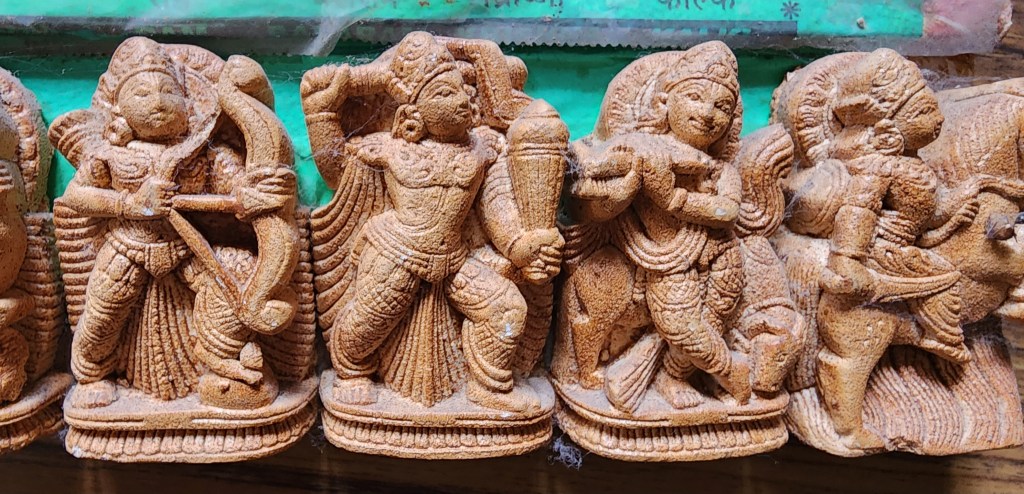
Balarama depicted as the 8th Avatāra in the Dashāvatāra. The above image shows, from left to right, Rama, Balarama, Krishna & Kalki.

Balarama is associated with 2 weapons, the plough and the gada (mace). The plough is the most iconic weapon associated with him, and this is shown in depictions of Balarama for almost 2 millennia now. The internet claims that the plough is associated with him because he evolved from originally being an agricultural God.

Balarama was the greatest exponent of the gada or mace of his age. He was the mentor for both Bhima & Duryodhana in the art of mace fighting. Observe the image of Balarama in the image seen below. Here he is depicted with the plough and a large staff, which is a pestle, called Musala in many Indian languages. The pestle or Musala could be considered a club or a bludgeoning weapon. A gada or a mace is an evolution of the club. So, Lord Balarama is associated with bludgeoning weapons.
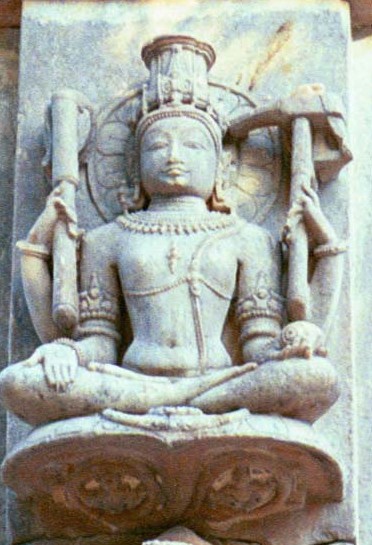
Balarama depicted with the Musala/Onake/Pestle in his left hand and the Plough in his right hand. This carving is from the Sasbahu temple in Nagda, Rajasthan. Image credit – Wikimedia Commons (Michael Gunther).

Balarama’s association with the plough and to a lesser extent the mace or large staff is what inspired this article. The occasion of Balarama Jayanthi gives us an opportunity to explore the various plough-like weapons in various cultures. It also gives us an opportunity to discover the use of the Musala as a weapon in recent Indian history!

The plough is a tool used to break the earth or turn over the soil in preparation for sowing. It is an ancient tool that has been in use for several thousand years. It is iconic in its shape. It consists of a wooden shaft with another piece of wood, called a ploughshare, attached at an angle to one end of the shaft. The shaft is pulled by a beast of burden, horses or oxen for example, while the angled piece of wood is drawn through the ground to turn the soil. The tip of the ploughshare could have a piece of metal attached to it, to increase its efficiency.
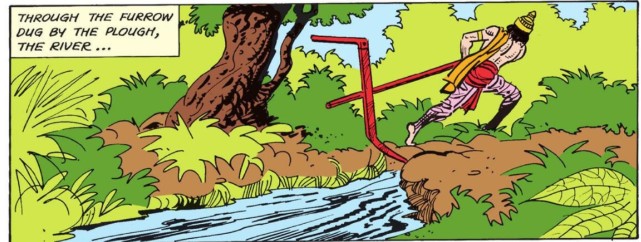
Balarama singlehandedly creating a channel for the Yamuna, using a traditional large plough. Image credit – “Tales of Balarama”, published by Amar Chitra Katha”.

The plough, sometimes spelled “plow” could be of varying sizes. Some could be large and pulled by animals while, smaller ones existed for use by humans. Of course, these days, mechanized ploughs can be much larger. Seen below are examples of a large are small ploughs.
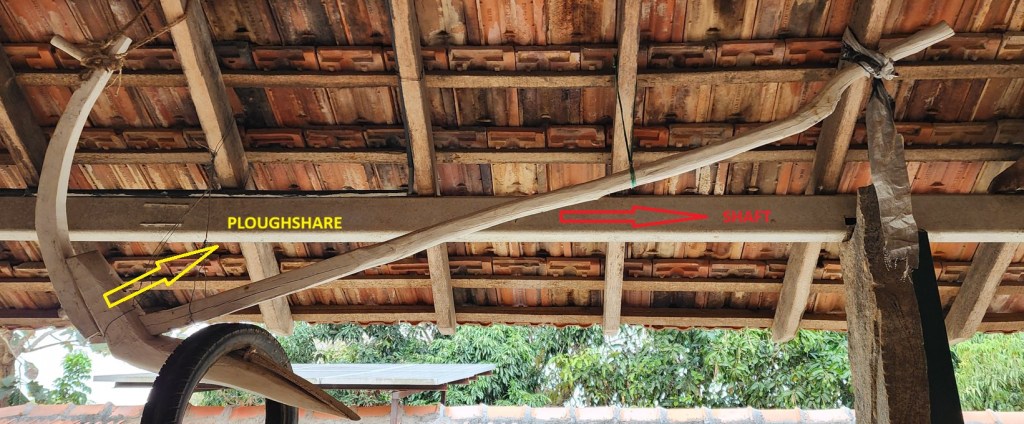
A big traditional plough. The shaft is mentioned in red, while the ploughshare is mentioned in yellow.
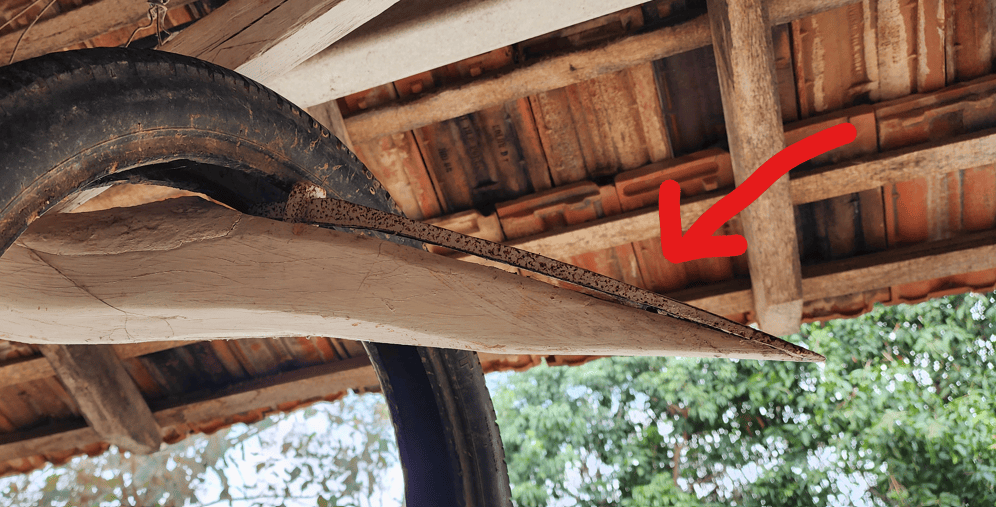
A closeup of the plough seen in the previous image. The metal plate affixed to the ploughshare is seen clearly in this image. It is pointed to by the red arrow.
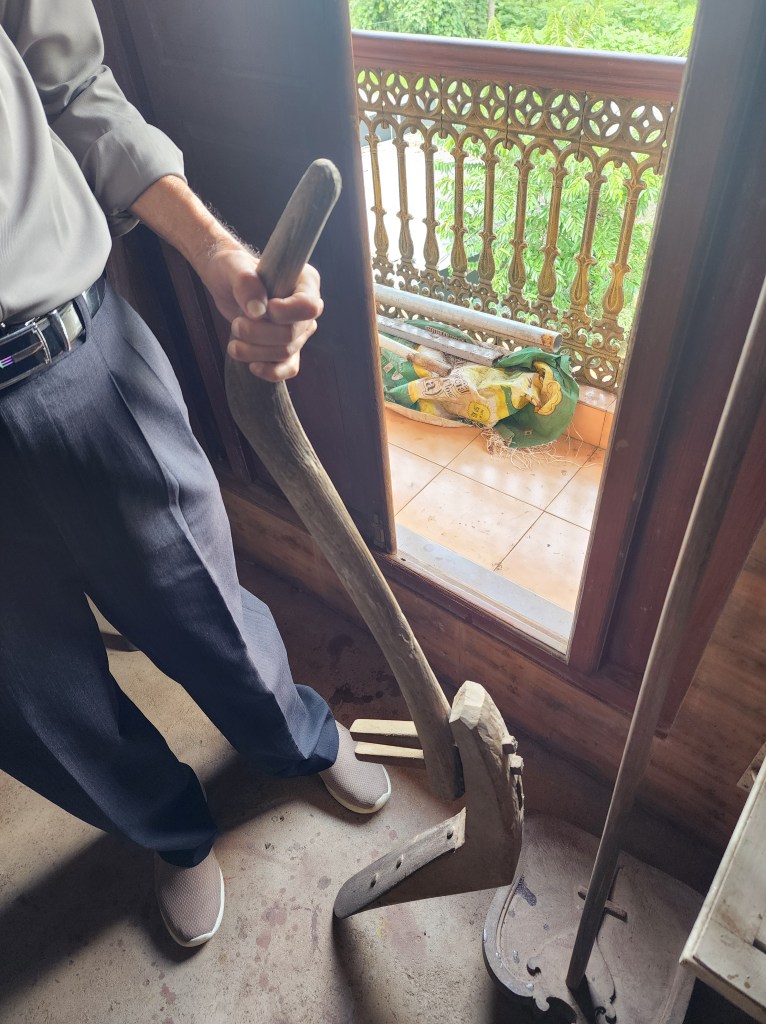
A small traditional plough on display at the Kumarakon Heritage Museum, Vembanad, Kerala.

Balarama wielding a plough is seen in multiple interpretations. The oldest is perhaps a coin issued by Agathocles, an Indo-Greek king from northwestern India in the 2nd century BCE. An image of Balarama, also called Sankarshana is seen in the image below.
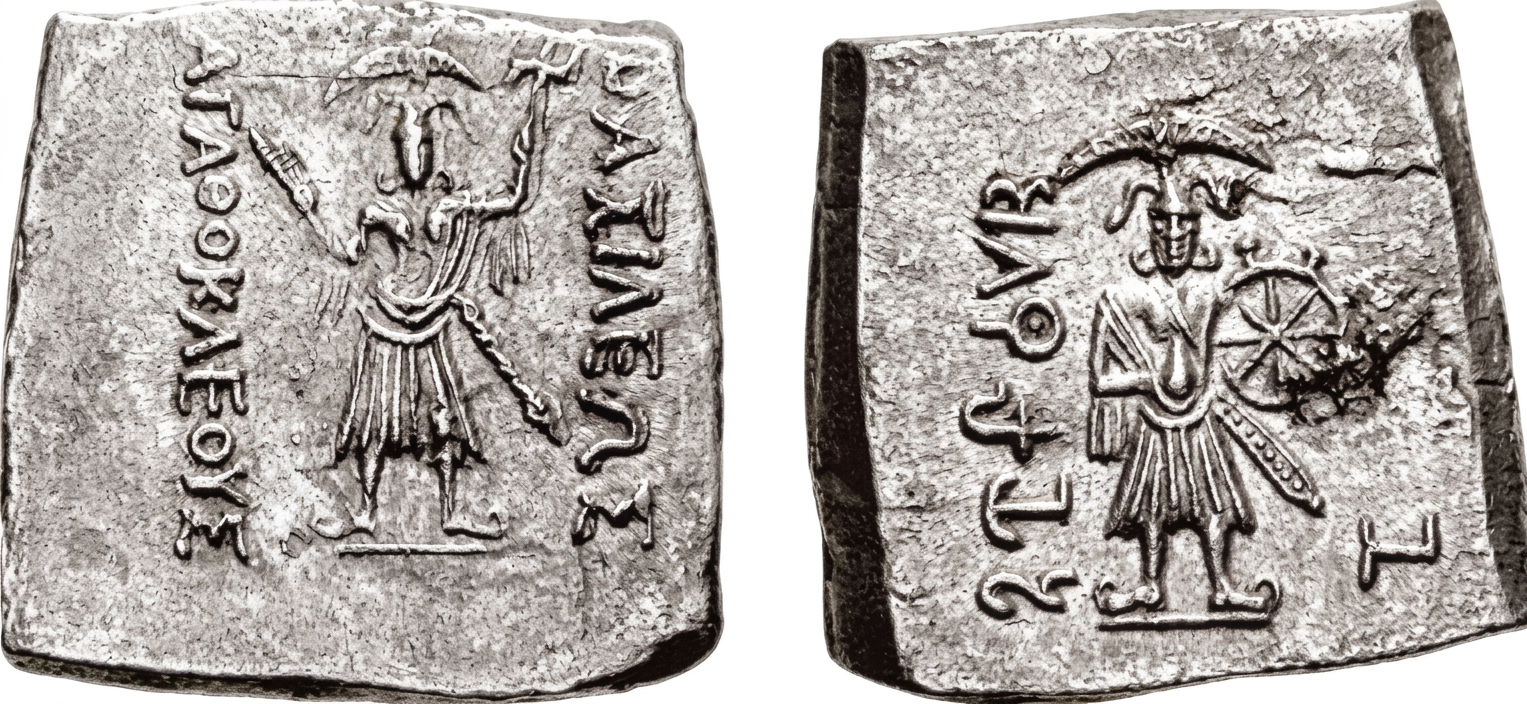
A coin from around 190 BCE, issued by Agathokles of the Indo-Greek Kingdom. The image on the left shows Balarama or Sankarshana. In his right hand, Balarama is holding aloft the plough. The image on the right depicts Lord Krishna. There two images are on two sides of the same coin. Image credit – Wikipedia.

Here, the plough is held in Balarama’s right hand. It is not a large weapon. It is not dissimilar in size from a modern-day hammer that exists in tool kits in many homes to this day. But modern interpretations show the plough being a large weapon. One such interpretation is from the Mahabharata published by Amar Chitra Katha in the 1980s. This interpretation is seen in the image below.
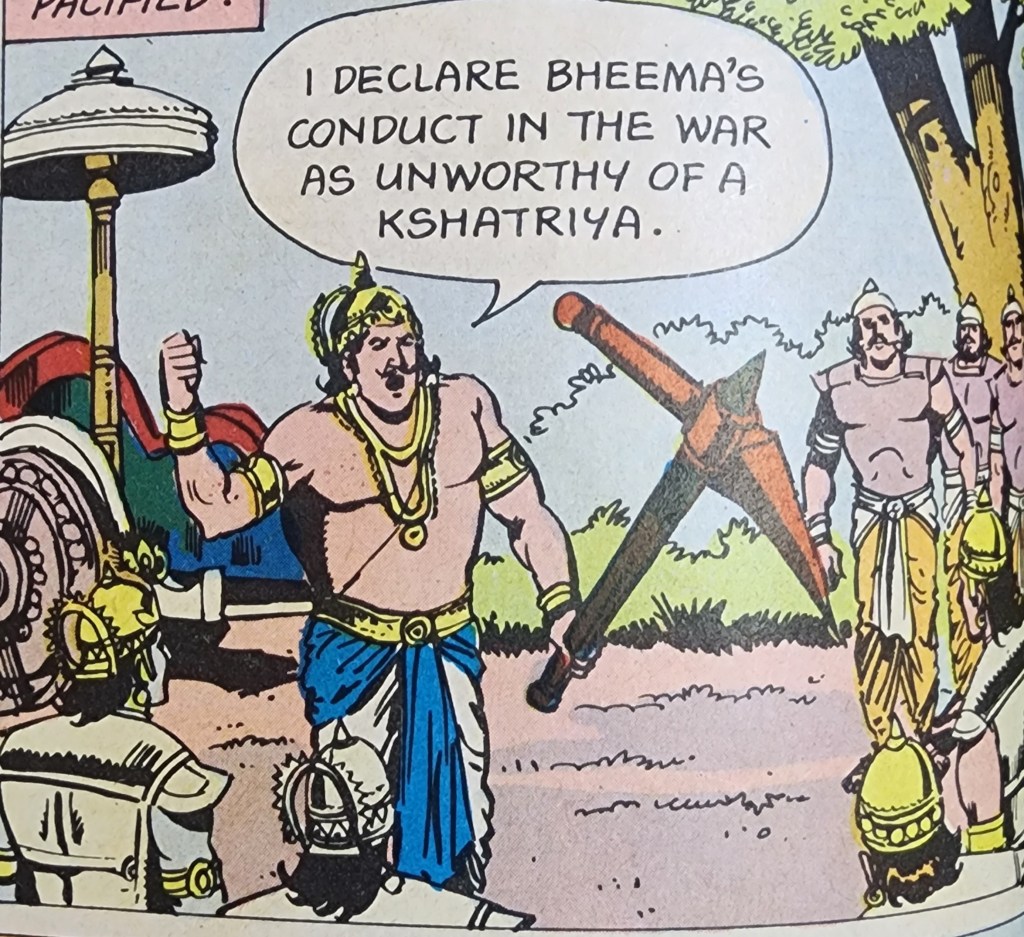
Balarama shown wielding a large plough as a weapon. Image credit – “Mahabharata 39 – After the War”, published by Amar Chitra Katha.

In the depiction of Balarama from the Sasbahu temple in Nagda, Rajasthan seen earlier, both the plough and the musala are seen as either short or medium sized weapons at best. The musala is called the “onake” or “vonake” in Kannada. It is a large pestle that was used to grind grains into flour.

These came in multiple sizes, from about 2 to 4 feet in length. The diameter is between 2 and 3 inches. This would correspond with a Jo or an Ojo in Bujinkan parlance. The Jo and Ojo are both staffs that are about 4 feet in length, with the Jo having a diameter of about an inch and the Ojo being larger, 2 inches or more.

The musala or onake could taper from the grinding end to the end handled by the user. With this design feature, the staff starts to resemble a club. And the mace is an evolution of the club. So, Balarama being depicted with a musala and being an ace wielder of the mace could be considered the same or at least an evolution of the depiction of the same martial skill set.

Can the depiction of Balarama with a plough and a musala be a representation of his creation (agriculture through the plough) and destruction (destruction with the mace) being two sides of the same coin? I have no idea.

I had written an article last year, detailing the extraordinary action of “Onake Obavva”. Obavva is a hero for the people of Karnataka. She used an onake/musala/pestle and fought off the army of Hyder Ali until help arrived during the late. She lost her life in the process. This event is from the 18th century. I had also shared videos with the article depicting modern day women wielding a jo and ojo. A link to this article is seen below. Do refer to the same for more information about the pestle as a weapon. Now we return to Lord Balarama.

Balarama was a great warrior. He, in conjunction with his brother Krishna was responsible for holding off the armies of Jarasandha 18 times, when Mathura was invaded repeatedly. Even as a child, he killed the Asuras Dhenuka and Pralamba. He killed the mighty wrestlers Mushtika and Koota in Kamsa’s arena as a young man.
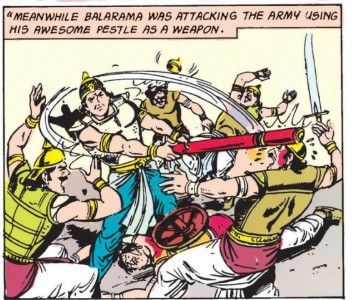
Balarama depicted using the Musala/Pestle against Jarasandha’s forces. Image credit – “The Bhagavata, Special Edition” (Kindle version), published by Amar Chitra Katha.

Later in his life he is said to have killed the mighty Vānara Dwivida. Dwivida was supposedly a part of the Vānara army that fought at Lanka during the Ramayana and a friend of Narakāsura, who was killed by Lord Krishna. Balarama is also supposed to have killed Rukmi, the King of Vidarbha, who was Krishna’s brother-in-law.
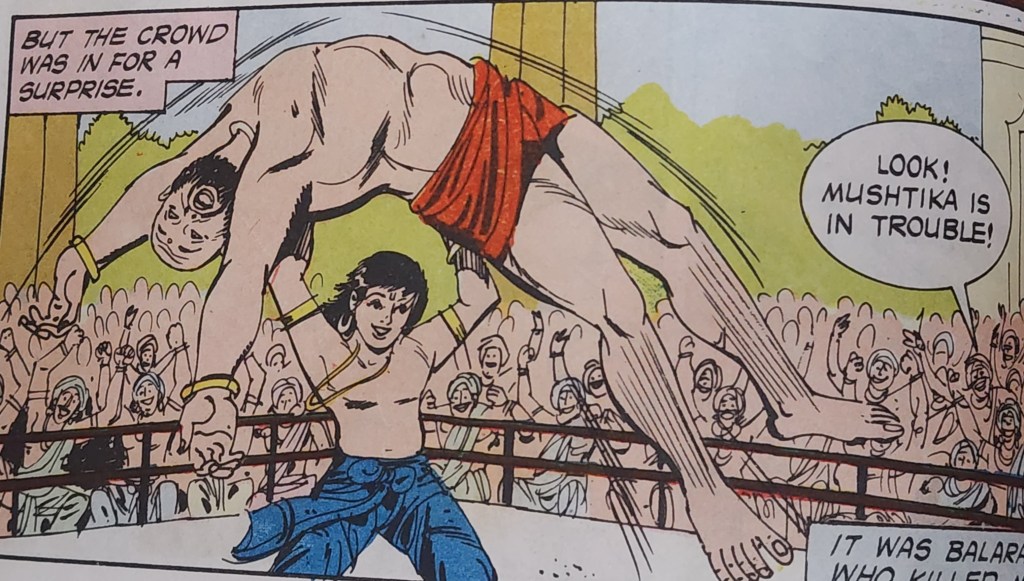
Balarama depicted defeating Mushtika. Image credit – “Tales of Krishna”, published by Amar Chitra Katha.

Balarama, from most depictions was a large and powerful individual. This in turn lends credence to his being an ace wrestler. Balarama killed Pralamba while being carried on the latter’s back. This could be imagined to be Balarama applying a lock on the upper body of Pralamba while choking him to death. Also, Mushtika was a dreaded wrestler who was killed in the ring in a fight with wrestling rules! Strikes were allowed in these wrestling matches; they were not purely restricted to grappling.
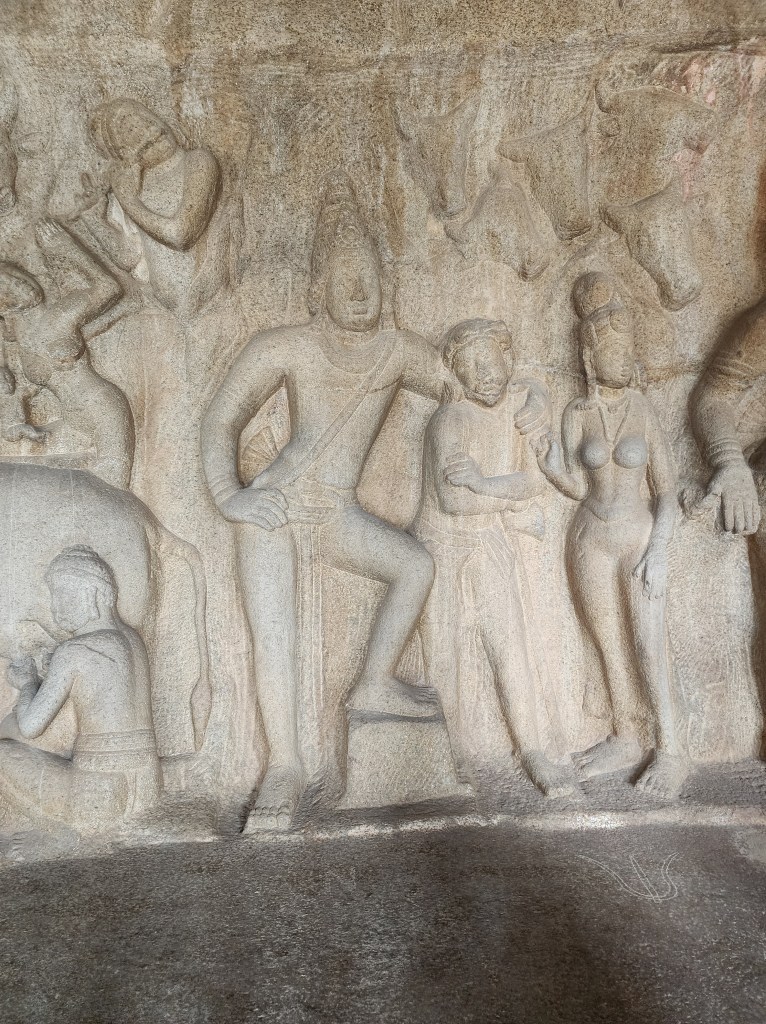
Balarma shown with a village chieftain in the Krishna Mandapam, Mahabalipuram, Tamil Nadu. Obser how Balarama is depicted as a much larger individual compared to those around him. Also, the person on whose shoulders Balarama has put his arm is depicted as being humbled at the casual gesture from the great man.

The image above shows how much larger than the regular citizens Balarama is shown to be. Of course, it could be that the size difference is showing the huge difference in the social standing of the individuals or the divine aspect of Balarama. The greater size could imply greater importance or divinity the individual. But considering the other known aspects of Balarama’s life, the size could be attributed to his strength and chosen warrior skills.

I would suspect Balarama was a great hunter as well. The Asura Dhenuka was killed while he was in the form of a donkey. Balarama was also supposed to have helped Krishna kill an elephant by the name of Kuvalayapeeda.
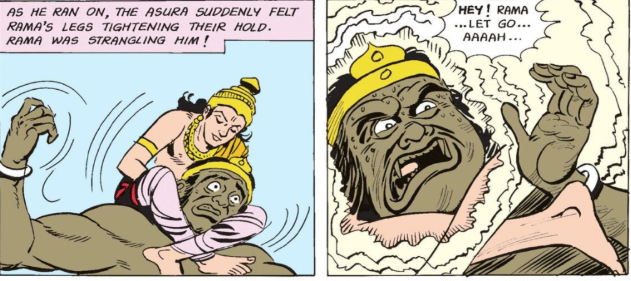
Balarama defeats the Asura Pralamba. Image credit – “The Bhagavata, Special Edition” (Kindle version), published by Amar Chitra Katha.

While fighting the armies of Jarasandha, Balarama used all the weapons a warrior of his class used in that era. He was proficient with the use of the bow and arrows as well. But his weapon of choice on the battlefield and his specialization was with the gada, or mace.
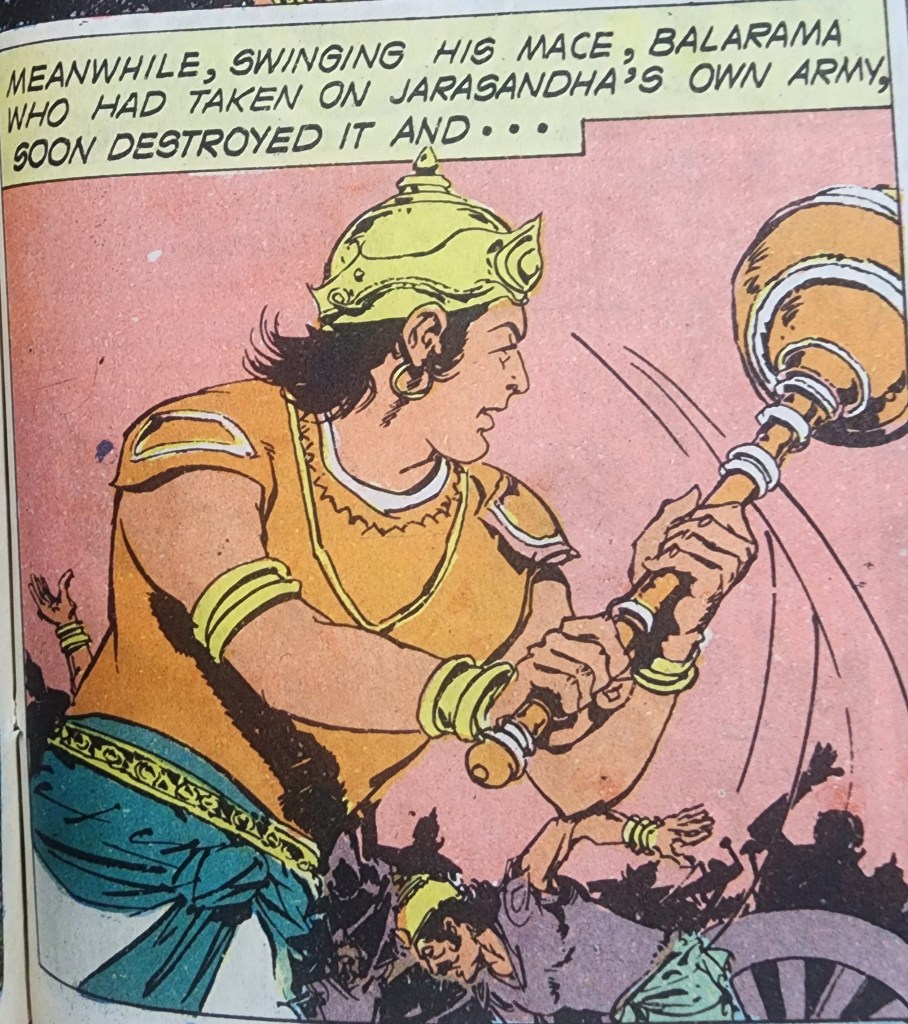
Balarama depicted using the Gada/Mace against Jarasandha’s forces. Image credit – “Krishna and Jarasandha”, published by Amar Chitra Katha.

As mentioned earlier, he was a mentor to both Bheema and Duryodhana in the art of mace fighting. The fact that his students were on opposite sides of the Kurukshetra War and that Krishna was not using weapons, were what resulted in his abstaining from the fighting in the great war.
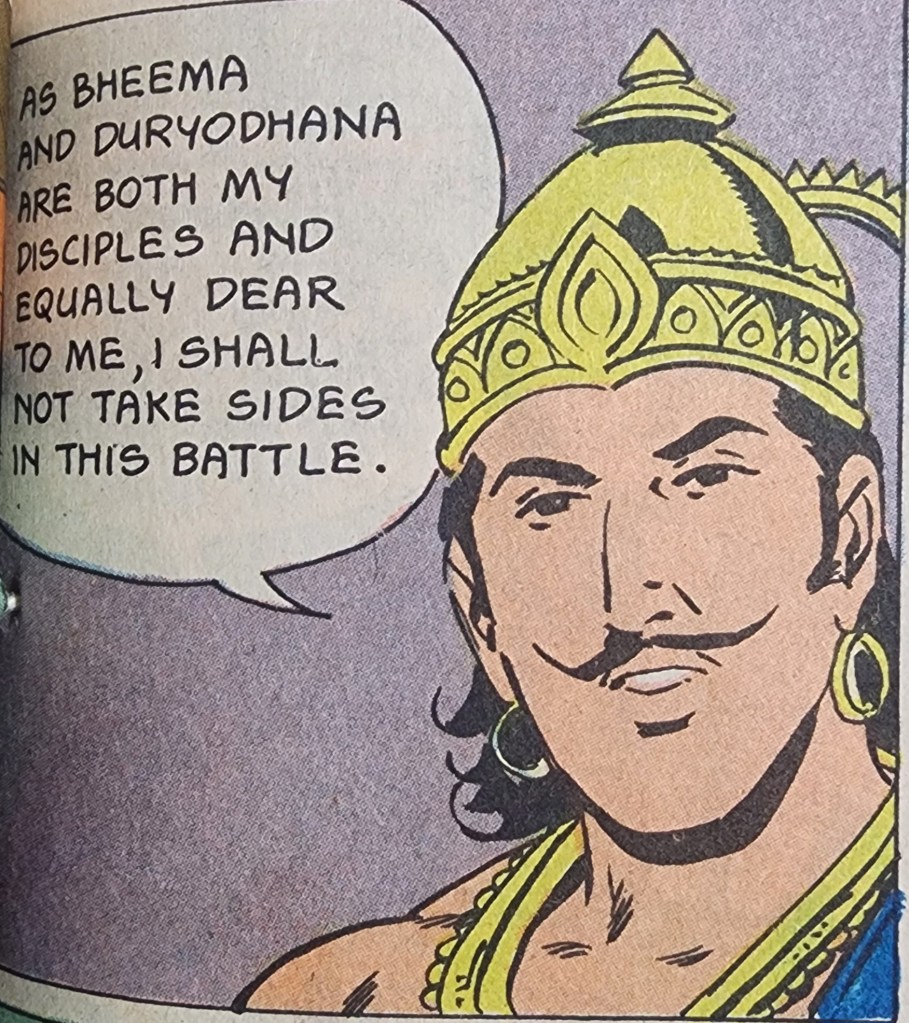
Balarama chooses to not participate in the Kurukshetra War. Image credit – “Mahabharata 27 – Sanjaya’s Mission”, published by Amar Chitra Katha.

This brings us to the plough being associated with Balarama. I have not heard of any description of how he used the plough in a fight, in any of the many conflicts he was involved with. So, I will use article to explore how the plough could have been a weapon or at least modified into one.

The plough is a tool that has a “head”, the ploughshare, that is at an angle of between 45 and 90 (or a little more) degrees to the shaft. To repeat myself, if one observes the plough depicted on the Agathocles coin and on the carving from Nagda, it is not a large weapon. It is either a short or medium sized weapon, that can be used in one hand.

One weapon from Japanese history that comes close to the form factor of a plough, is an agricultural implement that doubled as a weapon which was used in one hand, is the Kama. It is a sickle that was used as a weapon in the past.
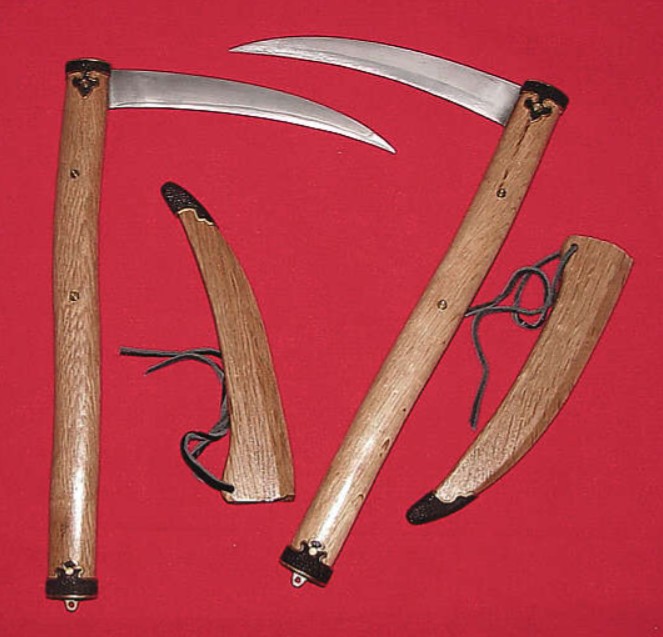
A pair of Kama. Image credit – Wikipedia.
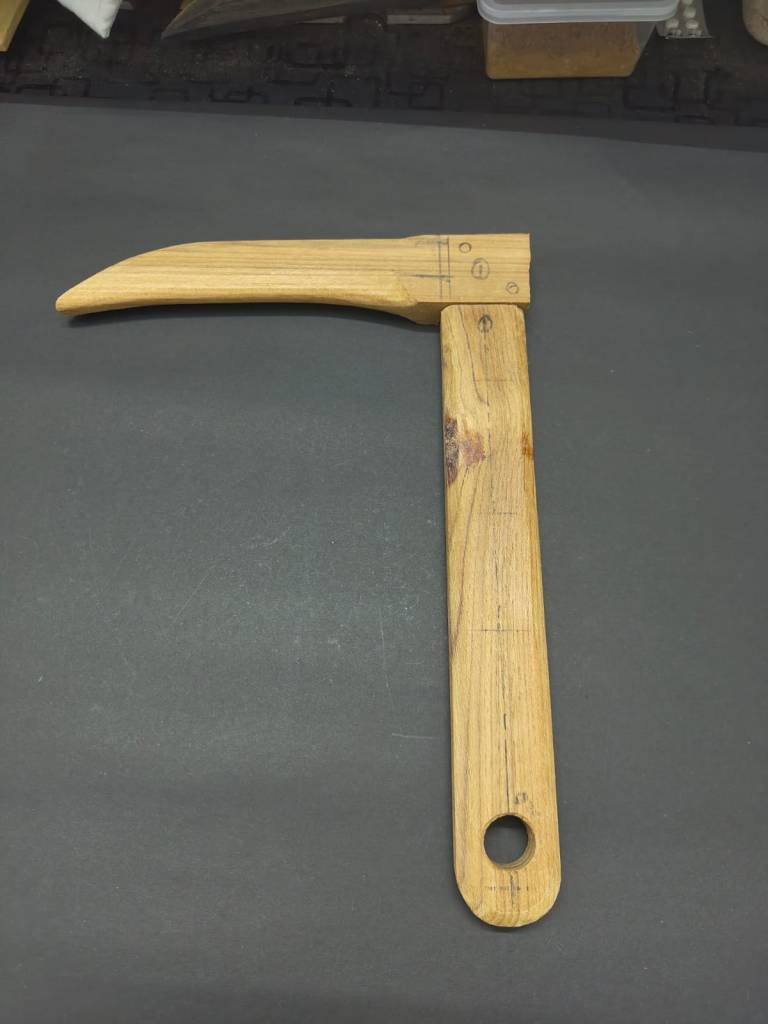
A training version of the Kama. This trainer was made and photographed by Siddharth Sahu.

The Kama was combined with a chain and a weight at the end of said chain. This combination of weapons was called the Kusarigama (Kusari – chain, Kama – sickle). The chain and weight were used for ranged attacks and also to distract or deter opponents. The Kama came into action at close quarters while the chain could also be used to immobilize opponents if the opportunity presented itself.
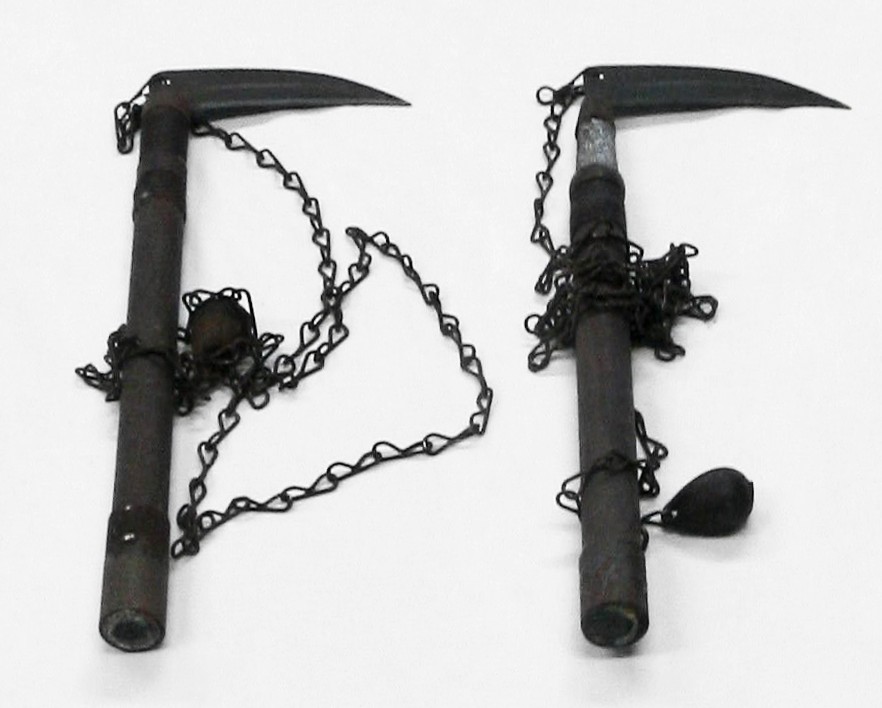
A pair of Kusarigama. Observe the chain (kusari) and bulbous weight (fundo) attached to the Kama. Image credit – Wikipedia.

Observe all the versions of the Kama from the 3 images seen above. The blade is roughly at a right angle to the shaft, similar to the plough. Now observe the artistic depiction of the plough in the image below. The plough depicted is very large, but the form is very similar to that of the Kama.
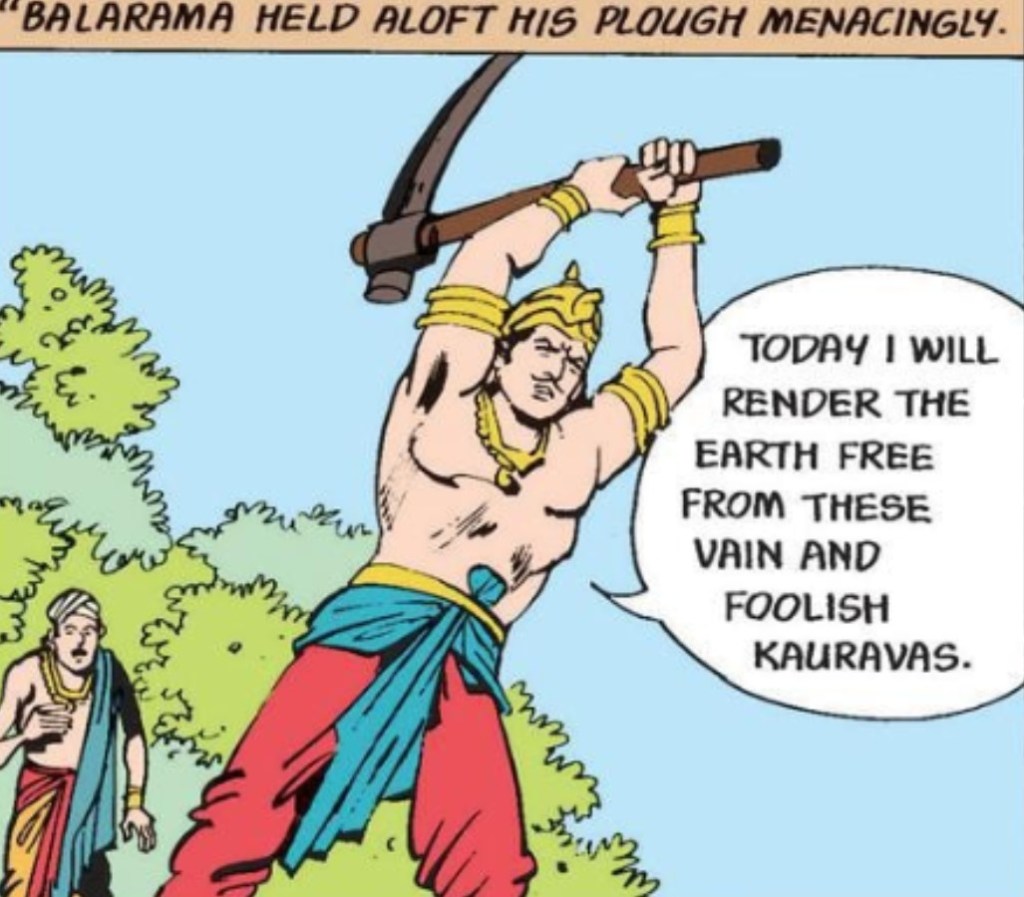
Balarama depicted using a plough that looks like a very large Kama! Image credit – “The Bhagavata, Special Edition” (Kindle version), published by Amar Chitra Katha.

A weapon used across India, Persia and Europe is the past, that was similar in shape to the Kama and therefore the plough is the Crow’s Beak axe. This of course, was always a weapon and never an agricultural tool. The Crow’s Beak was useful against chainmail armour and to a limited extend against plate armour.
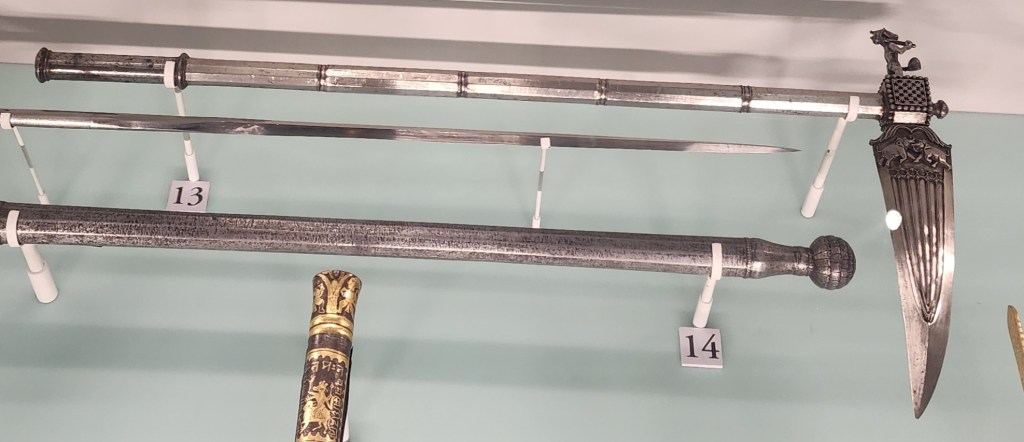
A Crow’s Beak axe, on display at the City Palace Museum, Udaipur, Rajasthan. Observe the incredible artistry on this weapon. Two elephats are depicted fighting at the base of the blade and Lord Hanuman himself is seen standing on the back!
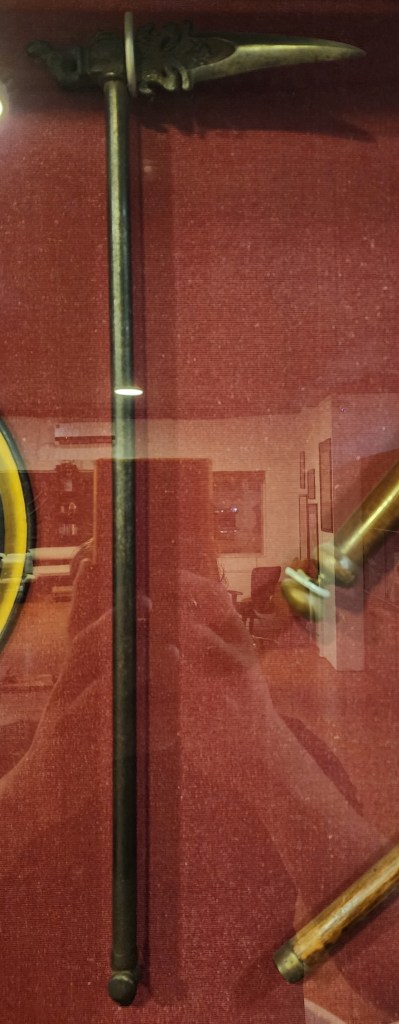
A Crow’s Beak axe on display at a dojo.
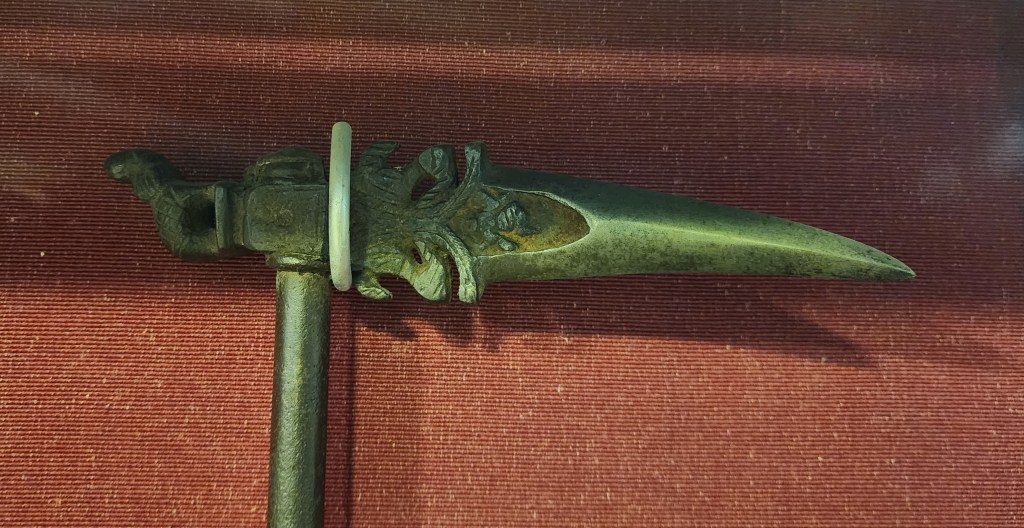
This is a closeup of the head of the Crow’s Beak from the previous image.

Now observe the image seen below. It is a closeup of the first image in this article. It is a modern-day depiction of Balaram in the style of ancient carvings. Here, Balarama wields the plough behind his head in his right hand and the club in his left hand. The plough is held like one would hold a Crow’s Beak axe while striking an opponent. The plough is indicated by the white arrow for clarity.
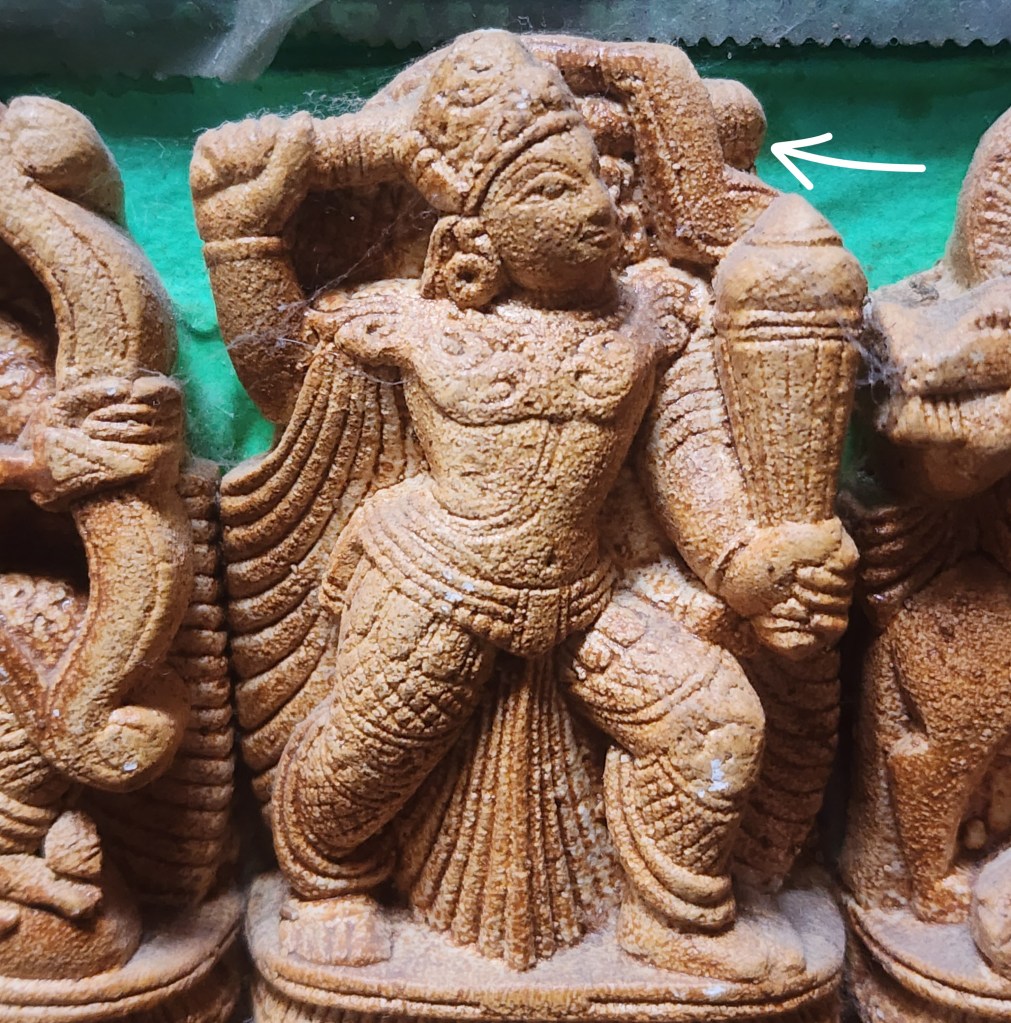
Balarama seen wielding the plough like an axe, in his right hand, while he holds a club in his left hand. The plough is indicated with the white arrow.

Considering this similarity to an axe, it must be noted that the depictions of the plough resemble two modern day tools. One is the modern-day Ice Axe, which resembles a plough due to the axe resembling the ploughshare in its angle to the shaft and the adze resembling the other part of the ploughshare, that farmers use to guide the plough in the right direction.
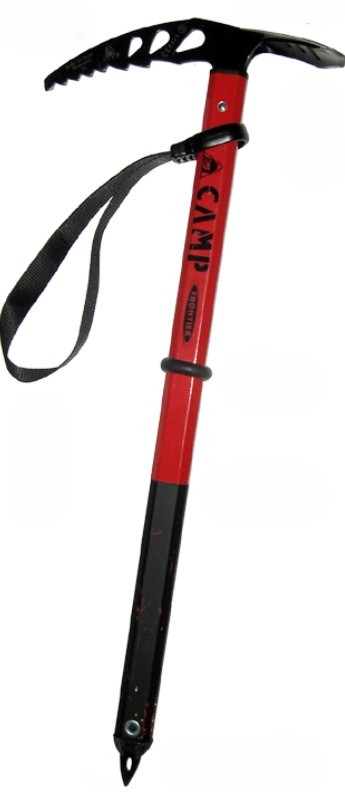
An Ice Axe. Image credit – Wikipedia.

The other modern-day tool is the Geologist’s Hammer. This tool has a point or an adze on one side and the other side of the hammerhead is a regular hammer. Observe the image below and the similarity in the form factor will be obvious.
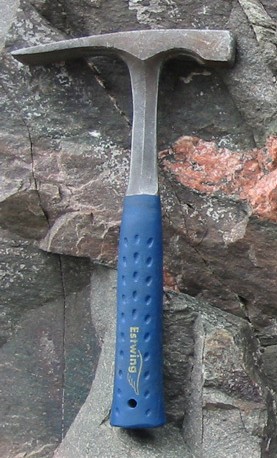
A Geologist’s Hammer. Image credit – Wikipedia.

Now observe the historical tool or weapon seen in the image below. It is a one handed two headed axe which resembles both the Ice Axe and the Geologist’s Hammer! Further, it has a recognizable axe head on one side and a short sickle head similar to that of a Kama on the other side! 😊
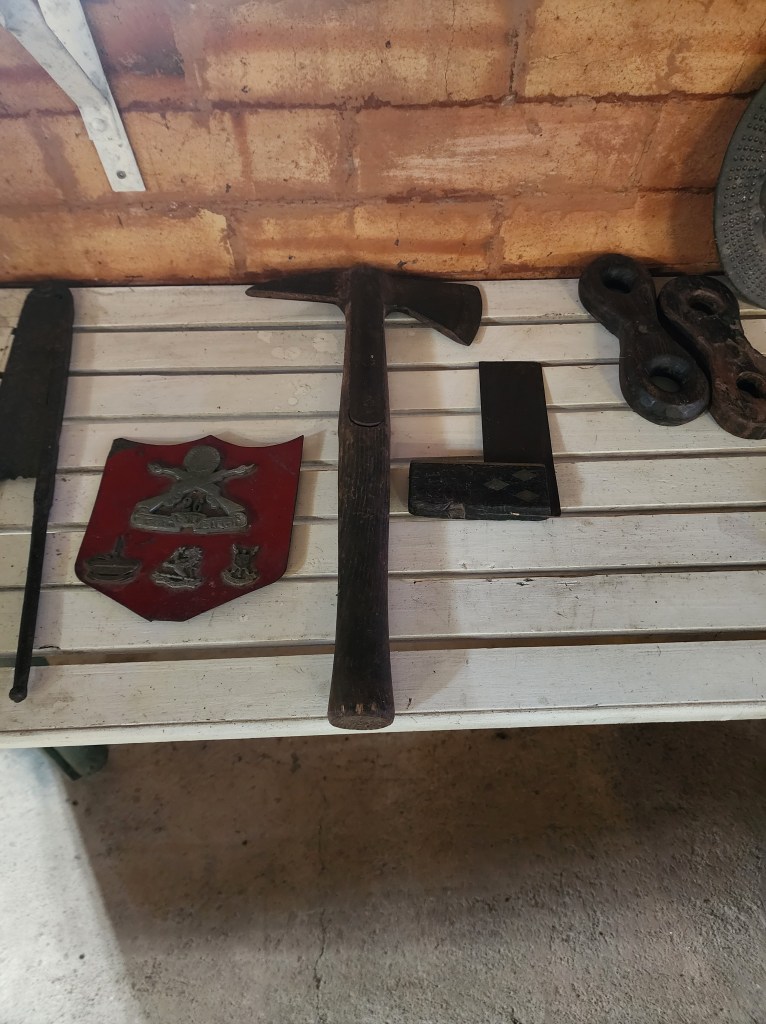
A two-headed axe, with a normal axe head on the right and a kama sickle blade on the left. This specimen is on display at the Kumarakom Heritage Museum, Vembanad, Kerala.

Now, once again look closely at the plough depicted in the right hand of Balarama in the ancient coin. It looks very similar to another tool which also doubled up as a weapon from Indian history! I am referring to the Ankusha or the elephant goad. The Ankusha is the weapon of choice for Lord Vayu, the God of the Wind and the Guardian of the Norwest.

In the image below, ignore the axe and the spearhead. The hook attached to a shaft is the Ankusha in its basic form. This is very similar to the depiction of the plough in the coin! This weapon, while combined with a spearhead or an axe or both was used in Indian history. The Ankusha was useful in hooking & deflecting weapons, shields and the limbs of opponents when necessary.
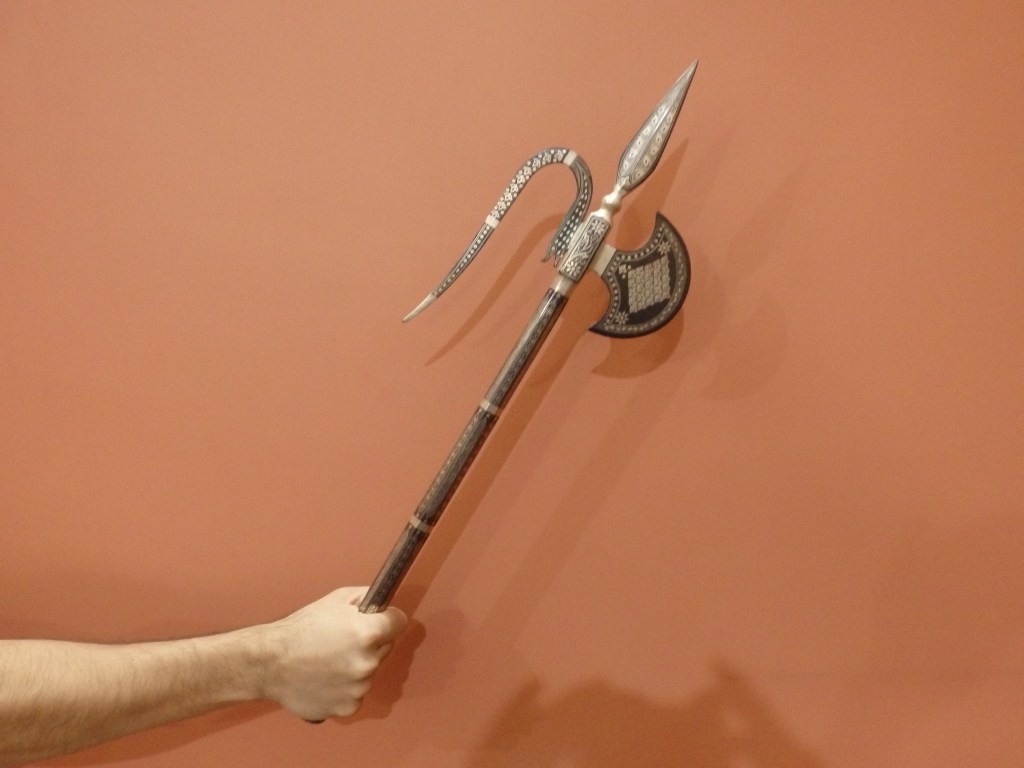
An Ankusha. Ignore the spearhead at the tip and the axe head. The hook with the shaft depicts a basic Ankusha. If one looks closely at the plough held in Balarama’s right hand on the coin seen earlier in this article, it looks remarkably similar to an Ankusha!

If we are speaking of an Ankusha and the plough can be held as an axe, we must mention the Bearded Axe. This is an axe that somewhat combines the utility of an axe and an Ankusha. The axe head delivers the blows while the “beard” of the axe head enables hooking weapons and the limbs of opponents. The shape of the axe head of a Bearded Axe, as seen in the image below indicates how an axe head could be constructed to function similarly to an Ankusha.
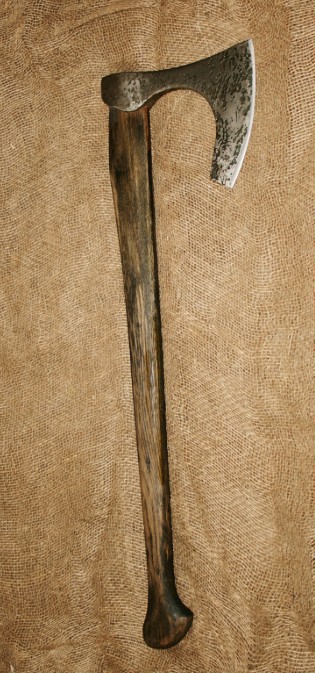
A Bearded Axe. Observe that the axe head also resembles the hook in the Ankusha in its form. Image credit – Wikimedia Commons.

Let’s now flip the plough, the smaller versions of course, that are depicted in Balarama’s hands. Imagine holding the plough depicted on the ancient coin, where the ploughshare is held near the fist and the shaft extends out beyond that. One could imagine this as the Ankusha from the image above held in reverse, with the spearhead being the handle. There did indeed exist such a weapon in Japan in the late 19th and early 20th centuries.

This was the Jutte. It was weapon issued to police officers in Japan when swords had been outlawed after the Meiji Restoration. The “hook” worked to catch/stop swords and redirect the attack. The protruding shaft made of metal worked efficiently as a club when necessary.
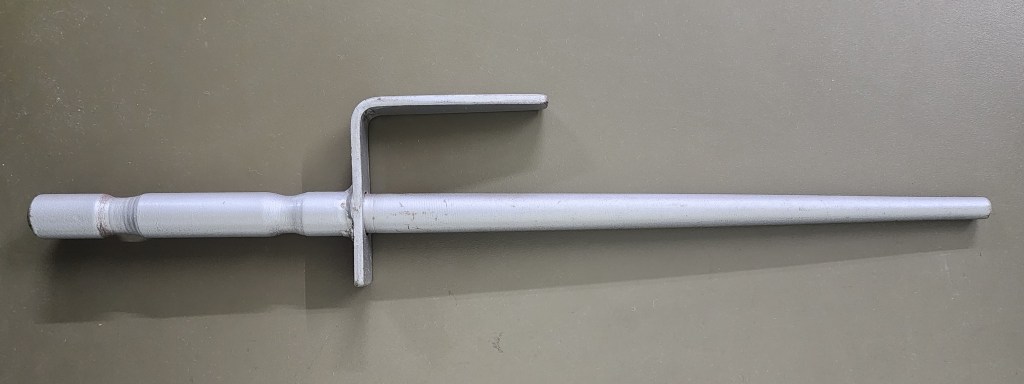
A training version of the Jutte. Observe that the slot looks similar to the hook on an Ankusha. This weapon is essentially a reversed Ankusha! Thus, it could be considered, in shape and form, a reversed plough as well!

Now let us get back to modern depictions of Balarama wielding a large plough. In the image below, while fighting the afore mentioned Vānara Dwivida, Balarama is depicted dual wielding a large pestle and a large plough! Imagine the strength that would require!
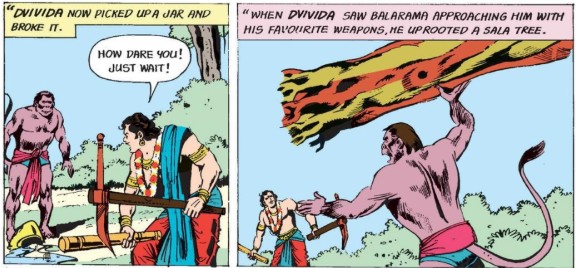
Balarama depicted dual wielding! With the plough and the pestle in each hand! Imagine the strength and skill needed to pull this off! :-) Image credit – “The Bhagavata, Special Edition” (Kindle version), published by Amar Chitra Katha.

A tool that would resemble a large plough in form factor, if not in weight is the Scythe. This again, is an agricultural tool with a large sickle blade. The blade seems like an oversized blade of a Kama from Japan. This tool is also commonly associated with depictions of the Grim Reaper, who symbolizes death.
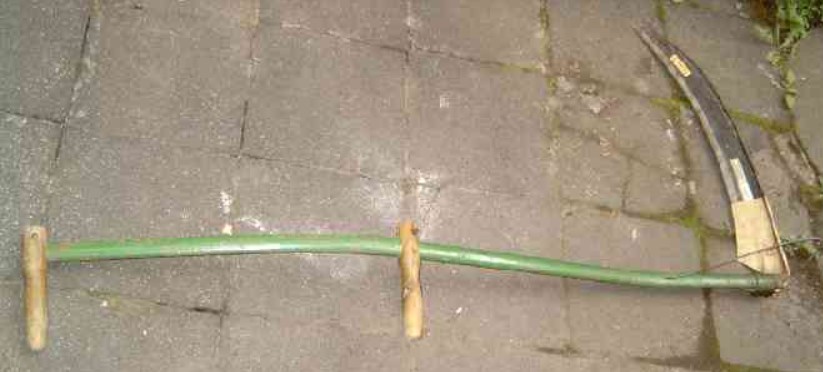
A Scythe. Image credit – Wikipedia.

While the Scythe in its original form might not have ever been used as a weapon, there existed a weaponized version called the “War Scythe”. This was a polearm with the blade turned up 90 degrees, to be parallel to the shaft rather than the usual perpendicular. This weapon, interestingly, leads us back to Japanese weapons from history. The War Scythe resembles the Naginata, which was itself a version of a glaive. The Naginata has a short blade on top of a long shaft. The difference though is that the Naginata has the sharp edge on the outer side of the curve of the blade, while the War Scythe has the same on the inner side of the curve of the blade, just like with a normal scythe.
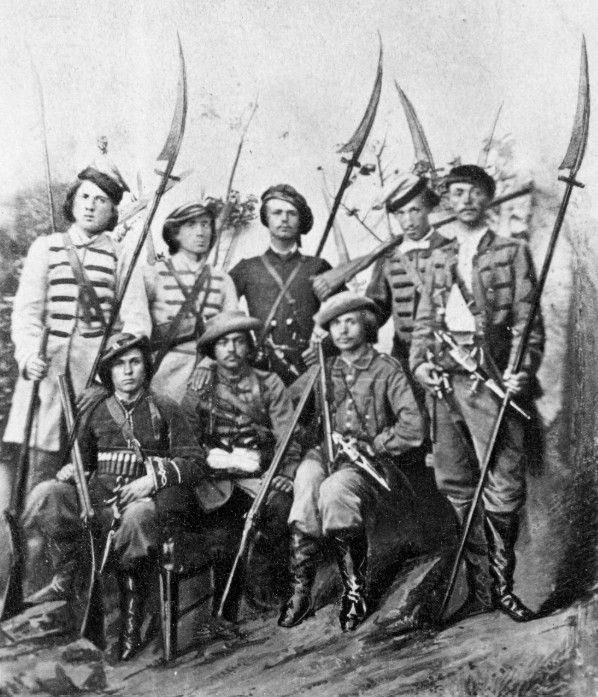
Troops from the Polish Lithuanian Commonwealth seen with their “War Scythes” in the mid-19th century. Image credit – Wikipedia.

I have no idea if Balarama ever used the plough like the weapons I described, but it is still worth considering, for warriors of the past, like their modern-day counterparts, could wield multiple weapons expertly, even if they had personal favourites among the tools of war. It would also not be wrong to presume that weapon designs borrowed from tools and warriors could adapt from one to the other as needed.

This concludes this article where I have tried to restrict myself to the martial aspects of Balarama that I could recollect. Balarama’s life is fascinating in many ways beyond his martial abilities. His marriage to Revathi has a sci-fi element to it, with time dilation being involved! Further, the pestle/musala/club/onake, while being a favourite weapon of Balarama’s, ended up being the implement responsible for the destruction of his entire clan! The Vrishni clan of the Yadavas literally self-destructed by killing each other with pestles! But these are points beyond the martial arts, at least for now.
The Bujinkan schools from an Indian perspective – Terrain, People & Evolution – Part 2

This post is the second part of a 2-part series. The link to the first part is seen below.

I would encourage everyone to read both parts. However, if you are here, there is no need to read part one before coming to this post. To enable this, I am sharing the introduction to this series, which is also seen with part 1, below. This gives a reader a fair idea to go ahead with this post and visit part 1 later.

Over the years of training the Bujinkan system of martial arts, one will invariably study the different schools that form a part of the system. There are 9 schools that the Bujinkan is comprised of. Of the 9 schools, 6 are practiced regularly in dojos around the world. These 6 schools are mentioned below.

  • Togakure Ryu
  • Gyokko Ryu
  • Koto Ryu
  • Shinden Fudo Ryu
  • Kukishinden Ryu
  • Takagi Yoshin Ryu

When we train each of these schools, we learn the evolution of these schools. This consists of the conditions in which these schools had their origin and how they evolved over the years. The origin of the schools pertains to a region and its geography.

As an Indian, the terrain in different regions of Japan, where these schools had their origin and evolution, does not come to mind immediately. But the geography and climate which influenced and perhaps defined the schools for a very long period of time is important. To perhaps alleviate this issue, I am writing this post.

I will share images and examples from Indian history which are rough approximations of the geography and physical conditions in which the 6 schools mentioned above were created and evolved over time.

In Jan 2025, I had written a more detailed post about the schools form a part of the Bujinkan system of martial arts. The link to this post is seen below. Do refer to this link for more information about the schools.

We had looked at the Togakure Ryu, the Gyokko Ryu and the Takagi Yoshin Ryu in part 1, the link to which is seen above. We will look at the remaining 3 schools in this post.

KOTO RYU

The Koto Ryu is a sister school of the Gyokko Ryu (which we looked at in the previous part) in some ways. Over the course of history students from the two schools have been handed over the responsibility of the Soke (Inheritor – Grandmaster) for the other when there was a need. Gyokko Ryu is an expression of Kosshi Jutsu whereas Koto Ryu is an expression of Koppo Jutsu.

The Koto Ryu is not necessarily specialized towards close-quarters combat. It favours slightly greater distances between opponents, a “middle distance” if you will. The Koto Ryu also favours individuals moving in and out of the range of opponents. The distances change from short to long alternatively and as necessary. This is not unlike fighting with sword and shield. The use of the sword takes one closer to an opponent while defending with a shield allows one to move out of the range of an opponent’s attack.

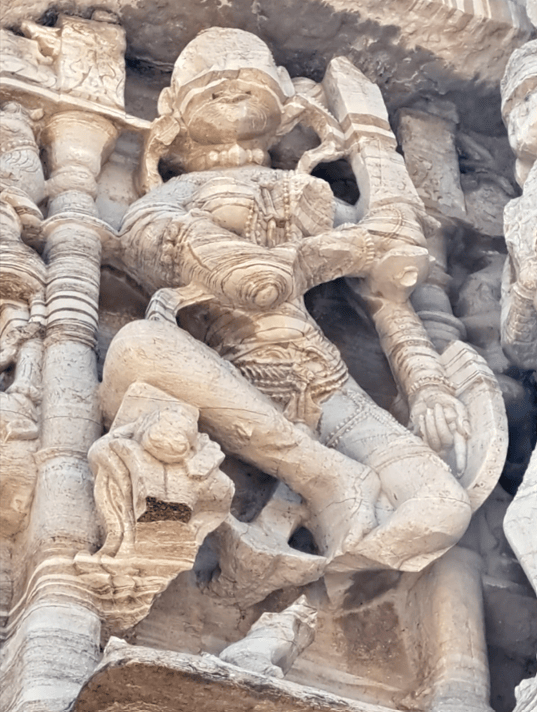
The above image shows a woman wielding a sword and a shield. This is a carving that is present on the Keerthi Sthamb (Tower of Glory) in the Chittorgarh Fort in Rajasthan. This lady is wielding a short sword. So, her fighting style could be relatable to the Koto Ryu, even if this school does not specify the weapons to be used. As someone wielding a short sword and a shield, she would dart in and out of the range of an opponent, for attack and defence, movement which is emblematic of the Koto Ryu.

KUKISHINDEN RYU

The Kukishinden Ryu, based on what I have learnt, is characterized today by arms and armour. Quite some weapons we train in the Bujinkan these days come from the Kukishinden Ryu. Supposedly, a lot of the techniques in the Kukishinden Ryu are descended from situations where the opponents used armour to protect themselves. The methods used to put an opponent at a disadvantage when she or he is protected in armour differ from when opponents are unarmoured.

The Kukishinden Ryu is also supposed to have a heritage of use at sea. Sailors are supposed to have used the Kukishinden Ryu on ships, or large boats in the past. This included pirates and naval troops. This is not to say that the Kukishinden Ryu was not applied on land. I have never seen this school be practiced in modern day on boats. This aspect, while discussed, does not overly inform the manner in which the school is practiced.

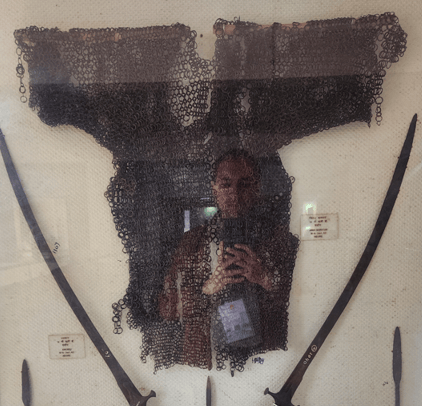
The above image shows a chainmail shirt displayed in the State Museum in Bhopal, Madhya Pradesh. This is perhaps the most commonly used form of armour over several centuries across most of Eurasia. The protection chainmail provided against cuts and slashes affected the way soldiers moved since they could ignore attacks that were purely cuts. This armour did not give the same degree of protection against thrusting attacks.

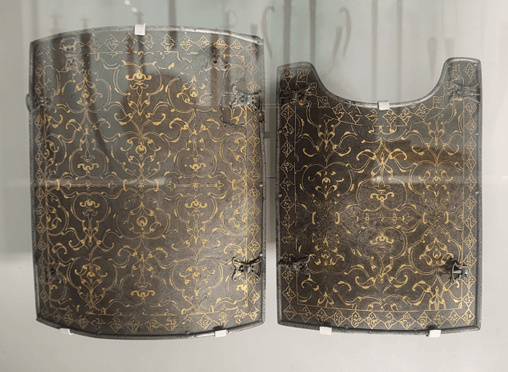
The above image shows the plates worn by soldiers on top of chainmail shirts. These were worn on the front over the chest and on the back. This display is from the City Palace Museum in Udaipur, Rajasthan. These plates added protection against thrusts in addition to the protection against cuts that chainmail afforded.

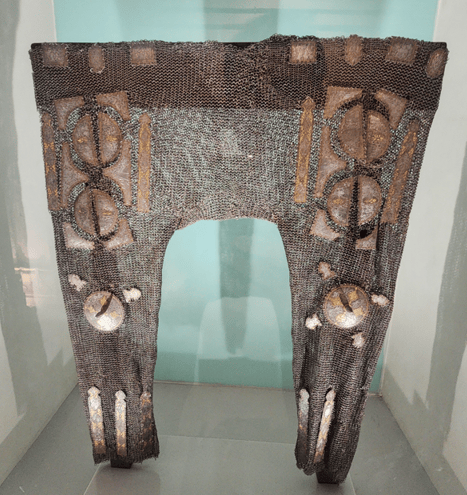
This image shows chainmail leggings which also have plates for added protection. These are also displayed in the City Palace Museum, Udaipur, Rajasthan. Observe the round plates over the knees. The have wicked spikes! I wonder if kneeing an opponent with the spikes was a good idea though. If the kick is against an unarmoured part of an opponent, it would be effective. But if it was against armour, the damage would not be great.

The chance of the spike getting caught in the opponent’s armour or causing pain to the one kicking needs to be considered, before concluding that spike was a smart addition! Also, could it have been placed there for a psychological advantage over an opponent? For it looked scarier than it was effective? I guess that is food for thought.

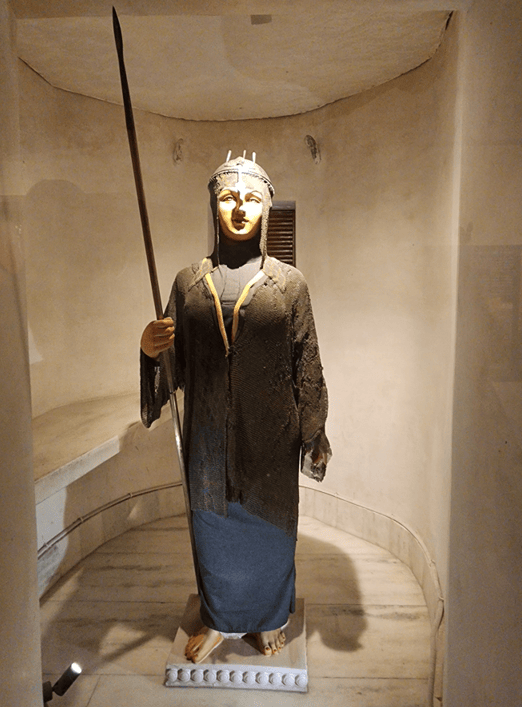
This image is also from the City Palace Museum, Udaipur, Rajasthan. It shows a female guard of the women’s quarters (Zenana Mahal). This guard is armed with a chainmail shirt, helmet and a spear. These guards, as discussed with another image in the section for the Gyokko Ryu, also used swords, shields, daggers and early firearms. The spear forms practiced in the Bujinkan also have their roots in the Kukishinden Ryu. In a way, this image captures very well the essence of the Kukishinden Ryu, weapons and armour.

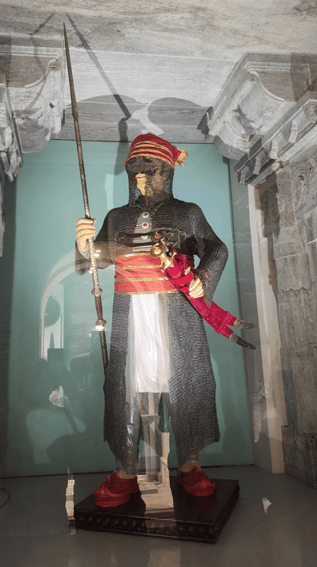
This image shows some arms and the armour used by Maharana Pratap. Pratap is perhaps the most famous ruler of Mewar and among the best-known warriors of historical India. In this display he is seen with a chainmail surcoat on top of a set of overlapping plates over his chest. The chainmail is fastened with a cummerbund.

Also seen in the image are his famous twin swords and spear, which was supposedly his favourite weapon. This display is also from the City Palace Museum in Udaipur, Rajasthan. The Kukishinden Ryu also has its own school of sword fighting. The kind of kit seen in this image is what would have been emblematic of elite warriors in India in the 16th century, which corresponds to the Sengoku period in Japan. This era was the high noon of mediaeval combat in Japan.

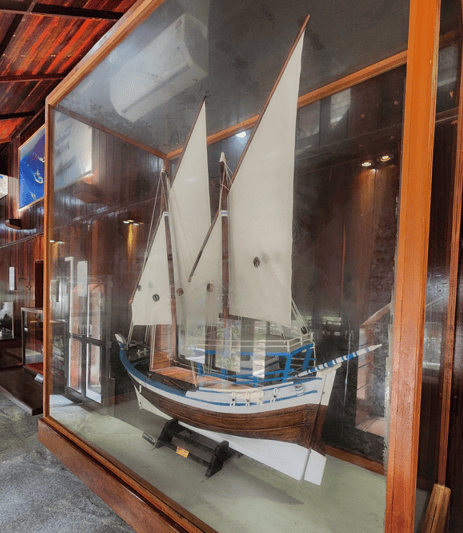
The above image shows a “Toothkudi Ship”. The image is from the Maritime Heritage Museum, Mahabalipuram, Tamil Nadu. This was a type of ship used historically on the East Coast of India.

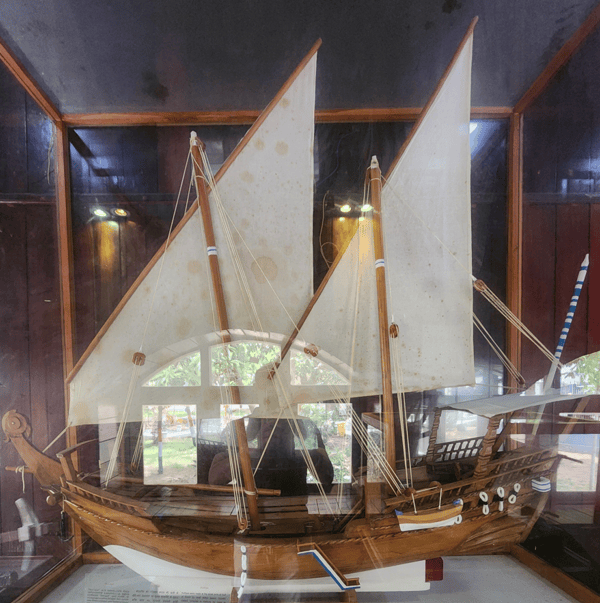
This image shows a “Kottiya”. This image is also from the Maritime Heritage Museum, Mahabalipuram, Tamil Nadu. This was a type of ship used historically on the West Coast of India.

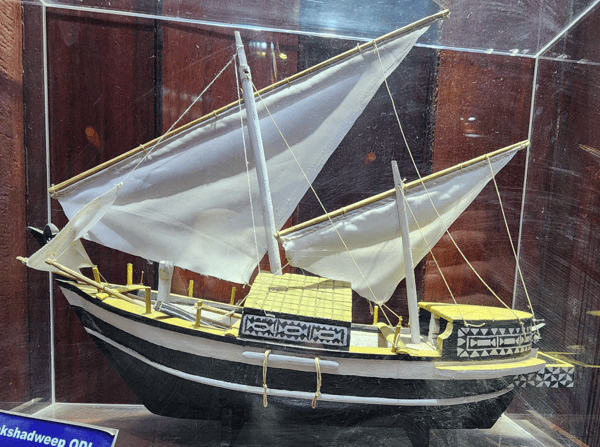
This image shows a model of a “Lakshadweep Odi”. The image is also from the Maritime Heritage Museum. This was a type of ship used historically on the on the Southwestern coast of India.

All the 3 types of ship seen above are what are classified as “Dhows”. Variants of this design of ship have been in use in Indian waters for almost 2 millennia, right up until the 20th century and were the mainstay of trade activities. The martial arts used by pirates and private guards of cargo and merchants would have likely applied their craft on boats of this kind.

SHINDEN FUDO RYU

The Shinden Fudo Ryu is a school that is supposed to have developed through combat in wooded areas. This school also has no defined physical postures (kamae), perhaps because keeping any defined physical posture in uneven terrain that forested areas present, is not practical.

The other oft observed aspect regarding the Shinden Fudo Ryu is that it uses open palm strikes. This supposedly is akin to the wings of birds which do not form fists! This attribute also harks back to the natural world which seems inextricably linked to the evolution of this school. In other words, the terrain seems to be the most important among the defining aspects of this school.

Many battles in Indian history have been defined by the terrain. One example is the Battle of Saraighat in 1671, where the river Brahmaputra played an important role in the victory of the Ahoms over the Mughals. Another example is the 3rd Battle of Panipat, in 1761, where the plain ground benefitted the use of mobile camel mounted artillery of the Afghans over the heavy artillery of the Marathas.

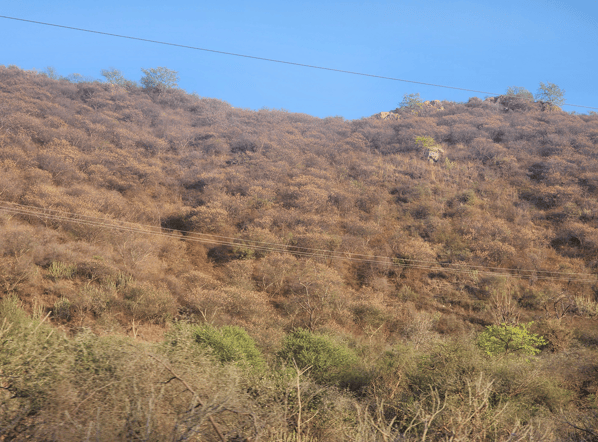
But one battle where the wooded terrain specifically aided one side was the Battle of Dewair in 1582, when the Rajput forces of Mewar defeated the Mughal Army in the Aravali Hills in Rajasthan. This Battle was fought in the hills and gorges of Dewair which is in the midst of the Aravali Hills, which are covered in dense scrub forest, which diminished the advantage provided by Mughal numerical superiority.

I am sharing videos and a photo of the terrain where this battle was fought. There is only a memorial built to commemorate this battle at the location. Nothing else has come up and no development has changed the terrain in nearly 450 years!

This video shows the entire area (Dewair ka Darra) where the Battle of Dewair was fought, from the top of the memorial that has been built. This shows the difficulty of the terrain for large bodies of troops to maneuver in.

This photo is from the road leading to Dewair. The density of the scrub and thorn forest on the slopes of the hills is clearly visible here.

This short video shows how poor the visibility is along paths with dense vegetation all around.

This video shows the terrain along the road close to the actual Gorge (Darra) of Dewair. Some of the sudden plunges in the rocky terrain are visible in this video.

The above photo and set of videos are a wonderful example of fighting in uneven terrain in wooded areas, very similar to the geographies that gave us the Shinden Fudo Ryu!

This brings me to the end of this two-part series of articles that show, from an Indian historical perspective, where the origins of the regularly practiced schools of the Bujinkan lie.

The Bujinkan schools from an Indian perspective – Terrain, People & Evolution – Part 1

Over the years of training the Bujinkan system of martial arts, one will invariably study the different schools that form a part of the system. There are 9 schools that the Bujinkan is comprised of. Of the 9 schools, 6 are practiced regularly in dojos around the world. These 6 schools are mentioned below.

  • Togakure Ryu
  • Gyokko Ryu
  • Takagi Yoshin Ryu
  • Koto Ryu
  • Kukishinden Ryu
  • Shinden Fudo Ryu

When we train each of these schools, we learn the evolution of these schools. This consists of the conditions in which these schools had their origin and how they evolved over the years. The origin of the schools pertains to a region and its geography.

As an Indian, the terrain where the schools had their origin does not come to mind immediately. The terrain and climatic conditions in India are quite different (at least in large parts) from that in Japan, where these schools had their origin and evolution. But the geography and climate which influenced and perhaps defined the schools for a very long period of time is important. To help my fellow Indians identify terrain and conditions similar to the those that led to the birth of these schools, I am writing this post.

I will share images and examples from Indian history which are approximations of the geography and physical conditions in which the 6 schools mentioned above were created and evolved over time. I have used, as far as possible images and videos of places where actual combat occurred. All the images are videos in this 2-part series are taken by me during visits to these locations.

In Jan 2025, I had written a more detailed post about the schools form a part of the Bujinkan system of martial arts. The link to this post is seen below. Do refer to this link for more information about the schools.

TOGAKURE RYU

I have heard from my teacher and mentors that the Togakure Ryu, at least in part, evolved from the way troops fought inside castles. The long deep kamae (physical posture) and linear movement in the Togakure Ryu is supposed to be an outcome of having to move linearly in narrow passageways. Castles, like many forts and palaces around the world, had narrow passages to defend them better. This same feature was true for walkways along fort walls. I am sharing images from the Udaipur City Palace the Kumbhalgarh Fort below.

The Udaipur City Palace was built with defence in mind, for the kingdom of Mewar, the capital of which was Udaipur, was at perpetual war with the Mughals, Afghans and other neighbouring Sultanates for centuries. Mewar’s earlier capital Chittorgarh was brutally sacked thrice between the 14th and 16th centuries.

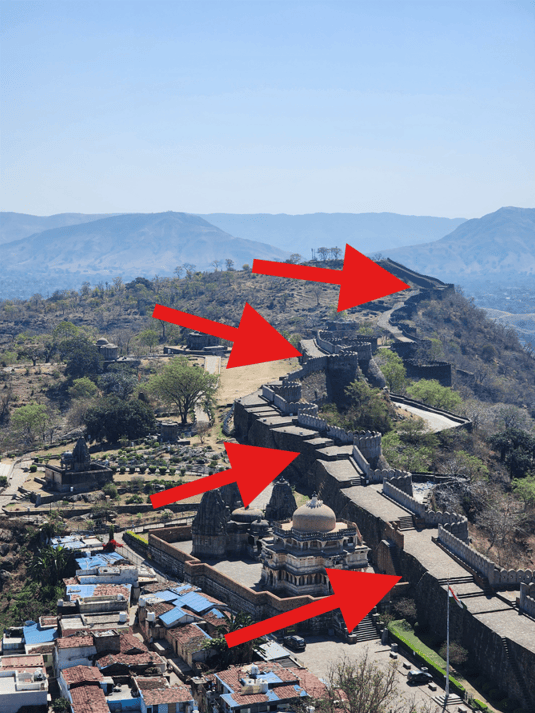
Kumbhalgarh, was smaller than other major centres of Mewar, and was never held for long by her enemies. It seems to have been built mainly for defence, with a 36 km long wall (supposedly the 2nd longest in the world after the Great Wall of China). The walls have wide walkways in places, but the stairs up and down the walls are narrow and easy to defend.

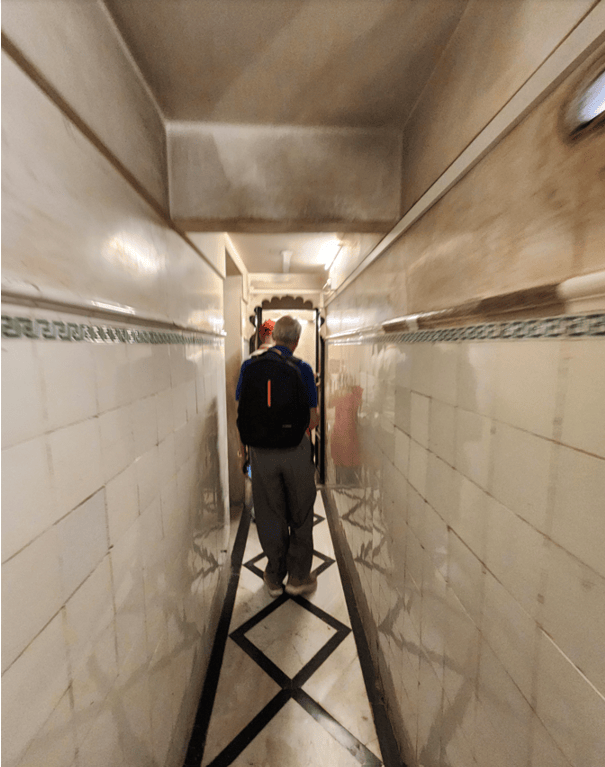
The above image shows a narrow passageway in the City Palace, Udaipur, Rajasthan. Two people will have a really hard time walking next to each other in this corridor. And there are no deviations to duck into. So, anyone who enters will be at risk from the moment they enter until they exit. Of course, with sturdy and big shields one can safely traverse these passages. But the passages can be barricaded and attackers can have a hard time fighting defenders, even in small numbers, especially if they are using pole weapons, to slow down the attackers.

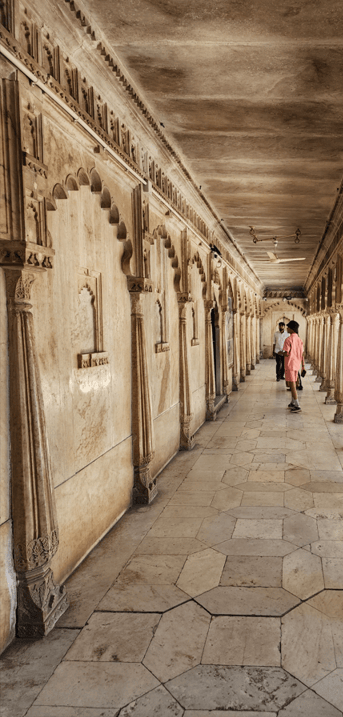
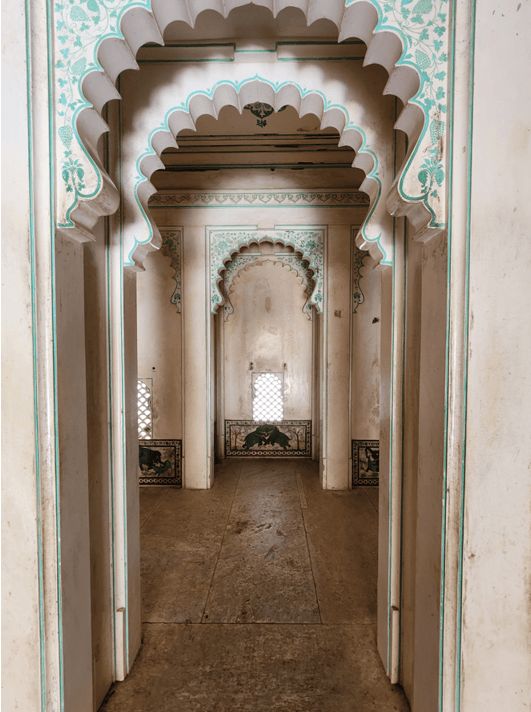
Seen above is another corridor from the City Palace, Udaipur. This one is much wider than the one in the previous image. Maybe 6 to 8 soldiers can walk next to each other here. But this also means a larger number of troops can hold corridors like this, in formation and full kit, like spears, swords, shields, armour and missile weapons.

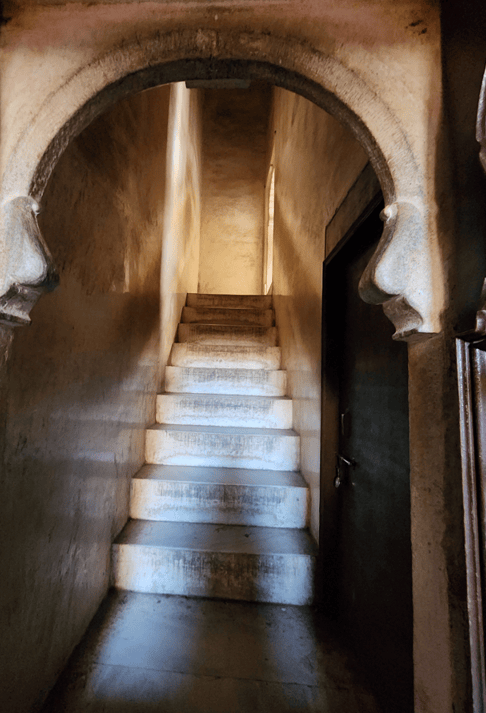
This is a narrow staircase from the Kumbhalgarh Fort, Rajasthan. Not only is it narrow, one also cannot see what is on the other side of the doorway to the right at the top. This uncertainly adds to delaying attackers and gives defenders opportunities to fight back.

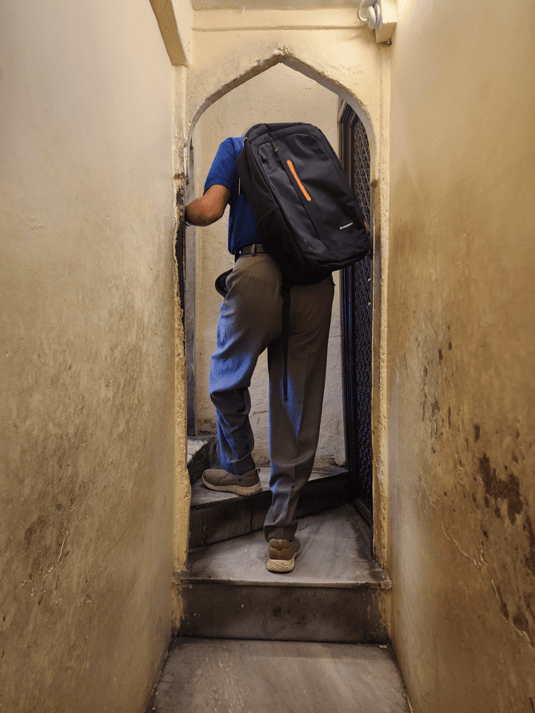
This image shows the entrance to another narrow staircase. Here, one needs to duck at the doorway, making one all the more vulnerable. This image is from the City Palace, Udaipur.

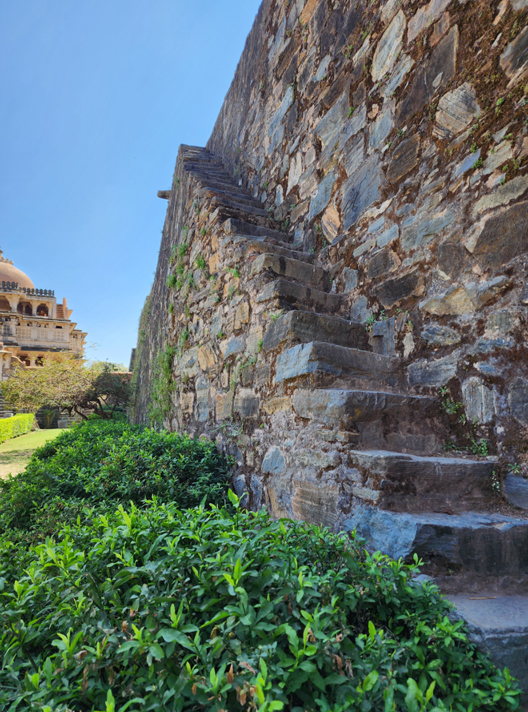
The above image shows the wall of the Kumbhalgarh Fort, indicated by the arrows in red. The wall stretches for 36 km, with varying widths. What is seen in the image is the widest part. It is said that 4 horsemen can ride alongside each other on the walkway. I would estimate that 8 to 10 soldiers can do the same. While this is much wider than the narrow passageways and stairways seen in the previous images, this is still not very wide. Considering that a fall off the wall would injurious, if not fatal, the lack of space is a considerable challenge to fighting on top.

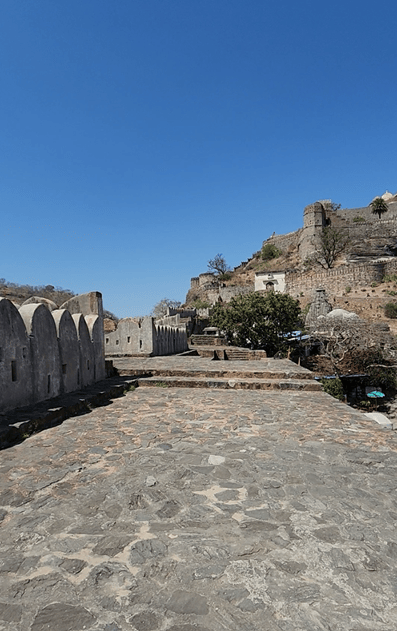
This image shows the walkway on the wall from the previous image, a “ground level” view if you will. Not only is the path not wide, the occasional steps also make the ground uneven while fighting.

GYOKKO RYU

The Gyokko Ryu, from what I have heard, is perhaps the oldest school in the Bujinkan system. The Gyokko Ryu is a system of very close quarters fighting, with just about a half-arm distance between the opponents. I have heard that this was a consequence of the Gyokko Ryu evolving from fighting in small spaces, like chambers and rooms in castles and homes in historic Japan.

It is also said that this system was used by women, mainly of the court, to protect themselves in case the castle was breached and their quarters were attacked. This seems logical as the Gyokko Ryu was already adapted to be applied in small spaces.

Considering that palace passages were narrow spaces themselves, some of the concepts of the Gyokko Ryu would be applicable in the spaces where the Togakure Ryu would be applicable. Of course, there is not strict distinction in where a specific system of fighting should be applied. It depends on the opponents, the situation and what one actually is capable of or trained to do.

The above image shows a room from the Kumbhalgarh Fort. It is not very big. Even the royal chambers of this fort are not very large. The guide there said that this fort was a “fallback option” for the rulers of Mewar. When Chittorgarh was attacked or Udaipur was threatened, they retreated to Kumbhalgarh while planning a counterattack.

Kumbhalgarh was well defended by terrain, by the Aravali hills, which were forested as well. So, taking this fort was a lot harder than attacking the other 2 major centres of Mewar. Considering this “fallback” feature of Kumbhalgarh, the living quarters are small compared to other palaces. And fighting in these chambers is kind of what the Gyokko Ryu was designed for!

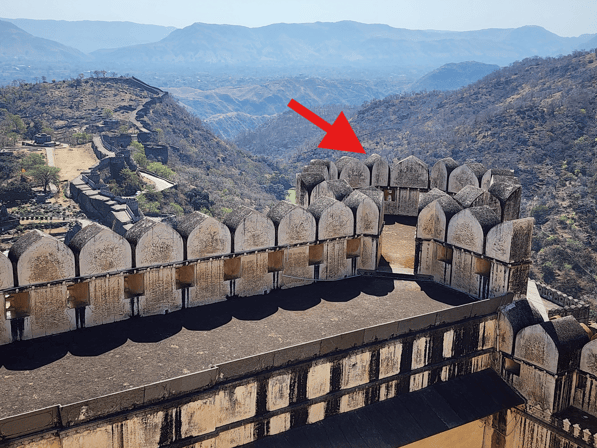
This image shows the walkway and watchtower at one of the higher points of the Kumbhalgarh Fort. Small cannons could also be placed here. Consider fighting in just the watchtower indicated with the red arrow. It is a confined space where fighting would be in very close quarters. While the walkway could be considered to be conducive to the Togakure Ryu and the Gyokko Ryu, the tower itself would be ideal space for the Gyokko Ryu.

This image shows the staircase up to the walkway of the main outer wall of the Kumbhalgarh Fort. It is so narrow that only one person can climb up at a time and her or his shoulder would scrape the wall doing so! I would say it is nearly impossible to fight on these stairs! It is pretty much suicide, if even a slight slip occurs.

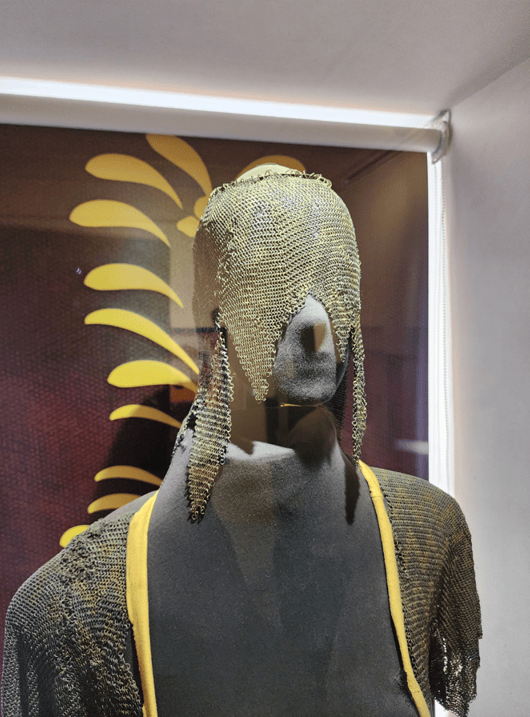
Considering that the evolution of the Gyokko Ryu involved women in combat, here are 2 examples. Seen above is the chainmail armour of a female palace guard from the City Palace museum in Udaipur. The women’s quarters, or Zenana Mahal, had guards who were women. These fighting women wielded spears, swords, shields, early firearms, knives and bows and arrows.

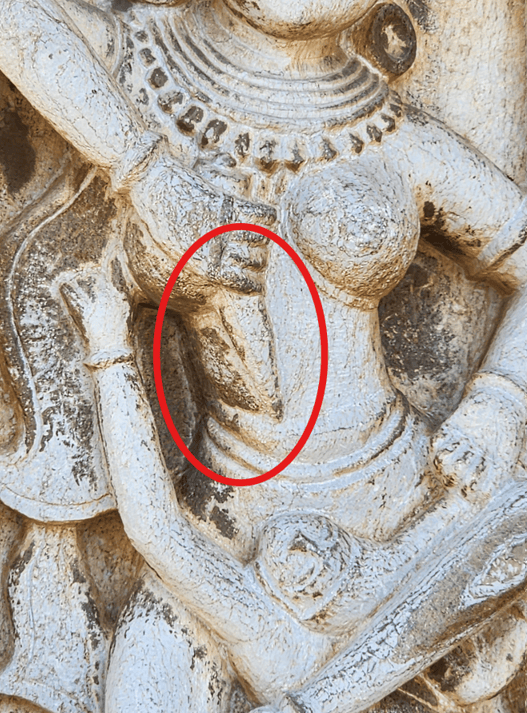
This image shows a carving on the Vijay Sthamb (Tower of Victory) in the Chittorgarh Fort. It is a close up showing a woman mid-flight. She is wielding a dagger and is poised to strike at an opponent she has trapped with her legs. This is a classic example of close quarters combat. She is in grappling distance and is utilizing a short-range weapon. The dagger is seen encircled in red.

TAKAGI YOSHIN RYU

The Takagi Yoshin Ryu is another school that has a link to palace culture. I have heard it said that this school evolved, at least partially, from the skills developed by bodyguards while defending their patrons, who tended to be aristocrats and wealthy folk. The techniques in this school include those that involve taking down and restraining individuals, something akin to arresting individuals. This was supposedly to capture potential assassins, spies and similar criminals, so that they could be questioned for information later. Restraining individuals in turn involves some movements that are expressions of grappling.

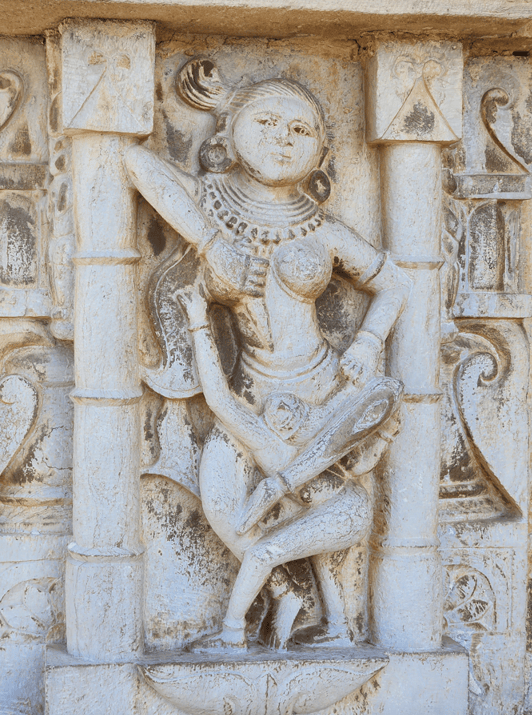
The above image shows a carving on the Vijay Sthamb in the Chittorgarh Fort. This is the carving, the close-up of which was seen in the earlier image. I considered it a display of an expression of the Gyokko Ryu earlier due to the use of the dagger and the close quarter fight that is shown. However, this image can also be considered an expression of the Takagi Yoshin Ryu.

The woman in the image has restrained, or perhaps trapped, another individual with her legs. It seems like the trapped individual is struggling and using his right arm to maybe fight back. But the woman is wielding a dagger, poised to strike. What we cannot tell is if the dagger is a threat, promising injury or worse if the person does not surrender, or if it is the moment before she strikes the fatal blow. If it is indeed a threat, the trapped individual could be interrogated later!

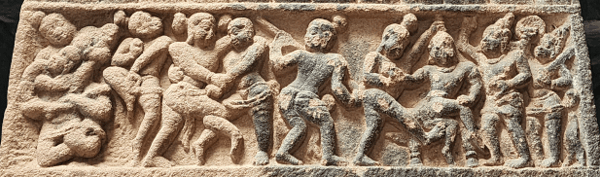
The above image shows a panel from a temple in Pattadakal, Karnataka. This carving dates to the 8th century CE. India has a very long tradition of wresting and grappling arts. This tradition includes the martial systems of Malla Yudhha, Kushti and Pehalwani.

This panel shows people trying to trap and take done one another. Individuals are trying to restrain arms, trip the other over and grasping about the waist. In the far-left panel, one individual is attacking another from behind, using legs to apply a body choke (tai jime) and a choke on the neck with the hands.

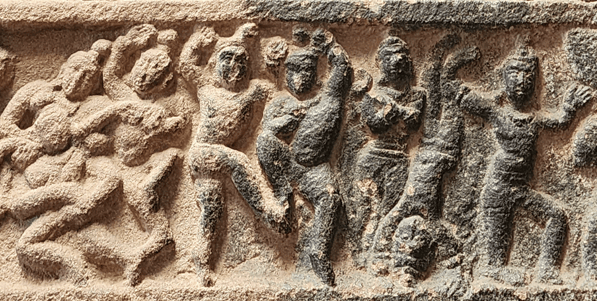
This image also shows a panel from Pattadakal, Karnataka. This panel also shows scenes of grappling and an attack from the rear. Towards the right side is an individual either performing a head stand in celebration or has been flipped over by his opponents.

I will conclude part of this 2-part series here. We will delve into the Koto Ryu, the Kukishinden Ryu and the Shinden Fudo Ryu in the next part.